



Nearly six months into a Strait of Hormuz closure that has cut flows from a region supplying 42% of the world’s urea supply (J.P. Morgan Global Research), the commodity itself looks unremarkable. I pulled the benchmark expecting to confirm a crisis. I found urea trading below where it sat a year ago. That gap, between what the chokepoint data says and what the price says, is the whole article.
The consensus: a shock that already happened and is fading
The dominant read is reasonable, and I want to state it fully before I depart from it. The Iran conflict shut the Strait of Hormuz in late February 2026. Nitrogen benchmarks spiked 25 to 50% within weeks (J.P. Morgan). The FAO’s Food Price Index climbed through July to 131.1, the highest reading since January 2023 (FAO Food Price Index). Now the story has run its course, the way commodity shocks usually do. China stepped in with export quotas. The largest buyers front loaded their purchases in the spring. Farmers, facing urea costs up as much as 80% since February on already strained budgets, may be cutting back on fertilizer rather than absorbing the bill (World Bank; Carnegie Endowment). Demand fell, supply found workarounds, and the market is pricing exactly what you would expect from that adjustment: urea roughly ten percent cheaper than a year ago, potash barely moved, a food price index elevated but no longer accelerating. The numbers line up.
The human cost version of this consensus is harder to wave off than the price chart alone. JPMorgan’s own April note flagged that 27% of vegetable growers in Australia had already cut production because of fertilizer shortages, months before the price data I am about to cite even existed (J.P. Morgan). Bryan Raymond, who covers Australian consumers for the bank, told clients that “reduced planting intentions, potential yield degradation and doubled input costs” would flow through to retail food prices “during late 2026 and into 2027.” That is a specific, dated claim. It’s part of why I don’t dismiss the underlying shock. I just do not think the spot price is currently measuring it.
This view has a real author, and it’s JPMorgan’s own. Nora Szentivanyi, the bank’s senior global economist, told clients in April the fertilizer shock “could lift global food inflation temporarily to 4 to 5%, but we expect the impact to show up with a considerable lag.” Elsewhere in the same report, the bank’s analysts project elevated fertilizer prices through the second quarter of 2026, with expected corrections in the second half as demand destruction and potential supply normalization occur (J.P. Morgan). Read the spot price today and JPMorgan called it almost exactly. Called early, called right. I don’t think that is the interesting story anymore, though. An April warning that gets recycled by aggregators in August, describing conditions that have already moved, is not wrong so much as stale.
The variant view: what the April forecast actually proves
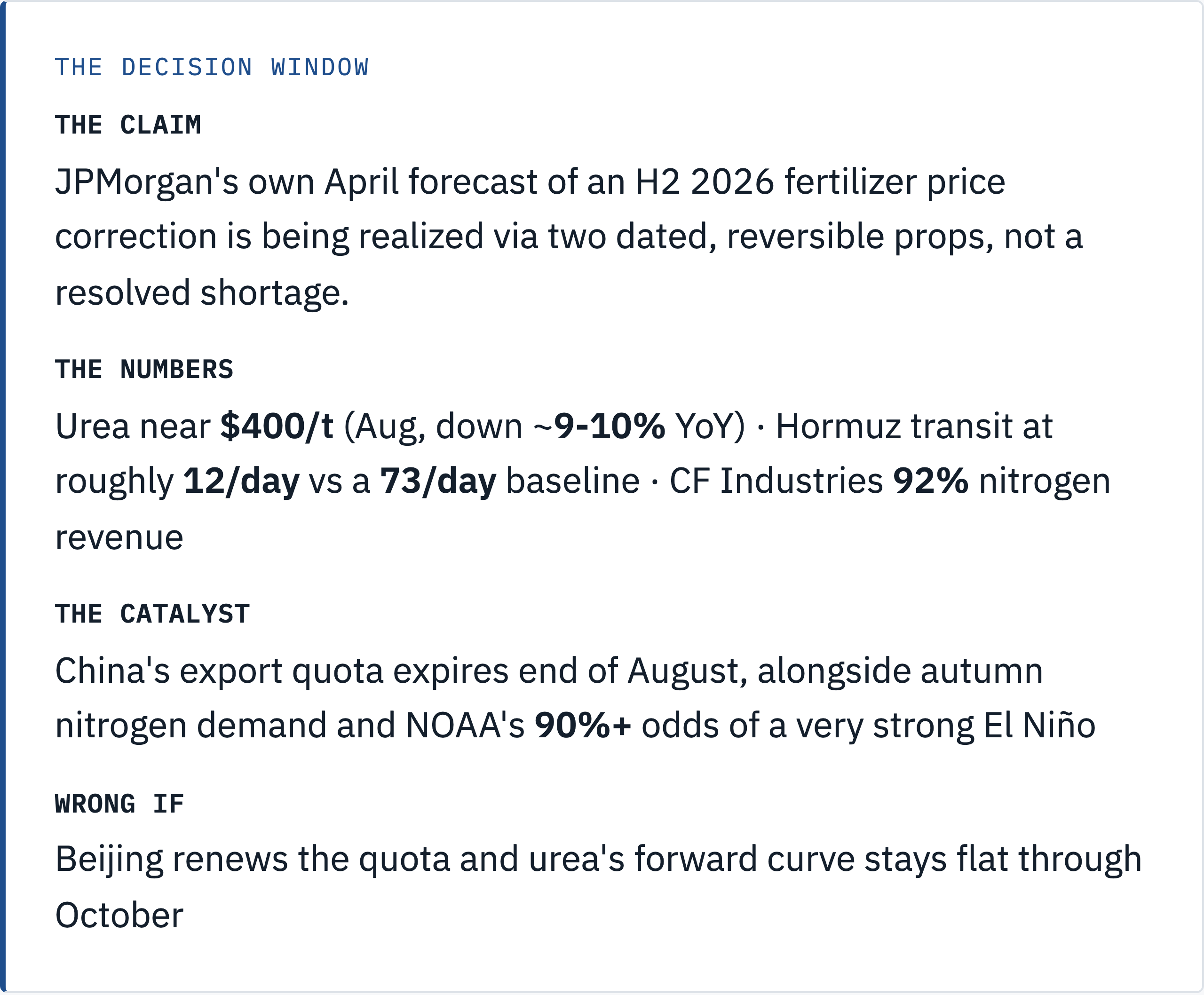
My read is narrower, and I think it’s more useful to anyone actually holding nitrogen exposure. The price calm isn’t evidence the Hormuz shortage resolved. It is evidence that two specific, dated, reversible props are holding urea down, and both were built to expire in roughly the same six week window this autumn.
The first prop is China. Beijing banned fertilizer exports outright in March. In May it carved out quotas of 1.5 to 1.6 million tonnes running strictly June through August, with a price floor of $660 a ton for prilled urea (Profercy; Hydrocarbon Processing). A government-set price floor. I read that as a valve Beijing opened for one quarter, at a government mandated price, because it judged the global shortage severe enough to justify raising its own farmers’ input costs. China’s own export controls in this cycle have shifted on a monthly or quarterly basis before (Risso Chemical), which cuts both ways: nothing guarantees the window closes cleanly at the end of August, and nothing guarantees it doesn’t. I treat that uncertainty as a real, unresolved input to this piece rather than something the current calm has already priced.
The second prop is buyer behavior, and it is the part the spot price obscures completely. I want to be precise about what “the largest buyers have already bought” means, because a trade note published in May made exactly this point while tracking the New Orleans urea barge benchmark as the North American proxy (Helios). Importers who feared a worse shortage in April pulled forward purchases they would otherwise have made in September or October. That flattened the spring to autumn demand curve and made spot prices look softer than physical scarcity would predict on its own. Demand pulled forward, not gone. Urea spiked as much as 25 to 50% in the weeks after the closure (J.P. Morgan), and the buyers who lived through that spike didn’t wait around for a repeat.
Neither prop is a supply fix. The physical chokepoint hasn’t reopened. The Middle East supplies close to 30% of global exports of major fertilizers, and the five Gulf states dominating that trade account for 34% of global urea flows and 23% of global ammonia flows in an ordinary year (International Fertilizer Association). A real chokepoint, still shut. None of that capacity has come back online. None of it returned. What changed is that the world stopped needing all of it for a few months, on purpose, through two mechanisms that expire on almost the same calendar.
The mechanism: why September is when the props get pulled
Walk the causal chain slowly. Each link is dated and checkable, not a feeling about sentiment.
Link one: the supply gap never closed. It was temporarily backfilled, and the size of the next backfill is contested. China’s nitrogen industry did not discover new export capacity in May. It redirected domestic facing tonnage toward the international market for a defined June through August window, at a mandated floor price, because Beijing judged the global shortage worth the political cost at home. That is a policy choice, not a structural addition to world urea capacity, and I want to be direct about the biggest hole in it: trade press covering China’s own export program has floated a full year 2026 figure as high as 6.5 million tonnes, well above the roughly 3.3 million tonnes issued so far, which would imply another tranche after August instead of a clean close. I could not confirm that larger number against a primary Chinese customs or ministry release. I’m treating it as a live possibility, not a confirmed fact, and it’s the single biggest reason my own confidence here is lower than the rest of this piece. The gap stays unresolved.
Link two: front loaded inventory is a one time buffer. It does not regenerate. Importers who pulled purchases forward in April consumed that cushion once. September’s Northern Hemisphere autumn nitrogen application, the pass most US corn and wheat growers make before or shortly after harvest, has to clear the same physical bottleneck that’s been running at a fraction of its normal capacity since February. I can’t find a mechanism by which that demand gets met more easily in October than it was in April, absent an actual reopening of the strait. No easier in October.
Link three: both props expire alongside a documented weather catalyst. El Niño’s official designation arrived in June. NOAA’s Climate Prediction Center put the three month Oceanic Niño Index for May through July at +1.39°C, firmly inside El Niño territory, and its August 13 diagnostic discussion raised the odds of a very strong event this winter above 90%, up from 81% a month earlier, with a 69% chance the October to December season exceeds every El Niño on record back to 1950 (NOAA CPC). A real, dated forecast. I am not asking you to take that forecast on faith. It’s the same index that called the 2023-24 event, and it governs the Southern Hemisphere growing season that starts sowing in September and October, right as the nitrogen bottleneck reopens on the demand side. I want to flag a limit here directly: I have not found primary crop yield data that isolates El Niño’s specific contribution to this season’s Southern Hemisphere outlook from the separate, purely economic pressure of expensive nitrogen, and I’m not going to imply a causal split I can’t source.
Put the three links together and September isn’t a date I am choosing for drama. A temporary export valve, a one time inventory buffer, and a weather pattern with a defined onset window all converge on the same six week stretch, against a physical Hormuz bottleneck that has not meaningfully reopened by any transit count I could find. My read is that the market is currently pricing the interval between the shock and the correction. It hasn’t started pricing what happens after the props get pulled, because that has not happened yet.
What the transit data actually shows
I should be honest about what the physical data can and can’t tell me here. Lloyd’s List Intelligence’s own weekly count for late July showed 84 transits, an improvement on the prior week’s 45, and I do not want to overstate a crisis that has eased at the margin on some measures (Lloyd’s List Intelligence). But even that improved week closed, in the brief’s own words, “on a violent note,” with fresh attacks on vessels using alternative routes and 65 ships left stranded after a diplomatic arrangement broke down. Bloomberg’s own August 4 dispatch on the strait used one word for what traffic remained: a trickle (Bloomberg). Eighty four transits a week works out to roughly 12 a day, against an IMF PortWatch pre crisis baseline near 73 a day (MacroMicro / IMF PortWatch). A sixth of normal capacity. That’s not a reopened chokepoint. It’s a chokepoint running at a sixth of capacity on its better weeks, which is precisely consistent with a market that is calm on price and still starved on physical flow. I’ve written before about how wide that chokepoint premium gets in shipping economics specifically: the run that skips the strait entirely has been paying roughly a quarter of the toll of the run that doesn’t.
CF Industries: the discriminator, not “a fertilizer stock”
Here is where the rival explanation breaks down under its own weight. The rival case says fertilizer equities are simply richly valued because the whole sector caught a war premium. That treats nitrogen, phosphate, and potash as one trade. They are not, and the split between them is the cleanest evidence I found that institutional money already understands the mechanism above, even where the commentary covering it hasn’t caught up.
CF Industries drew 92% of its 2025 revenue from nitrogen products alone: ammonia at 31%, granular urea at 25%, UAN at 30%, and ammonium nitrate at 6%, recomputed directly from the company’s own reported segment dollars ($2.176B, $1.781B, $2.161B and $421M against $7.084B in total net sales) (CF Industries FY2025 results). It carries no potash and no phosphate segment to dilute a nitrogen call in either direction. Nitrogen pure, no dilution. Its second quarter 2026 numbers, net earnings of $727 million and adjusted EBITDA of $1.2 billion, arrived alongside management raising baseline mid cycle EBITDA guidance to $2.9 billion and flagging a path toward $3.3 billion by 2030 (CF Industries Q2 2026 earnings call). Real earnings, real guidance. Management’s stated logic is that higher global capital costs have structurally lifted the incentive price for new nitrogen capacity. Read that carefully. It is a claim about the cost of building new supply, which supports incumbent low cost pricing power whether or not Hormuz reopens tomorrow. I can’t fully verify that claim from public filings alone. I’m flagging it here as management’s framing. It has not been through an independent audit that I can point to.
I also don’t want to present that quarter as uniformly bullish, because it wasn’t. CF’s headline print landed short of consensus revenue and earnings estimates, the stock sold off on the release, and at least three sell side desks trimmed their price targets in mid July on concerns that nitrogen pricing was already softening. Retail nitrogen benchmarks tracked by DTN fell for seven straight weeks into that same period. Seven straight weeks down. None of that contradicts the raised mid cycle guidance, which is a multi year framing rather than a call on this quarter, but a reader weighing “does the market already agree with this thesis” should know the market’s most recent verdict on CF specifically was mixed, not uniformly confirming. A mixed quarter, not a clean win.
Mosaic and Yara: the same trade, priced correctly apart
Mosaic is the control group here, and it’s failing the war premium story on its own numbers. Potash, Mosaic’s and Nutrien’s larger segment, is priced at $310 to $380 a ton in the US Corn Belt this spring: flat to up 10% year over year, sitting near five year averages (GrainBrief potash pricing). Near five-year averages, not a spike. Canadian and Belarusian potash supply chains never ran through the Persian Gulf. They never needed to. Mosaic actually withdrew its full year 2026 phosphate guidance this spring, citing sulfur cost pressure and operating rate uncertainty that has nothing to do with Iran (Seeking Alpha, Mosaic Q1 2026). If this were a generic geopolitical premium sitting across the whole fertilizer complex, potash would carry some of it too. My read of the data says it doesn’t. The market is not pricing “fertilizer risk” as a bloc. It is pricing a nitrogen specific, Gulf specific mechanism, correctly separated by product line, and institutional positioning already reflects that separation: CF Industries carries 93.06% institutional ownership, and second quarter 13F filings show Dimensional Fund Advisors lifting its stake 37.6% and Worldquant Millennium Advisors opening a fresh $96.6 million position (HedgeFollow 13F data). Institutional money already knows.
Yara International sharpens the same point from the opposite direction. It’s a nitrogen producer too, headquartered in Norway, and it carries a Zacks Rank #1, Strong Buy, with 61.1% expected earnings growth for 2026 (Zacks Industry Outlook). A strong number on its own. I want to correct myself here, plainly: an earlier version of this piece claimed Yara’s growth rate led CF’s. It doesn’t; the same source puts CF’s own expected 2026 growth at 84%, well above Yara’s. The correction stands. What actually separates the two, on the numbers I can verify, is estimate momentum. Zacks ranks CF a comparatively cautious #3 against Yara’s #1, a revisions signal rather than a raw growth signal, and it lines up with the mid July target cuts I flagged above. Both companies are still, unambiguously, nitrogen names trading on nitrogen fundamentals, which is the point that matters for the discrimination argument: nobody is pricing Yara or CF as generic “fertilizer stocks” swept up in a broad war premium. The market is pricing nitrogen specifically, on nitrogen specific and company specific facts, on top of the split between nitrogen and its potash and phosphate neighbors.
I wrote up the trade shaped version of this argument separately, with position level detail this article doesn’t carry: The Nitrogen Trade Hiding Inside a Calm Urea Price.
Three confounds I can’t rule out
I want to name three places I could be wrong here, because a principal who finds an unstated confound stops trusting everything above it.
First, and this is the confound I take most seriously, China could issue another export tranche after August instead of letting the window lapse. I already flagged the specific number above: trade press has floated a full year 2026 figure as high as 6.5 million tonnes against roughly 3.3 million tonnes issued so far, which would leave room for a further release right when my thesis needs the valve to close. Nothing in the public record commits Beijing either way, and a government facing its own farmers’ complaints about the March export ban has domestic political reasons to keep some valve open. If a further tranche materializes at similar volume, my whole prop one argument weakens considerably, and I’d expect urea to stay range bound through the autumn instead of repricing. The biggest open risk.
Second, I’m leaning on a single trade note, the Helios piece, for the specific “largest buyers have already bought” mechanism. It isn’t a primary data source the way a customs release or an inventory survey would be. I couldn’t independently verify country level import volumes within the scope of this piece, so treat that link in the chain as the most inferential one I’m making. The weakest link, named plainly.
Third, if CF Industries’ own structural incentive price argument is correct on its own terms, nitrogen prices could stay elevated for reasons that have nothing to do with Hormuz reopening or China’s quota lapsing. That would make my September timing argument coincidental rather than causal, even if the price direction turns out right. I can’t separate, from public disclosures alone, how much of CF’s guidance rests on the transient Gulf disruption versus the structural capital cost argument management is making. That’s a genuine confound. I’m not adding it here for cover; it’s the scenario that would hurt this thesis most. The scenario that hurts most.
What would change this view
This thesis is falsifiable on a specific, dated question. Does China renew, extend, or expand the urea export quota beyond its current August cutoff? Does the global urea benchmark move meaningfully off $400 a ton, in either direction, once autumn application demand hits the market in September and October? A renewed or expanded quota paired with a flat forward curve through October kills the thesis outright. A quota that lapses without renewal, paired with urea reclaiming the $500 to $600 range it held in March and April, would confirm it. I’d also watch the weekly Hormuz transit count for any sustained move back toward the 73 transit a day pre crisis baseline. A genuine reopening of the strait would make the China quota question moot, because the underlying supply gap it’s currently papering over would close on its own terms.
CF Industries through the September window
If you hold nitrogen exposure through CF Industries, Nutrien’s nitrogen segment, or the broader urea complex, the real question here isn’t whether there’s a food crisis. It’s whether you’re being paid to hold that position through a six week window where two of the three things currently keeping urea calm expire on a calendar you can check yourself, today, without waiting on me. I wouldn’t treat the $400 benchmark as the resting price of a resolved shortage. I’d treat it as the price of a shortage that a temporary export valve and a one time inventory buffer are muting for a few more weeks, against a Hormuz strait that transit data says hasn’t reopened. Watch the China quota announcement first. It will move before the spot price does, and by the time urea itself confirms which way this breaks, the trade will already be crowded. Early beats right-but-late. I’d rather be early and wrong on timing than right after the crowd has already repriced it.
I’d size this as a watch item first. It only becomes a position for me if you already carry the exposure through an existing nitrogen allocation. The asymmetry is real: a renewed Chinese quota costs you little if you’re already long CF or Nutrien on the structural incentive price argument, since that thesis survives either outcome. A lapsed quota into a tightening physical bottleneck is the scenario nobody’s spot price is currently paying you to hold through. My capacity note: this isn’t a call on the whole agricultural complex, only on the narrow nitrogen sliver of it, and it says nothing about wheat, corn, or soybean exposure directly, only about the input cost that feeds into all three.
Which side of that September calendar are you underwriting: the reopening, or the reversal?
📊 The Decision-Grade Version
This piece is complete on its own: the thesis, the evidence, and what would kill the view are all above, nothing was held back to sell you a next step.
The Patreon note is a different piece of work, not a deeper cut of this article. It takes one trade from inside this story, which nitrogen equities are actually exposed to the September window and which “fertilizer stocks” only look like they are, and writes it the way a desk would act on it: the position, the levels, the sizing, and the risk that would take it off. Written for people who put capital behind a view.
Or join the Patreon community for every note
I break down mechanisms like this one on video too: The Mathematical Trader on YouTube. Connect on LinkedIn if you want to talk through the position directly.
Cover photograph: Mathias Beinling, CC BY-SA 4.0, via Wikimedia Commons.