


The consensus, stated the way a crude desk would defend it
Brent settled near $79 on 4 August, down about 6% across two sessions from roughly $88 at the end of the prior week. I don’t think that move is wrong.
Here is the strongest version of it. Hormuz carried 21 million barrels a day in 2022, about a fifth of global petroleum liquids consumption and more than a quarter of all seaborne traded oil (EIA; the agency’s later reads put 2024 nearer 20 million). Take that volume out and you get the spring of 2026. Put it back and the barrels stacked behind the chokepoint reach the market at once. Morgan Stanley counted 35 tankers leaving the strait in a single day during the June opening, close to the daily average before the war, and Goldman Sachs cut its Brent forecasts for Q4 2026 and the 2027 average (Semafor). Flows need to recover to only 65% of pre-conflict levels to balance next year. UBS has the market moving from deficit to a 2.9 million b/d surplus in Q4 2026 (Investing.com).
So the consensus isn’t lazy. On the flat price I think it’s right, and I’d expect the risk premium to keep bleeding out of crude.
My disagreement is about a different instrument.
Same cargo, same destination, three times the money
The cleanest evidence I’ve found for a permission premium doesn’t require anyone’s proprietary data. It’s two published route assessments.
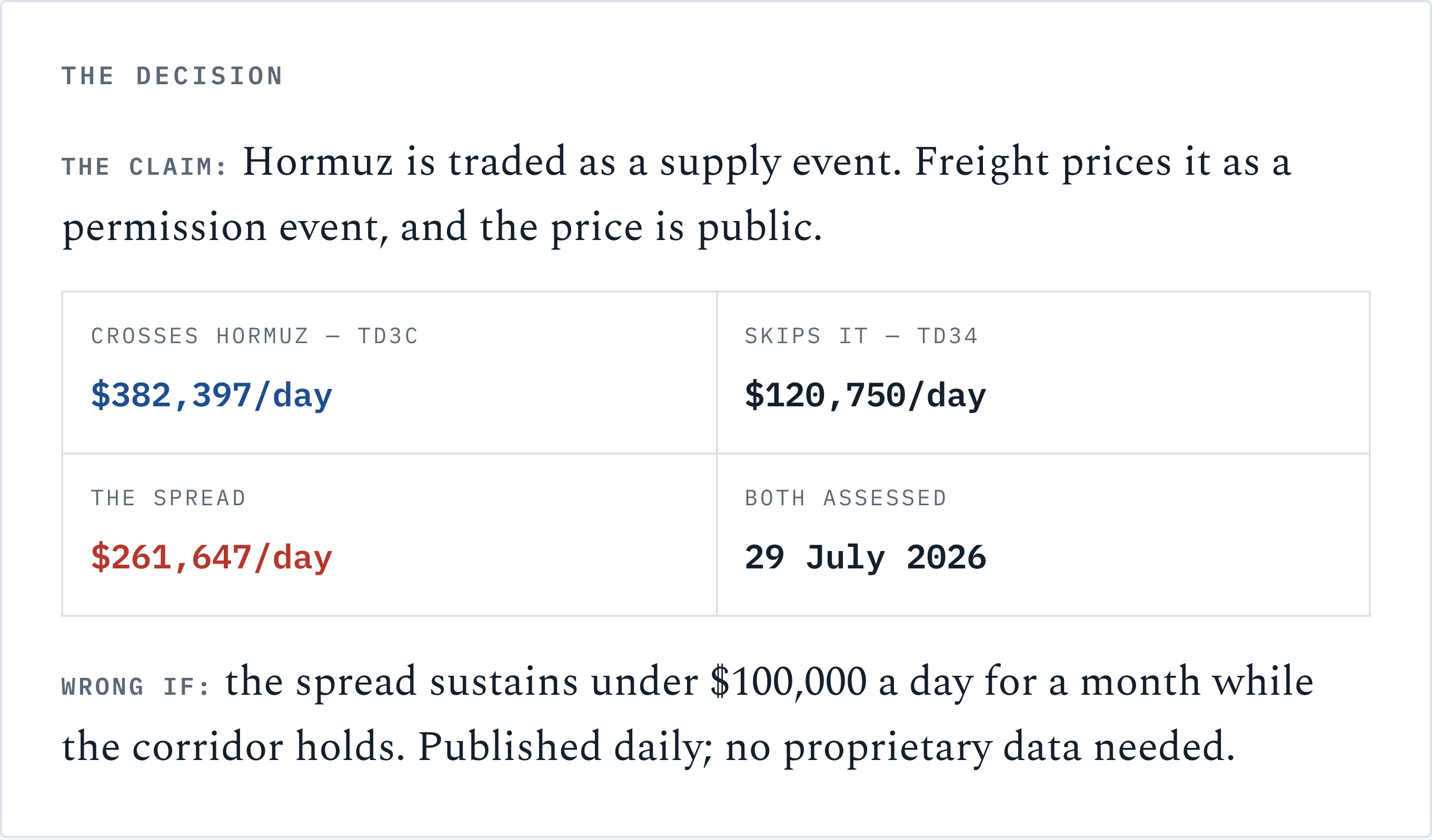
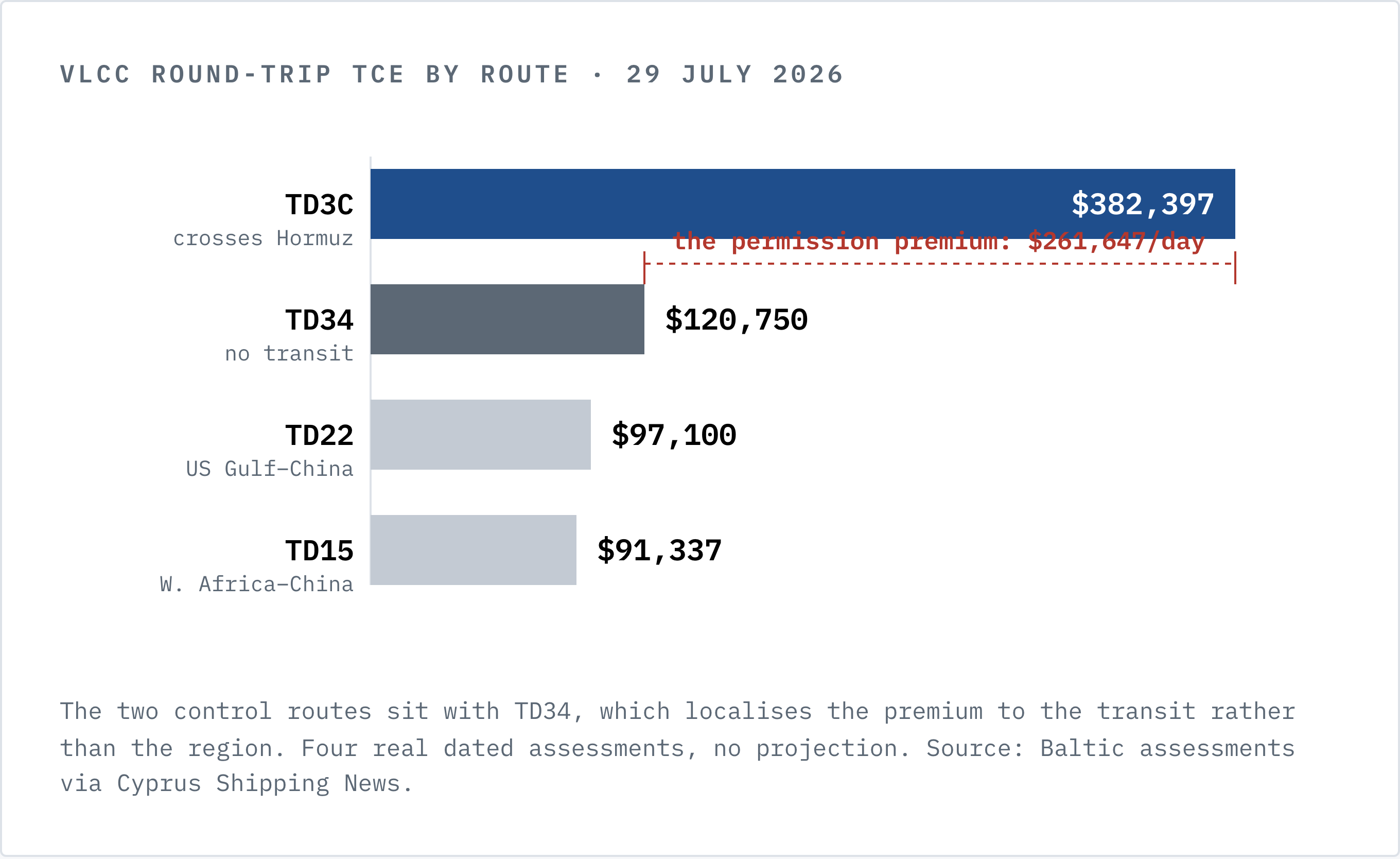
On 29 July, TD3C, the Middle East Gulf to China VLCC benchmark that transits Hormuz, assessed at WS386.78, a round-trip time charter equivalent of $382,397 a day. TD34, Gulf of Oman to China, is the same vessel class carrying the same grade to the same buyers, loading just outside the strait. It assessed at WS148.6, or $120,750 a day (Cyprus Shipping News).
The gap is about $261,000 a day, and it isn’t a regional premium. West Africa to China printed $91,337 and US Gulf to China $97,100 that week, so TD34 sits close to the other non-Hormuz routes while TD3C sits at four times them. The premium attaches to the transit itself.
Direction matters more than level. That week TD3C rose ten Worldscale points and TD34 fell ten. The two legs of the same trade were moving apart while the corridor talks were underway.
Time charter equivalent, for anyone who doesn’t live in freight, is a voyage’s revenue net of voyage costs expressed as a daily rate, which is how an owner compares a Gulf run against an Atlantic one. What the spread says is that the market will pay a quarter of a million dollars a day, per ship, to have someone else accept the transit.
What the last corridor deal actually did
The piece I’d have written a week ago said the June reopening proved freight rallies on good news. Running that episode to its end says something better and less comfortable.
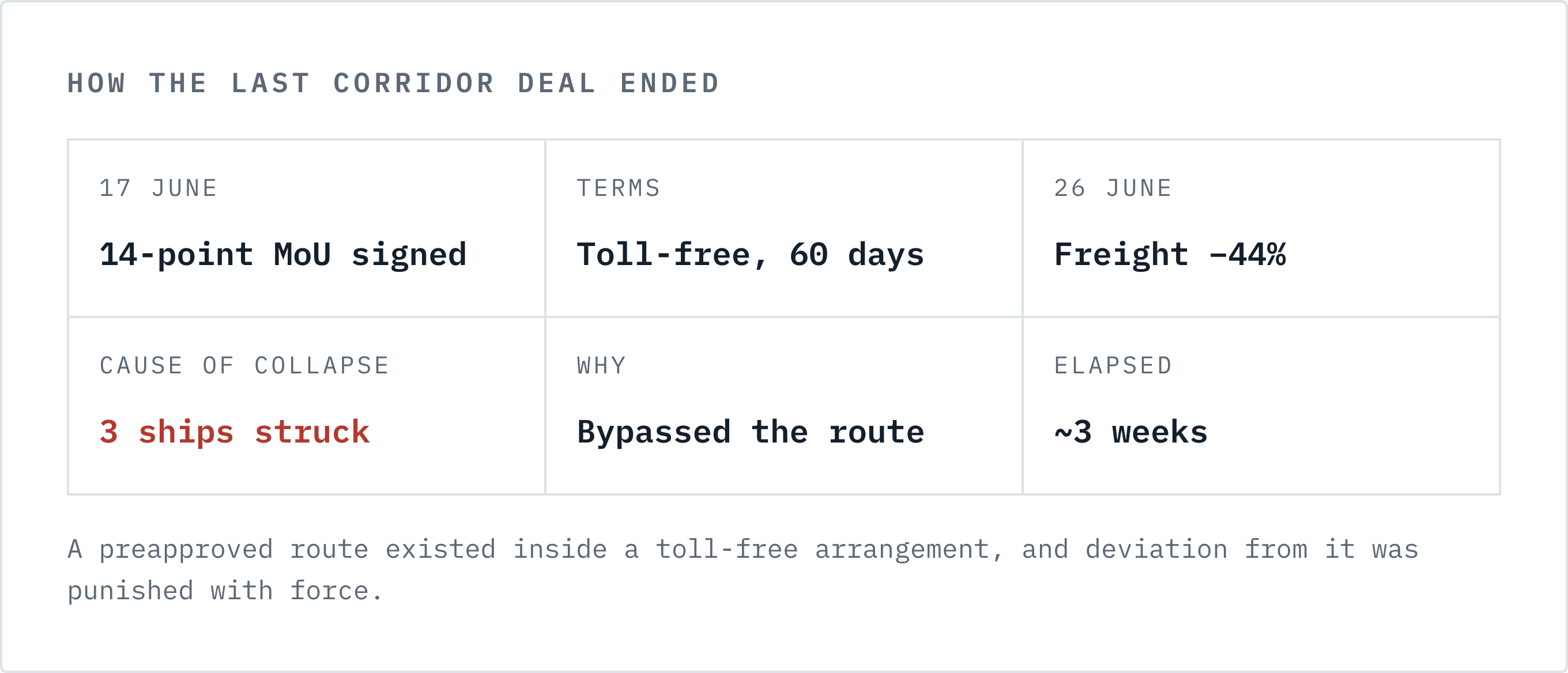
Trump and President Masoud Pezeshkian signed a 14-point memorandum on 17 June. It reopened Hormuz to commercial shipping toll-free for 60 days, ended the US naval blockade, and extended the ceasefire (Britannica).
Rates spiked on the announcement, with Hormuz-transiting fixtures near $470,000 a day and one Sinokor booking done at 897% of the Middle East Gulf to India benchmark (OilPrice). I put more weight on the named fixtures than on any index print, and two were reported: the VLCC Delos to Mercuria at $469,000 a day for the Gulf to China run, and the Nissos Kea to Vitol at $439,000 for the Gulf to the Far East, against a broader market near $200,000 (Seatrade Maritime, citing Tankers International). Then rates gave most of it back. By 26 June the Gulf to China rate had fallen 44% in four sessions as normalisation set in, and Kpler attributed the fall to inbound ballasters returning to the region and easing the tightness.
So the announcement trade lasted days. I was wrong to call the reopening the long side, and the correction matters, because the deal itself didn’t last much longer.
The memorandum collapsed in July, and the way it collapsed is the whole argument. The conflict resumed when Iran struck three commercial vessels that had bypassed its preapproved route (CFR). A preapproved route existed. Deviation from it was punished with force. That is a permission regime being enforced, inside a toll-free arrangement, three weeks after it was signed.
The August terms are the same shape: a designated corridor, inbound through Iranian territorial waters, outbound through Omani waters in coordination with Tehran, no tolls for 60 days, mines cleared from the median lane within 30 (Axios, via JPost). I’d price the second one against the first.
The legal argument, narrowed to what it can carry
I want to be careful here, because the strong version of this argument doesn’t survive contact with the law.
Iran signed UNCLOS in December 1982 and never ratified it. At signature it declared that Part III rights, transit passage among them, are benefits of the treaty bargain available only to states party, and it applies innocent passage at Hormuz instead. Its 1993 maritime law makes no reference to transit passage at all (Washington Institute). The United States hasn’t ratified either.
What I can’t claim is that this leaves shipping unprotected. UNCLOS forbids suspension twice, at Article 44 for transit passage and Article 45(2) for innocent passage in straits (UNCLOS Part III), and those rules also exist outside the treaty. The 1958 Geneva Convention codifies a non-suspendable right, and the ICJ’s Corfu Channel judgment of 1949 supplies one that predates UNCLOS entirely. Most states hold transit passage to be customary law binding on Iran whatever it signed. Legal scholars are split, and Tehran’s fallback is that it’s a persistent objector (The Conversation).
So the tradeable point is narrower, and I think it still holds. The market can’t rely on a rule the coastal state has denied for 43 years, whatever a tribunal would eventually say. Underwriters price what a ship can be stopped from doing this week, and Iran demonstrated in July exactly what it does to a vessel outside the approved lane. A right that has to be vindicated after the fact isn’t the same asset as one nobody contests.
I’d also drop a framing I used earlier. Routing inbound traffic through Iranian territorial waters isn’t a new legal category, because every navigable metre of Hormuz is already Iranian or Omani territorial sea. That’s what a strait is.
The fee fight is live, which is why eight associations moved
On 3 August, eight industry bodies including BIMCO, INTERTANKO, the International Chamber of Shipping and the World Shipping Council wrote to the UN and IMO secretaries-general opposing any Hormuz charge, warning against “service fees that are a toll in all but name” and arguing that once such a precedent is established, it becomes increasingly difficult to resist similar measures elsewhere (gCaptain).
They weren’t being hypothetical. Tehran insists on charging passage fees on the basis of sovereign control while the US and Gulf states demand free navigation, and the Iran–Oman track explicitly contemplates service fees tied to security and environmental protection (Euronews). The interim arrangement charges nothing for 60 days. Day 61 is the thing under negotiation, and I read the letter as an industry that argues about basis points going to the United Nations pre-emptively, which is not what anyone does about a hypothetical.
