



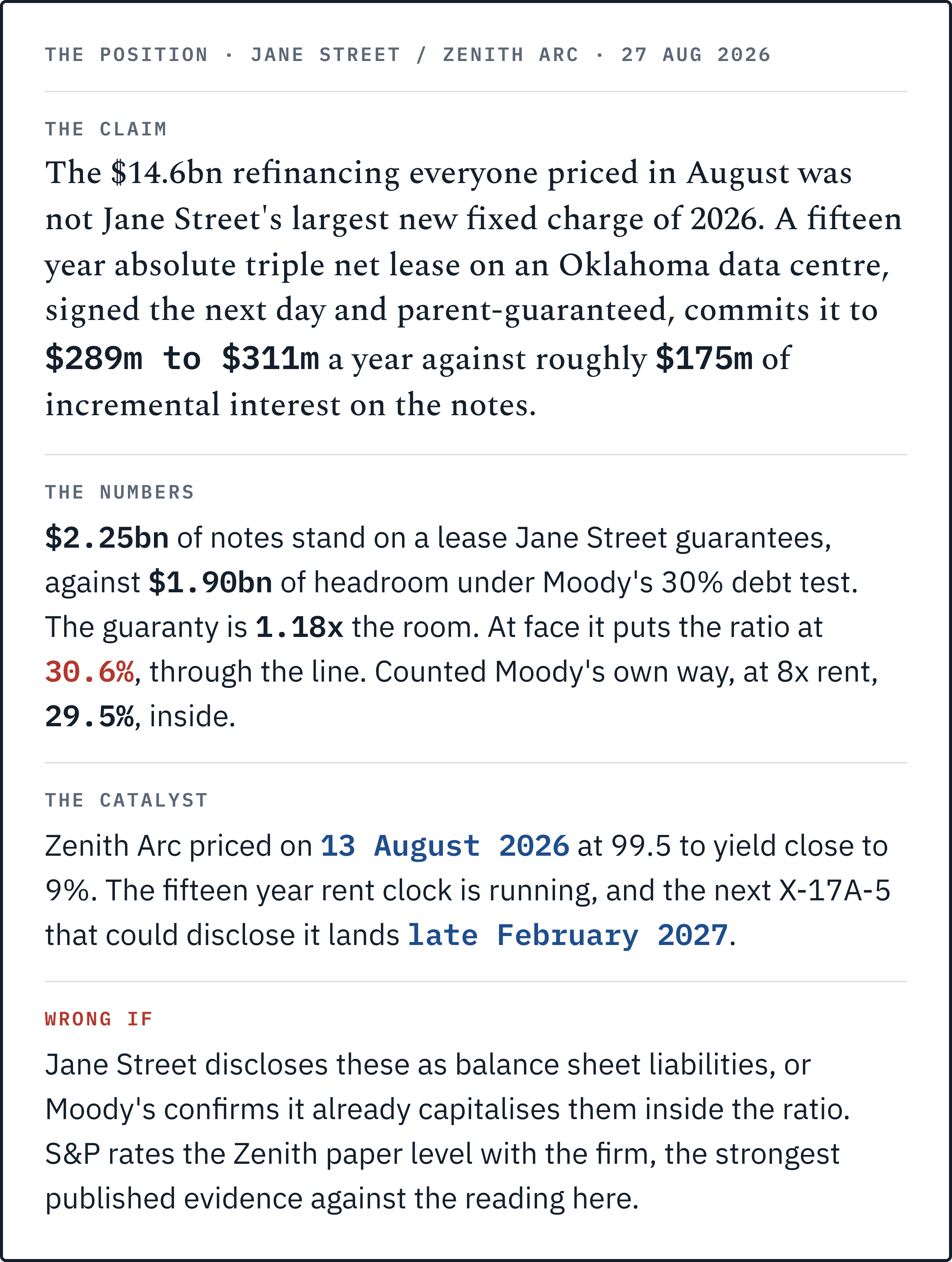
The $14.6bn refinancing everyone priced in August was not Jane Street’s largest new fixed charge of 2026. A fifteen year absolute triple net lease on an Oklahoma data centre, signed the next day and parent-guaranteed, commits it to $289m to $311m a year against roughly $175m of incremental interest on the notes. The notes are counted, rated and public. The lease is none of those.
Below the paid line: the committed charge arithmetic, 149MW at the EIA’s June 2026 Oklahoma tariff of 7.37c/kWh, to a fifteen year undiscounted $4.34bn to $4.66bn. Moody’s 30% trigger worked line by line at 26.5% and 30.6%, and the 8x-rent method that lands it at 29.5% instead. Then the full 2026 obligation stack, the capacity table, the ICE BofA control, and five confounds I cannot rule out.
What Jane Street’s $14.6bn refinancing bought, and why it read like the whole story
On 12 August Jane Street priced $14.6bn of senior secured notes into a private group led by JPMorgan with PIMCO in the book: $5.86bn to 2031, $5.13bn to 2033, $3.64bn to 2036, the long piece at 8.088%. Roughly $11.2bn retired a $5.5bn term loan and $5.7bn of existing notes, as Bloomberg reported. The reading that followed was coherent and mostly right. New money costs about 311bp against roughly 152bp on the paper it replaced, about $175m a year of incremental interest, and it takes the funding private. Bloomberg Opinion called the swap smart self-defense. A firm that had just printed its first losing month in a decade paid nine figures a year to control who reads its numbers. I wrote about that two weeks ago and still think the disclosure motive is right. This piece is about the deal nobody set beside it.
The three obligations of 2026, and the one that got priced
Jane Street has been buying compute all year, four ways, and nobody has put the year in one table.
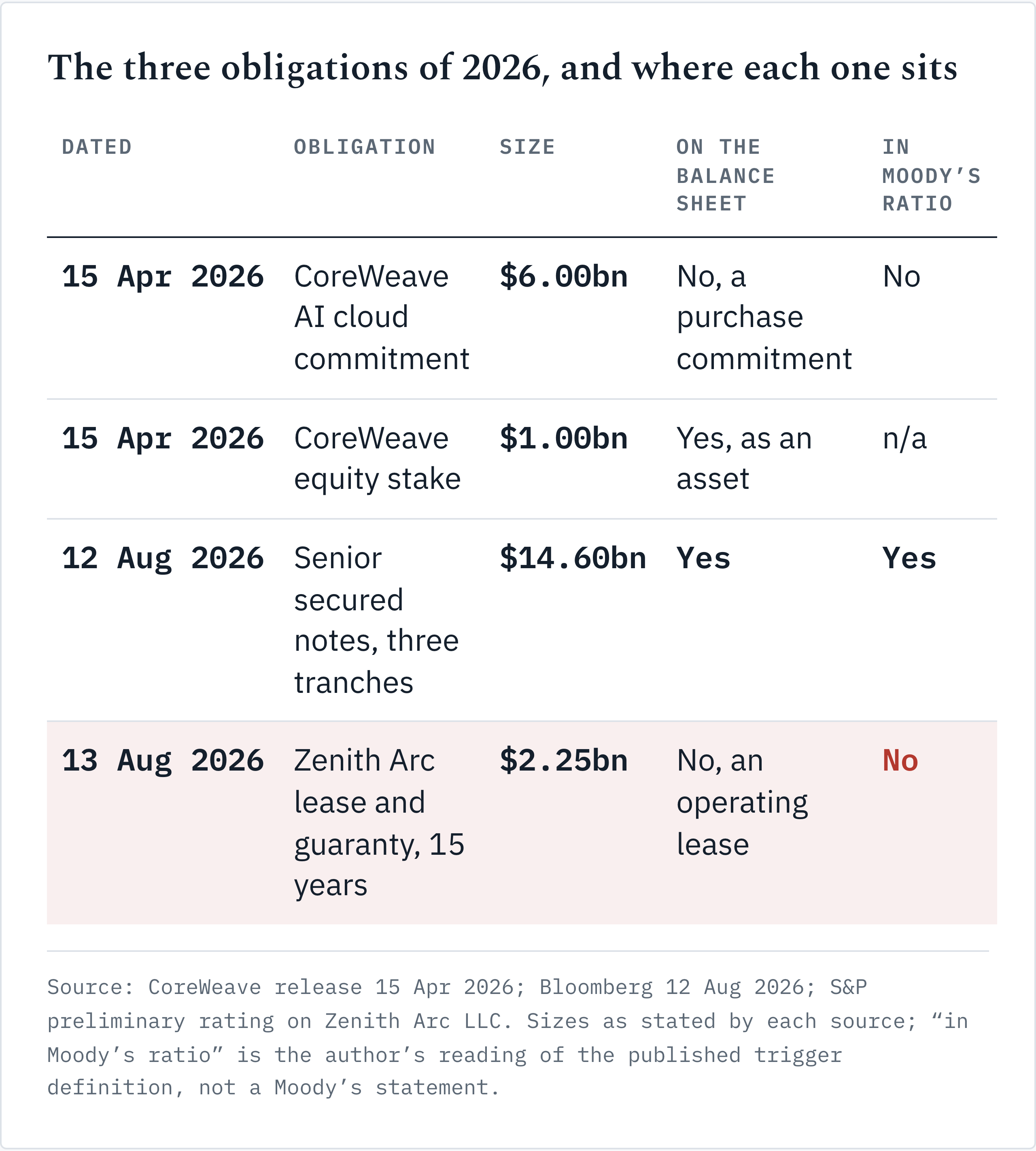
CoreWeave’s announcement is unambiguous: “Jane Street has committed approximately $6 billion to use CoreWeave’s AI cloud platform,” alongside a $1bn equity investment at $109.00 a share. It states no term, a gap I return to. Bloomberg reported in June that the firm is separately weighing its own 100MW to 200MW data centre, self financed, on a plan to go from tens of thousands of GPUs to hundreds of thousands.
The two off metric lines come to $8.25bn in one year, against $1.90bn of headroom under Moody’s test, worked below.
⛔ Those two are not the same instrument. A guaranty of third party debt is close to debt and is the kind of contingent obligation a rating methodology can capitalise. A cloud purchase commitment is a vendor contract, and no agency’s leverage metric counts those as debt, for any issuer anywhere. The lease is the sharp case. CoreWeave is not evidence of a gap in anyone’s metric. That one costs me the headline number. It’s there for scale: its April date turns the August lease into a pattern.
Zenith Arc, 149MW, and a lease with no bid
Zenith Arc LLC, a subsidiary of Prairieland Rivers LLC, sold $2.25bn of green bonds due 2031 to fund a data centre and substation in central Oklahoma: 149MW, leased for fifteen years to JS Data Center LLC, a Jane Street Group subsidiary, with the parent guaranteeing. That lease is no normal tenancy: under an absolute triple net lease with a guaranty Jane Street owes base rent and, separately, every property expense: maintenance, property taxes, utility bills, insurance premiums, and electricity. All of them, uncapped, fifteen years, whether the machines inside earn anything or not. Moody’s rated the notes Ba2, two notches below investment grade. I read the guaranty as why they cleared at all.
That shape is why the credit prices where it does. A firm at 6.2x balance sheet leverage borrows at investment-grade-adjacent levels because its book is self-liquidating: if the business stops on a Tuesday you sell it and pay everyone back by Friday. Jane Street Capital’s own Form X-17A-5 for 2025 shows it: assets $60.70bn, liabilities $54.42bn, equity $6.28bn, and securities sold short of $45.01bn against long positions of $41.70bn. A book made of things with bids. A fifteen year lease on an Oklahoma substation has no bid, cannot be sold or hedged, and does not shrink when the trading book does. July was the first down month in a decade; the rent would have been due anyway. Jane Street has always had office leases, so non trading obligations aren’t new. The scale is, and so is a public rating letter on one.
Baa3, Ba1, Ba2: Moody’s three notches, and why they prove less than they look
Moody’s affirmed Jane Street Group at Ba1 on 22 July, outlook to positive, and affirmed Baa3, investment grade, on the four wholly owned operating subsidiaries. Two days later Fitch upgraded the group to BBB- from BB+, citing “strong through-the-cycle growth in net operating income.” Three weeks later the same agency looked at a bond whose economics are almost entirely Jane Street’s promise to pay rent, and rated it Ba2.
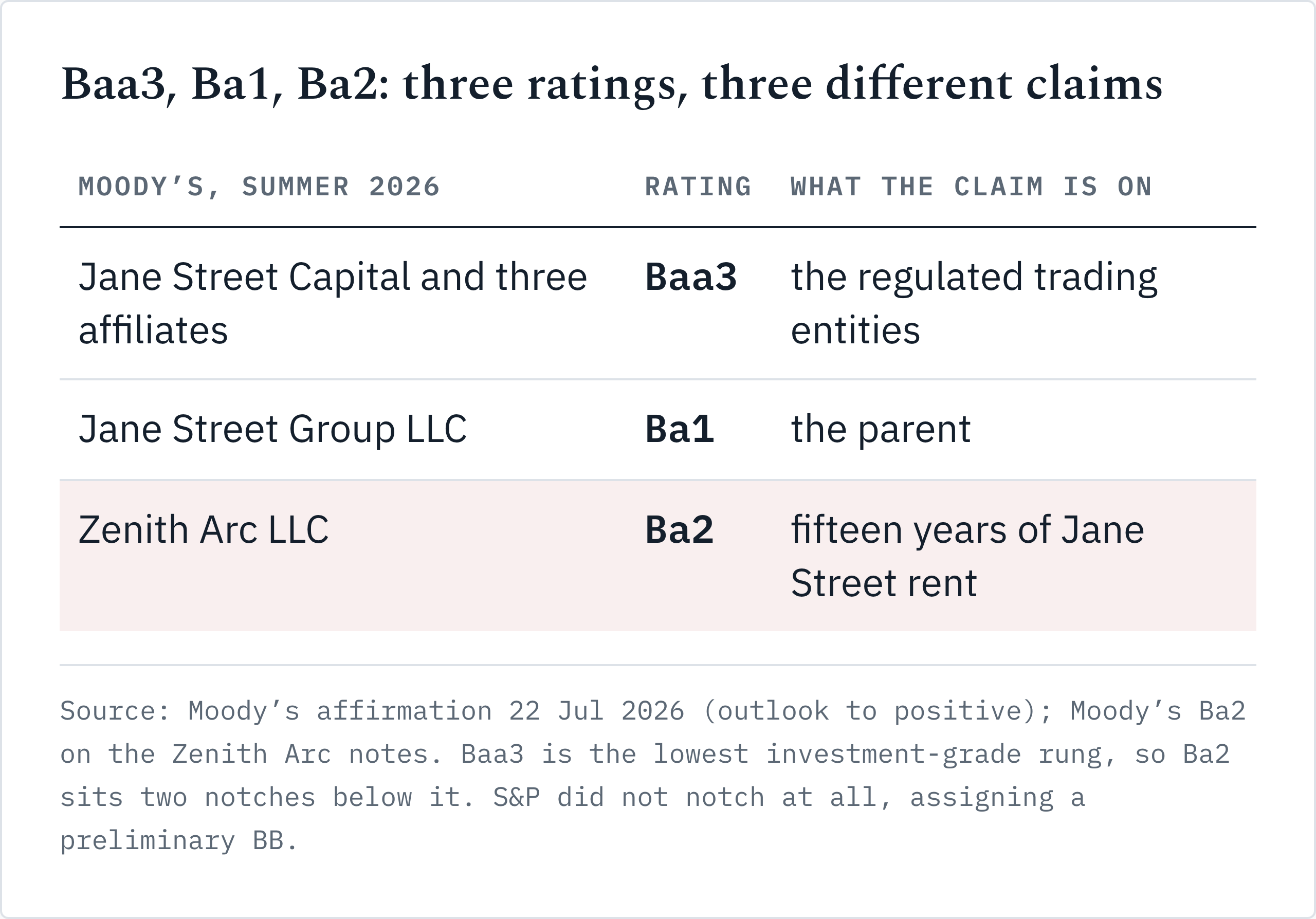
I wanted that ladder to mean the market prices Jane Street’s duration. It doesn’t, and I’ll say why before someone else does. Clifford Chance’s July briefing on exactly these structures says data centre lease bonds are “notched down for structural reasons (e.g., completion risk or refinancing risk at a bullet maturity)”, with the notch being about structure, not credit. Zenith Arc has both: a construction financing with a 2031 bullet against a fifteen year lease. And S&P didn’t notch it at all, assigning a preliminary BB, where it already rates Jane Street.
The ladder is real. It is not evidence of what I wanted, and I am not going to dress that up. What survives: a Jane Street obligation is now rated in public, on its own, by two agencies, and neither puts it above the firm. The rest runs on the cash.
The rent floor is $202.5m. The power bill is bigger than I expected.
Nobody discloses the rent, so I built a floor from the debt it services. $2.25bn priced at 99.5 to yield close to 9%. That is $202.5m of interest a year, and under an absolute triple net structure rent must cover it. Real rent sits higher: it carries the developer’s equity return, fees and reserves too.
Electricity is where I was wrong. I expected a rounding line; on 149MW of critical IT load it isn’t, so I priced it. The EIA’s Electric Power Monthly, Table 5.6.A puts Oklahoma industrial electricity at 7.37 cents per kWh in June 2026 against 6.57 a year earlier, a tariff rising 12% a year that the tenant absorbs uncapped. Two cases, bracketing the uplift for cooling and losses:
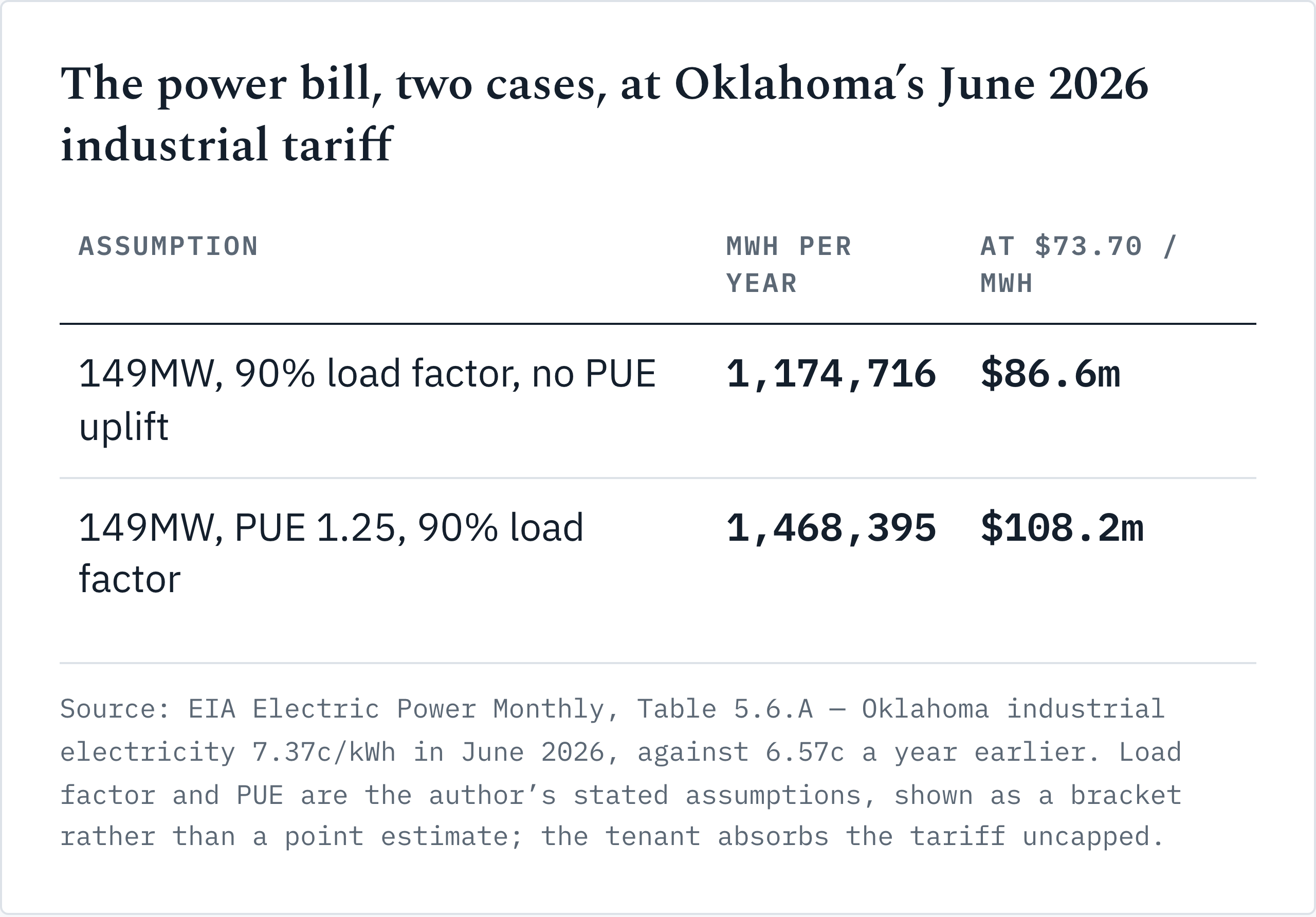
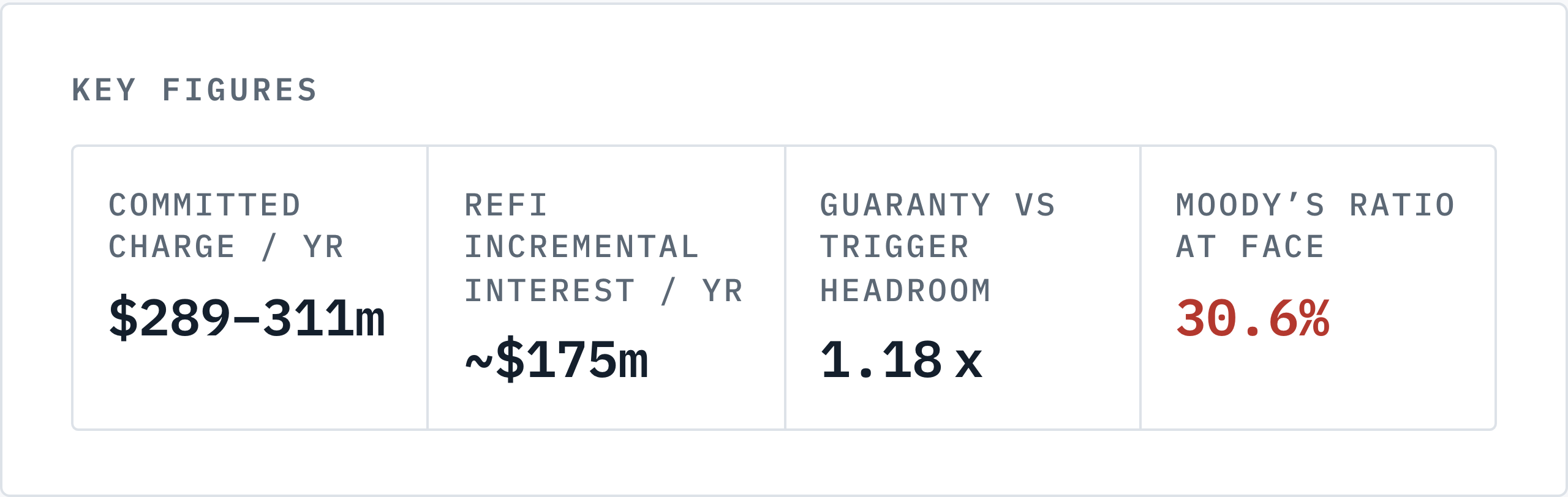
Add them. I make the committed annual floor $289m to $311m: $202.5m of rent plus $87m to $108m of power, before the property taxes, insurance and maintenance the lease also assigns to Jane Street and which public data cannot size. Fifteen years, undiscounted: $4.34bn to $4.66bn, or 69% to 74% of the $6.28bn of equity in the broker-dealer that does the trading. Now put the two August deals side by side.
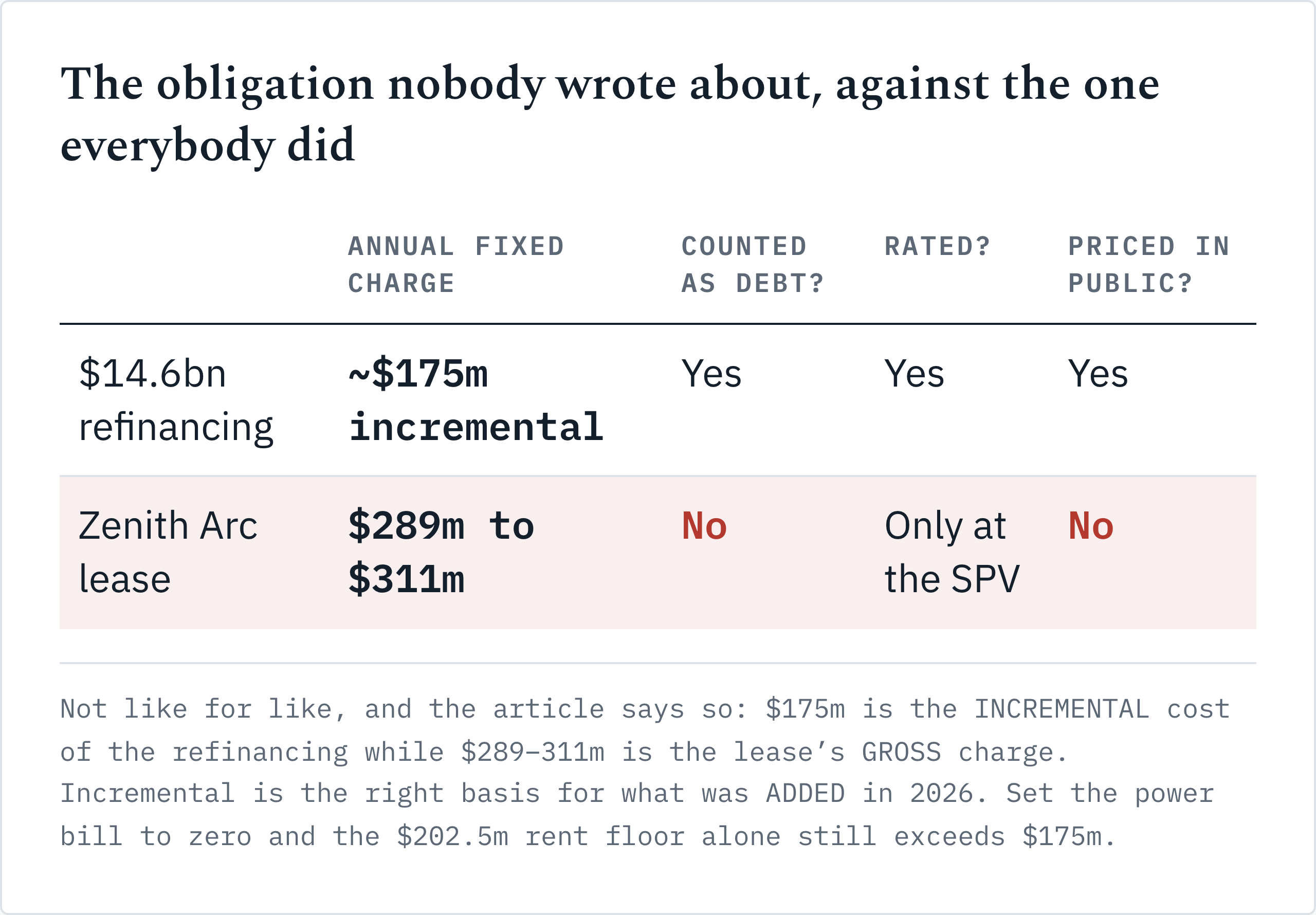
The obligation nobody wrote about runs between 1.65 and 1.78 times the size of the one everybody did. One caveat, because it isn’t like for like: $175m is the INCREMENTAL cost of the refinancing while $289m to $311m is the lease’s GROSS charge. Incremental is the right basis here because the subject is what Jane Street ADDED in 2026: the refinancing added $175m, the lease at least $289m. My load and PUE assumptions are moveable and a reader should move them, though not far enough to reverse this: set the power bill to zero and the rent floor alone still exceeds $175m. That’s the gap.
