



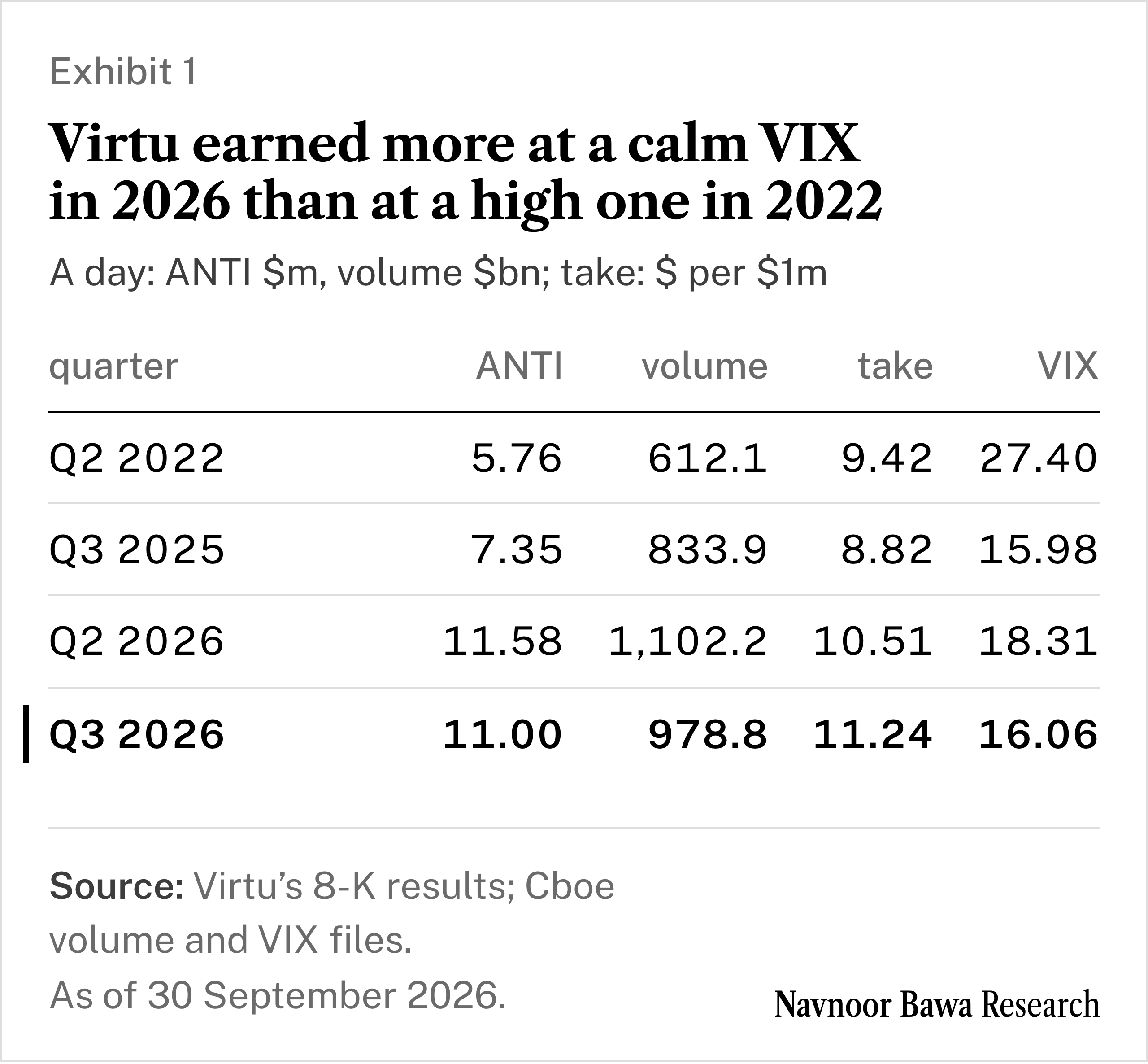
On 5 November 2026 Virtu Financial reported its third quarter in one release. It made $11.0m a day at a VIX averaging 16, against $7.35m a year earlier at the same VIX, the options market’s gauge of expected S&P 500 swings.
Walnut, “an AI investing app”, said on its Virtu stock page that a quieter third quarter “would show up directly in results”. Virtu’s own 10-Q argues the same. The quiet came; the money held. Was that volatility, volume or Virtu?
My answer is volume, plus a weak year-ago quarter or swings in single stocks; the flat VIX cannot have paid for the rise. Virtu kept $11.24 of every $1m the U.S. market traded. Outside a crisis (a quarter whose VIX averages above 30), its quarter follows what the market trades, so a calm market costs it money only when it also trades less.
Virtu’s fourth quarter, printed by 1 March 2027, tests the model behind it. The paid half gives its odds of beating the third and the daily dollar volume to 31 December that decides it.
The take rose while the VIX stood still
A market maker quotes a price to buy and a higher price to sell, and keeps part of the gap on whatever trades: a wider gap pays more on each trade, a busier market on more of them. I divided Virtu’s money, quarter by quarter since 2014, by the dollar value the whole U.S. stock market traded, from Cboe’s free daily files; that ratio is Virtu’s take. Then I forecast every quarter since 2023 in 34 ways, each fitted only on the quarters before it, as if in real time. I fixed that crisis rule before fitting anything; it takes out the first half of 2020.
Virtu Financial reports its money as Adjusted Net Trading Income (ANTI), a non-GAAP measure of what it keeps after paying to trade, payments for order flow included: what it pays brokers who send it their customers’ orders.
Source: Virtu’s results releases (8-K Exhibit 99.1) of 5 November 2026, 30 July 2026 and for Q2 2022; Cboe’s U.S. equities volume files and VIX history; author’s calculation, as of 9 November 2026. Volume a day uses NYSE trading days as Virtu counts them, half days as half; the take is unrounded ANTI over dollar volume.
On the call, chief executive Aaron Simons called volume and volatility “somewhat lower than the first half of the year, although they remained elevated relative to historical averages”. Against the second quarter alone, Exhibit 1 shows both down and ANTI a day down by less than either.
Virtu’s own 10-Q makes the volatility case: “Increases in market volatility can cause bid/ask spreads to widen”, so “market makers’ capture rate per notional amount transacted may increase”. Read that way, the take should have sagged from the second quarter, as the VIX and the S&P 500’s own swings both fell; it rose. Earnings Whispers, in a note Finviz carries, saw that Virtu “can still earn well in a quieter tape” without measuring why.
The VIX was calm; single stocks were not
What surprised me was 2022: the VIX averaged from 24.8 to 27.4 in each quarter, and Virtu kept about the same or less of each million traded as it did in this calm summer.
The third quarter of 2025 is where volatility looked like the driver: the take fell 22.6% from the quarter before. The S&P 500’s realized volatility, how much the index actually moved, fell to 8.67 on my count from Cboe’s closes, the lowest of the 29 quarters since mid-2019; this summer it was 10.95.
Cboe’s VIXEQ, the implied volatility of S&P 500 stocks one by one, averaged 41.79 in the third quarter. A year earlier it averaged 34.12, the calmest of its seven live quarters since its November 2024 launch. DSPX, Cboe’s dispersion index, a gauge of how far those stocks are expected to scatter around the index, rose 27.9% on the year.
Acadian’s Owen Lamont, who tracks daily dispersion, wrote in August: “While the aggregate market appeared calm, prices of individual stocks gyrated wildly.” Against a year earlier, realized volatility, which the 10-Q names as a driver, rose from its low, and volatility in single stocks rose further. Volume is the confound: it rises when markets swing, so volatility can still pay Virtu through the trading it brings.
In the third quarter Flow Traders, the ETF market maker, behaved as the 10-Q’s argument predicts. Its net trading income fell 43% from the second quarter on “subdued market activity and lower volatility”, with value traded about 2% lower, while Virtu’s ANTI a day fell only 5.0% from the second quarter’s.
Four readings compete with volume: volatility in single stocks, retail trading, which the 10-Q also names, Virtu’s push abroad, and the trading capital it keeps adding. That capital grew by about $900m this year, on co-president Joe Molluso’s count. Each would show up as money that dollar volume does not explain.
Trend models lost the forecasting race
I raced models with a time trend, a term that lets their money drift by a fixed share each year, against a plain rule. The rule extends our October piece on Hudson River Trading, where a firm grows at about the pace of volume: the last four quarters’ average take times this quarter’s dollar volume.
Of the 34 versions, the volume model, which fits volume alone on the last twenty quarters, missed by 8.7% on average since early 2023, against the plain rule’s 10.7%. Every model with a trend missed by more, from 12.7% up to 21.2% for my rebuild of the volatility argument. That rebuild, the VIX, volume and a trend since mid-2019, came in low in 13 of the 15 quarters.
Fits reaching back to mid-2019, with a trend or without one, leave far more of the quarter’s ANTI unexplained than fits on recent quarters do; it is the long window that makes Virtu’s quarters look lucky.
On the third quarter, the volume model, fed the quarter’s dollar volume, forecast about $680m of ANTI in real time against Virtu’s $704.0m, closer than the $660.0m estimate on QuiverQuant’s results page, which calls ANTI revenue.
Fits that add the VIX to volume did about as well as volume alone. Fifteen quarters cannot tell the volume model from the plain rule either: the gap is within noise, and the volume model’s lead rests on the carry, the part of its last miss each fitted model adds back.
So read Virtu off Cboe’s free volume file, complete weeks before it reports, and distrust any estimate with a time trend.
The rest: a weak base, or single stocks
ANTI a day rose 49.6% on the year, 40.3 log points (log points add where percentages compound). At about 1.16% more ANTI a day per 1% more dollar volume, volume accounts for 18.6 of those points, less than half.
Most of the other 21.7 sit in the quarter a year earlier, which came in 17.6% below the volume model’s fitted value. Forecast in real time, it missed by more: the third quarter of 2025 came in 24.3% below, one of three shortfalls of 20% or more in fifteen quarters, while this quarter came in 3.6% above.
Volatility in single stocks is the one lead: all three shortfalls came in the six quarters with the lowest VIXEQ; the other nine missed by 7.5% or less. I sorted after the fact; five of the six predate VIXEQ’s launch, in Cboe’s back-calculated history.
A fit adding VIXEQ to volume gives it 6.9 of the 40.3 points on its 22.5% rise. That term, 0.34 against a standard error (the fit’s margin of doubt) of 0.27, is within noise. Fitted only on the fifteen quarters forecast in real time, it measures 1.10 against a margin of 0.31, clear of noise, which is why it stays a lead. At that size, VIXEQ’s rise alone would account for about 22 of the 40.3 points, all of the rest. On these quarters, a weak base and volatility in single stocks cannot be told apart.
Patrick Moley, Piper Sandler’s analyst on the call, noted market making was “down only about 4% sequentially” while “U.S. equity volumes were down mid-teens”, a count of shares; dollar volume a day fell 11.2%. Simons cited “offshore equity perpetuals”, stock futures with no expiry, traded abroad: “it’s not going to be as correlated with those metrics as it used to be.” The 10-Q’s geographic note books revenue by subsidiary, not where trading happened; from the second quarter, revenue booked abroad rose 2.7%, about $6.9m; U.S.-booked revenue fell 4.6%. Those are moves from the second quarter, so they do not size the year’s rise.
Retail trading and the added capital go untested. Robinhood’s equity notional volume rose 53% on the year. On Cboe’s file, trades reported away from the exchanges grew 25.7% a session, against 18.3% for all trading, and a model of total volume cannot see a shift toward that flow.
Texas will raise the bar to sue
On 4 November 2026 Virtu’s board, on the recommendation of a committee of independent directors, approved converting from Delaware to Texas, and TJMT Holdings LLC, the holding vehicle of founder Vincent Viola’s family, consented in writing that day. The 14C, the notice to holders of a decision taken without their vote, gives TJMT 87.2% of the vote and names Delaware’s litigious environment among its reasons.
Under the Texas charter, holders, alone or together, will need to “beneficially own at least 3% of the total outstanding shares” to bring a derivative claim, a suit on the company’s behalf, against a director or officer. Because the 10-Q’s cover counts the unlisted Class C and TJMT’s Class D shares, which vote but carry no economic rights, that is 5.26% of the listed Class A: $251.1m of stock at the 6 November close.
On the 14C’s ownership table, BlackRock, Vanguard Portfolio Management and FMR, Fidelity’s parent, each clear the bar alone, though FMR’s own ownership filing, a 13G/A, puts it below on 30 September. Every other outside holder must pool, and the bar reaches only derivative claims over conduct after the conversion.
→ Virtu Financial’s 2017 KCG takeover, rebuilt from KCG’s proxy and Virtu’s filings, Trade File No. 12 on Patreon.
Does Virtu’s fourth quarter beat the third’s $11.0m a day, and how much daily trading to 31 December does it take?
Below the paid line:
The verdict, and its odds at six paces of daily volume
The odds under one changed input, three outcomes, the line that would kill the call, and the book of record
The test to run on the next firm, and three dated things to watch