



Chase Coleman’s Tiger Global closed June with the heaviest chip bet it has filed since at least 2013. Its flagship lost 8.5% in October, Hedgeweek reported, relaying Bloomberg, whose headline had Tiger “battered by AI fears”. The losses, Hedgeweek wrote, “followed a widespread retreat from technology and semiconductor stocks”.
But Tiger’s own June 13F put 44.7% of its filed book of 46 US stock lines in chip and AI infrastructure. Held still means June’s share counts at later closes, never a loss Tiger booked. Held still, the chip lines Tiger disclosed in June lost $1.7bn in October, about 63% of what its whole filed long book lost.
Tiger’s flagship lost less than that book did, and its next filing shows whether it still held those chips at 30 September. Philippe Laffont’s Coatue, heavier in chips, saw its flagship gain in October.
The paid part weighs whether Tiger still held them when October hit, shows what Coatue did differently, and puts odds on Tiger’s next filing. The number we compare is what each flagship lost per dollar its June book lost.
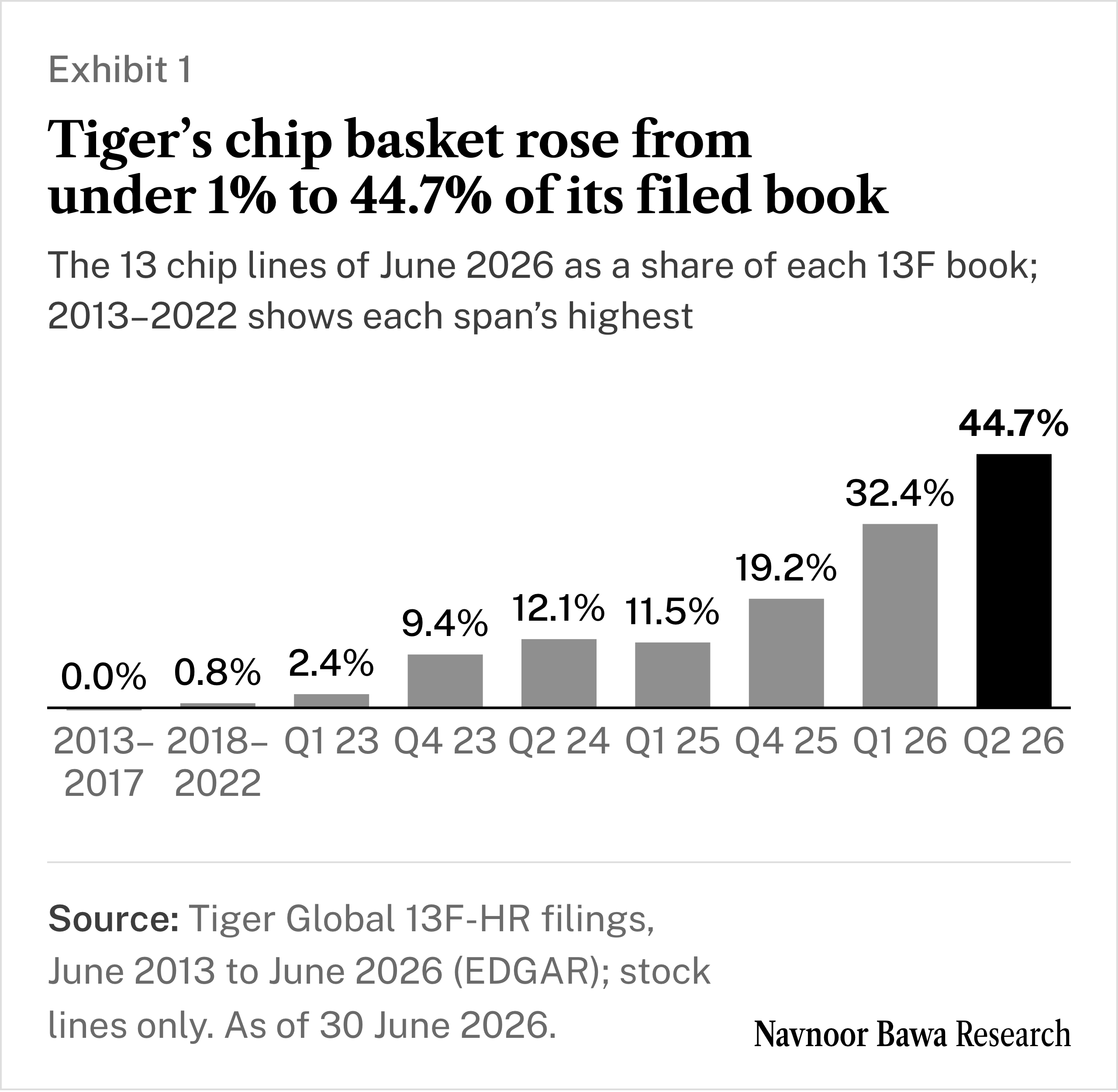
Source: Author’s calculation from Tiger Global’s 13F-HR filings, June 2013 to June 2026 (EDGAR, CIK 1167483), as of 30 June 2026. The basket is the 13 chip lines of the June 2026 filing, run back through each filing; stock lines only, options excluded.
Tiger built the chip bet; prices finished it
The 46 lines Tiger filed for June are the only book anyone outside can mark. Worth $23.98bn, they hold US-listed stock for every Tiger vehicle together, with no shorts, cash or private holdings, and are filed within 45 days of the quarter. I priced the stock lines of five firms’ June filings at each month end through October and at 6 November, at least 98% of each book by value. Each 30 June close was checked against the filing’s own value per share; Tiger’s 46 lines match to the cent. Held still shows what the June positions would have done, never what Tiger did.
For a decade the bet barely existed. The basket is the 13 lines in the June filing that make chips, the tools and drives around them, or house and power them: TSMC, Nvidia, Lam Research, Applied Materials, Broadcom, Intel, AMD, Cerebras, Seagate, GE Vernova and three data centre hosts, Applied Digital, Cipher Digital and Core Scientific. From 2013 to 2022 only one of the 13, TSMC, appeared as a stock line, at 0.8% of the filed book in September 2022.
Then it came in steps. The basket was 11.5% of the filed book at 31 March 2025 and 32.4% at 31 March 2026. At 30 June it was 44.7%, the highest of the 53 filings Tiger has made with a machine readable table, the first of them for June 2013.
The last step was mostly price, beside a swap inside chips that netted to about zero. In the second quarter Tiger halved Broadcom, trimmed Lam, GE Vernova and TSMC by 12% to 19% and Nvidia by 6.8%, and sold all of Lumentum. It also grew Intel 2.6 times, and six chip lines were new to the filing: Cerebras, AMD, Seagate and the three hosts, worth $1.41bn at 30 June. Our October piece found the quarter’s selling sat outside chips; these trims and new lines are the swap it saw inside them.
Yet Lam’s line rose in value from $833m to $1,371m on fewer shares. Applied Materials’ rose from $566m to $1,180m on 1.5% fewer. Prices did nearly all the lifting.
Neither report of the build added the chip lines up against the whole book or marked them through October: InvestorLens covered the first quarter’s and Hedgeweek the second’s. The selloff story, as Hedgeweek relays it, is right about the chips and silent about how much of them Tiger owned.
Photo: Tony Hisgett from Birmingham, UK · CC BY 2.0, adapted · via Wikimedia Commons

Tiger has said nothing publicly about October and its investor letters are private, so its brochure is the nearest thing to its own words. Item 6 of the brochure, the Form ADV Part 2A every adviser registered with the SEC files, dated 27 March 2026, gives the portfolio manager “broad authority to make investment decisions”.
Item 13 makes the portfolio manager “responsible for reviewing trading data on a continuous basis” to decide which positions to keep, so the chip lines can change any day between filings. Item 8’s concentration language names “Internet, cloud computing, software, and artificial intelligence”: artificial intelligence, but no chip sector, and the word “semiconductor” doesn’t appear. At 31 March, four days later, Tiger’s 13F had the basket at 32.4%.
The 44.7% is a weight in the long stock book, never in the firm. Item 4 of the brochure puts Tiger’s net assets under management at about $54.7bn on 1 January 2026; the filed book a day earlier was $29.71bn, and the basket then about a tenth of those net assets. The flagship, Tiger Global Investments, L.P., is the largest of three funds whose long books the brochure expects to overlap, beside the Long Opportunities Fund and the Crossover Fund.
Tiger swapped chips in the spring, rising prices did the rest, and it went into the summer with nearly half its filed book on one theme.
October fell on the chips
Lam Research shows the method end to end. On 30 June Tiger reported 3,163,495 Lam shares worth $1,370.8m. That is $433.33 a share, Lam’s 30 June close to the cent, the check every one of Tiger’s 46 lines passed. Held still, the same shares were worth $1,039m at Lam’s 30 September close and $756m at its 30 October close.
October alone took 27.2% off the line, or $283m. That is about a tenth of the whole filed book’s $2.74bn October loss, from a line that was 5.7% of the book’s June value.
Coatue’s June filing held Lam too, $4.09bn of it, and held still it was Coatue’s costliest October line, at $844m.
Across Tiger’s book, every one of the 13 chip lines fell in October, against 20 of the other 33. Held still, the chip lines lost 17.5% in October and the rest of the book 7.3%. The chips’ $1.71bn was 7.2 of the 11.5 points the book lost from its 30 September value. The chip bet was most of the book’s October loss, held still.
Intel, the line Tiger grew most in the spring, fell 45.3%, a $232m loss held still. It closed at $65.76 on 30 October, below the exit price our October piece set for the Intel long it proposed, so that trade lost.
From 1 to 6 November the June chip lines lost a further $0.88bn held still, 10.9%, while the whole book lost $0.31bn. If the bet was still on, November didn’t help.
Of the other firms in Hedgeweek’s account of Bloomberg’s report, Whale Rock Capital Management and Coatue filed June books with a larger share in chip makers than Tiger’s. Whale Rock’s flagship lost about 8% in October and Atreides Management’s 9.5%, with Atreides’s smaller hedge fund down 16%. Dan Sundheim’s D1 Capital Partners, whose June filing is 62% one stock, SpaceX, lost 4.4% in its equity portfolio, and Coatue’s flagship strategy gained 0.2%, by the same report.
Goldman Sachs prime brokerage data, from the desk that lends to and clears for hedge funds, as Hedgeweek reported them, put fundamental long/short equity funds down 3.5% as a group in October. The same selloff hit them very unevenly.
Tiger’s 8.5% sits inside that spread, from Coatue’s gain to the 16% at Atreides’s smaller fund, and is more than twice the long/short group’s loss. It left the flagship about flat for 2026, after a 9.4% gain through September in Hedgeweek’s report of 9 October. None of these reports says why Tiger’s flagship lost less than the firm’s filed book.
Tiger’s flagship lost less than its book
I measure the gap in cents on the dollar: what one fund loses in a month for each dollar its firm’s June filed book loses held still that month. Tiger’s flagship lost 8.5% in October against the filed book’s 11.5%, which is 74 cents. That is about what a fund three quarters net long on that book would lose, if its shorts and hedges fell as far as its longs. Seventy-four cents fits a bet kept and a bet partly sold alike, until the filing tells them apart.
The ratio folds in what the filing can’t see: short sales and hedges, fees, private marks, cash, trading since 30 June, and the gap between one fund and the whole firm’s book. It moves with the fund chosen: the Crossover Fund lost 3.3% in October, by the same report, or 29 cents.
In October, Alphabet, Meta and Amazon fell with the chips: with the chip lines they were 91% of the filed book’s October loss, held still. Yet across the five funds, June chip weight and October return show a correlation of −0.04. Owning more chips in June didn’t sort who lost most in October.
Four explanations compete for the 26 cents the flagship didn’t lose, beside the plain gap between one fund and the firm’s filing.
Tiger may have sold chip lines in the third quarter, after July’s fall. The Bank of England’s Financial Policy Committee described that summer in its record of 30 September: “Equity valuations for AI companies fell sharply in July. The scale of the adjustment was amplified by an unwinding of stretched positions and associated deleveraging activity.” This predicts 30 September counts far below June’s, and the 16 November filing is its trip wire.
The flagship is a long/short fund (Item 4 of the brochure) whose program “includes the execution of short sales” (Item 8), so it runs less net exposure, longs less shorts, than an all long filing shows. In Hedge Fund Alpha’s account of Tiger’s letter for the first quarter of 2025, Tiger “slashed its net exposure by more than a third”; its 13F for that quarter still held 0.90 of the previous quarter’s chip shares, by value. This predicts counts held and a reported loss smaller than the long book’s, which is what October shows, though every rival predicts that smaller loss.
Private marks offset public losses. Hedgeweek reported on 9 October that Tiger’s early stake in OpenAI sits “among the largest holdings in the firm’s latest venture capital vehicle, Private Investment Partners 16”, and that the investment “has also contributed to positive performance across Tiger Global’s funds this year”. This predicts a lift tied to a valuation date rather than to chip prices, larger in the venture vehicle than in the flagship.
Tiger may have sold during October itself. In Hedgeweek’s account of Goldman’s data, “Five consecutive sessions of selling in AI-related equities between 8 and 14 October erased all cumulative net purchases of the sector since the beginning of 2025”. This predicts full counts at 30 September and a realised loss smaller than the held still mark.
Only the first is settled soon: Tiger’s 13F for 30 September is due by 16 November, and its counts, read against October’s 74 cents, separate it from the rest. The second and fourth stay folded together until the 31 December filing, due by 16 February 2027, shows Tiger’s trading, and even then only net of November and December. No document sizes the third’s effect on the flagship, and no filing on 16 November tests it. For anyone holding the same chip names, what matters now is whether Tiger still had them at 30 September.
→ Tiger Global’s 2022 growth stock retreat, rebuilt from its SEC filings, Trade File No. 11 on Patreon.
Coatue held more chips than Tiger and gained in October: did its flagship break from its book after July, and did Tiger’s?
Below the paid line:
Five June books against their October returns, and Coatue’s July against its October.
Our odds on Tiger’s 16 November filing, with what its expected chip shares were worth.
Every chip line at three closes.
A test in three lines for any fund, and dated checks.