


In Q2, Chase Coleman’s Tiger Global sold about $3.7bn more stock than it bought. Its 13F still showed a book that grew, because prices rose faster than Tiger sold. The selling sat outside chips; inside them, Tiger swapped names and let the rally make semiconductors a bigger share of the book. The one chip line it built in both quarters is Intel, worth owning beside Tiger only below today’s price. Anyone long Broadcom, Lam or TSMC had a large holder cutting into the rally.
Lam grew while Tiger cut it
A 13F’s value column is each line’s share count times the stock’s close on the quarter’s last trading day. The Form 13F instructions value every holding “at the close of trading on the last trading day of the calendar year or quarter.” So the column moves with prices whether the manager trades or not. The filing lists long US-listed positions only, at quarter end, up to 45 days later, with no shorts or swaps.
Lam Research shows how far the two can part. Tiger cut its Lam share count by 18.9% between 31 March and 30 June. The same line rose $537.5m in value, because Lam’s close doubled.
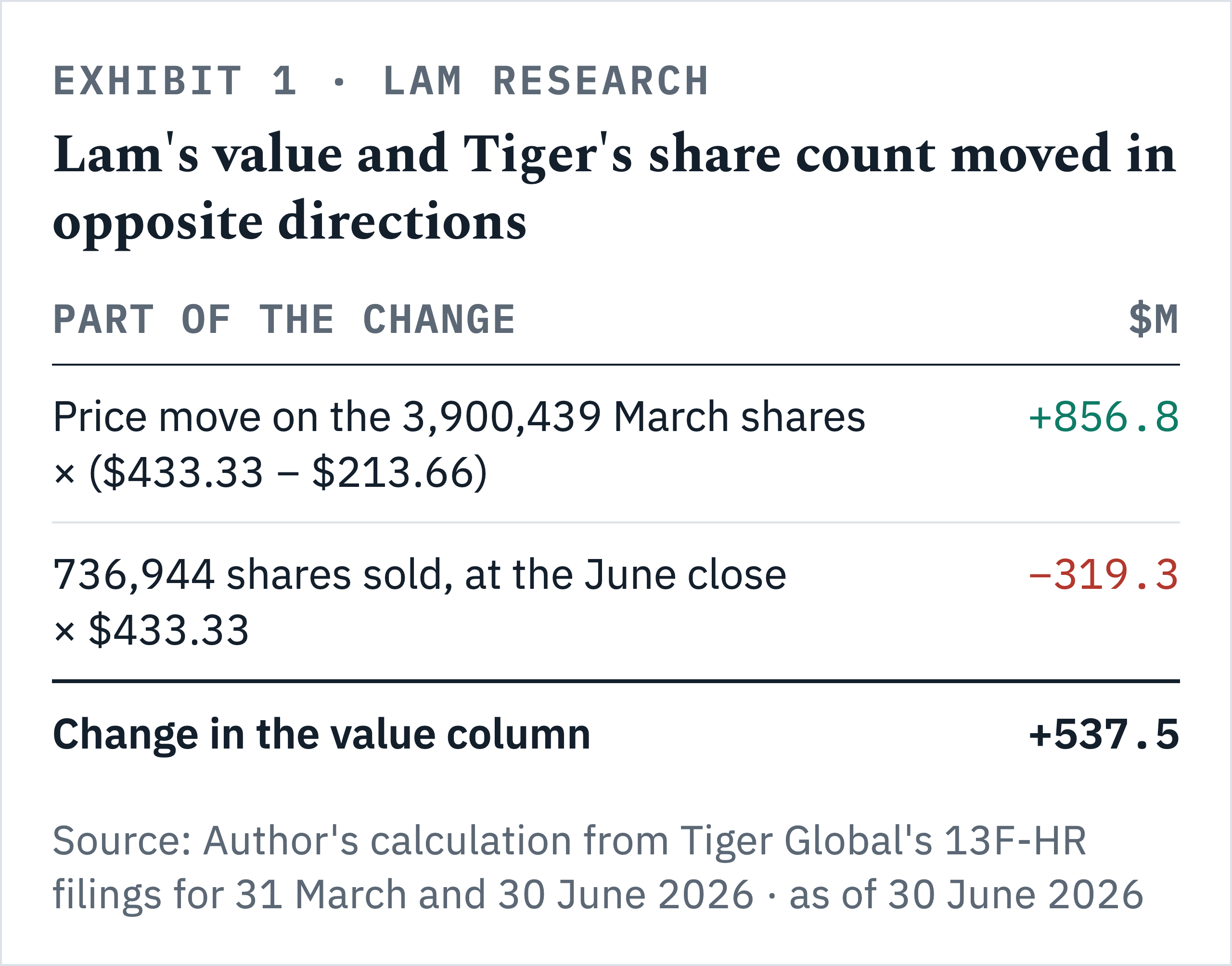
Source: Author’s calculation from Tiger Global’s 13F-HR filings for 31 March and 30 June 2026 · as of 30 June 2026.
The price move added more than Tiger took out, so a list sorted by value shows Lam among Tiger’s biggest gains in a quarter when Tiger was selling it. Run that split across all 46 lines Tiger reported in June and the 17 it closed, and the real question appears: how much did Tiger sell, and from where?
Most of the selling sat outside chips
The answer comes in four steps.
Priced at the June close, Tiger’s share changes and the lines it closed net to about $3.7bn of stock sold.
Lines outside chips and storage carry nearly all of it, led by Alphabet, whose Class A count Tiger cut by 45.4%.
Inside chips and storage, money moved from Broadcom, TSMC, Lam, Nvidia and Applied Materials into Intel, AMD, Seagate and Cerebras, a newly listed AI chipmaker. At June prices the two sides came out within a tenth of a billion of each other.
Chip prices ran, the VanEck Semiconductor ETF (SMH) rose 71% in the quarter, so chips became a larger share of a book Tiger was shrinking.
When SMH rises 71% in a quarter, a chip line’s value mostly tells you what SMH did; only the share column says what Tiger did, and only the sum of every line says how much.
For your book, that changes two readings. If you own Broadcom or TSMC, Tiger’s count fell 51.1% in Broadcom and 12.3% in TSMC. If you are weighing whether to follow Tiger into chips, the filing says it added close to nothing to them on net.
Tiger had no Intel line at the end of 2025 and opened one in the first quarter. In the second, its count rose from 1,638,700 to 4,252,690 shares. Over that quarter Intel’s close went from $44.13 to $139.63.
Tiger was also alone. Coatue and Lone Pine, two growth funds with the same kind of public book, ran through the same rally, and put through the same split, both come out as net buyers.
The paid half holds the swap table, the same split on Coatue and Lone Pine, and the Intel entry with its levels. The call settles on 16 November 2026, when Tiger’s filing for the September quarter is due; the 45-day deadline falls on a Saturday.
The question it settles is whether a 13F follower should buy Intel now, wait for a lower price, or skip it before Tiger’s November filing.
Below the paid line:
The decomposition table: Tiger’s reported change split into price, trading and exits.
The table of ten chip and storage lines, each flow at the June close.
The peer table: the same split on Coatue and Lone Pine, beside Tiger.
The position: instrument, entry, levels, sizing and the dated line that takes it off.
