



Eureka lost 5.4% in October, the FT and Bloomberg reported, the month after Marshall Wace’s 30 September fee date. If Eureka is one of the funds on that date, the loss opens its next fee year 5.7% in the hole, and we price that hole in pounds from the firm’s filed accounts.
Marshall Wace’s funds had charged their performance fees a month before Eureka, its equity long/short flagship, lost 5.4% in October. The FT and Bloomberg reported the loss, relayed by Hedgeweek and HedgeCo. That timing holds for the funds whose fee falls on 30 September.
That was a bad month, not a collapse: Eureka was still up for the year.
For those funds, October didn’t touch this year’s fees. It opened next year 5.7% in the hole, the gain it takes to undo the fall. If Eureka is one of them, its return to 30 September 2027 decides whether money invested before October pays a performance fee that year.
Eureka’s bad month inside a good year
Performance fees are the part of this firm that moves, and the partners’ pot moves with them. In the accounts Marshall Wace LLP files at Companies House, the UK’s register of companies, the profit its members divide was £723m in the year to February 2022 and £538m a year later. Then it fell to £192m as the performance fee line fell 73%. It rebuilt to £652m. October lands on that line.
I lined up three years of Marshall Wace’s filed accounts against the fee year each one books. The 30 September fee date comes from its US affiliate’s SEC brochure. The two fee lines in each set of accounts add to the turnover it prints, its whole fee income, to the thousand pounds.
The paid half settles what October costs Marshall Wace in pounds, priced from its own filed accounts, and in which year’s accounts it shows. It carries our odds, as a number, that the next fee year ends below its high water mark, the level the investment must regain before another performance fee is due.
The first test of that price comes this month: the accounts to 28 February 2026, due at Companies House by 30 November, either land inside the band the paid half sets or show the price is off. The fee date itself is settled by the performance fee line in the accounts to 28 February 2027, due by 30 November 2027. A print in one band fits the 30 September date, a print in the other says 31 December, and anything else leaves the date open.
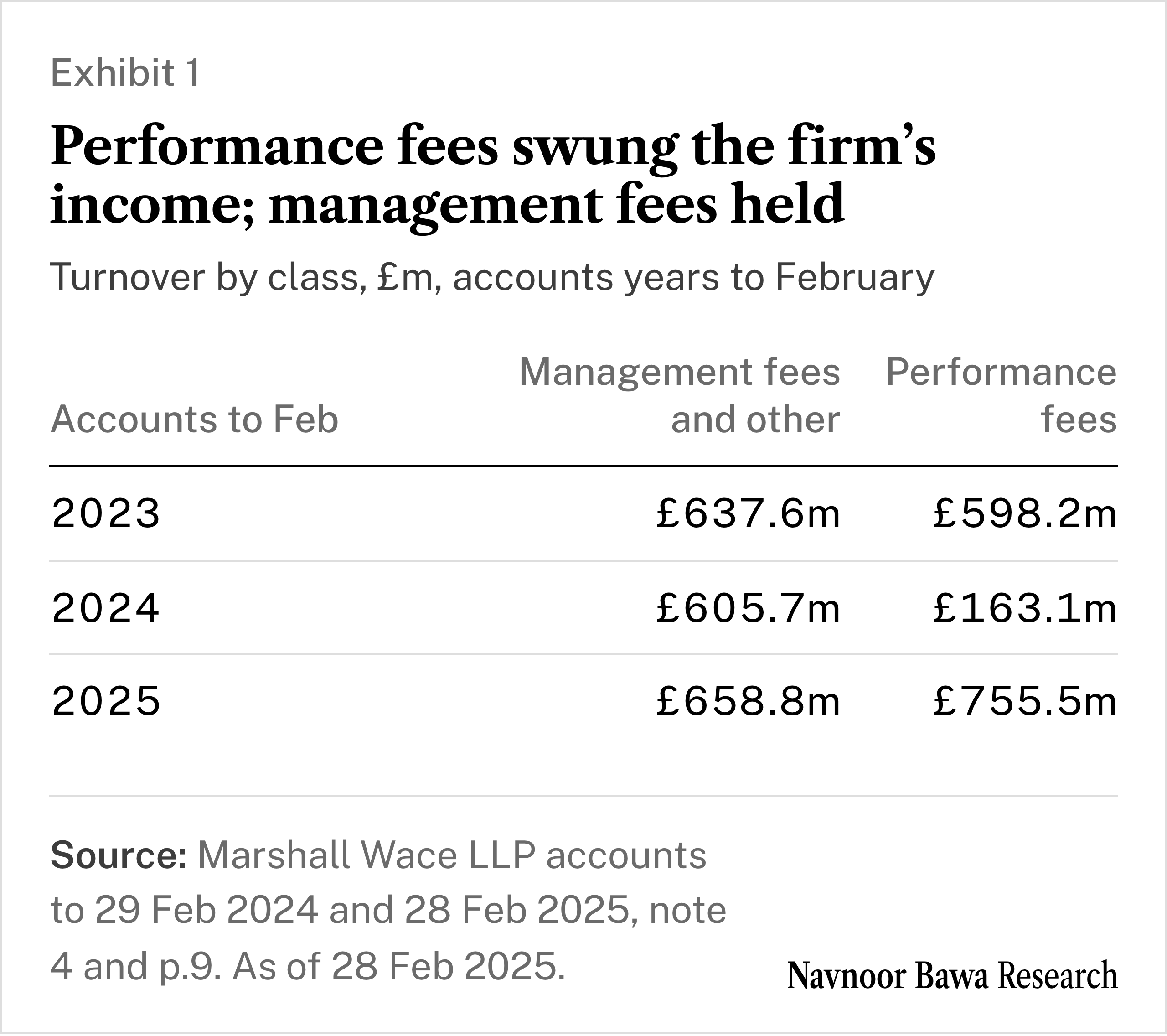
Source: Author’s table from Marshall Wace LLP accounts to 29 Feb 2024 and 28 Feb 2025, note 4 and p.9 · as of 28 Feb 2025. On the 30 September date, each set of accounts books the fee year to the 30 September before it.
In the latest year, £658.8m of management fees and other income plus £755.5m of performance fees make the £1,414.3m of turnover on page 9.
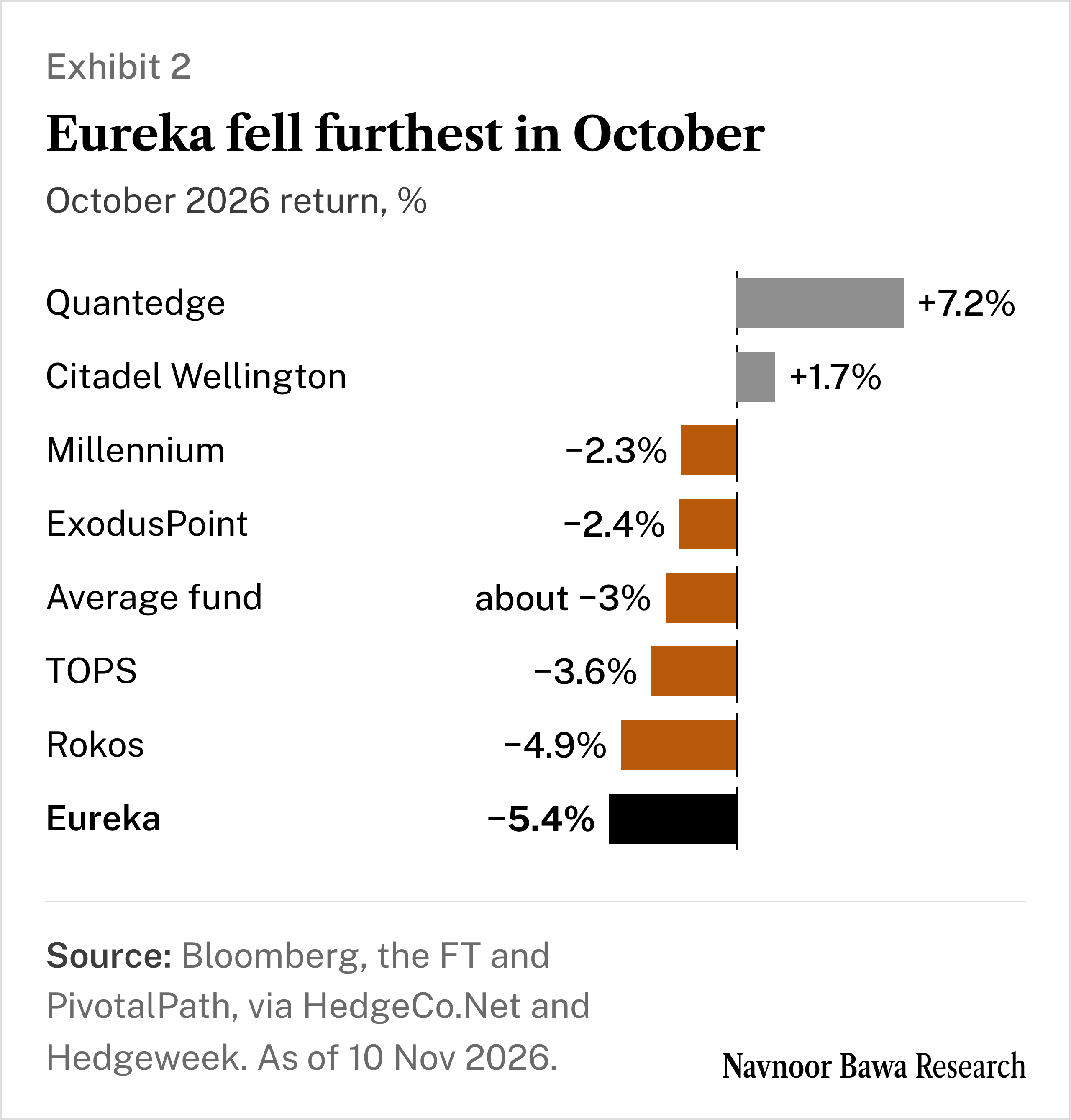
Source: Author’s chart from Bloomberg via HedgeCo.Net (4 Nov 2026), the FT via Hedgeweek (3 Nov 2026) and Hedgeweek (10 Nov 2026) · as of 10 Nov 2026
Eureka lost nearly twice what the average fund lost, while two large firms made money in the same month. It was still up 5.3% for 2026 afterwards, the FT reported. TOPS, Marshall Wace’s systematic strategy, which crowdsources its stock ideas, fell 3.6% and was up 1.3% for the year. Both books are still ahead.
The firm Paul Marshall and Ian Wace founded is not small. Its 13F, filed on 13 November, reports $114.3bn of US-listed holdings at 30 September, and that count leaves out everything it holds outside US markets.
The case for ignoring October is that a 5.4% month is noise at a firm this size. Noise predicts that nothing shows up in any set of accounts. For the fee year just booked that’s right; for the one that follows it’s wrong.
Two documents date the fee to 30 September
The first is the firm’s own. Marshall Wace North America’s SEC brochure (Form ADV Part 2A, 29 May 2026) says in Item 5:
“Performance fees, if applicable to relevant Fund shares, are charged or made as at 30 September in each year. Performance fees are also generally automatically deducted on any withdrawal of capital by, or other distribution of monies to, an investor, generally subject to a loss carry-forward mechanism.”
The funds take their performance fee once a year, on 30 September, and on money that leaves before then, and a loss is carried into the next year. Where the affiliate is itself the manager, the fee “generally does not exceed 20% above a high water mark”, or a higher percentage above an index. The date also sets each investor’s high water mark.
The brochure never names Eureka. A Eureka fund is on the affiliate’s Form ADV, though that fund’s primary adviser is Marshall Wace LLP.
The audited accounts to 30 September 2025 of Lumyna-Marshall Wace UCITS SICAV, a Luxembourg umbrella fund for several TOPS funds, set the same date on their own. A SICAV is an investment company whose capital rises and falls as investors come and go; this one runs under UCITS, the EU’s rules for funds sold to the public, with Marshall Wace LLP as investment manager. Its accounts give a fee “Calculation Period” of twelve months “beginning on October 1 and ending on the following September 30”.
We found no fee document specific to Eureka, so the claim holds for the funds on that date; whether Eureka is one of them is the hinge the last filing below tests.
The brochure’s next item says what a client below its high water mark pays:
“one or more clients will be effectively assessed only on a fixed management fee (until the client’s net asset value satisfies any “catch up” or similar requirement).”
In the catch up, the client’s value climbs back above its previous peak, and only then does the performance fee start again. That is the firm’s own description of money in the hole: the management fee runs and the performance fee waits.
The fee year that closed on 30 September, the twelve months each fee is measured over, was a good one. Eureka was up 8.04% at the end of September 2025, Reuters reported, and 11.6% for 2025 by 30 December, Fortune reported. So the last quarter of 2025 added about 3.3%. Its 5.3% for 2026 after a 5.4% October means it stood about 11.3% up at the end of September. Chained, the fee year comes to about 15%.
A second Reuters figure, implying 7.87% at the end of September 2025, gives the same answer. October sits outside that year.
The press read October in calendar terms: the loss was “reducing its year-to-date gain to 5.3%” in Hedgeweek’s relay of the FT and “cutting its year-to-date gain to 5.3%” in HedgeCo’s of Bloomberg. That number is correct and conventional. The reading it invites, that this year’s fees shrank, isn’t supported. If the calendar were the fee clock, the brochure would date the fee to 31 December; it dates it to 30 September, and the funds charged on a year about 15% up. The fees were taken before the loss arrived.
Each investor’s account carries its own high water mark, and withdrawals are charged as they happen, but across that umbrella’s TOPS funds 98% of the performance fees for the year to September 2025 were still payable on 30 September. So October belongs to the fee year that ends on 30 September 2027.
The firm’s own books follow the same clock. Marshall Wace LLP’s accounting policy says performance fees “are recognised at the point of crystallisation when the relevant performance obligation is satisfied”, which is when the fee is charged and locked in. A fee charged on 30 September is booked in the accounts year that holds that date, the year to the following February.
Performance fees are the swing
Management fees and other income stayed between £606m and £659m across the three filed years in Exhibit 1. Performance fees went from 48% of turnover to 21%, then to 53%. One column barely moves; the other decides the year.
The same accounts say where the fees come from and where part of them goes. Of the latest year’s £1,414.3m of turnover, £1,001.9m, 71%, came from Ireland. That is the home of Marshall Wace Funds plc, the Dublin company whose notice to MW Eureka Fund shareholders names Marshall Wace LLP as the fund’s investment manager, so Eureka’s fees reach this line.
Of that turnover, £633.2m, 45%, goes out again as “fee rebates and other fees payable”. The accounts’ note says what that holds: “a proportion of management/performance fees are rebated” to certain investors, and the firm “has sub-advisory agreements with other group companies”. A pound of performance fee is not a pound of the partners’ pot.
The partners felt the swing directly. The largest member’s share of the pot went from £266.2m to £74.0m in the weak year, then back to £259.8m, 40% of the latest pot. The members’ report names the cause in the firm’s own words:
“The principal risks and uncertainties affecting MW LLP relate to the performance of the underlying funds it manages and the impact that poor performance may have on the ability to attract and retain investors.”
The firm acts on that risk. Last November Bloomberg reported it would hand $3.1bn back to investors, and Hedgeweek placed it among managers “choosing to curb asset growth to protect performance”.
Others have printed parts of this. Hedgeweek, relaying the Telegraph, tied the fee line’s plunge to the funds’ weak returns, and eFinancialCareers reported the pot. Neither tied the fees to the 30 September date.
The related party notes hold one more line. Inside the firm’s turnover sits income from Marshall Wace (GP1) Limited, a sister company under the same ultimate owner, for “sub-advisory and support services”. It read £226.0m in the year to February 2022 and £137.8m a year later. Then it fell to £24.2m in the weak year and came back to £136.2m in the strong one, moving with the fee line each time.
What surprised me is the size of that swing: in the year to February 2025, the money that moved with returns was nearer £892m than the £755.5m the fee line shows. The accounts don’t say which of the two turnover classes holds the GP1 income, so I do not call it a performance fee. If it already sits inside the fee line, adding it counts it twice.
A point of Eureka, in pounds
Divide the fee line by Eureka’s return and you get what one point of Eureka is worth to the firm. Each set of accounts, made up to February, books the fee year that ended the September before, so the return to divide by is that fee year’s. The two share nine months, so a calendar return stands in for it.
Of the three filed years with a reported Eureka return, the years to February 2022, 2024 and 2025, the two latest give different prices, so the price carries a range. The earlier one, held out as a test, missed, in the direction that puts the true cost higher.
The LLP’s line holds every fund, TOPS and Alpha Plus (the third family of funds on its Form ADVs) included, so the price is the whole firm’s fee line per point of its flagship. It wanders from year to year: the strong year paid half as much again per point as the weak one. The pounds are below the wall.
→ Marshall Wace’s 2025 puts on a chip stock ETF, rebuilt from its 13F filings, Trade File No. 16 on Patreon.
How much of the next fee year did one bad month take, and which filing will show it?
Below the paid line:
What October cost: four paths for Eureka’s year and four readings of the price
What this changes: a test in four steps for any manager with an annual fee date
What to watch: three dated checks and what each result would mean