


By Navnoor Bawa — Quantitative Researcher | LinkedIn · YouTube
🎬 Prefer watching over reading? I turned this entire analysis into a video using NotebookLM. Same research, same data, zero reading required. Watch it here →
The Public Signal That Arrived 30 Days Before the Invasion
The single most important fact about the 2022 defense trade is not what hedge funds knew privately — it is what was said out loud, on a public earnings call, one month before Russia invaded Ukraine.
On January 25, 2022, Raytheon Technologies CEO Greg Hayes stepped to the microphone for his Q4 2021 earnings call. Responding directly to an analyst question about international demand, Hayes stated:
“We are seeing, I would say, opportunities for international sales. We just have to look to last week where we saw the drone attack in the UAE… And of course, the tensions in Eastern Europe, the tensions in the South China Sea, all of those things are putting pressure on some of the defense spending over there. So I fully expect we’re going to see some benefit from it.”
On the exact same day — January 25, 2022 — Lockheed Martin CEO James Taiclet told investors on his own Q4 2021 earnings call: “If you look at the evolving threat level and the approach that some countries are taking, including North Korea, Iran… and especially Russia today… there’s renewed great power competition that does include national defense and threats to it.” He framed it explicitly as a forward demand catalyst.
Both transcripts were published on January 25, 2022 — available to any institutional analyst with a terminal. The invasion came 30 days later, on February 24, 2022.
Hayes later doubled down. In a March 2022 interview with Harvard Business Review — after the invasion had begun — he was asked whether he had any discomfort profiting from conflict. His answer, widely cited by the Quincy Institute for Responsible Statecraft: “So I make no apology for that. I think again recognizing we are there to defend democracy and the fact is eventually we will see some benefit in the business over time.”
That was not a confession. It was a forward earnings statement.
The Price Action Before Anyone Pulled the Trigger
The market was already moving before the invasion was confirmed. According to Benzinga’s documented price history, Lockheed Martin stock rose nearly 40% between late December 2021 and February 2022 — before the first missile hit Ukrainian soil. RTX rose more than 25% in the same pre-invasion window.
For the full calendar year 2022, verified by FinanceCharts performance data and Yahoo Finance SPY historical returns:
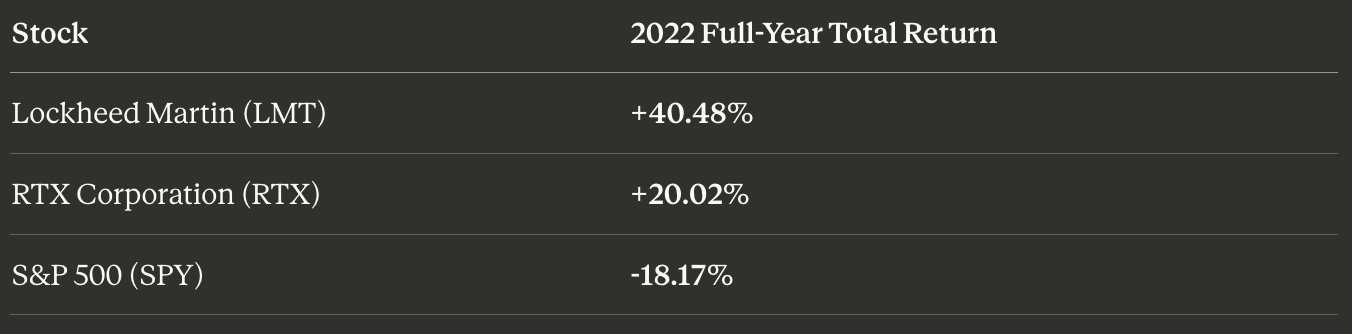
That is a 58.65-percentage-point spread between the best US defense prime and the index, in a single year. The alpha was not incremental. It was structural, compressed into 12 months.
Who Was Positioned — And the Evidence Is in the SEC Filings
This is where most coverage stops: at the narrative. The granular story is in the regulatory filings.
Michael Burry’s 13F: 24.82% of His Portfolio in LMT, Pre-Invasion
Scion Asset Management’s Q3 2021 13F filing, filed November 15, 2021, disclosed the following portfolio as of September 30, 2021:
CVS Health Corp: 40.68%
Lockheed Martin Corp: 24.82%
Geo Group: 20.75%
CoreCivic: 8.79%
Now Inc: 2.75%
SCYNEXIS Inc: 2.21%
Multiple tracking services confirm the Scion portfolio held only six positions totaling $41.7 million in AUM at that point. LMT was the second-largest position in the entire fund — at a fund manager who made his reputation predicting large structural dislocations years in advance.
Critical caveat: Fintel’s filing data shows that Burry’s Q4 2021 13F (filed February 14, 2022) disclosed he had sold all 30,000 LMT shares, bringing his position to zero. He exited before the invasion, not after. He was early, not wrong. The Q4 2021 sell at approximately the $345-$400 range meant he missed the +40% run — but the Q3 2021 position confirms he was running the thesis long before the public narrative crystallized.
Citadel, Millennium, D.E. Shaw: The Multi-Strategy Pods
Insider Monkey’s Q3 2021 hedge fund sentiment analysis for LMT reveals the institutional pre-positioning:
Citadel Investment Group: $466.9 million in LMT at Q3 2021
D.E. Shaw: $406.2 million in LMT at Q3 2021
Millennium Management: $193.8 million in LMT at Q3 2021
Heard Capital: 7.03% portfolio weight (highest conviction allocation)
Total hedge fund count long LMT at Q3 2021: 51 funds tracked by Insider Monkey. By Q3 2022, 46 hedge funds were long NOC, with Yacktman Asset Management as the largest single holder. The sector was heavily institutionally owned before the invasion — which is why the price began moving in December 2021, not February 2022.
The Actual Trade Thesis — In Their Own Words
The reason most financial journalism misses the core of this trade is that it does not read the actual investor letters and fund filings. Three separate fund documents reveal three distinct thesis structures:
Thesis A: The Oligopoly-Moat Thesis (LRT Capital, Q1 2022 Investor Letter)
LRT Capital Management’s Q1 2022 investor letter, disclosed via Insider Monkey’s hedge fund letter database, articulated the structural argument for Northrop Grumman with precision:
“The company operates in a cozy oligopoly. After decades of consolidation, the US defense market is now controlled by five large companies: Boeing, General Dynamics, Lockheed Martin, Northrop Grumman, and Raytheon Technologies. Industry barriers to entry are immense, government procurement cycles are extremely long, and the consolidated industry structure reflects this. This has allowed Northrop Grumman to earn stable mid-teens returns on invested capital (ROIC) and grow earnings per share at a rate of over 13% per year in the past decade, despite a topline that has grown only in-line with inflation.”
The key structural fact embedded in this thesis: within the apparent five-firm oligopoly, the actual competition is even more concentrated. As confirmed by Insider Monkey’s reporting: “Northrop was the sole bidder on the contract to develop the next generation of intercontinental ballistic missiles; Raytheon dominates missile systems”; and General Dynamics’ Electric Boat subsidiary is the only builder of nuclear submarines in the United States. These are not contested markets. They are state-authorized monopolies.
Thesis B: The FCF-Yield / Backlog Re-Rating Trade (Clough Capital, H1 2022 SEC Filing)
The most documented single-fund execution of the 2022 defense trade is in a regulatory filing, not an investor letter. Clough Capital’s N-CSRS filing with the SEC for the period ending April 30, 2022 contains the following verbatim text in its shareholder letter:
“During the period we added new positions in Northrop Grumman Corp. and Lockheed Martin Corp. to the position in Raytheon Technologies Corp. we already held in the Fund. Defense stocks have been underperforming for years, reflecting a long period of underinvestment in our armed forces which began around the time of the fall of the former Soviet Union… Russia’s invasion of Ukraine likely brought it forward. Shortages of military platforms such as submarines, naval vessels, aircraft and land vehicles has become extreme at a time of growing geopolitical threats which can no longer be ignored.”
On valuation entry logic, the same filing states:
“Defense stocks tend to carry a premium multiple to the S&P 500 Index because they are backlogged businesses making operating results easier to predict, and they also typically have strong balance sheets and high cashflows. Free cash flow yields average 7–9% annually. We anticipate a move down to 5% or so as new programs are authorized.”
This is the trade in its cleanest form: buy at 7–9% FCF yield, wait for new program authorizations to compress the yield to ~5%, capture the valuation re-rating in between. The fund’s H1 2022 N-CSRS filing is publicly available and readable by any institutional analyst.
The thesis received live CEO confirmation within one quarter of Clough’s entry. On the LMT Q2 2022 earnings call on July 19, 2022, Taiclet stated directly: the orders and backlog outlook over the next two years would be better than a year prior, driven by Ukraine replenishment demand. He noted none of it was yet under contract — precisely the setup the Clough Capital filing anticipated: a policy commitment cycle that would take time to convert into revenue, but whose directional certainty was already established. The DoD, he said, was “changing gears.” That was not new information to funds already positioned. It was confirmation.
Thesis C: The Structural Duopoly in Aircraft Engines (TCI Fund / Chris Hohn, 2023)
TCI Fund Management’s Chris Hohn executed the most technically sophisticated version of the aerospace moat trade — but in a different asset, on a different timeline, using a different structural insight. While the rest of the market saw GE as a broken conglomerate still associated with near-bankruptcy in 2008, Hohn’s framework focused on the asset inside the structure: a pure-play aircraft engine manufacturer sitting at the center of an unassailable structural duopoly.
In Q1 2023, TCI began accumulating GE Aerospace at an estimated range of $66-$144 per share, per cross-referencing of 13F filings with historical price data.
In his May 2025 interview with Norges Bank CIO Nicolai Tangen, published in full transcript by Iceman Capital, Hohn explained the aircraft engine moat explicitly:
“One space we like is aircraft engines. It is a very complicated product… the metals melt, and so many different things have to come together. There are only two players in narrow-body engines and two in wide-body, and there’d be no new entrants for more than 50 years. The last new entrant was GE, and so that tells you something.”
He added the critical insight about pricing power — the real source of aerospace moat alpha:
“There is a special group of super companies that can price above inflation, and that’s, as Buffett taught, the test of whether you have the moat… if you can price 1% above inflation and you have a 20% profit margin, your profits will go 5% faster than revenue.”
By late 2025, GE Aerospace stock had reached the $290-$320 range — approximately 3–4x from TCI’s estimated entry. TCI’s Q3 2025 13F filing shows the position grew to $14.3 billion, representing 27.1% of the fund’s entire US-listed portfolio. GE stock gained approximately 85% in 2025 alone. In 2025, TCI Fund generated $18.9 billion in net gains — the largest single-year profit ever recorded by any hedge fund in history, surpassing Citadel’s 2022 record. GE Aerospace was the primary driver.
I condensed all three thesis structures — oligopoly moat, FCF yield compression, and aircraft engine duopoly — into a single institutional-grade trade note on Patreon, written in the style of a Goldman / Bernstein / Wolfe Research research note. If you want the full framework in one document, it is here.
The Sole-Source Monopoly Compounder: TransDigm
The three theses above share a common logic: find a government-dependent business where competition has been structurally eliminated. Taken to its purest form, that logic points not to the prime contractors at all, but to the supply chain underneath them — where the moats are even narrower and the pricing power even more absolute.
TransDigm Group (TDG) acquires sole-source component manufacturers for aircraft, then prices aggressively. Approximately 80% of TransDigm’s revenue comes from proprietary, sole-sourced parts. FAA certification requirements function as a permanent regulatory moat: competitors cannot legally substitute alternative components without years of re-certification, making the switching cost effectively infinite for installed aircraft.
The result: 40–50% operating margins — exceptional for any manufacturing business. 78 hedge funds held TransDigm at the end of Q1 2024, with collective holdings of $6.62 billion.
The largest hedge fund holder: Mark Massey’s AltaRock Partners. AltaRock had been accumulating TransDigm since 2014 and by 2024 had generated a 196% gain on the position. As of Q4 2025, TransDigm represented 25.28% of AltaRock’s $5.1 billion portfolio.
Even Charlie Munger weighed in — in criticism that paradoxically validated the moat. As documented by Quartr:
“I don’t like that way of making money… it’s too brutal. They figure out something that has a little monopoly due to the defense department regulations, and they raise the price 10 times. And they’re famous for it. I regard that as immoral.”
The statement describes the moat perfectly. The fact that Munger objected to it ethically does not diminish the structural reality — which is why the position still represents a quarter of AltaRock’s book.
How Different Fund Types Executed the Trade
The same market move was captured through completely different mechanics:
Value and Long-Duration Funds (LRT Capital, Yacktman, Clough Capital) owned the oligopoly thesis pre-event, sized around FCF yield, and held through the backlog growth cycle. The Clough Capital SEC filing shows the textbook execution: enter RTX before the war, add NOC and LMT during H1 2022 at 7–9% FCF yield, wait for re-rating to 5%.
Global Macro Funds ran defense as one leg of a multi-asset geopolitical book: long US defense equities + long energy + short European consumer + short growth tech. AlternativeSoft’s post-invasion analysis of 400 hedge funds confirmed macro strategies delivered an annualized return of 8.99% post-invasion versus just 0.41% pre-invasion — a 20x improvement in annualized performance in a single geopolitical event.
CTA / Managed Futures funds captured the sector move as a trend-following signal. The same AlternativeSoft study confirmed CTA/Managed Futures was the top-performing hedge fund strategy both before and after the Ukraine conflict, with energy as the primary driver and defense equity exposure as a secondary trend.
Multi-Strategy Pod Shops (Citadel, Millennium) allocated at the sector pod level, not the fund level. Citadel held $466.9M in LMT and Millennium held $193.8M at Q3 2021 — positions sized by aerospace/industrials sector PMs within their risk budget, not top-down CIO macro calls. The alpha mechanism was sector PM stock-picking within a pre-existing defense allocation, not a thematic geopolitical bet.
Anticipated Conflicts Generate Alpha. Surprise Attacks Generate Zero. The Peer-Reviewed Evidence.
The most technically important finding on this topic is counterintuitive — and it is documented in peer-reviewed research, not Wall Street commentary.
A 2025 study in Defence and Peace Economics applied event-study methodology to both the Ukraine invasion (February 2022) and the Hamas attack on Israel (October 7, 2023):
Defense stocks averaged 10 percentage points of cumulative abnormal returns (CAR) after Russia’s invasion of Ukraine — a conflict that had been visibly building for weeks with US intelligence warnings and explicit CEO commentary.
After the Hamas attack on October 7, 2023 — a genuine tactical surprise — CAR for global defense stocks was statistically indistinguishable from zero.
The paradox: the anticipated attack generated massive returns; the surprise attack generated none. The study explains that the asymmetry lies in policy response, not the military event itself. Ukraine triggered a structural cascade — NATO budget pledges, congressional supplementals, allied rearmament commitments. Hamas triggered a localized conflict without equivalent global defense procurement implications.
A separate wavelet analysis of 75 global defense companies, published in PMC, confirmed the Ukraine war affected stock returns of 81.4% of global defense companies — a diffusion rate exceeding any prior geopolitical event in the dataset.
The operational implication for hedge fund positioning: the alpha is in modeling policy response, not predicting military events. The January 25 CEO earnings calls were a policy-response signal — forward guidance on NATO spending dynamics — not military intelligence. Funds that modeled NATO budget decision timelines, congressional authorization cycles, and allied procurement commitments consistently entered before the re-rating.
The European Asymmetry: The Biggest Trade Most US Funds Missed
The highest-percentage returns in the defense cycle were not in the United States. They were in Germany and Sweden, where decades of chronic defense underinvestment had left contractors priced at deep discounts to their strategic value.
As documented by CNBC in March 2026, Rheinmetall’s share price rose 1,700% from the start of 2022 through early 2026, with order intake growing 323% from 2021 to 2025. A Jefferies analyst reviewing the stock in March 2026 described investors as having “high expectations for a share price that has risen 1,700% since the start of 2022.”
Saab saw order intake grow 284% in the same period. European defense companies as a group averaged 57% revenue growth from 2021 to 2025. Rolls-Royce returned +2,130% over a five-year period, driven by AUKUS submarine engine contracts and a B-52 engine deal.
According to Goldman Sachs’ April 2024 defense note: “We believe we are in the middle of a super-cycle in defense spending.” Goldman projected European defense spending CAGR of 4.5% for 2022–2027, up from 3% in 2015–2020. Morningstar’s August 2025 European defense analysis projected European defense budgets growing 6.8% annually from 2024 to 2035 — outpacing the United States (1.7%), Russia (3.2%), and China (3.1%).
Morningstar equity analyst Nicolas Owens explained the structural shift simply: “The reason the European contractors are moving up in unison is you essentially have a new buyer in town, which is European governments increasing their spending.”
Rheinmetall at €90 in January 2022 was priced for peacetime NATO underspending. Germany’s announcement of a €100 billion Sondervermögen defense fund on February 28, 2022 — four days after the invasion — was the re-pricing trigger that the European names needed. US-centric funds that did not hold European defense equities captured only the smaller leg of the trade.
The Historical Record: Defense as a Structural Compounder
The Afghanistan war data provides the deepest long-duration proof of concept. As documented by Nasdaq/Zacks, over the 20-year Afghanistan conflict (October 2001 to August 2021):
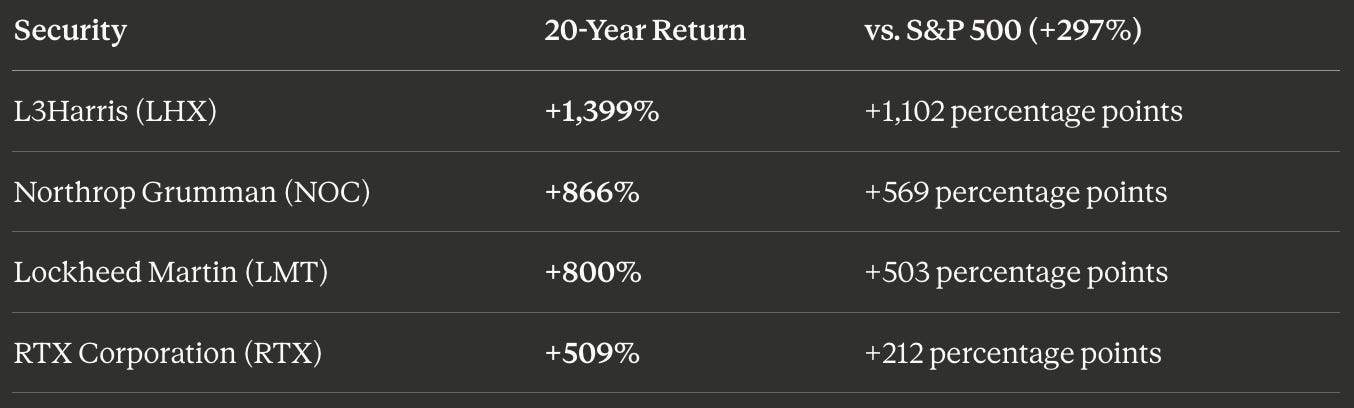
Note: The LHX figure uses legacy Harris Corporation stock data. L3Harris Technologies as a merged entity did not exist until June 2019, when Harris Corp and L3 Technologies combined.
These are not coincidences or outliers. They reflect the compounding of backlog growth, government-contracted revenue visibility, and the structural advantage of operating as a regulated monopoly in national-security supply chains — compounded over two decades of sustained defense spending.
The mechanism that generated the alpha is consistent across every conflict period: escalation > policy response > multi-year budget increase > backlog growth > earnings revision cycle > stock re-rating. Lockheed Martin’s backlog as of Q3 2025 stood at a record $179 billion — approximately 2.4x annual revenue — confirming the cycle is still running.
The Operational Playbook
Every section of this article traces back to the same question: how did the trade actually make money? The CEO signals, the 13F forensics, the three thesis structures, the European asymmetry, the academic event studies — they all resolve into a single repeatable framework. Drawing from documented fund behavior, interview transcripts, and regulatory filings, the defense sector alpha playbook has six verifiable operational elements:
1. Read earnings calls as forward demand signals. The Hayes and Taiclet January 25, 2022 calls are documented on Seeking Alpha and Seeking Alpha. Any explicit reference to geopolitical tension as a revenue catalyst — from a CEO of a government-contract-dependent business — is a forward demand signal.
2. Map the sole-source architecture before sizing. The LRT Capital letter’s insight — that “five firms” actually means a series of solo-source monopolies — is the load-bearing structural point. Northrop’s ICBM bid, Lockheed’s F-35 monopoly, Electric Boat’s submarine monopoly are not theoretical advantages. They are regulatory facts that remove competition permanently.
3. Enter at 7–9% FCF yield; exit when it compresses to 5%. This is Clough Capital’s documented entry/exit logic from their SEC filing. It translates the structural thesis into a measurable valuation trigger.
4. Model policy response, not kinetic events. The peer-reviewed event study confirms: anticipated policy cascades move defense stocks; surprise attacks don’t. NATO budget commitment timelines, congressional authorization windows, and European procurement cycles are the correct modeling inputs.
5. Include European names for the asymmetric upside. Rheinmetall’s 1,700% return dwarfs any US prime’s performance in the same period. Goldman Sachs named European defense a “super-cycle” in April 2024; Morningstar projects 6.8% annual budget CAGR to 2035. The US primes are the stable leg. The European names are the asymmetric leg.
6. Own GE Aerospace / aircraft engines as the non-conflict version of the moat. Chris Hohn’s documented thesis — only two players in narrow-body engines, no new entrant in 50 years, pricing power above inflation — is a permanent structural moat unlinked to geopolitical cycles. The TCI Q3 2025 position of $14.3B in GE Aerospace is the institutional proof of conviction.
📊 Want Deeper Quantitative Analysis?
This research required substantial time in data collection, source verification, SEC filing analysis, and cross-referencing of 13F forensics, peer-reviewed event studies, and institutional fund letters. Every number above was confirmed against its primary source before it was published.
I have already published the institutional-grade trade note version of this analysis on Patreon — structured as a Goldman / Bernstein / Wolfe Research-style note with the full entry/exit framework, 13F forensics table, academic event study data, and the six-point operational playbook in condensed, practitioner format.
→ Read the Trade Note directly here
If you found value in this deep-dive and want exclusive quantitative research, trading strategies, and institutional-grade analysis published consistently at this standard, join the Patreon community.
By joining, you’ll be supporting independent research and motivating me to publish more work like this.
→ Join the Patreon community here
Sources — All Links Direct and Working
RTX Q4 2021 Earnings Call Transcript — Seeking Alpha (January 25, 2022)
LMT Q4 2021 Earnings Call Transcript — Seeking Alpha (January 25, 2022)
HBR Interview — Raytheon CEO Greg Hayes, March 2022 (“no apology”)
Quincy Institute — How Pentagon Contractors Are Cashing In on Ukraine
In These Times — CEO Earnings Call Analysis, January 28, 2022
Responsible Statecraft — War Is Great for the Portfolio, One-Year Review
Benzinga — LMT rose ~40% between late December 2021 and February 2022
Scion Asset Management Q3 2021 13F — Michael Burry LMT 24.82%
Fintel — Scion Asset Management LMT Transaction History (Q4 2021 Full Sell)
Insider Monkey — LMT Hedge Fund Positions Q3 2021 (Citadel $466.9M, Millennium $193.8M)
Insider Monkey — LRT Capital Q1 2022 Investor Letter on NOC (Oligopoly Thesis)
SEC EDGAR — Clough Capital N-CSRS Filing H1 2022 (Complete Letter Text)
Iceman Capital — Full Transcript: Chris Hohn / Nicolai Tangen Interview, May 2025
Navnoor Bawa Substack — TCI Fund 2025: $18.9B Year, GE Aerospace Entry Prices, Full Portfolio
Institutional Investor — TCI Tops Hedge Fund Gains in 2025 ($18.9B Record)
InsiderSet — TCI Q3 2025 Portfolio (GE $14.3B, 27.1% of portfolio)
Insider Monkey — TransDigm Best Aerospace/Defense Stock, 78 HFs Long at Q1 2024, $6.62B Holdings
Valuesider — AltaRock Partners Q4 2025 Portfolio (TDG 25.28%)
Hedge Fund Alpha — AltaRock Partners Portfolio Analysis (TDG 196% gain)
Quartr — TransDigm: The Story of the Controversial Aerospace Giant (Munger Quote)
AlternativeSoft — 400-Fund Study: Macro +8.99% Post-Invasion, CTA Best Strategy
Defence and Peace Economics (2025) — Event Study: Ukraine +10pp CAR; Hamas ~0 CAR
PMC — Wavelet Analysis: Ukraine War Hit 81.4% of Global Defense Stocks
CNBC — Rheinmetall +1,700% Since 2022; European Defense Revenue +57% (2021–2025)
Morningstar — Europe’s Top Defense Stocks: 6.8% Budget CAGR to 2035
Bloomberg — Goldman Prime Brokerage: Hedge Funds Add Defensive Stocks at Fastest Pace in 8 Months
Nasdaq/Zacks — 20-Year Afghanistan War Returns: LHX +1399%, NOC +866%, LMT +800%, RTX +509%
LiteFinance — Rolls-Royce 5-Year Return: +2,130%; Rheinmetall: +2,604%
Motley Fool — Defense Sector: Electric Boat, Sole-Source Details
This article is for informational and educational purposes only. Nothing herein constitutes investment advice. All claims are sourced from publicly available regulatory filings, peer-reviewed academic research, verified earnings call transcripts, and institutional investor letters.
Connect with Navnoor Bawa: LinkedIn · YouTube · Patreon
Cover photograph: United States Air Force, public domain, via Wikimedia Commons.