


Ken Griffin’s Citadel will hand back about $3.5bn of this year’s gains, Bloomberg reported on 25 November.
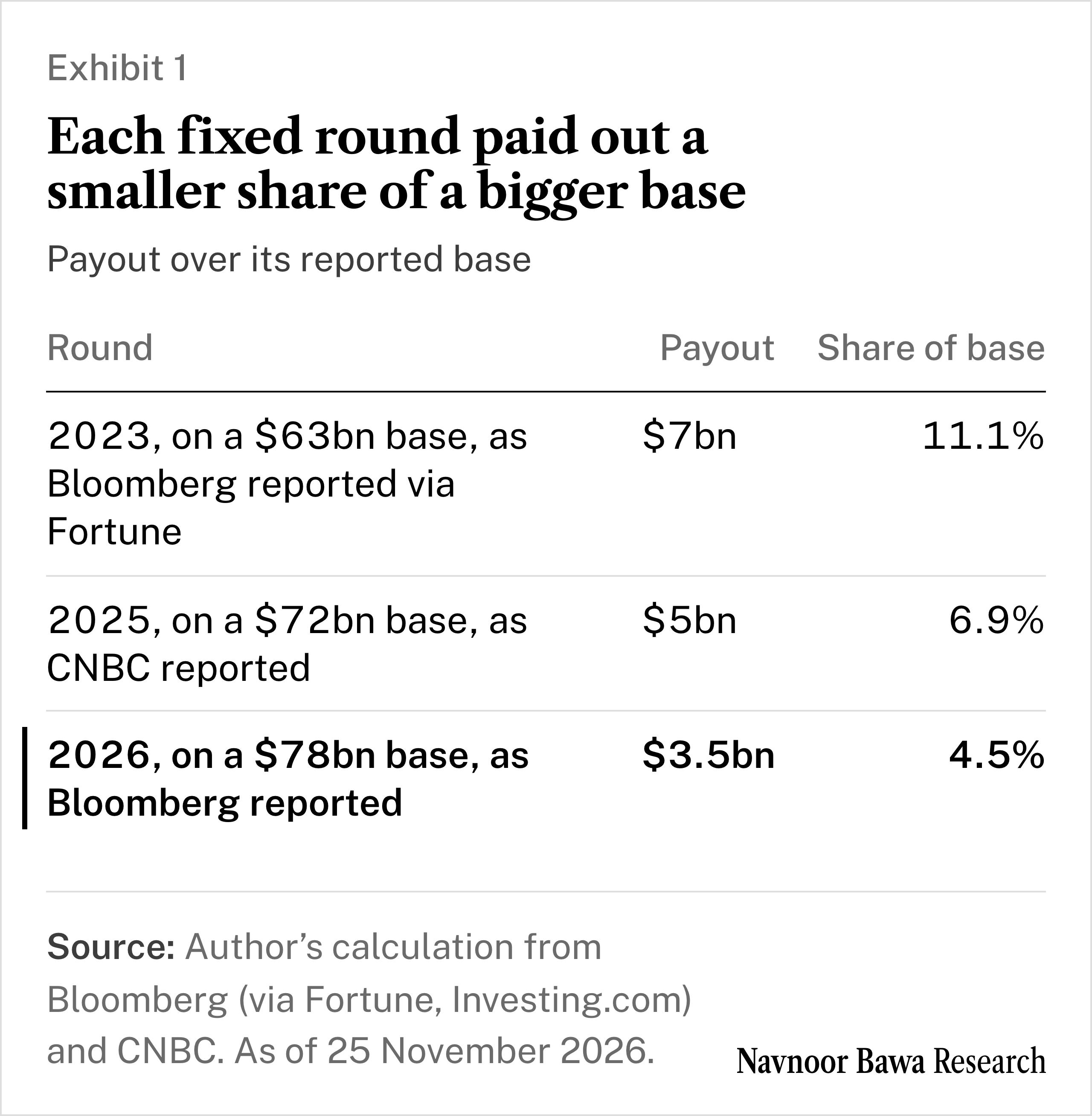
The reports say the payout keeps Citadel’s size in check. By our division, the share of its base the firm pays out fell from 11.1% in 2023 to 4.5% now. The rule moved from required redemptions, through an optional 2024, to about half of net profits, and no report I read prints the profit figure that half is taken from. The payout still serves size, but the size Citadel accepts rises each round.
A client therefore gets back a smaller slice of a larger account each year, and the rest stays at work inside Citadel.
Why does a firm that hands its gains back keep getting bigger?
The paid half settles one question for anyone with money in Citadel’s funds: whether next year’s payout stays under half of the base’s rise. It reaches a verdict and puts our odds on it as a number. The figure that decides it is one ratio, which the paid half builds and no report I read prints.
The giveback became a dial
Take the 2026 round. CNBC reported that the funds would start 2026 at $67bn, the base at the start of the year. Wellington, Citadel’s flagship fund, was up 15.3% through October, and the 1 November base stood at $78bn, as Bloomberg reported via Investing.com. Bloomberg’s headline, read from its URL, puts the payout at about $3.5bn, which is 4.5% of that base. On our arithmetic from the 1 November figure, the funds stand about $7.5bn larger than they began the year, even after the payout.
I rebuilt each payout as a share of the base its own report printed, for those three rounds in Exhibit 1, and none of the reports I read prints that share.
The elective 2024 round is left out, because clients chose the withdrawals and Citadel fixed no amount: about $300m of $66bn, as Bloomberg reported via Hedgeweek.
The rule became a dial, an amount Citadel now sets each round, in four steps:
Before 2024 it was an obligation: Hedgeweek reports that Citadel “historically required investors to redeem profits annually,” a practice meant to manage capital levels.
In 2024 it became a choice: the firm began “allowing clients to choose whether to withdraw profits,” Hedgeweek reports, and most investors kept their capital invested.
In 2025 it became a portion: CNBC wrote that “The profit being returned is not all that was generated in 2025.” It also wrote, in the present tense, that “The firm does not opt for profit distributions every year.”
In 2026 it became a share: Bloomberg’s report, relayed by Investing.com, says investors “can reportedly expect roughly half of their net profits to be returned.”
The WSJ’s 2024 profile, reprinted on Citadel’s site, says that by 2018 Citadel had “more demand from investors than capacity.” So, in the WSJ’s account, it stopped actively raising capital and began returning “excess profits every year.” In the same account, Griffin, after a giveback in early 2020, lamented to employees at Chicago’s JW Marriott that they “couldn’t find enough opportunities to put that money to work.”
The press reads the payout as size control. Bloomberg’s report, as Investing.com relays it, gives the purpose as “to keep its assets under management in check,” and our 14 Aug piece said “The money is generated. It is not retained.”
A size held still would predict a payout every year and a flat base. The year 2025 fits that: the base went from $66bn at the start of 2025 to $67bn at the start of 2026. The year 2026 does not: the round above leaves the funds larger than they began it, so more of the money is retained, and the size Citadel accepts has moved.
The year’s return alone would predict that the share tracks the return. In 2023 Wellington was about 15% through November under the old rule; in 2026 it made about the same through October, yet Exhibit 1’s share fell by more than half. Two years under different rules is thin, but both point away from the return.
The opportunity set would predict that Citadel keeps more when it sees more to do. CNBC said the 2025 payout constrained capital “to better match what the firm sees as the opportunity set going into the new year.”
In 2026, a year in which Risk.net, weighing whether more trades like the one below will follow, writes “opportunities seem likely to arise,” the share of its base paid out fell again. On those two rounds the payout moved as the opportunity reading would predict (the firm’s, via CNBC, in 2025; Risk.net’s in 2026), so this record cannot tell that reading apart from a rising limit on size.
Divided by the printed base, the share falls from 11.1% in 2023 to 6.9% in 2025 and 4.5% in 2026, while the base rises each round. A year’s gain arrives only in part: this year’s round sends out about half of net profit, and the rest stays in a base the reports put higher each round.
What surprised me is that 2026 returned about what 2023 did by about the same month, yet pays out half as many dollars, from a base about a quarter larger.
The balance sheet sets the room
KBRA, the rating agency that rates Citadel’s funds, describes “generally more than 30% of investment capital held in cash and cash equivalents.” It adds that “the fund averaged more than 40% during 2025.” Risk.net reports a liquidity buffer of 35% to 40%, which may measure something else. At either rate, the more each payout leaves inside, the larger the reserve Citadel can deploy.
The 13F, the quarterly SEC list of US-listed long positions and options, shows the positions. Citadel Advisors’ own lines other than options for the 30 September quarter, without the lines of the other manager included in the filing, come to $132.2bn, about 1.7 times the 1 November base, though that is a gross figure. The Form ADV, the registration filing an adviser keeps current with the SEC, gives $570.6bn of regulatory assets as last updated, 7.3 times that base, but it is gross, counting borrowed money and positions, the wrong base for a payout.
The room was used. On the night of 29 July, Citadel bought the bulk of the public equities book of Situational Awareness, a hedge fund, at a discount of more than 10%, Risk.net reports. In three weeks it completed close to a hundred block trades worth more than $4bn, cutting the book’s risk by about 80%, and by the end of September it had closed out the rest.
Griffin told Risk.net that a firm that runs its balance sheet this way “can do a Sowood or Situational Awareness or Amaranth trade.” Sowood and Amaranth are funds whose books Citadel bought before: Sowood’s nearly 20 years ago and Amaranth’s natural gas book in 2006, per Risk.net. The same profile adds that “Griffin is clear that the firm is not constructed with such an objective in mind.” Gerald Beeson, Citadel’s chief operating officer, describes the firm as “a crisis capital provider over time,” Risk.net reports.
Nothing here says those trades caused the payout. The trade shows the balance sheet in use, and it was struck on the night of 29 July, before this year’s payout was reported. S&P upgraded the main funds in October and still said the deal had “temporarily spiked” risk metrics such as VAR, value at risk, to net asset value, Risk.net reports.
What the record shows is the room the balance sheet gives Citadel to take on another fund’s book when that fund must sell.
Clients who stay could explain the larger base
What a payout leaves inside is slow to come out. KBRA says “Approximately 70% of the investor base has the contractual right to redeem and extract a 1/16th of capital,” so about 70% of holders can take out a sixteenth at a time, which slows how fast most capital can leave. It also counts “Citadel principals and employees representing 18% of the capital base for the Rated Funds,” the funds it rates. No source says whether that money sits inside the payout, and I do not assume it does.
The rising base could instead be clients choosing to stay, as most did in the elective 2024 round. No 2026 report I read says whether clients may decline the payout, so that choice may still play a part.
Among peers, D.E. Shaw paused its payouts in January 2026, as Bloomberg reported via Hedgeweek, after Composite and Oculus, its two main funds, made an estimated 18.5% and about 28.2% in 2025. Hedgeweek wrote that the pause “may reflect abundant market opportunities and client demand to remain fully invested.” In September 2024, Bloomberg reported via Hedgeweek, Point72 was preparing to return capital for the first time, when Citadel had returned $25bn since 2017.
For this year, I am wrong if the final 2026 payout, as reported by 15 January 2027, a date I set, is $5.42bn or more: 2025’s share, CNBC’s $5bn over its $72bn, applied to the $78bn 1 November base. It needs about $1.9bn more paid out than reported, or about $3.8bn more net profit at about half.
Bloomberg’s report, as Seeking Alpha relayed it, said Citadel “could give back more,” so the line can fire. If no new figure is reported by that date, the $3.5bn stands and the line has not fired. The bet on 2027 breaks on its own date: a 2027 payout of half or more of that year’s rise in the base, at 31 December 2027.
Which way 2027 lands changes what a Wellington client does now. If the payout keeps taking back less than half of the base’s rise, the stake grows unless the client redeems, and KBRA says most holders can take out only a sixteenth at a time. If it again takes back most of the rise, as in 2025, Citadel does the trimming.
The paid half models both paths. In its table, every case short of a flat 2027 leaves Citadel’s funds larger a year on, even a repeat of 2025, which carries the model’s heaviest single weight.
Will next year’s payout trim a Wellington client’s stake, or is keeping it near its size now the client’s job?
Below the paid line:
The verdict and our odds: why “half” and the base’s rise do not square, and the odds on 2027’s payout.
The model: three outcomes for 2027 with their weights, a base case and a sensitivity table.
The book of record: the three feeder funds summed to the dollar from Citadel’s Form ADV, and their owner mix.
What to watch: three dated checks, from 15 January 2027 (our date).