


Bridgewater Associates sold more than half its AI shares in the second quarter, its 14 August filing shows. Its chip, cloud and power stocks fell from 34.0% of its reported stock book in March to 20.8% in June, the deepest cut among the large funds I checked. It looks like a vote against AI, cast in the quarter its own research said compute would need rationing. Its own filings say otherwise: they show its AI holdings moving inside a band, and a cut like this one before, followed by buying. If you sold chips on this filing, you sold beside a fund that has bought back before.
The reading that followed the filing was simpler: Bridgewater dumped its AI stocks, so the world’s biggest macro fund has turned on the AI trade. Coverage of the June filing read it as a cut to big tech and chips. The cut is real. The turn is missing from the record.
A fifth, stretched to a third
Bridgewater’s 13F lists the US listed stocks and listed options it held long at a quarter end, filed up to 45 days later. It shows no shorts, futures or currencies, and nothing of when in the quarter the firm traded.
That list is one sleeve of a larger firm. Bridgewater’s Form ADV, signed on 18 August, reports $150.16bn of regulatory assets, a gross measure that counts borrowed money. The $24.38bn stock book in its June 13F is about a sixth of that. The second quarter’s AI sale, $7.09bn net, came to more than a quarter of that stock book.
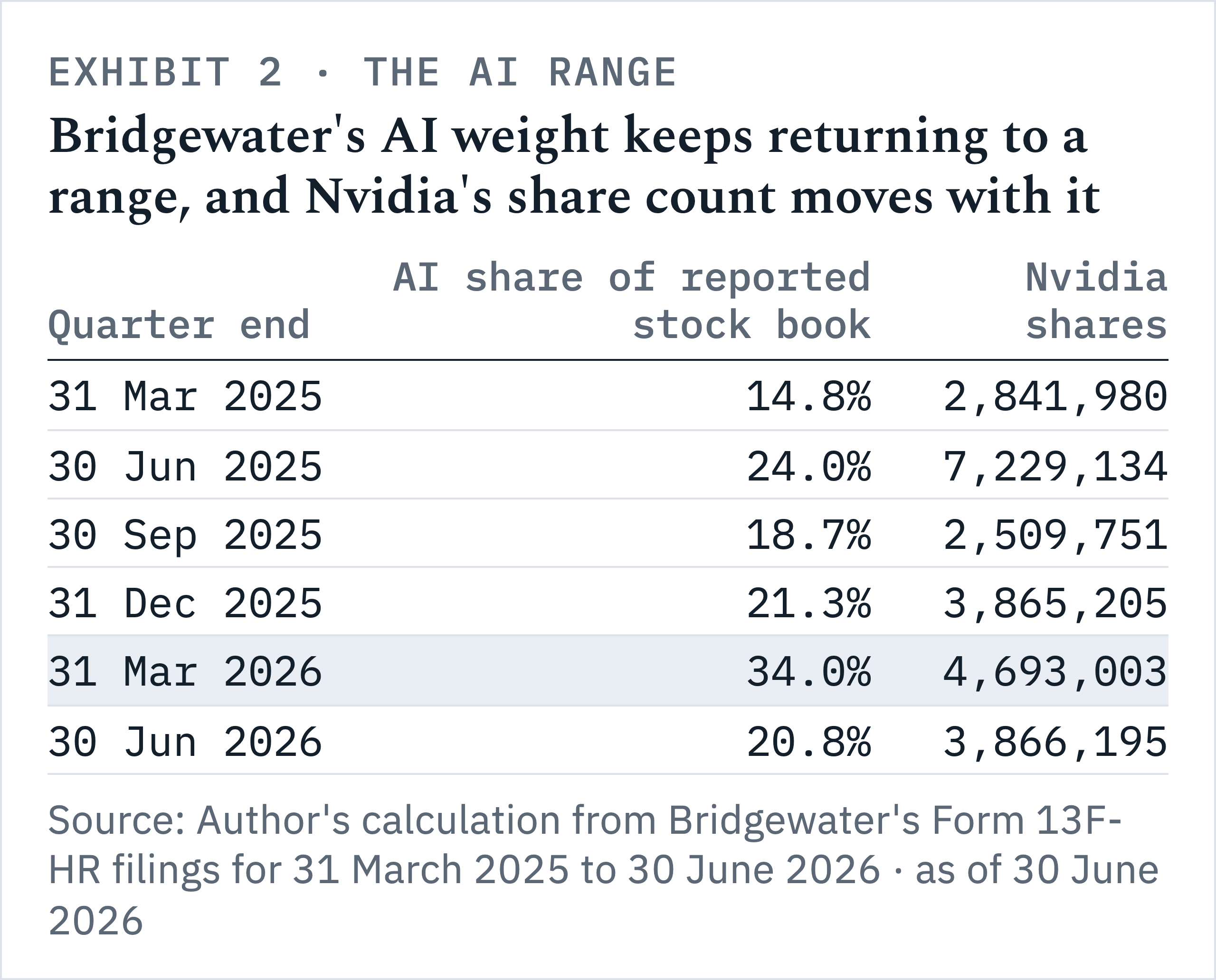
I sorted the AI lines in its filings into one basket of 38: chipmakers and their suppliers, the hyperscalers (the cloud and internet giants that buy the chips) and the power producers that feed data centres. Across six quarter ends, four of the basket’s weights sit between 18.7% and 24.0% of the reported book. I call that band the AI range. March 2026, at 34.0%, is the stretch, the only quarter end at which AI passed a quarter of the book.
The basket’s 38 lines, as filed: Advanced Micro Devices, Alphabet (class A and class C), Amazon, Applied Materials, Arista Networks, ARM Holdings (ADS), ASML (NY registry shares), Astera Labs, Broadcom, Celestica, Cisco, Coherent, Constellation Energy, CoreWeave, Credo Technology, Dell Technologies, GE Vernova, Intel, KLA, Lam Research, Marvell, Meta Platforms, Micron, Microsoft, Monolithic Power Systems, Nebius, Nvidia, Oracle, Qualcomm, Sandisk, Seagate, Super Micro Computer, Talen Energy, TSMC (ADS), Vertiv, Vistra and Western Digital.
Equity lines only; the six Bridgewater filings used here carry no option lines. A line’s weight is its filed value over the filing’s total.
I read Bridgewater’s 13F as a sizing machine: it holds AI inside that band, will stretch past it by choice, and sells back into it, whatever its research says about AI. The March stretch came from buying. The June sale handed it back after a rally had made it larger still.
The quarter’s arithmetic shows how much larger. The AI stocks Bridgewater held at the end of March rose about 60% over the quarter, weighted by their March values. Had it kept its March share counts, with the rest of the book as it ended the quarter, AI would have been about 39% of the book. The rally added about five points; the sale took off eighteen points, handing back the rally and the stretch the firm had chosen in March.
For a portfolio manager, a cut from the stretch back into the band is weak evidence of a turn. For an allocator, the band across six quarters says more about Bridgewater’s view of AI stocks than any one quarter’s cut.
The research expected more spending
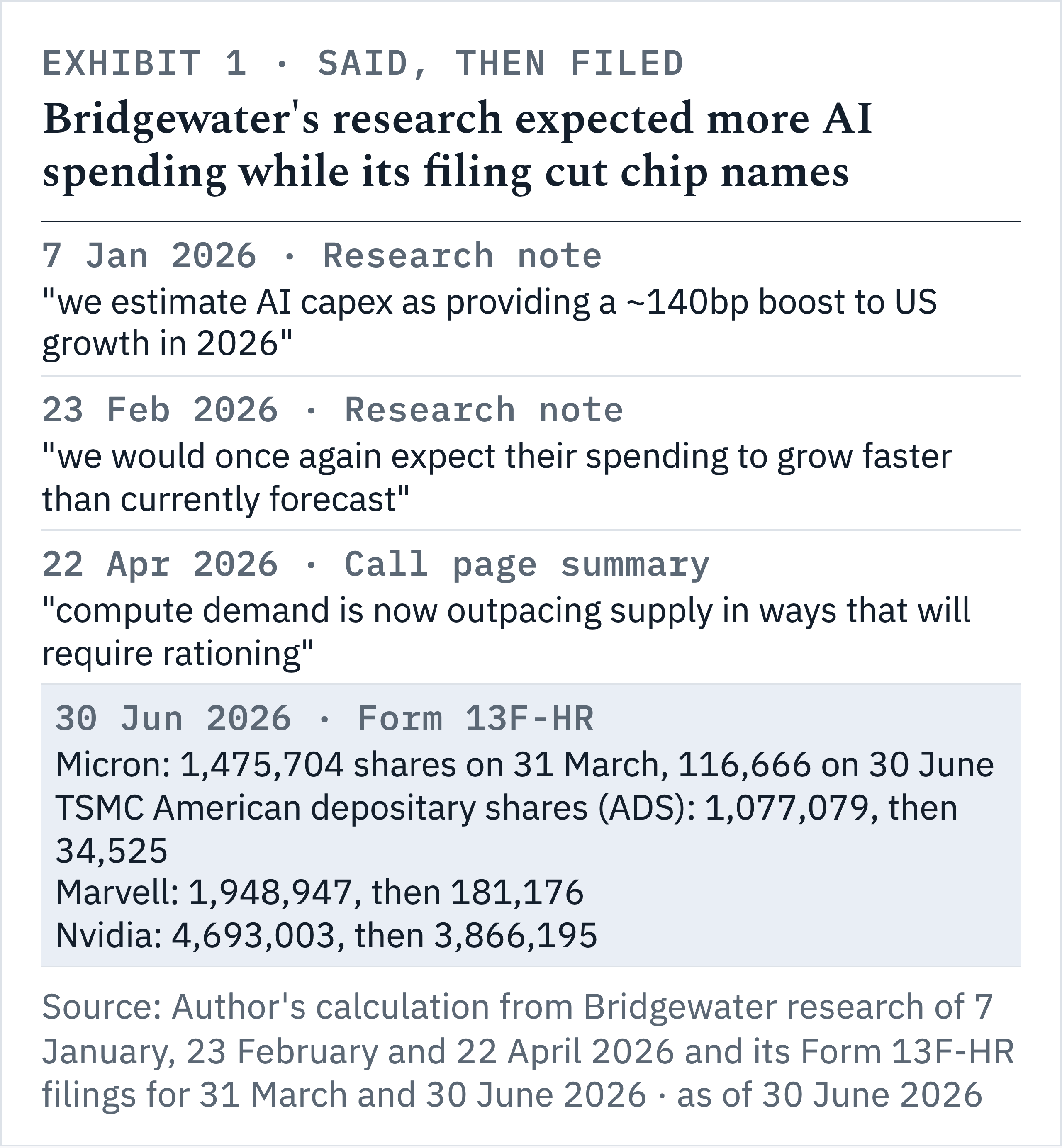
In January, Bridgewater estimated what AI spending would add to US growth in 2026. In February it put the four largest spenders’ capital spending at $650bn for 2026, against $410bn in 2025, and expected them to spend more than forecast. In April, the page for its first quarter chief investment officer call said compute was running short. Exhibit 1 sets those words beside the June filing.
Source: Author’s calculation from Bridgewater research of 7 January, 23 February and 22 April 2026 and its Form 13F-HR filings for 31 March and 30 June 2026, as of 30 June 2026.
The research and the filing part where the quotations end and the share counts begin. Micron, TSMC and Marvell each lost more than nine tenths of their shares in the quarter its research page described compute running short, while Nvidia lost less than a fifth.
The words are about the economy; the filing is about position size. The research says how much the spenders will spend and what that does to growth. The filing says how much of one stock book a theme should fill after a rally. A firm can believe the first and still sell to satisfy the second.
March pushed AI to the top
The quarter before built what June sold, and in it the research and the filing pointed the same way. The January and February notes expected more AI spending, and the book bought the stocks that sell into it.
Bridgewater raised its AI share count by about 29%, weighted by value, in a quarter when the basket’s prices rose only 0.5%. Its Nvidia shares rose between the end of 2025 and 31 March. It also sold a net $5.06bn of other single names, so the rest of the book shrank. AI reached 34.0%, the highest weight in Exhibit 2, because the firm bought AI and sold other stocks, not because prices lifted it.
Source: Author’s calculation from Bridgewater’s Form 13F-HR filings for 31 March 2025 to 30 June 2026, as of 30 June 2026.
March 2025, at 14.8%, is the one quarter end below the band, before the build that followed.
The second quarter’s rally would have stretched it further, and chips led that rally. The price of SOXX, a fund of chip stocks, divided by that of SPY, an S&P 500 index fund, rose from 0.505 on 31 March to 0.858 on 30 June on Nasdaq closing prices. Chips gained more than two thirds on the index in three months, and a book that held still would have let that rally decide how much AI it owned.
Micron led the June sale
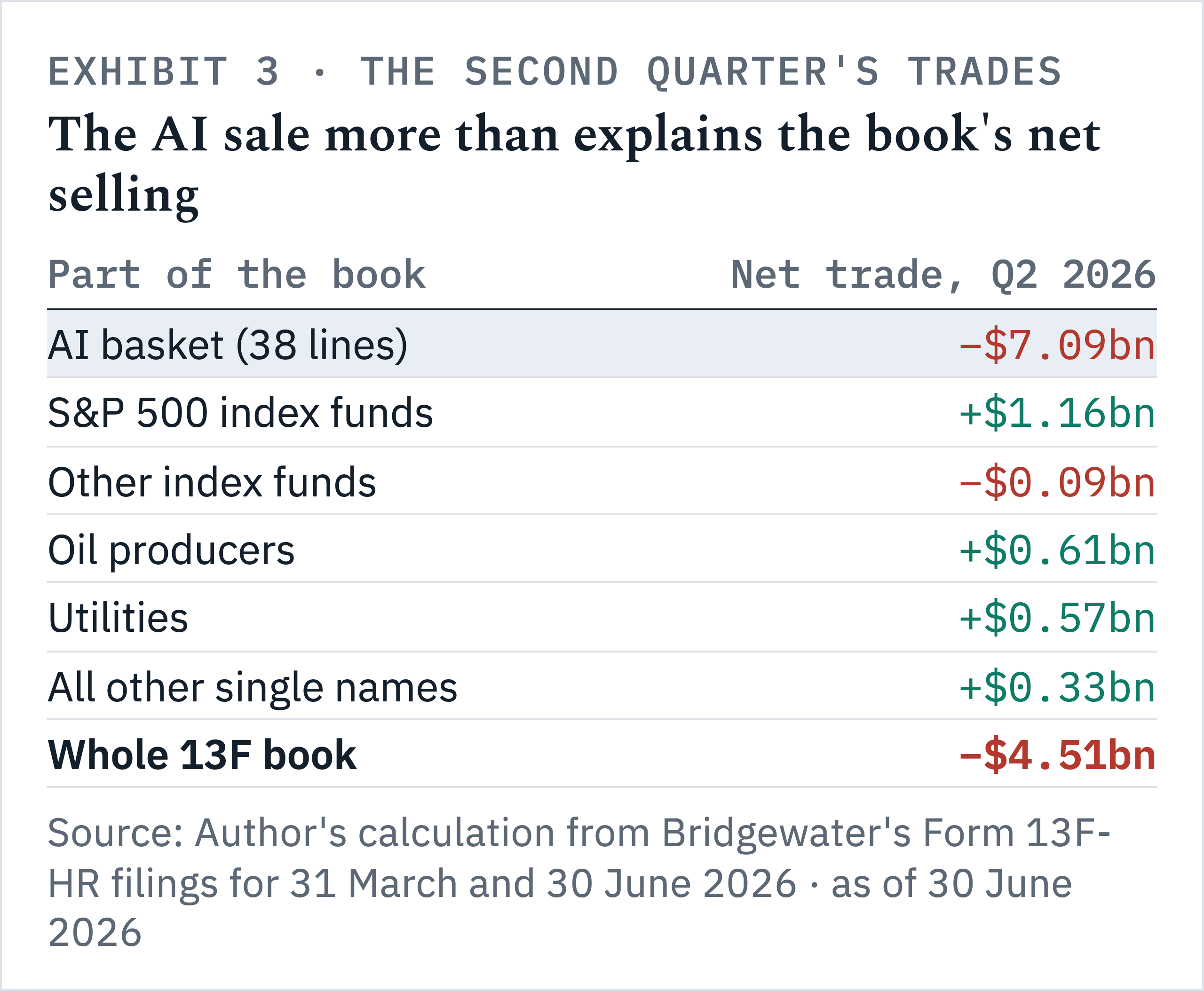
Counted in shares and weighted by each line’s value, Bridgewater cut its AI holdings by 58.3% in the quarter. That was a net sale of $7.09bn at 30 June prices, more than a quarter of the stock book it reported that day.
Micron, the memory maker, was the largest single sale: Bridgewater sold a net 1,359,038 shares, the gap between the two Micron counts in Exhibit 1. A 13F values each line at the quarter’s last close, and the same rule prices the sale at Micron’s 30 June close:
1,359,038 shares × $1,154.29 ≈ $1.57bn
That one line is more than a fifth of the whole AI sale. I priced every net trade the same way, at 30 June closes, and valued lines sold out entirely at their 31 March price, because a line that is gone has no June price in the filing. On that one convention the quarter adds up.
Source: Author’s calculation from Bridgewater’s Form 13F-HR filings for 31 March and 30 June 2026, as of 30 June 2026.
The first six rows sum to the last. Inside the AI row, chipmakers and their suppliers carried $5.50bn of the sale, the hyperscalers $1.18bn and the power producers $0.40bn. About a third of the money went back into other listed holdings, the largest part into the index: SPY took $713.5m, iShares Core S&P 500 $242.0m and Vanguard S&P 500 $205.9m. The rest left the part of the book a 13F can see. The book’s dollar value still rose, from $22.40bn to $24.38bn, because prices rose.
Bridgewater cut its weight the most
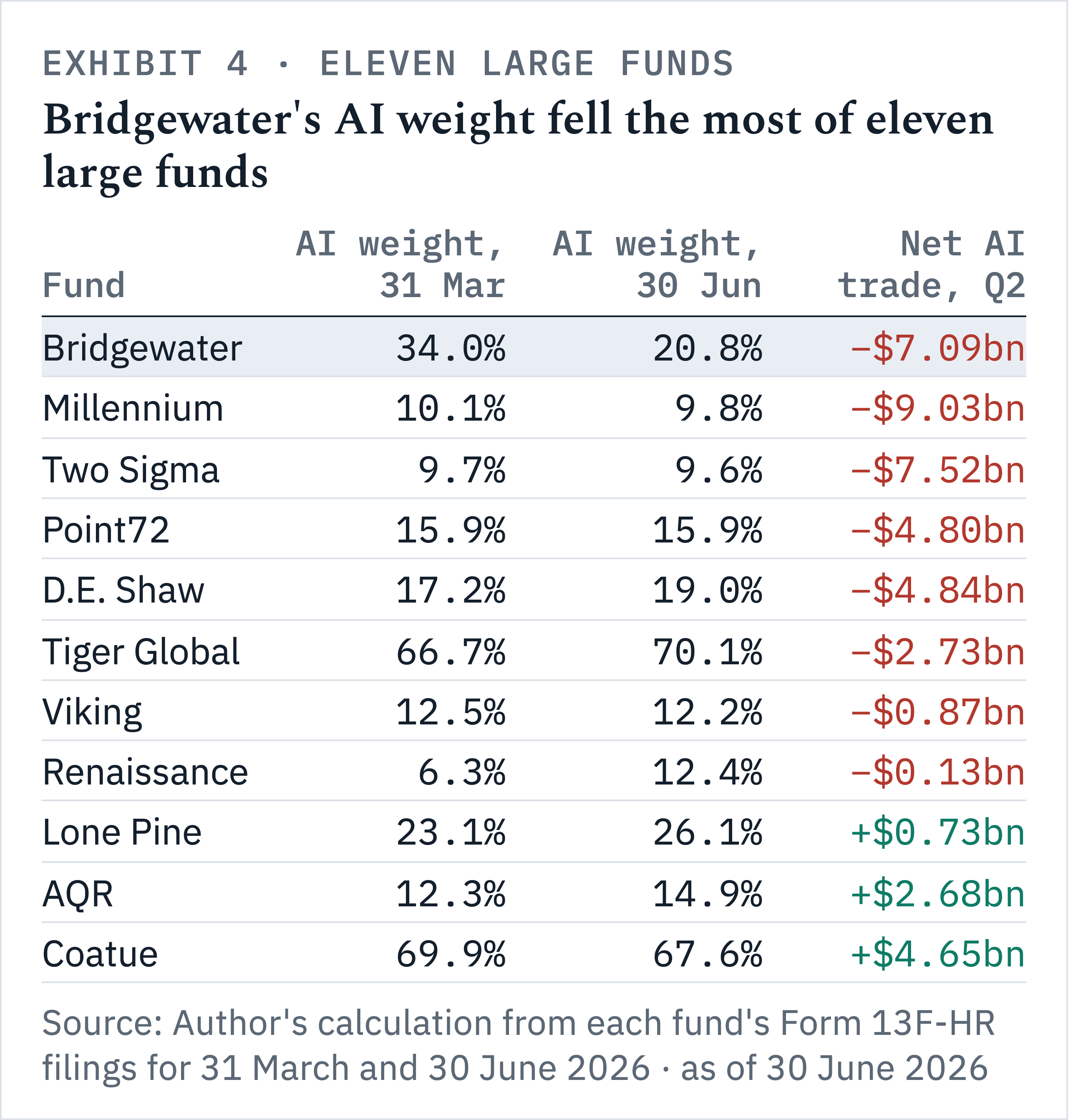
I ran the same basket of 38 lines through the 13Fs of ten other large funds for the same two dates, counting equity lines only. Eight of the eleven sold AI, net, in the quarter, so selling was common. What stood out was how far each fund let its AI weight move.
Source: Author’s calculation from each fund’s Form 13F-HR filings for 31 March and 30 June 2026, as of 30 June 2026.
Bridgewater’s weight fell the most, by 13.2 points. Millennium and Two Sigma held theirs roughly flat while cutting their AI shares by more than a third, weighted by value, and each sold more AI stock in dollars than Bridgewater did. Weight is the fair base because it nets out the rally: a fund that sells about as fast as prices rise ends the quarter where it started, whatever its dollar sales say. Bridgewater sold far faster, so its weight is the one that fell.
Point72 is the cleanest case of the rule. It sold nearly a third of its AI shares, weighted by value, and finished the quarter at the AI weight it started with, to the decimal, because the rally replaced in price what it took out in shares.
Three funds took the other side. Coatue Management, AQR and Lone Pine were net buyers of the same names in the quarter, Coatue by the most. The basket Bridgewater sold down to a fifth of its book made up about two thirds of Coatue’s.
Tiger Global sold a net $2.73bn of the basket and its AI weight still rose, to 70.1%, which fits our read of Tiger’s own filing: it sold more stock than it bought while prices carried its book higher.
Nvidia shows the move twice
Nvidia’s column in Exhibit 2 is the machine’s fingerprint. Bridgewater more than doubled its Nvidia shares in the second quarter of 2025, cut them by about two thirds in the third, rebuilt them over the next two quarters and trimmed them in the latest. Its Nvidia count moved the same way as its AI weight in all five quarterly moves, and on 30 June 2026 it held almost exactly as many shares as at the end of 2025.
The third quarter of 2025 is this quarter’s twin. Bridgewater cut Nvidia by 65.3%, Alphabet’s class A shares by 52.6% and Meta by 48.3%. The AI weight fell from 24.0% in June 2025 to 18.7%, the lowest of the five quarter ends from June 2025 to June 2026. In the next quarter it was buying Nvidia again, and by March AI stood at its peak. Rebuilding that fast is what a sizing machine does after a cut.
For a reader who holds the same names, the twin is the useful part, and the weak one: one precedent is thin, and it is the only one these six filings hold.
Any reader can run the test on any fund: multiply each 13F line’s share count by the quarter end price, then set the fund’s AI weight against its own last six quarters and against its peers in the same quarter.
September’s filing can break the range
The case against the sizing reading rests on three facts. The first is the split inside the sale. Bridgewater cut its chip, supplier and power names harder in share terms than the hyperscalers, by about 63% against about 44%, weighted by value, which looks like a call against chips. In dollars, though, its chip exposure fell 32% and its hyperscaler exposure 37%, close to the same cut. That is what a rebalancer does: the stocks that ran fastest need the most shares sold to bring their dollars back down.
The second is the research after the quarter. On 28 July, a Bridgewater talk page summarised the discussion as covering “emerging risks to frontier labs’ revenue growth across regulation, adoption challenges, and competition from cheaper models”. That is cooler than April’s talk of rationing, because frontier labs are among the buyers of compute. It came after the quarter closed, so it cannot explain the June sale, but it could drive a September one.
The third is the names. On the 13F’s own quarter end prices, Micron rose 242% in the second quarter and Marvell 201%, and the filing left each with under a tenth of its March shares, while Nvidia rose 15% and kept more than four fifths of its. That much fits sizing by name. TSMC rose 41% and lost 97% of its shares. Amazon rose 14% and lost 54%. Those two are choices, and the filing does not say why.
The next filing settles it. Since 30 June the chip sector has fallen against the index: SOXX/SPY stood at 0.858 on 30 June, 0.746 on 30 September and 0.700 on 12 October. Price alone can move the AI weight, so the test has to be read in trades, the way Exhibit 3 reads the second quarter.
This reading is wrong if Bridgewater’s 13F for 30 September 2026, due by 16 November 2026, shows it sold AI shares again on net, valued at 30 September prices, and AI below 18.7% of its reported stock book, the floor of the five quarter ends before it. That outcome would mean Bridgewater is leaving AI in the part of its book a 13F shows. A net purchase says the band holds, as it did after the cut in the third quarter of 2025. A net sale that leaves AI inside the band says the trimming is not finished, and the reading stays open.
Until that filing lands, the verdict is the AI range: Bridgewater did not turn on AI in June; it sized its AI stocks back into the band, as it did in the third quarter of 2025, and the last time it did that it bought back.
Further reading
Tiger Global Sold $3.7bn of Stock, and Its 13F Shows One Chip Bet Built Up: Intel: the same share count method, on a fund that built one chip bet
How Elliott Is Long Synopsys With Software Hedged, From Its Own 13F: one fund’s bet read line by line from its own 13F
Bridgewater’s Pure Alpha Returned 33% in 2025. Here’s the Exact System Behind It: the macro system behind the stock book this 13F shows
Next Thursday: a named fund’s bet, read from its own filing, with the position.
→ Bridgewater’s 2025 AI cut and its refill, name by name on Patreon, open to everyone.
Navnoor Bawa · YouTube · LinkedIn · Patreon
Cover photo: Web Summit · CC BY 2.0, adapted · via Wikimedia Commons
