


On 9 December 2025, in Abu Dhabi, Dmitry Balyasny named AI the largest tail risk heading into 2026. Eleven months on, his firm is down 2.7% for the year, as Bloomberg reported, after an October that Millennium and Point72 lost too.
Balyasny did not lose its year in October; it was already flat by September, 7 to 13 points behind its largest peers, and October took the last of the cushion.
I expect 2026 to end below 0.0%, which the final print in early January will test. Two months remain to decide whether Balyasny’s investors take a losing year while its largest rivals’ are up.
The paid half gives our odds that 2026 ends at or above zero, the return November and December need, the firm’s own record in those months, and what the funds made over the October to September year some managers are paid on. Where 2026 ends against zero decides whether, in funds that charge one, it owes an incentive allocation, the firm’s share of profits, or leaves a loss to make back first.
The year was flat before October
Balyasny publishes no returns, so every return here is the press’s, mostly Bloomberg’s and Business Insider’s. What it files with the SEC is its holdings and its rules. The 13F is a quarterly list of its long US-listed holdings; the Form ADV is its adviser registration, and its Part 2A, the brochure, says how it charges its funds and pays its staff.
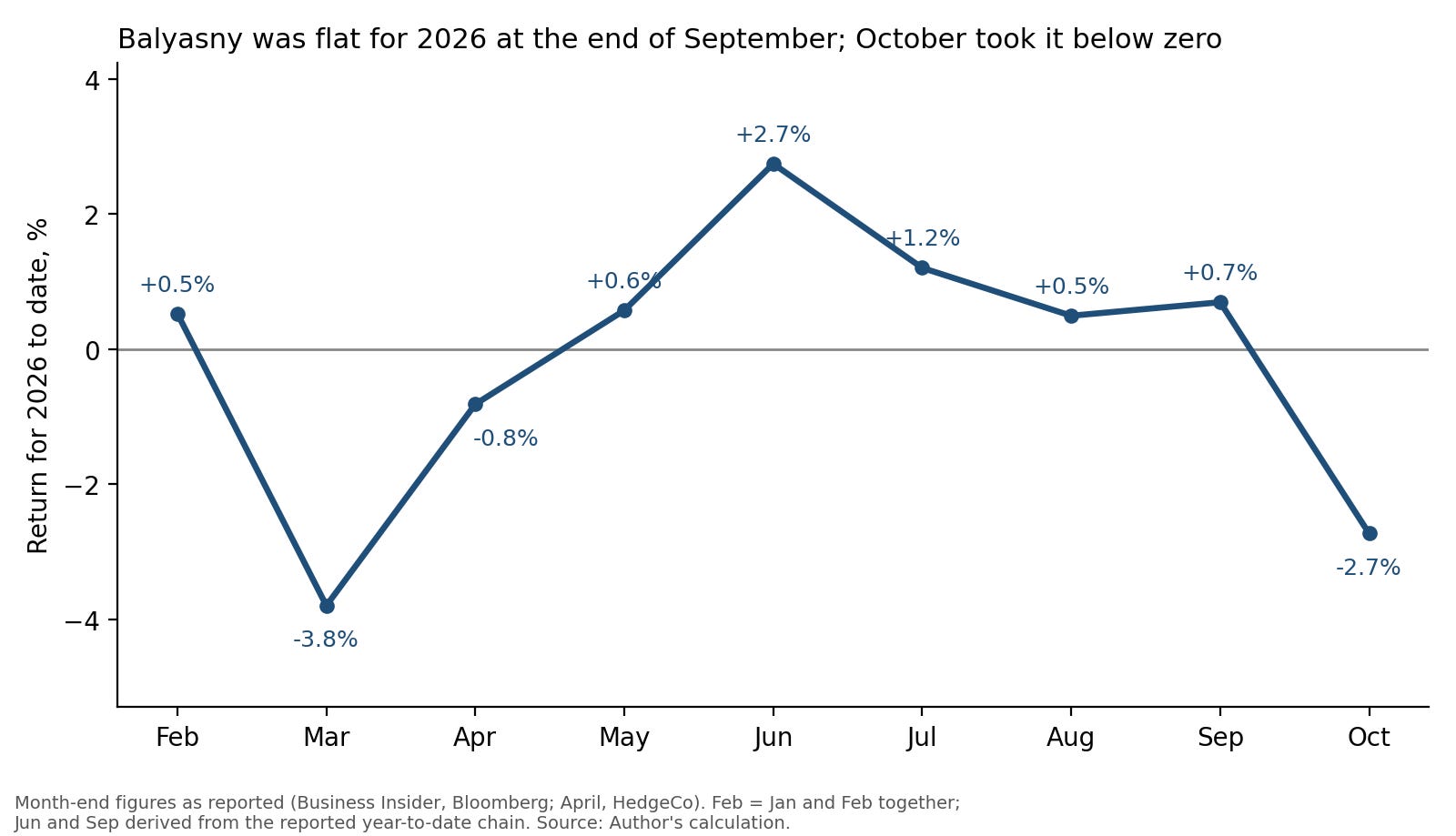
I parsed Balyasny’s last five 13F filings line by line and set them against the Form ADV and brochure it filed on 6 November; the press printed the returns, and no press account printed the book. Chained month by month, the reported figures agree with each other: the +0.7% through September and October’s 3.4% loss compound to −2.72%, against the −2.7% printed for the year.
The path never strayed far from zero. March cost 4.3% and left the year at −3.8%. By the end of May the year was positive again, and by the end of July it stood at +1.2%. August lost 0.7% and September added about 0.2%, which is where October found it.
Hedgeweek, citing Bloomberg, wrote that “crowded technology positions, geopolitical shocks and credit market volatility triggered simultaneous drawdowns”. On Bloomberg’s Odd Lots podcast, its chief hedge fund correspondent labelled October, in the news site BigGo‘s summary of the episode: “It was a perfect storm. Everyone failed together.” He also allowed that the AI exposure behind it may run through credit or rates rather than equities.
For October, the record mostly agrees: Balyasny’s month was only 1.1 to 1.4 points worse than Millennium’s and Point72’s, while Wellington, the Citadel fund the press reports, gained 1.7%. For the year, it does not. Hedgeweek printed the +0.7% on 6 October, carrying Bloomberg, and called the firm “well behind several of its largest multi-strategy peers”, the platforms that split their capital among many separately paid trading teams. The gap in points is ours.
Each rival’s 30 September figure is worked back from its October month and its year to October. On that basis Balyasny trailed Millennium by 7.5 points, Point72 by 10.1 and Citadel’s Wellington fund by 12.7; Point72’s figures are BigGo’s.
Our 19 October piece said it would be wrong if Millennium’s, Point72’s or Balyasny’s flagship lost more than 5% in October. None of the three reported a loss above 5%; the largest was Balyasny’s 3.4%, so that call held.
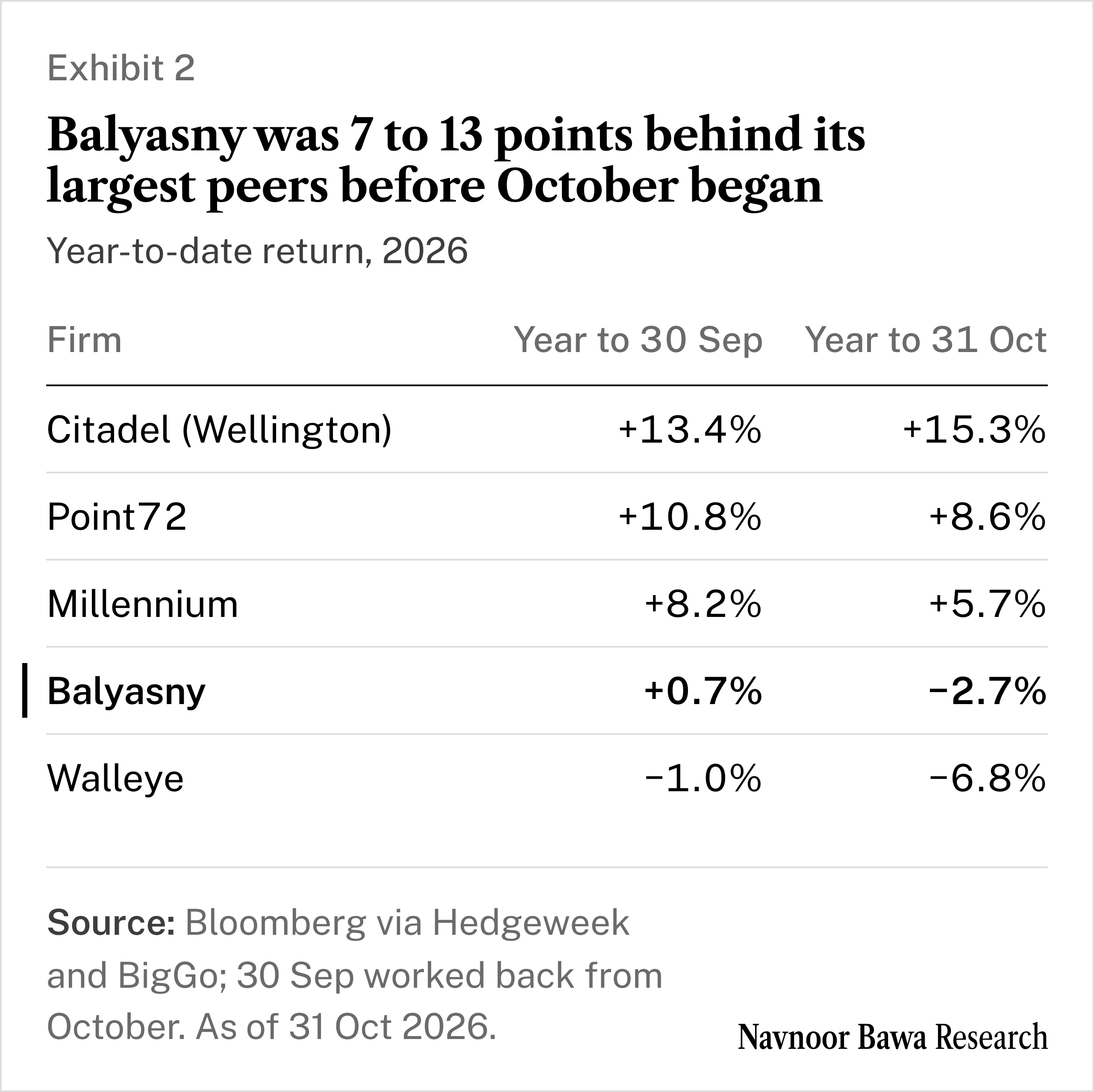
October changed no firm’s place in the order; Walleye, a multi-manager fund, trailed Balyasny at both dates.
Dmitry Balyasny’s own sentence in Abu Dhabi allowed for a month like this: “Either of those scenarios could create some instability, but the more likely outcome is that it continues to grow the way that it has.” The instability arrived in October.
Bloomberg, as Hedgeweek carried it, reported that equities were profitable through September while fixed income and macro recorded losses. Equities is the business Dmitry Balyasny helps run, and in a Business Insider interview Hedgeweek carried on 2 January 2025 he said his equities teams had been “trading too much and not investing enough”. No document splits October by business.
The Bloomberg reports do not give the fee basis. One report, Hedgeweek’s of 13 November citing eFinancialCareers, calls the 2.7% loss after fees and puts it on the nine months to September, then October’s 3.4% before fees. Read that way the year would be about −6%, which no report prints; the Bloomberg months, chained, put the 2.7% at the end of October.
The filings cannot rule out a second reading of the +0.7%. The brochure says the costs the funds pay through to the firm, its pass-through expenses, with portfolio managers’ pay among them, “are material”. A year that made money before those costs can read close to zero after them.
What it carried into October
Balyasny’s 13F for 30 September, filed on 16 November, lists 2,961 lines worth $85.6bn. It shows long US-listed positions at the quarter’s end: no shorts, no bonds other than convertible notes, which can turn into shares, no rates, futures or non-US listings, and nothing about October.
It is also a combination report, which leaves some holdings to another manager’s filing. Longaeva Partners L.P., an adviser Balyasny’s brochure lists as relying on its registration, reports those on its own 13F, 296 lines worth $4.84bn, a split all five filings share.
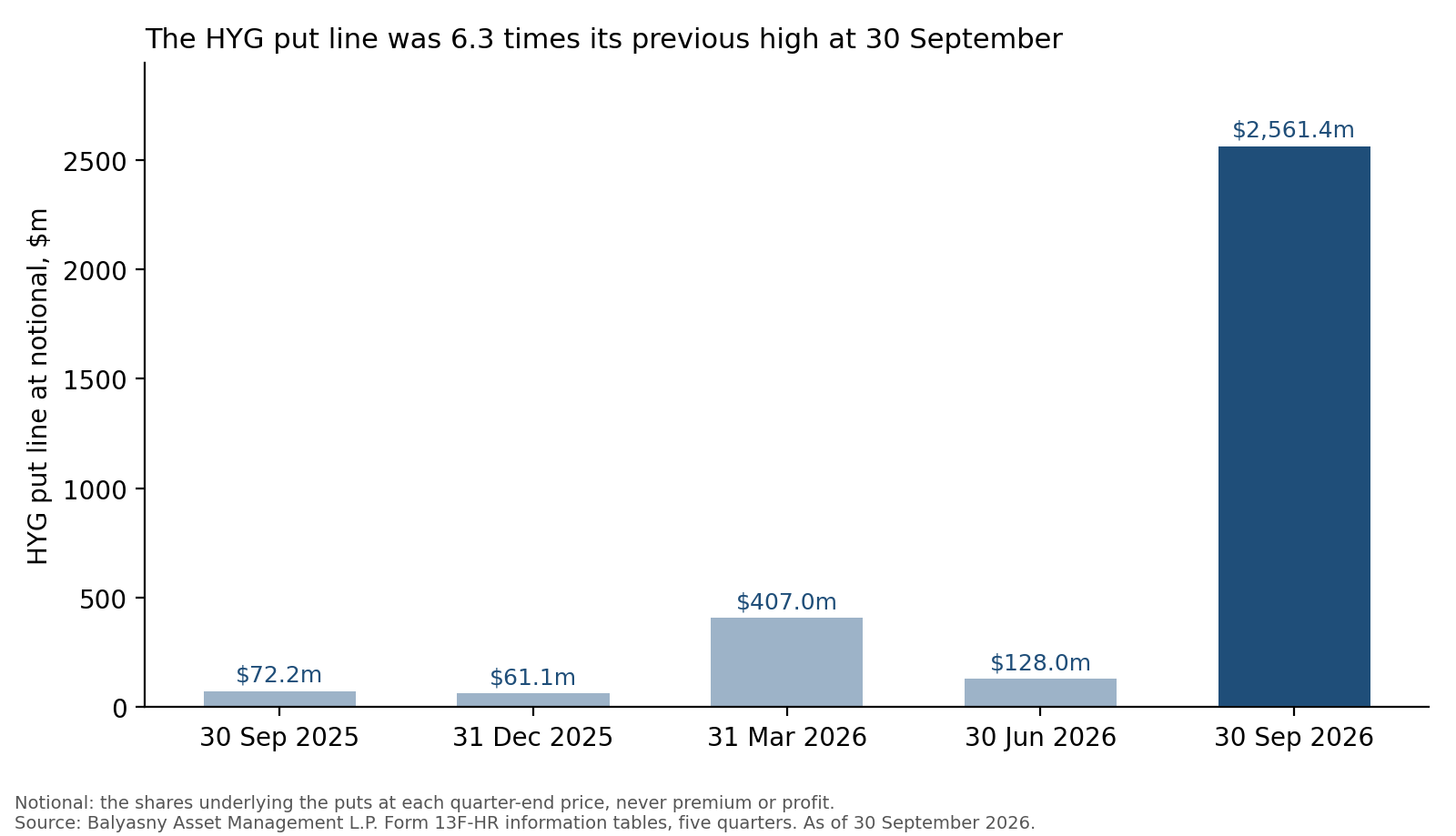
The line that moved most is a put on the iShares iBoxx High Yield ETF, HYG, a fund of high yield corporate bonds. At 30 June the 13F valued it at $128.0m on 1.6m shares. At 30 September it was $2,561.4m on 33,175,000 shares.
That value is notional, the value of the shares the option covers; the premium paid for it is not reported. This filing values the line at $77.21 a share of HYG, against $79.97 in June. That is the ETF’s share price, so the line grew on its share count while the ETF fell.
Balyasny held puts on $2.56bn of a high yield bond ETF at 30 September, six times the largest such line in the four quarters before it. No line in the five filings surprised me more: a year earlier it was $72.2m, its previous high was $407.0m at 31 March, and at 30 September it was 20 times June’s.
A put line is an option the firm held. The SEC staff’s Form 13F FAQ says so at Question 43: “You should not report put or call options that you write.” Because written options go unreported, a held put can be one leg of a spread or a collar, a bought option paired with a sold one. So notional is not exposure. The same filing carries an HYG call line of $115.8m on 1.5m shares.
The line itself is common. Citadel’s 13F for the same date holds $3.97bn of HYG puts and Millennium’s $1.68bn, and Citadel’s line prices HYG at the same $77.21. Balyasny’s is 3.0% of its filing, against about 0.4% at Citadel and 0.6% at Millennium. Its HYG puts outweigh its HYG calls about 22 to 1, against about 2 to 1 at both. What sets Balyasny’s apart is weight and balance.
The put book reached $24.04bn, the highest of the five quarters, against $18.35bn to $21.05bn before it. With calls at their own high for the five quarters, options at notional rose from 31.8% of the filing at 30 June to 40.1% at 30 September.
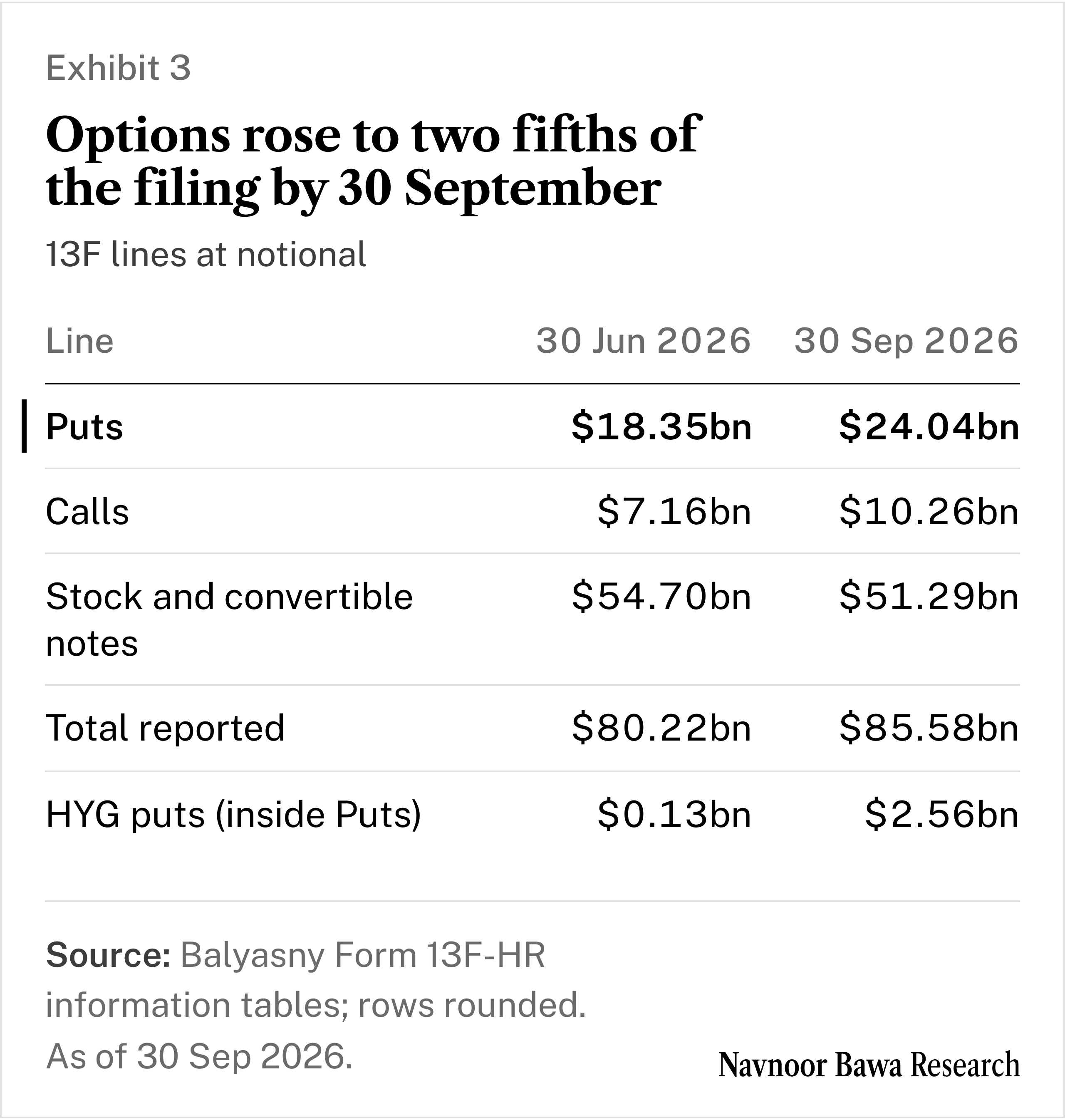
The filing is the whole firm’s, and its lines point several ways. The Microsoft and Nvidia stock lines grew over the quarter, and about half the put notional sits on exchange traded funds and trusts, the HYG line among them.
It cannot say what the HYG line was for, a view on high yield bonds or one leg of a spread, nor what it cost or earned.
The HYG put line did little in October. HYG closed the month at $77.43, above the filing’s $77.21, after a lowest close of $76.81 on 14 October. On the price move alone, puts on the 33,175,000 shares could have gained at most about $13m at that close, and by the month’s end had lost up to about $7m.
That is about a hundredth or less of what October cost the firm, so whatever its strike, the price move alone could neither have caused the month’s loss nor cushioned it, if the line was held through the month. A rise in volatility could have added to a put’s value, and no filing shows that.
The founder warned of AI in December, and the correspondent said the AI exposure may run through credit; the filing cannot join those words to this line. What it shows is that on the last day before the losing month, the firm held a high yield put line far outside its own record and its peers’ share of their filings.
A losing year lands on investors
The 13F is one slice of a larger book. Balyasny’s Form ADV, amended on 6 November, declares $248.1bn of regulatory assets under management, the gross value of the funds’ positions with no debt deducted. The brochure puts client assets at $29.39bn at 31 December 2025, and the firm’s site gives $37bn as of 1 November.
The gross figure counts what borrowed money buys, and client assets are counted by a different method, so the gap measures scale, not leverage. Even the 13F’s stock and convertible note lines, $51.3bn at 30 September, exceed the $37bn the firm runs, a size that takes borrowed money or the proceeds of short sales. The size that matters here is the client money, $31bn last December and $37bn by October, that the year’s dollar losses are counted on.
The largest private fund on the ADV is Atlas Macro Master Fund, with $182.9bn of gross assets, but three of the firm’s own master funds wholly own it, so its assets overlap theirs. By the one report there is, the year’s losses through September came in fixed income and macro, and neither appears on a 13F.
Dmitry Balyasny founded the firm in December 2001 and “owns approximately 70% of BAM and is the only principal owner”, the brochure says. Equities, the business he helps run, held about 35% of gross capital and almost 100 portfolio managers in October, Bloomberg reported. A losing 2026 would follow a 2025 in which the firm made 16.7%, the Economic Times reported.
Its portfolio managers each run a pod, a team paid on its own book. The brochure says the firm pays the winners whatever the funds make: managers with positive performance are paid even in a year the funds lose, generally on the calendar year, with select staff paid on a year that ends on 30 September. That pay is among the pass-through expenses, so a losing 2026 would reach investors with the winning pods’ pay already inside it.
Will November and December bring Balyasny’s 2026 back to zero, or leave its investors a loss to make back first?
Below the paid line:
The odds the year ends at or above zero, the return November and December need, and the model’s three endings.
Why the firm’s own November and December record reads kinder than the model, and a table of each changed input.
The brochure’s pay clauses against the year’s loss in dollars, a three line test for another platform, and dated checks.