


On 2 October, Blue Owl’s tech fund told its holders that about 13% of exit requests would be filled. The letter, from Craig Packer, chief executive of Blue Owl Technology Income Corp. (OTIC) and Blue Owl’s head of credit, and Erik Bissonnette, its president, added that leverage sat “below its target range”, “providing capacity to thoughtfully deploy into both new investments and existing borrowers”.
Beside the fund’s quarterly report, that capacity is thinner than it sounds, and the fund is shrinking: its debt fell from $2,836m at 31 December 2025 to $2,344m at 30 September 2026, and new lending has nearly stopped. The 5% gate, the board’s cap on the shares it buys back each quarter, is the board rationing a shrinking fund.
The shares turned away in September, what I call the line, are worth $932m, more than a third of the fund, and what their holders get back turns on the next tender, expected in December.
OTIC has the cash to pay this quarter’s leavers, and not the room to pay the line.
Six tenders paid, then the line stuck
OTIC is a nontraded business development company (BDC): it lends to private companies, here software companies, and its shares do not trade on an exchange. Every nontraded BDC with a 5% quarterly tender runs on the same exit clock.
The shares a tender turns away must be asked for again. I rebuilt OTIC’s line share by share from its nine final tender filings, the amendments (Schedule TO-I/A) that report how many shares were bought. Then I sized every ceiling on paying it from the September balance sheet, including the cushion the fund itself says it keeps for loans it has promised borrowers.
The rebuild reproduces the fund’s own figures, down to the 12.8% fill September’s filing prints. At that fill, a holder who tendered $1m of shares got about $128,000 back, in a note, and has to ask again next quarter.
The paid half settles how much of a stuck position the next four tenders are likely to return. It gives my odds on the cap and on a raise as numbers, what each of four outcomes pays, and the one number that decides it: the count of shares OTIC accepts in its fourth quarter tender.
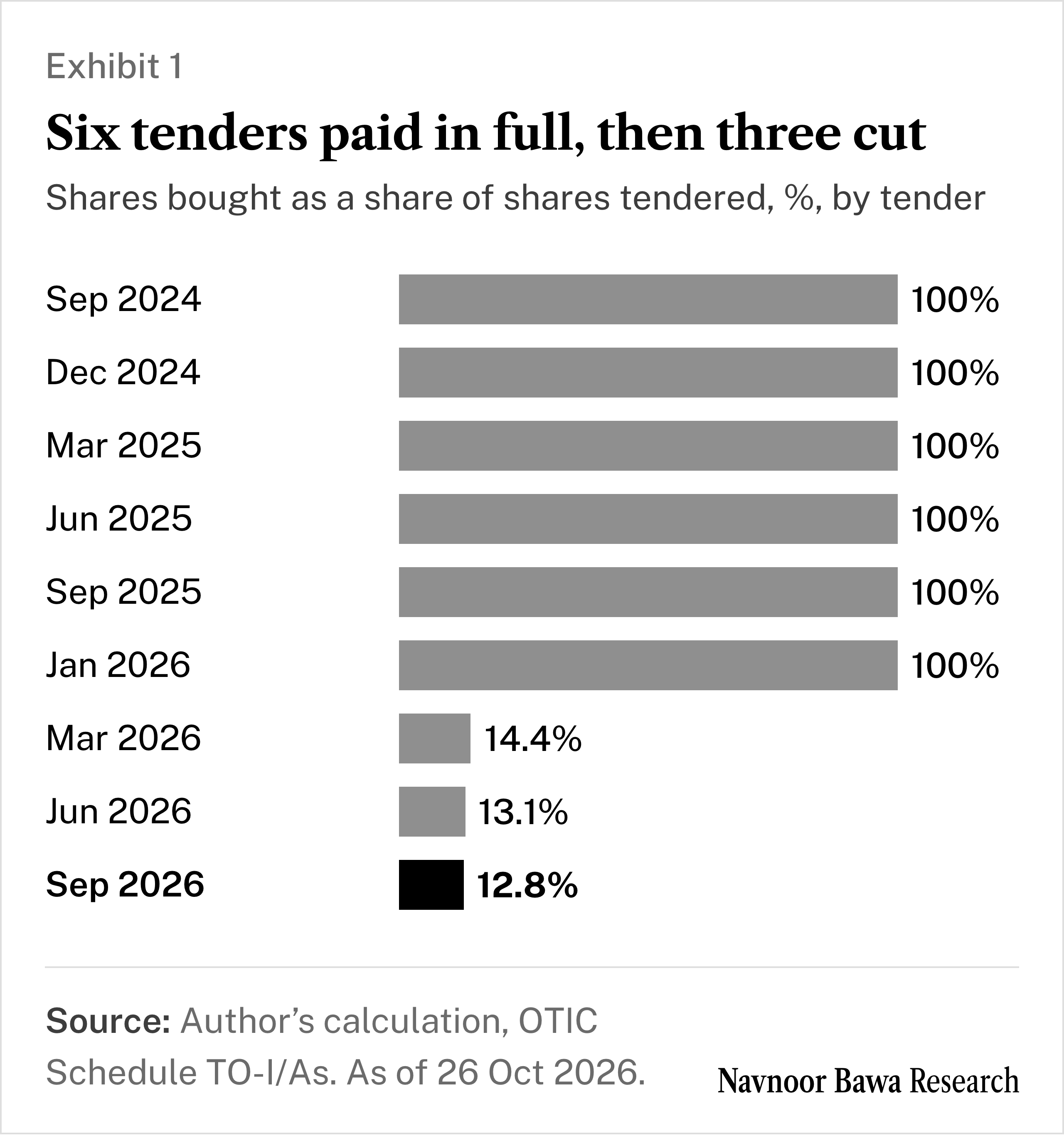
Source: Author’s calculation from OTIC’s final Schedule TO-I/A for each tender, October 2024 to October 2026 · as of 26 Oct 2026
From September 2024 to September 2025, OTIC never had to ration. Each quarter the board offered to buy back 5% of the shares, and fewer than that asked to leave. In the tender that closed on 30 September 2025, 8.7 million shares were tendered and every one was bought, at $10.42. As in all nine tenders, OTIC paid in promissory notes that bear no interest, held for each seller by DST Systems, the transfer agent.
The next quarter broke the pattern. On 26 November 2025 the board offered the usual 5%, about $171m. Requests came in far above it. On 23 December the board filed an amendment raising the maximum to 65,771,325 shares. When the offer expired on 8 January, OTIC bought 50.8 million shares for $527m, 15.4% of the fund by the managers’ own count, and filled every request.
So the cap is a number the board can move inside a quarter, by a filing. It did so once, while it was still paying every request, and has rationed in the three tenders since.
Then the line stopped moving
In the quarter to March, 119.9 million shares asked to leave and 17.2 million were bought, at $9.82. That was still the 5% rule, applied to the 31 December share count before January’s buyback came off it, not a raise. In June, 109.9 million asked and 14.4 million left. In September, 108.6 million asked and 13.9 million left, at $9.85.
The FAQ says unfilled requests “do not carry over to the next tender offer and must be resubmitted”. Packer and Bissonnette wrote that “the vast majority of tender requests were resubmissions of previously unfulfilled tenders”. So the question is how many requests are new.
The line after each tender went from 102.7 million to 95.4 million to 94.6 million. Subtract each line from the next quarter’s requests and the remainder is the floor on new sellers: at least 7.2 million shares in June and at least 13.1 million in September. New requests are rising while total requests hold flat.
That is why a fund buying 13.9 million shares a quarter shortened its line by less than one million. The buyback is roughly matched by people joining the back of it. New money is not filling the gap either: by my count from the filings, issuance and reinvested distributions added about 3.4 million shares in the September quarter, a quarter of what left, part of a slowdown in Blue Owl’s credit fundraising that began earlier.
OTIC’s sister fund, Blue Owl Credit Income Corp. (OCIC), shows what a shorter line looks like. There, 16.8% of shares were tendered in September and 29.8% of each request was filled, at the same 5% cap. OTIC’s holders asked to leave at more than twice OCIC’s rate. The managers’ April letter says OTIC’s demand “was amplified by the fund’s more concentrated shareholder base” and by concerns over “AI‑related disruption to software companies”.
The board chose five percent
Who sets the gate is not in doubt. OTIC’s quarterly report says the company “intends to limit the number of shares to be repurchased in each quarter to no more than 5.00 % of its outstanding shares”.
The managers give two reasons. The FAQ says the program “was carefully designed to provide periodic liquidity while considering the duration of the Fund’s underlying assets”. The letter calls the 13% fill “consistent with our commitment to balancing the interests of both tendering and remaining shareholders”.
The first reason meets the fund’s own sale: in February 2026 it sold $344.0m of its best rated loans, nearly all first lien (loans repaid first if a borrower fails), marked at 99.6% of par, their face value. The length of its loans did not stop a sale that size near full value, though a sale big enough to pay the line has not been tested.
The second reason stands: a board that paid the whole line at once would hand the leavers its most liquid assets and leave the stayers with the rest.
Two other pressures bear on the same choice. Fitch put the leverage risk in its own words, carried by Alternative Credit Investor in June 2026: “sustained increases in leverage or weakening liquidity profiles could drive negative rating action over the medium term.” And the adviser’s base fee is 1.25% a year of average net assets, so the whole $932m line pays about $11.7m a year of it while it stays; the record cannot tell how much weight the board puts on that.
The objection is that this board has paid everyone before. It has, once. In April the managers called January “the one‑time increase to accept 15.4% of shares last quarter”, and spoke of a “willingness to provide additional shareholder liquidity when conditions warrant”.
By the fund’s own count in its April filing, requests came to 40.4% of its shares after the January tender. After it paid in full, a bigger line formed in the next quarter. The managers blame selling across the industry and worries about software for that wave; whatever the cause, a board that paid in full and then met a bigger line has reason to ration.
The leverage room is thin
At 31 August the managers counted “ample liquidity of $1.2 billion”: cash, undrawn debt, loans that trade, and unsettled trades. The September tender cost $137m.
The 10-Q shows a fund barely lending and paying down debt. It cut its facility commitments from $4,145m to $3,470m, and on 10 September it signed the fourth amendment to its revolving credit facility with Sumitomo Mitsui Banking Corporation (SMBC) as agent. The filing says the fund “voluntarily reduced the total facility amount in order to reduce borrowing costs and align with its target leverage”, from $1.05bn to $975m. The fund is paying money out to leavers and lenders.
Room, here, means leverage room: how much more the fund can borrow before it reaches the top of its own target. The 10-Q says: “Our current target leverage ratio is 0.90x-1.25x.” Net of cash, OTIC’s debt was 0.86x its $2.64bn of net assets at 30 September as filed, under the floor of the range, as at every quarter end of 2026. Paying the September tender’s notes lifts it to about 0.91x, just inside.
A tender paid with new debt pushes leverage up from both sides: debt rises and equity falls. So the whole line cannot be paid at once without carrying the fund well past the top of its range. A smaller raise fits under the top, if the board is willing to borrow to it. The legal limit sits further out: a BDC must keep asset coverage, its assets per dollar of debt, at 150% or more, and OTIC’s was 212%.
Then come the promises. The fund has committed to loans its borrowers have not yet drawn, and the 10-Q says it plans its leverage around them: “We seek to carefully consider our unfunded commitments for the purpose of planning our ongoing financial leverage.” Those commitments draw on the same room a tender would. Counted as drawn, they leave room under the top for a tender barely bigger than one 5% cap.
SMBC’s fourth amendment also “resets the minimum shareholders’ equity test”, tested at each quarter end. Tenders shrink equity, so that test is the lender’s own floor under the gate.
OTIC’s room pays for a raise only if the board borrows to the top of its range and its borrowers draw little, and this year the board has paid debt down instead.
What leaving early costs
A holder who will not wait has nowhere obvious to go. OTIC “does not intend to list its shares on any securities exchange”, the letter says, and it repeats the prospectus warning: “You should not expect to be able to sell your shares regardless of how OTIC performs.”
In February, Cox Capital Partners and Saba Capital announced plans to tender for shares of three Blue Owl funds, OTIC among them, at a price “expected to be at a 20-35% discount” to net asset value. The filing warned that the offers “may not provide a meaningful liquidity solution for all investors”.
One of those offers was completed, for Blue Owl Capital Corporation II, or OBDC II. Cox paid $3.80 a share, a 34.93% discount to the “implied value” it named, and John Cox, its chief investment officer, signed the result: “The Offer was not oversubscribed.” At 65 cents on the implied dollar, holders tendered no more shares than Cox stood ready to buy.
The OTIC offer was announced and never launched: no tender for its shares followed on EDGAR. For its holders, the exit with a price on it is the one the board sizes each quarter, at net asset value, paid in notes.
→ Blue Owl’s 2026 loan sale out of OTIC and two sister funds, rebuilt from their filings, Trade File No. 17 on Patreon.
So how much of a stuck OTIC position will the next four tenders return?
Below the paid line:
My call on the cap, with its odds, and the lending line that shows where the letter’s capacity is going
Four outcomes for a holder who tenders every quarter, the outside bid beside them, and a table of ceilings
A test in four steps for any fund on the same quarterly cap, and the sister fund to run it on next
What to watch: four dated checks, starting with the size of the next offer