


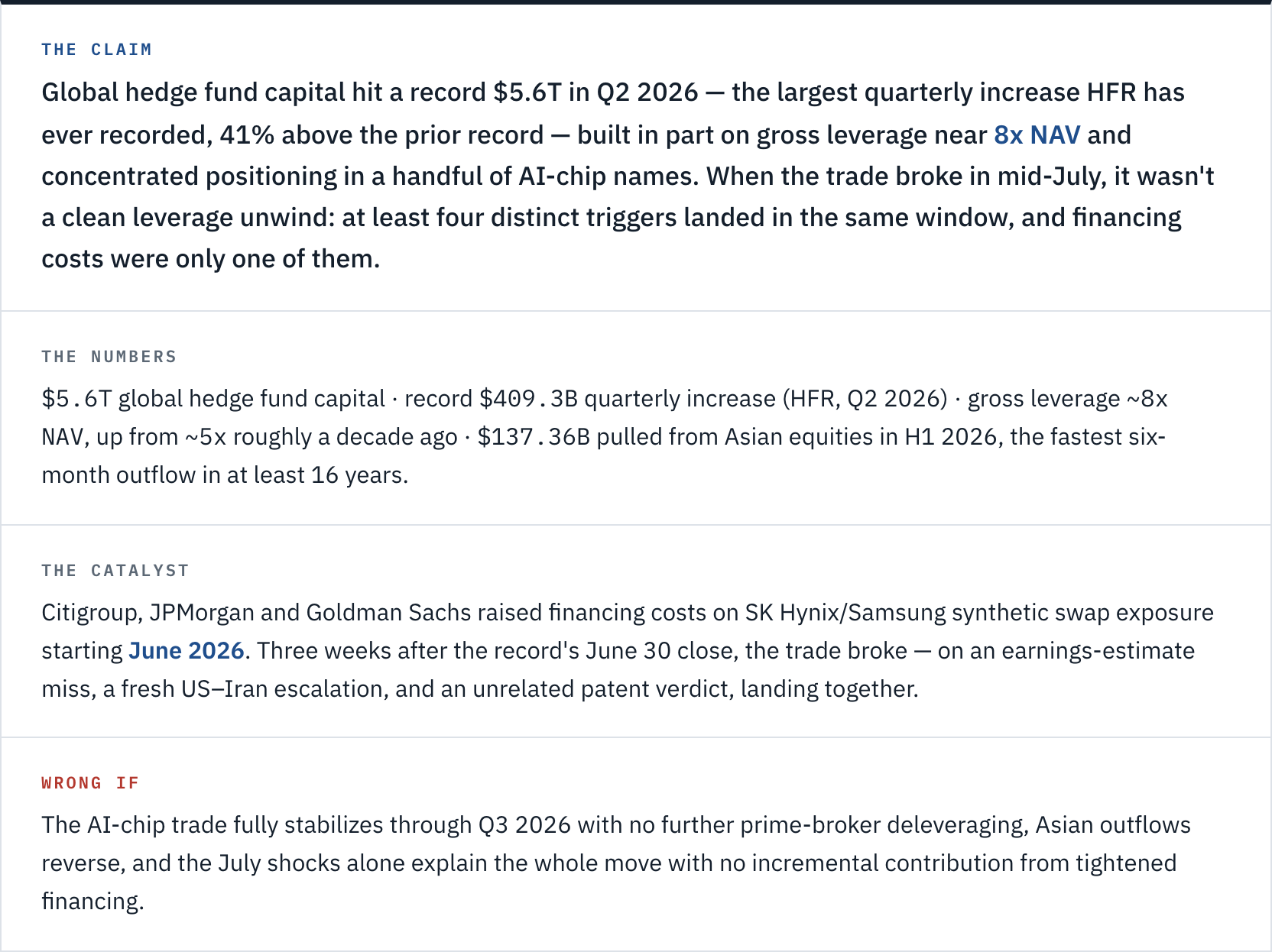
Global hedge fund capital hit a record $5.6 trillion in Q2 2026 on the largest quarterly increase HFR has ever recorded — built in part on gross leverage near eight times NAV, concentrated in a handful of AI-chip names. And when that trade broke in mid-July, it was not a clean leverage unwind: at least four distinct triggers landed in the same window, and financing costs were only one of them.

The record, precisely
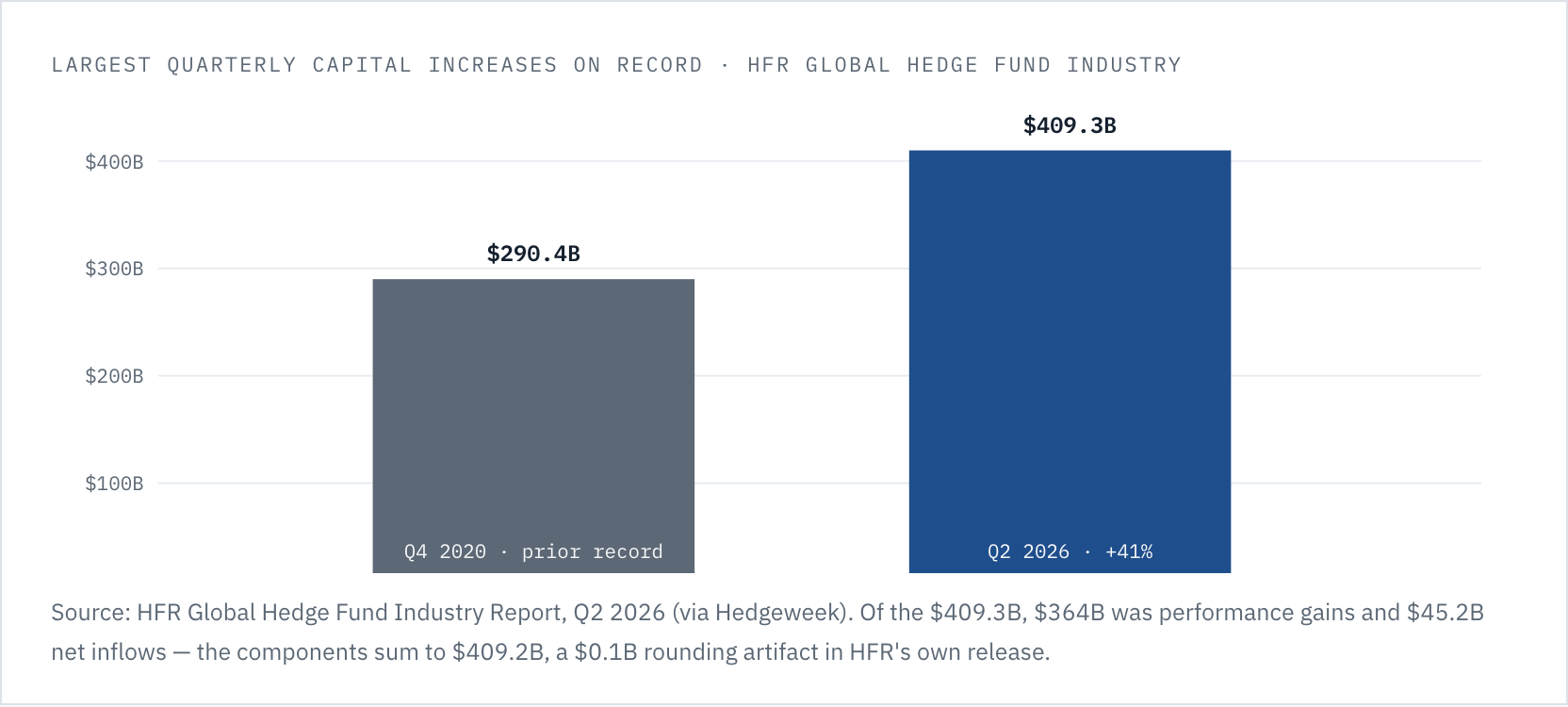
Global hedge fund industry capital rose to $5.6 trillion at the end of Q2 2026, up $409.3 billion in the quarter alone — the largest single-quarter increase HFR has recorded since it began tracking the industry, surpassing the previous record of $290.4 billion set in Q4 2020 by 41% ($409.3B / $290.4B = 1.41x) Hedgeweek: Hedge fund assets surge by record $409bn to $5.6tn in Q2. Of that increase, $364 billion was performance gains and $45.2 billion was net investor inflows — the two components round to $409.2B against HFR’s own stated $409.3B total, a $0.1B rounding artifact in HFR’s release, not a discrepancy this piece introduces — extending a run of 15 consecutive quarterly expansions Hedgeweek: Hedge fund assets surge by record $409bn to $5.6tn in Q2. HFR President Kenneth J. Heinz put it plainly: “The current environment is unequivocally the strongest for hedge fund capital growth since industry inception” Hedgeweek: Hedge fund assets surge by record $409bn to $5.6tn in Q2 — consistent with HFR’s own Q1 2026 commentary on the run-up to that record HFR: Investor Inflows Drive Global Hedge Fund Industry Capital To New Record.
The HFRI Fund Weighted Composite Index gained 7.5% in H1 2026, its strongest first half since 2021, led by equity hedge strategies (+9.6%, with the technology-focused sleeve specifically up 19%) Hedgeweek: Hedge fund assets surge by record $409bn to $5.6tn in Q2. Equity hedge assets alone grew $173 billion in Q2 to $1.76 trillion. This is the headline story, and it is real: by dollar magnitude, this is the fastest the industry has ever added capital in a single quarter. It is also a global, cross-strategy figure — event-driven, macro, relative value and fixed income all contributed alongside equity hedge — so nothing below should be read as claiming the entire $409.3B traces to one trade. It doesn’t. What follows is about the specific, disproportionately AI-chip-exposed slice of the industry that grew fastest and broke first.
Where AI-focused managers actually stand, and why the number keeps moving
Underneath the industry aggregate sits a smaller, faster story: a handful of pure-play AI managers posting “some of the fastest asset growth rates the industry has ever seen” Hedgeweek: AI-focused managers deliver fastest asset growth in hedge fund industry history. Situational Awareness — founded by former OpenAI researcher Leopold Aschenbrenner in late 2024, backed by Jane Street and the Collison brothers — grew to over $20 billion in assets in under two years, up roughly 270% year-to-date through May 2026 and more than 1,000% net of fees since inception, running on 8 employees at the start of 2026 Hedgeweek: Situational Awareness soars past $20bn; WithIntelligence: Focus on AI companies fuels fastest-growing hedge fund managers in industry’s history. One of its disclosed core positions is SK Hynix Hedgeweek: Situational Awareness soars past $20bn — the same South Korean memory-chip maker at the center of the July reversal below. To be clear about what that link does and doesn’t establish: no public reporting located for this piece shows Situational Awareness’s own July performance, and its disclosed portfolio has separately included semiconductor-sector put exposure — so its SK Hynix stake illustrates the broader theme’s positioning, not a confirmed casualty of the reversal specifically.
Value Aligned Research Advisors (VARA), a roughly 20-person Princeton firm, tells a parallel story: its long-only sleeve grew from $542 million at the end of 2024 to $5 billion by June 2026, and its long/short VAR AI Fund reached $15 billion, for $20 billion total — after gains of 113% in 2025 and 90% through April 2026 WithIntelligence: Focus on AI companies fuels fastest-growing hedge fund managers in industry’s history. What happens when AI-fund AUM outgrows its opportunity set is a story I’ve documented before — the last generation converged to index-like exposure at scale: AI Hedge Funds Now Run 0.99 Beta to the S&P. You’re Paying 2 and 20 for an Index Fund.
Here is the mechanism a Bloomberg terminal summary won’t flag: these funds’ own SEC-filed numbers do not agree with each other, let alone with the press. Situational Awareness’s Form ADV — the regulatory-AUM figure advisers are legally required to report — showed just $383 million, while the same fund’s own Q4 2025 Form 13F (covering long US equity positions as of December 31, 2025) separately disclosed $5.5 billion in long equity exposure alone Forbes: What One Former OpenAI Researcher’s SEC Filing Tells You About The Real AI Race — a roughly 14x gap between two SEC-filed figures for the same fund ($5.5B / $383M = 14.4x). Part of that specific gap is mechanical, not just timing: a 13F captures gross long exposure including leverage, not net regulatory AUM, so a highly-levered long book will show a 13F figure well above the ADV’s net number even measured on the same day. Press coverage separately put the fund at $20 billion just months later Hedgeweek: Situational Awareness soars past $20bn — a ~52x gap against the original $383M ADV figure. VARA’s SEC registration separately shows roughly $9.1 billion in regulatory assets FinTRX: Value Aligned Research Advisors, LLC firm profile, an undated aggregator snapshot; trade press had the firm at $20 billion within the same general window — again more than double (2.2x) WithIntelligence: Focus on AI companies fuels fastest-growing hedge fund managers in industry’s history.
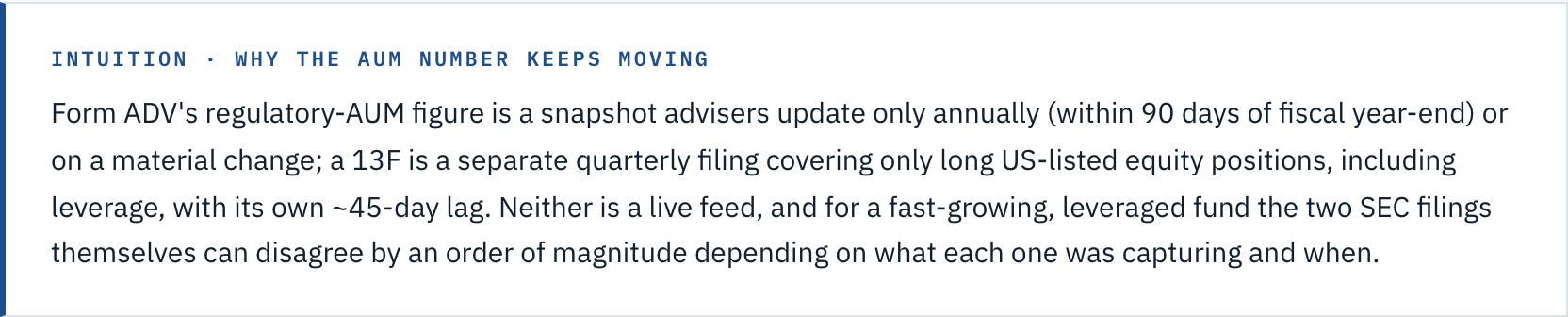
This is not an accusation that any fund misreported anything — each figure is a real, dated SEC or press disclosure; they measure different scopes (net vs. gross, annual vs. quarterly) at different lags. The point is structural: for funds compounding assets at multiples-per-half-year, none of the disclosure mechanisms investors and journalists use to sanity-check manager-claimed AUM — not the annual ADV, not the lagged and gross-inclusive 13F, not press coverage — agree with each other closely enough to pin down a “current” number, and the gap ranges from roughly 2x (VARA) to an order of magnitude or more (Situational Awareness). The “fastest growth in history” is also, definitionally, the growth every available disclosure mechanism is structurally the least equipped to measure in real time.
The other side of the same balance sheet: leverage, not just capital
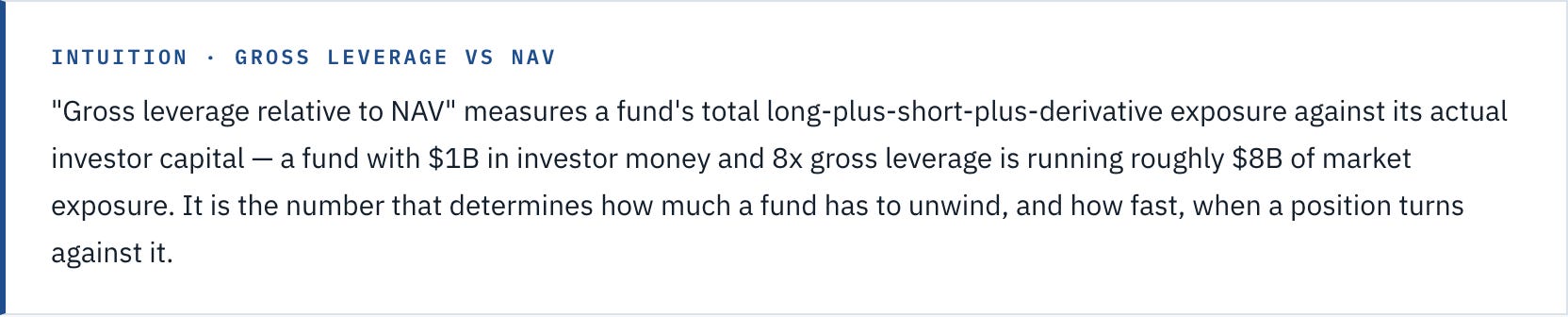
The $5.6 trillion HFR figure is net investor capital. It is not the industry’s actual market exposure. Two sources put hedge funds’ mean gross leverage ratio (total long, short and derivative exposure relative to NAV) at approximately 8x, up from roughly 5x about a decade ago: the Federal Reserve’s Financial Stability Report, via a report on its findings, and a separate S&P Global assessment published in early May 2026 Atlantic Council: As markets turn volatile, leverage is back in the spotlight; Resonanz Capital: Four Banks, Eight Times Leverage — What the S&P Warning Means for Hedge Fund Counterparty Risk. Neither link is the primary document itself — the Atlantic Council piece is commentary on the Fed’s report (the report itself is a large PDF this piece could not extract reliable text from directly), and the Resonanz piece is a boutique advisory note citing an S&P Global report that is not publicly linked and appears to be subscription-gated. Worth disclosing directly: the Resonanz piece’s own source list includes this same author’s prior published work as one of its inputs, alongside named third-party data providers — so while the specific 8x/68%/25% figures are attributed by Resonanz to those other named sources, not to that prior piece, the two “independent” corroborating chains for the leverage figure are not as fully arm’s-length as an “independently corroborated” framing would suggest. Treat the 8x figure as well-attested by trade coverage of both the Fed and S&P Global, not as two airtight independent primaries. That leverage growth (8/5 = 1.6x, a 60% rise in the ratio itself) is layered on top of the net-capital growth — meaning gross market exposure has been growing faster than the headline AUM number for roughly a decade, and the gap is widest right now.
That leverage is not diversified across the financing system. BNP Paribas, Barclays, Goldman Sachs and Morgan Stanley collectively account for roughly 68% of industry-wide prime brokerage revenue share, and their combined prime brokerage revenue rose approximately 25% over the past year as balances and margin lending expanded Resonanz Capital: Four Banks, Eight Times Leverage. (I mapped the revenue mechanics behind that concentration in How Prime Brokers Make $37B: Revenue Models Behind $6.2T Hedge Fund Leverage.) That is a separate statistic from — not the same banks as — the three institutions named below that specifically tightened AI-chip swap financing; only Goldman Sachs appears in both groups. The Fed’s own report separately notes hedge funds’ long US Treasury exposure hit a record $2.4 trillion — about 10% of all private-sector Treasury holdings — with $631 billion sitting in interest-rate swap-spread basis trades, a structure related to the swap positions that were unwound in April 2025 after that year’s tariff shock (the separate, comparatively stable cash-futures Treasury basis trade held up through that same episode) Atlantic Council: As markets turn volatile, leverage is back in the spotlight. Separately, margin debt reached $1.416 trillion in May 2026 (+53.7% year-over-year, 4.45% of GDP versus a historical median of 2.37%), with only three prior periods — late 1999–early 2000, mid-2007, and spring 2021 — showing comparable growth rates RealClearMarkets: Behind the AI Rally Lies a Dangerous Leverage Cycle. A full month before the named prime-broker tightening below, a 3x leveraged semiconductor ETF dropped 31% in a single session on June 5, 2026 RealClearMarkets: Behind the AI Rally Lies a Dangerous Leverage Cycle — an early sign that leverage in the sector was already fragile before any bank is reported to have acted.
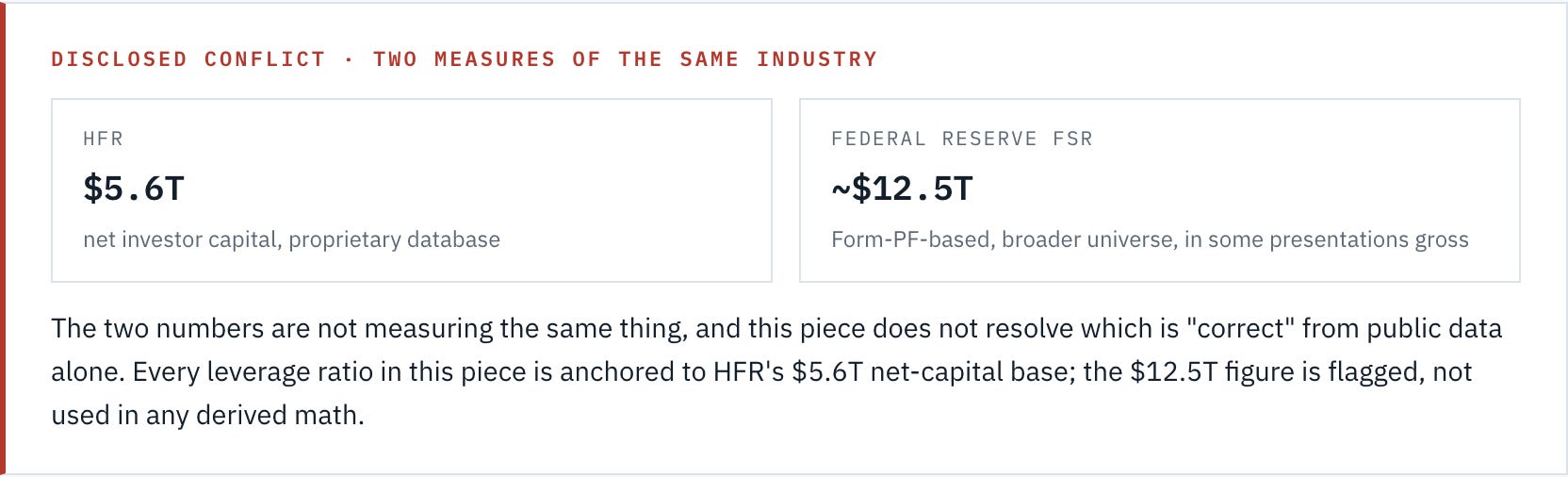
The conflicting figure is the Fed’s Financial Stability Report citing total hedge fund AUM around $12.5 trillion Atlantic Council: As markets turn volatile, leverage is back in the spotlight — every leverage ratio in this piece is anchored to HFR’s $5.6T net-capital base; the $12.5T figure is flagged here, not used in any of this piece’s derived math.
