


The consensus: a neutral speech is already priced
Bank of America’s August fund manager survey states it plainly (Investing.com). 53% expect a neutral tone from Warsh at Jackson Hole, 31% expect hawkish, and 7% expect dovish. Cash balances sit at 3.5%, near a record low. Global equity allocation runs a net 56% overweight, the highest since November 2021. A record 56% of respondents call for a “no landing” outcome, and 43% call for an outright “boom,” the most since February 2022. Seventy-two percent do not expect a rate increase before the November midterms.
That’s a coherent, defensible position, and I want to state it at its strongest before I depart from it. Warsh has already told markets what to expect from him personally. In his July 29 press conference he said market prices “will continue to respond in the direction and magnitude they see fit,” and that the central bank “need not always and everywhere be the center of attention” (CNBC). He’s stripped forward guidance out of FOMC statements on purpose. A chairman who has already announced his own reticence gives professional listeners very little to misread on August 28. If the market has already absorbed that Warsh won’t move it by design, a “neutral” outcome isn’t really a forecast. It’s close to a tautology. Pricing calm around a man who told you he plans to be calm isn’t a mistake.
Layer the labor data on top and the calm reads as informed. It rests on real numbers, not optimism. Nonfarm payrolls fell by 23,000 in July, reversing a revised 20,000 gain in June and running well under the prior twelve months’ 34,000 monthly average (BLS data via reporting). The decline was concentrated in government payrolls; private hiring still managed a small gain. The unemployment rate ticked down to 4.1% from 4.2%, though that decline came mostly from fewer people looking for work. Fewer looking, not more hired. I would not read it as good news dressed up as a number. Average hourly earnings growth slowed to 3.2% over twelve months, the softest since May 2021. A softening labor market, on the standard read, is exactly the kind of evidence that talks a hawkish chairman toward patience. Softer, not broken. That is the consensus, and every piece of it holds up.
There is a second, more technical argument underneath the survey. Warsh has three hawks on his own committee actively agitating for a hike: Cleveland’s Beth Hammack, Minneapolis’s Neel Kashkari, and Dallas’s Lorie Logan all dissented at the July meeting, each preferring to raise the target range a quarter point (Federal Reserve). First unified hawkish dissent since 2016 (InvestmentNews). A chairman managing that kind of pressure has every incentive to sound boring in public, and sounding boring is itself a form of guidance: it signals the center is holding against its own hawks without saying so. On that view, “neutral” is Warsh choosing not to hand the hawks a headline three weeks out. I take that read seriously.
The variant view: the market already tested this, with money
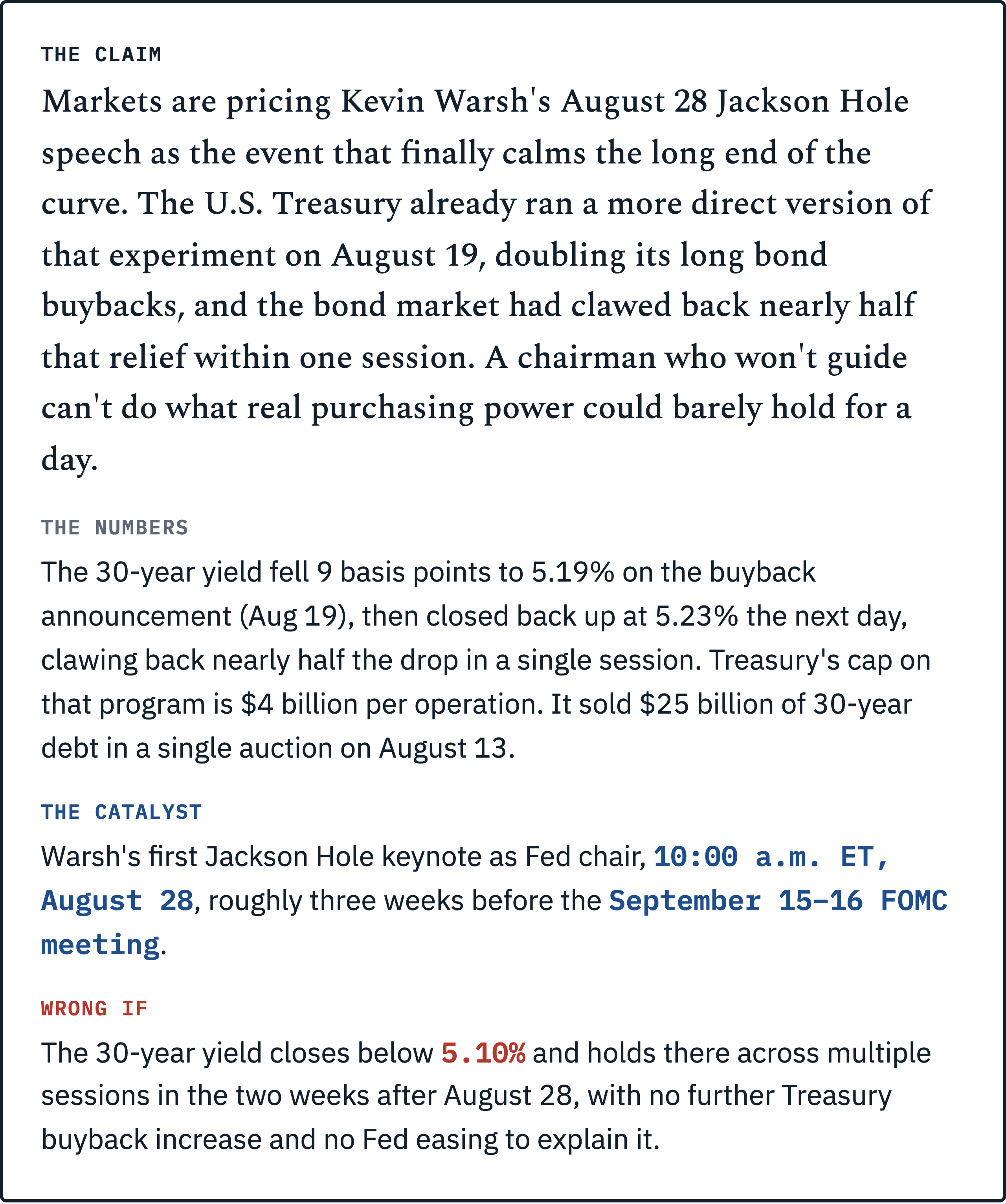
Here’s the observation that forces a different read. On August 19, three weeks before anyone was scheduled to hear from Warsh, the U.S. Treasury tried to do with dollars what the market is hoping Warsh will do with words. Scott Bessent announced Treasury would at least double the size of its long end liquidity support buybacks, covering the 10 to 20 year and 20 to 30 year sectors, from a $2 billion cap to a $4 billion cap per operation, running September 9 through November 4 (Treasury press release, reported; personally led by Bessent per CNBC). It’s the government’s own debt manager showing up with a bid, real money against a real price.
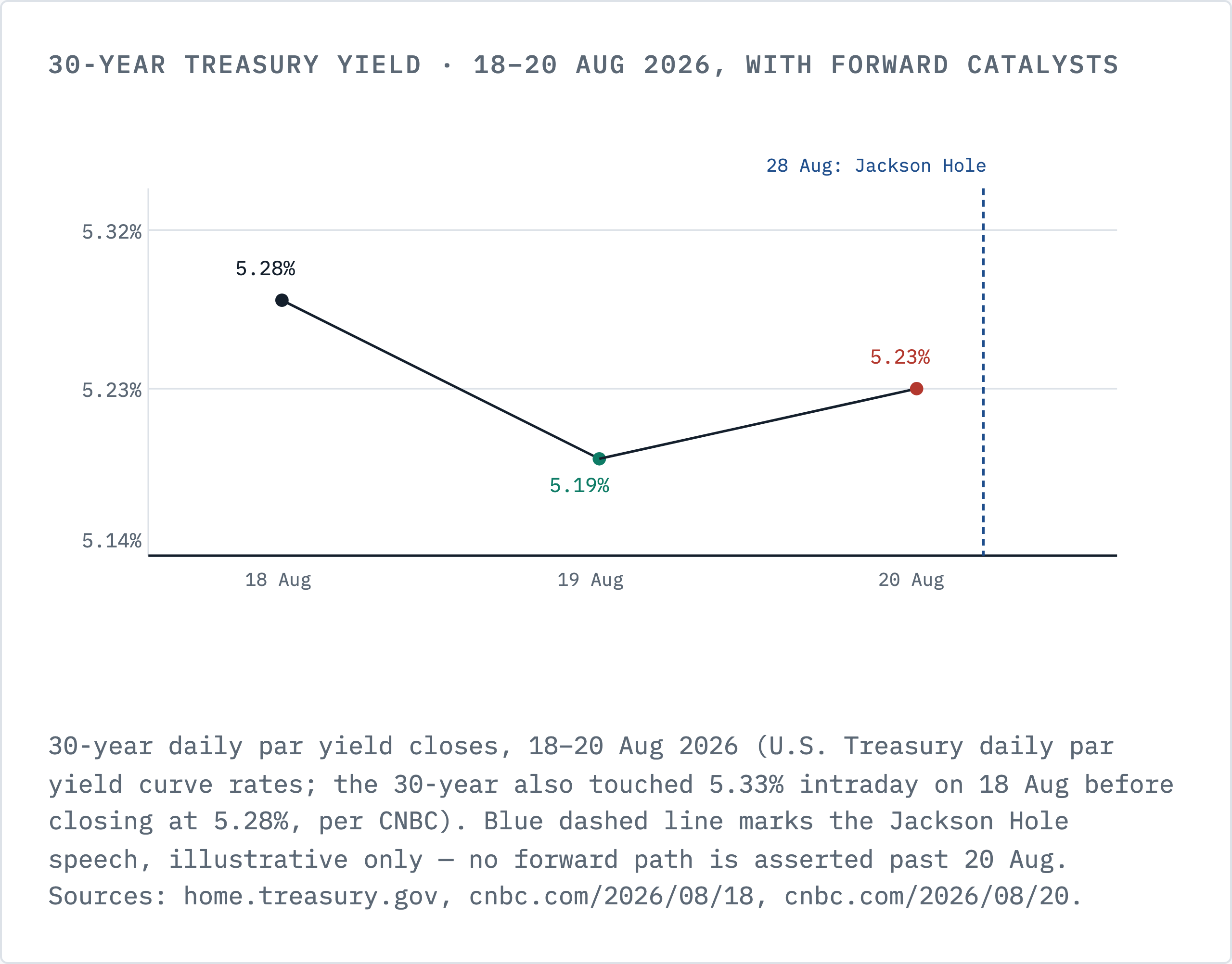
The 30-year yield, which had touched a fresh 19-year high of 5.33% intraday the day before and closed at 5.28% (U.S. Treasury daily par yield curve rates; CNBC via Wayback Machine), fell 9 basis points to 5.19% on the news. By the next session it had climbed back to 5.23%, still five basis points short of where it sat before the buyback was ever announced (U.S. Treasury daily par yield curve rates). Nine basis points down. Four back up the very next session. Nearly half the relief was already gone. Line it up: August 18, 5.28% at the close. August 19, buyback announced, 5.19%. August 20, 5.23%. Almost half the drop unwound before the announcement had finished traveling through a full news cycle.
Bessent then went out and called the $4 billion figure a floor and vowed to go bigger (Euronews). That’s what you say when the first number didn’t hold. I don’t read that as the behavior of a program that worked, and I doubt Bessent does either, whatever the public framing says.
My own read is that this failed experiment tells you more than Jackson Hole itself will, because it isolates the one variable everyone’s actually arguing about. Warsh’s speech will combine two effects at once, communication and any hint of a policy shift, and nobody will be able to cleanly separate them afterward. The Treasury operation was communication and cash with zero change to the policy rate. It failed on its own terms in a single trading session. If a direct increase in demand for the paper can’t hold the yield down, I don’t see how a speech with no purchasing power behind it, from a chairman who’s told you in advance he intends to say as little as possible, does better. It’s the same lever, just weaker.
The mechanism: why dollars failed where only more dollars can work
A liquidity support buyback is Treasury repurchasing older, less liquid bonds to smooth market function. I don’t think it was ever meant as a policy tool for bending the yield curve. Using it to fight the term premium is a bit like pointing a fire extinguisher at the weather. It can put out a single flare up. It cannot touch the humidity.
Here is the intuition on term premium, since it is doing most of the work below. It is the extra yield investors demand to hold long dated debt instead of rolling short dated debt over and over, compensating for the risk that future rates, inflation, or supply surprise them badly. I think of it as the price of not knowing. It is the piece of the 30-year yield that is not explained by where the Fed sets overnight rates. Two forces are pushing it higher right now, and I read both as structural. Neither cares much what gets said from a podium.
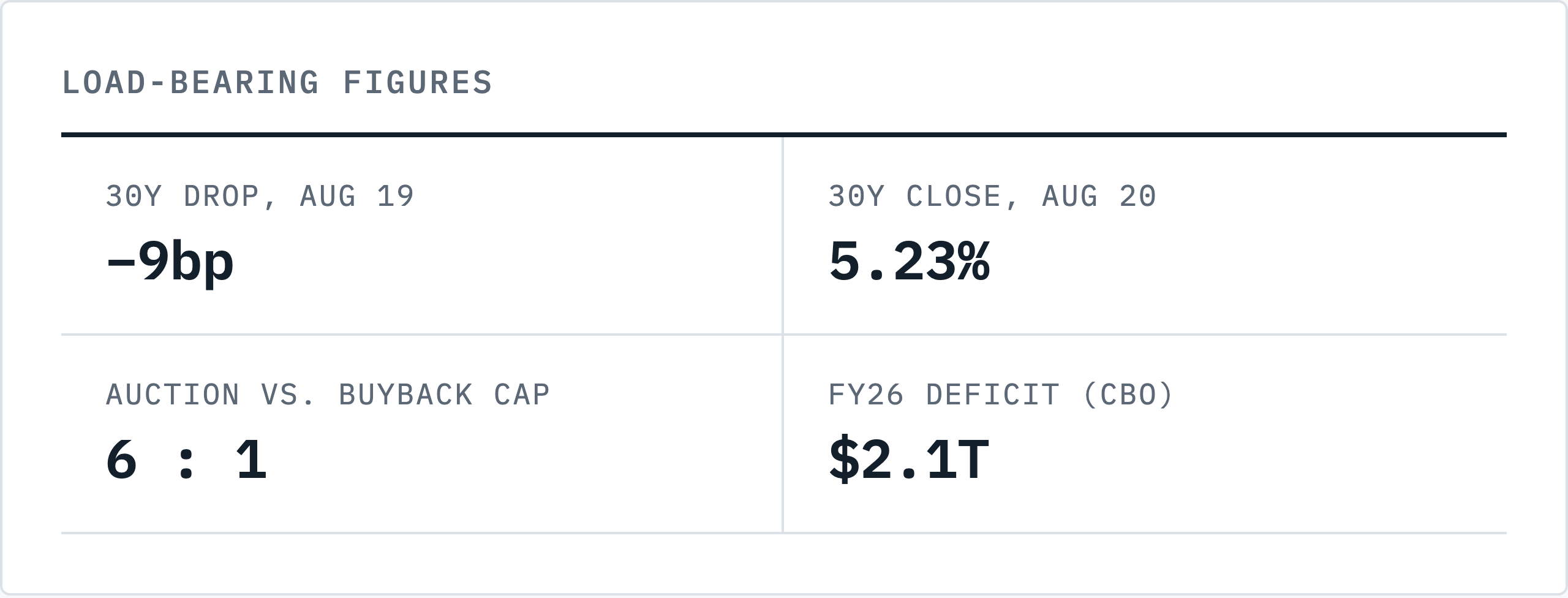
First, supply. The CBO’s $2.1 trillion deficit estimate sits $200 billion above its February projection, and Treasury auctioned $25 billion of 30-year paper in a single sale on August 13, against a buyback program capped at $4 billion an operation. The government is issuing roughly six times more debt in one auction than it is repurchasing in one operation. Six to one. That is not a program sized to move the price of the thing it is buying, and it was never built to be. I’ve written separately about the budget side of the same buyback, where the doubled per-operation cap didn’t come with a larger quarterly envelope behind it, reallocation rather than new firepower. Reading a liquidity buyback as a yield suppression tool is a category error. The market made that exact error for one day before correcting itself.
Second, demand. Foreign appetite for U.S. debt is fading. The U.K. has overtaken China as the second largest foreign holder of Treasuries, behind only Japan (Congressional Research Service, Treasury International Capital data), while both China and Japan have been steadily trimming their holdings. When the largest natural buyers of long paper shrink their positions as the issuer sells more of it, the clearing price moves against the seller, regardless of the podium in Wyoming. This does not mean foreign buyers are boycotting the auction; every recent 30-year sale has cleared fine. It means the marginal buyer is more price sensitive than it used to be, so the yield needed to clear a given size keeps drifting higher, independent of anything the Fed says. A price sensitive buyer does not respond to a speech. It responds to the coupon. Demand set the price, not Wyoming.
Warsh’s silence makes the term premium worse, not better
Warsh’s own framework compounds the problem instead of offsetting it. Goldman Sachs chief economist Jan Hatzius has warned that stripping out forward guidance leaves markets with less information and, in his words, potentially “more inaccurate beliefs” about the policy path (Fortune). He names two risks: policy that lags the real economy because markets misjudge the Fed’s reaction function, and volatility from investors overreacting to routine data because there is no anchor to weigh it against. Jeremy Siegel went further after the July press conference, saying it “fell well short” of explaining the framework behind the committee’s decisions (Fortune). Evercore ISI’s Krishna Guha put the contradiction plainly. Warsh wants the market to set an unguided yield curve on its own, but “it is hard to make that case when investors see Bessent as trying to manage the long end” (Yahoo Finance). Warsh removed the one lever that could offset a rising term premium, and calls it a feature. His own Treasury Secretary is quietly trying to do the job for him.
None of this sits in isolation. The FOMC’s own July minutes, released August 19, the same day as the buyback announcement, judged the equity premium (the forward earnings to price ratio, adjusted for long rates) to be at a level “that has only been lower in recent history during the dot-com bubble” (Federal Reserve). Stretched equities and a rising term premium are the same trade wearing two faces. A committee that just wrote down valuation risk on the equity side has little reason to lean on its own chairman for a costless favor on the bond side too.
I would put more weight on the buyback failure than on almost anything Warsh says on August 28. It is the closest thing to a controlled test this cycle has produced. Communication changed. Purchasing power changed. Policy rate did not. The yield moved for a day and came back. Up, then back. A term premium problem revealing itself. Not a credibility problem waiting on better phrasing.
The discriminator: why this isn’t just markets testing resolve
The obvious rebuttal is that markets are simply testing Bessent’s resolve, the way they tested the Bank of England in September 2022, and resolve eventually wins if the authority keeps showing up. Let me flag the imperfection in that comparison before I lean on it, since I’d rather name it than have a reader find it for me: the BOE was stopping a disorderly crisis in gilt selling by pension funds, feeding on itself, not targeting a yield level in an orderly market the way Bessent is. Different problem, and the part of the comparison that transfers is narrower than “crisis beats no crisis.” It’s a fair comparison on the narrower point, and I’d have believed the broader version myself a few weeks ago. I don’t think the broader version survives the details once you actually line the two episodes up side by side. What transfers is the design of the commitment itself.
The Bank of England’s gilt intervention worked because it was structured as unlimited. The Bank said it would buy whatever scale of long gilts was necessary to restore order, capped operationally at £5 billion a day but framed as open ended, running from September 28 to October 14, 2022 (Bank of England). It ended up buying only £19.3 billion of a possible £65 billion. Thirteen days. Under a third spent. The number that mattered was never the amount purchased. It was the absence of a stated ceiling, which let the market stop testing the position because there was no edge left to find.
Treasury’s buyback program is close to the mirror image. It has a stated per operation cap, a fixed start date of September 9, and a fixed end date of November 4, all published in advance (Treasury press release, reported). Every dealer on the other side of that trade knows exactly how much Treasury can buy, on what dates, and when the program stops. A bounded, calendared operation invites the market to trade around it. I’d trade around it too, and I suspect most desks already are. The BOE’s tool worked because nobody could find its edge. Bessent’s tool has failed, so far, because everyone already has.
This is also what discriminates against the simplest bearish read, that nothing government does matters here and yields just keep climbing. I think that’s too strong, and I’d bet against it. An unlimited, Fed-backed purchase program aimed explicitly at the term premium, the sort of thing only the central bank itself can credibly announce, would very likely work, the way it worked in the U.K. Warsh has shown no appetite for that tool. He’s presiding over a committee where three regional presidents just dissented in favor of a hike, the most unified hawkish dissent since September 2016. His own words are aimed at removing himself from the conversation. Nobody is putting the balance sheet into it. The lever that could actually work is sitting unused. I read that as a choice, and I’d want to be shown I’m wrong before I’d call it a structural constraint instead.
Three things that could break this: size, sample, and a real rate signal
Three things could break this read, and a principal who found them without me would stop trusting the rest of it.
First, size. Treasury has already signaled it will exceed the $4 billion figure. If Bessent scales the program by an order of magnitude instead of incrementally, my “too small to matter” argument weakens, and I can’t rule out that a large enough, sufficiently open ended expansion starts behaving more like the BOE’s tool than its own August 19 version. Watch the size of the next announced operation. The fact of a next operation tells you little on its own.
Second, one reversal on a two day window is a small sample, and correlation isn’t causation here. Treasury had a full slate of bill and note auctions scheduled for that same Thursday, and fresh short end supply landing the same day is a real, competing explanation I can’t fully separate from the buyback’s own credibility problem. My honest guess is that it strengthens the supply argument rather than undercuts it, but I won’t pretend the two are cleanly isolated in this window. It’s still one dated episode.
Third, Jackson Hole is a speech, and it can carry more than tone. If Warsh uses it to signal an actual September rate path instead of continuing his “blank piece of paper” posture, that changes the policy rate expectation. It would reach past the term premium entirely, and duration could rally on that basis alone. My thesis is specifically about words without a rate signal attached. A real rate signal is a different animal, and Warsh hasn’t ruled one out. He told the July press conference he was approaching the speech as “a blank piece of paper,” with no drafting begun as of that date. That cuts both ways. The speech is still undetermined. Nobody has committed it to a script yet, so a chairman managing three open hawkish dissents has just as much reason to use a blank page for a hawkish signal as a dovish one.
What would change this view
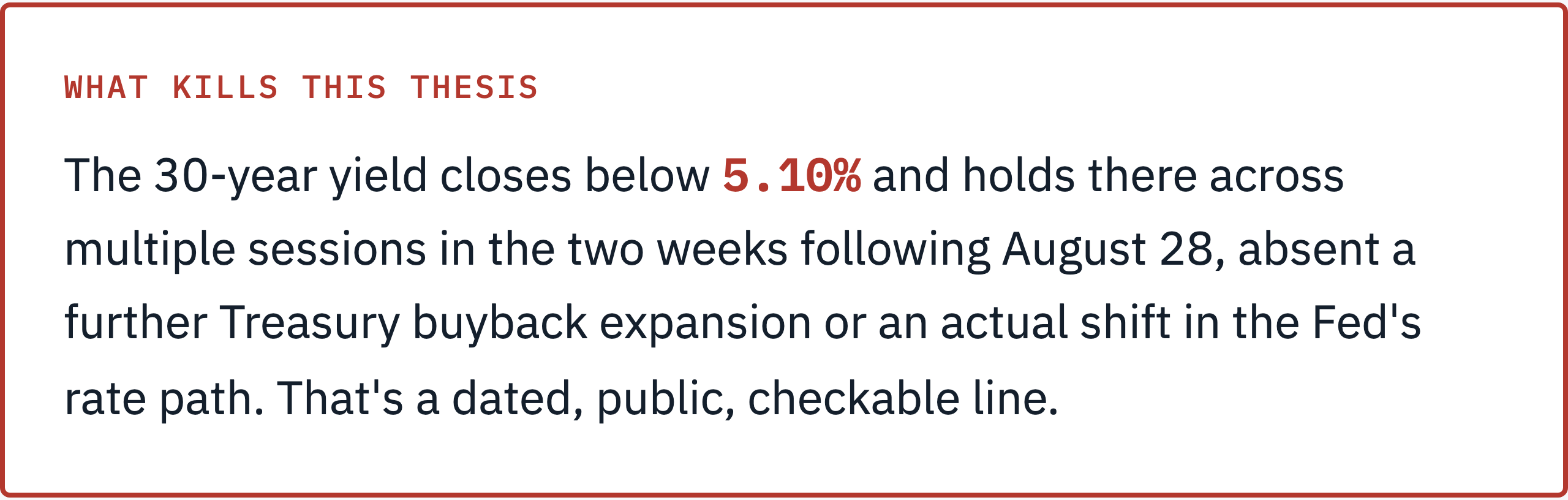
If it happens on Warsh’s words alone, my read on communication versus term premium is backward, and I’d rather say so in three weeks than defend a thesis the tape has already killed.
I’m also watching the size of Treasury’s next buyback announcement at the November 4 refunding. A jump from $4 billion toward the tens of billions per operation would tell me the government has decided to fight the term premium with size, not symbolism. That’s the one version of this trade with real precedent behind it, and I’d have to take it seriously if it shows up.
The trade: fade the podium, watch Bessent’s checkbook
If the last four weeks are a fair sample, the long end of the curve isn’t taking instruction from anyone in Washington anymore. It’s pricing a deficit and a shrinking pool of foreign buyers, and no podium changes either number. I wouldn’t size a bet on Jackson Hole compressing the 30-year yield on communication alone. My trade fits the opposite way: fade any relief rally in long duration Treasuries or rate sensitive equities that shows up purely on Warsh’s tone, and treat a durable move as real only once it survives the next 30-year auction, October 8, without a fresh Treasury intervention holding the yield down first. Watch the size of the next buyback operation before you watch the transcript of the speech. Bessent’s checkbook is a cleaner tell than Warsh’s podium, and it’s already told you the term premium isn’t for sale at these prices. I’ve laid out the full position, including entry, sizing, stop, and the two dated catalysts that would confirm or kill it, in a deeper note on Patreon.
The implication splits by mandate, and I’d size it differently depending on which desk I sat at. A rates desk running duration should treat any Jackson Hole rally in the 30-year as a fade unless it survives the next 10-year and 30-year auctions without fresh buyback support underneath it. A fund running several strategies at once, sitting inside the BofA survey’s crowded long equity, low cash positioning, should note that the same forces pressuring the long end, an unabsorbed deficit and a thinning foreign bid, are the ones the FOMC’s own minutes just flagged as consistent with the valuation era it named outright. Those aren’t two separate risks to hedge. They’re one risk, priced twice, in two markets currently pretending not to notice each other. I wouldn’t hedge them separately if I ran both books. I’m not going to hand you a size or an instrument here, on purpose. Duration exposure is personal to whatever your book already holds in a way a single name idea isn’t, and a specific ticket would pretend otherwise.
On capacity, this is not a crowded strategy with a small ceiling. Fading a rally driven purely by communication, whether in 30-year Treasuries or in equities sensitive to duration, sits inside the deepest, most liquid markets in the world, the kind that can absorb billions without moving the clearing price against the trader the way a niche credit strategy would. The constraint here is not capacity. It’s a calendar. The mispricing decays the moment either side of the evidence changes: a further Treasury buyback expansion at the November 4 refunding, a genuine signal on the rate path from Warsh rather than a tone, or a full auction cycle that clears without support. Until one of those happens, I don’t see a size limit on the position, only a shelf life on the thesis.
Here’s the specific question worth arguing about, because reasonable people land on both sides of it: if Treasury’s own $2 billion increase in real purchasing power couldn’t hold the 30-year yield down for one full session, what size operation, or what actual change in the policy rate, would you need to see before you’d trust a rally in long duration paper to hold?
📊 The Decision-Grade Version
This piece is complete on its own. The thesis, the evidence, and what would kill the view are all above, and nothing was held back to sell you a next step.
The Patreon note is a separate piece of work rather than a deeper cut of this article. It takes one trade from inside this story, i.e. fading any tone-driven Jackson Hole rally in the 30-year, and writes it the way a desk would act on it: the position, the levels, the sizing, and the risk that would take it off. Written for people who put capital behind a view.
→ Read the Treasury buyback trade note
→ Or join the Patreon community for every note
I post the research behind these pieces on YouTube and LinkedIn as well, if either is where you’d rather follow along.
Cover photograph: Rhododendrites, CC BY-SA 4.0, via Wikimedia Commons.