


EquiLibre Technologies’ $500M venture valuation prices its AI trading operation using software-scaling logic — but Grinold’s law, the 2007 quant unwind, and Renaissance’s own three-decade capacity discipline all show a trading edge scales in the opposite direction from a software product.

Three former DeepMind researchers spent the early 2020s teaching a computer to bluff. Martin Schmid, Rudolf Kadlec, and Matej Moravčík co-authored DeepStack, the first program to beat professional players at heads-up no-limit hold ‘em, while working out of DeepMind’s Edmonton office as visiting researchers. In 2022 they moved back to Prague and founded EquiLibre Technologies, betting that the reinforcement-learning techniques that solved poker would generalize to a domain with an even simpler reward signal: markets, where the score is just the account balance.
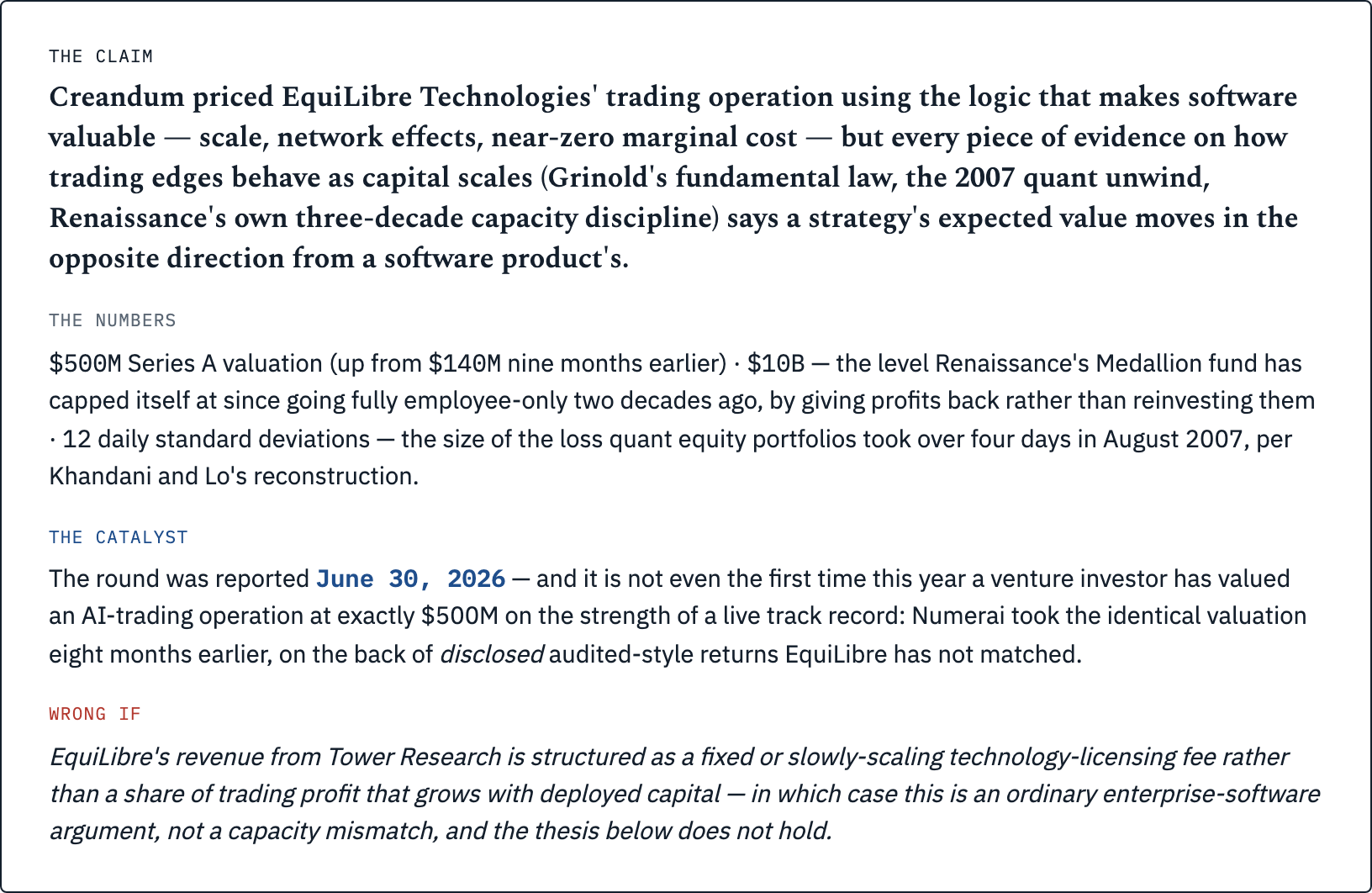
That bet just got priced at $500 million, roughly 3.6x the $140 million seed valuation EquiLibre carried nine months earlier. The round was led by Creandum, the European venture firm behind Spotify and Klarna, whose vice president Cameron Sellers confirmed to TechCrunch it was “the largest single investment the firm has ever made in one go into a company”. Neither Creandum nor EquiLibre has disclosed the actual dollar size of the check behind that superlative, or the round’s total size — only the resulting $500M valuation — so “largest investment ever” describes an undisclosed capital figure, not the valuation number driving this article’s argument, and the two should not be read as the same thing.
What’s actually being priced here is not a product. It’s an unaudited trading track record — and EquiLibre is not even the first AI-trading operation to get this exact treatment this year. Numerai, an AI-driven hedge-fund platform backed by Paul Tudor Jones, raised a $30 million Series C in November 2025 — eight months before EquiLibre’s round — at the identical $500 million valuation, after growing AUM from roughly $60 million to $550 million and posting a 25.45% net return in 2024, its strongest year. The difference is disclosure: Numerai’s return and AUM figures are stated and dated; EquiLibre’s “zero negative months” is not. Two AI-trading startups, the same $500M number, and very different amounts of the underlying evidence made public.
Tower Research Capital’s own website confirms that in late 2023 the three founders agreed to contribute their algorithms exclusively to the firm — republishing Bloomberg’s original May 2024 report on the arrangement — giving EquiLibre a live, revenue-generating book roughly two and a half years before its Series A closed. Tower Research is the New York proprietary trading firm Mark Gorton and Alistair Brown founded in 1998 that has historically traded only its own capital across equities, futures, and FX, with no outside-investor assets under its traditional structure to answer to about capacity — though that is now changing (more on this below). Through the arrangement, EquiLibre’s agents reportedly execute billions of dollars in daily volume across the S&P 500 and Nasdaq, and the company told TechCrunch it has a “perfect record of zero negative months since inception” — counting from a 2025 rollout on crypto markets that was later extended to equities. That figure is EquiLibre’s own characterization, relayed by a single outlet; no independent performance audit, return series, or Sharpe ratio has been made public, so treat “zero negative months” as a claim awaiting disclosure, not an audited result.
The pitch is a software pitch, and Sellers says so
Sellers didn’t describe EquiLibre as a fund with a good year. Explaining the size of the check to TechCrunch, he said “the potential total addressable market of trading in the financial markets is one of the biggest on earth, and there are countless funds over the years that have generated quantums of profit that make most venture-backed successes look small.” That is TAM language — the vocabulary of a venture capitalist pricing a company against the total size of a market it might capture a share of, the same framing used for a payments processor or a cloud database. And EquiLibre’s own leadership doesn’t resist the framing: Sellers said the company “explicitly defines itself as ‘a lab first, not a finance firm.’” Schmid, EquiLibre’s CEO, told TechCrunch the appeal of markets as a training ground is precisely their software-like measurability: “the nice thing about trading and markets is that the scoring is super simple: how much money did the agent make?”
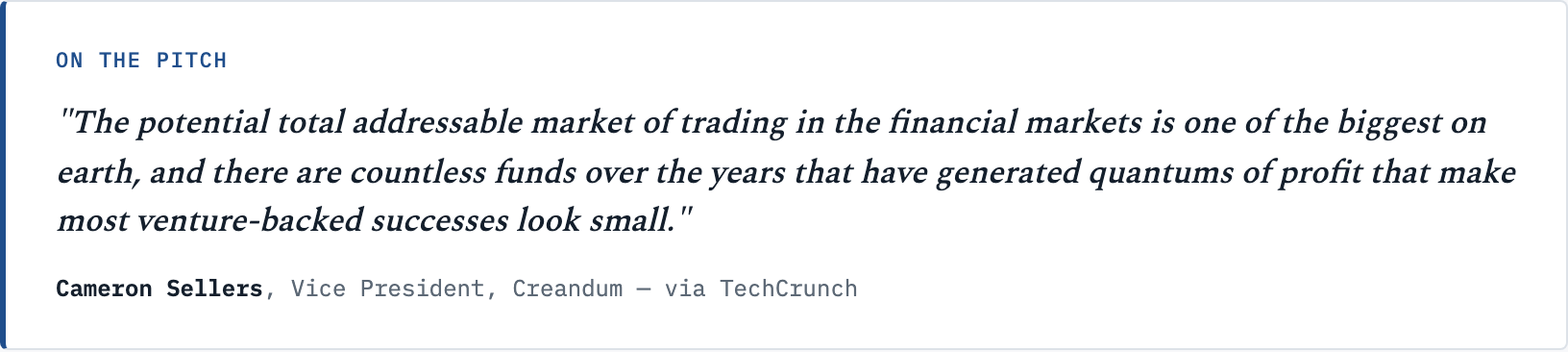

That is the correct way to talk about a research lab that ships models. It is the wrong way to talk about the economics of the thing those models actually do once deployed, because the two objects obey opposite laws.
A software company’s central promise to a venture investor rests on a mechanism a16z’s D’Arcy Coolican and Li Jin describe plainly: “platforms and products with network effects get better as they get bigger — not just in value to users, but also in accruing more resources to improve their product.” More users make the product more valuable to the next user, and the marginal cost of serving one more of them is close to zero. That combination — increasing returns to scale, cratering marginal cost — is what allows a venture fund to underwrite a startup on the assumption that a big enough share of a big enough market compounds into a business worth far more than the sum of the capital poured in.

A trading strategy does not behave this way, and the reason is not folklore. It has a name.
Grinold’s law says the opposite thing
In 1989, Richard Grinold formalized what quantitative managers now call the fundamental law of active management — published as Grinold, R.C., “The Fundamental Law of Active Management,” Journal of Portfolio Management, Vol. 15, No. 3 (1989), pp. 30-37 (the original journal archive sits behind an institutional paywall; linked here to an openly-accessible explainer that reproduces the formula and derivation intact): a manager’s information ratio — the risk-adjusted value of their skill — equals their forecasting skill (the information coefficient, IC) multiplied by the square root of breadth, the number of independent bets they can make: IR = IC × √BR. The square root is the whole point. It is a diminishing-returns function, not an increasing one: doubling the number of independent forecasts a strategy makes does not double its edge, it multiplies the edge by roughly 1.41. A trading strategy’s value does not compound the way a network’s does — it grows sublinearly with more opportunities, and separately, it shrinks as more capital chases the same opportunities, because every added dollar has to transact in the same finite pool of liquidity.
That second mechanism — capital chasing a fixed opportunity set — is capacity decay, and it is the more binding constraint for a fast, liquid strategy like the kind Tower Research runs. A strategy that holds positions for minutes or hours, the way high-frequency and short-horizon statistical arbitrage books do, earns its edge from being early to a price correction. Deploy more capital into that same signal and each additional dollar’s trade moves the price further before it fills, which taxes every dollar that follows it — the strategy’s own execution erodes the mispricing it exists to capture. This is the mechanical reason a $10 million version of a strategy and a $10 billion version of the identical strategy do not earn the same return per dollar; frequently they cannot both exist.
Software has none of this friction. A cloud database serving its ten-millionth query does not degrade the answer to the first query. A trading algorithm executing its ten-millionth dollar absolutely can degrade the price available to the first dollar — and to every dollar deployed by every other fund running something similar. Two businesses, opposite arithmetic, and Creandum’s own language treated them as the same thing.
Capacity, in dollars, for the specific style Tower Research runs
Grinold’s law explains the shape of the problem. The size of it, for the trading style involved here, has actually been measured. Tower Research Capital’s core business — the firm EquiLibre’s algorithms trade through — has historically centered on high-frequency equity trading and market-making: providing liquidity and capturing small, fast price discrepancies at high turnover, the style of trading where capacity constraints bind hardest and fastest because the edge decays within minutes, not quarters. In 2010, computer scientists Michael Kearns, Alex Kulesza, and Yuriy Nevmyvaka published an empirical study that simulated an “omniscient” high-frequency trader — one who could see future prices perfectly — to establish the theoretical ceiling on what the most aggressive style of HFT could ever extract from the entire universe of U.S. equities. Their finding: even for this best-case, all-seeing trader, the maximum conceivable annual profit pool across all of U.S. equities in 2008 was on the order of $21.3 billion at the longest holding period they studied (a 10-second hold), collapsing to roughly $21 million at the shortest (a 10-millisecond hold) — a thousand-fold difference driven entirely by how much faster the edge deteriorates the more aggressively (and therefore more capacity-sensitively) it is captured.
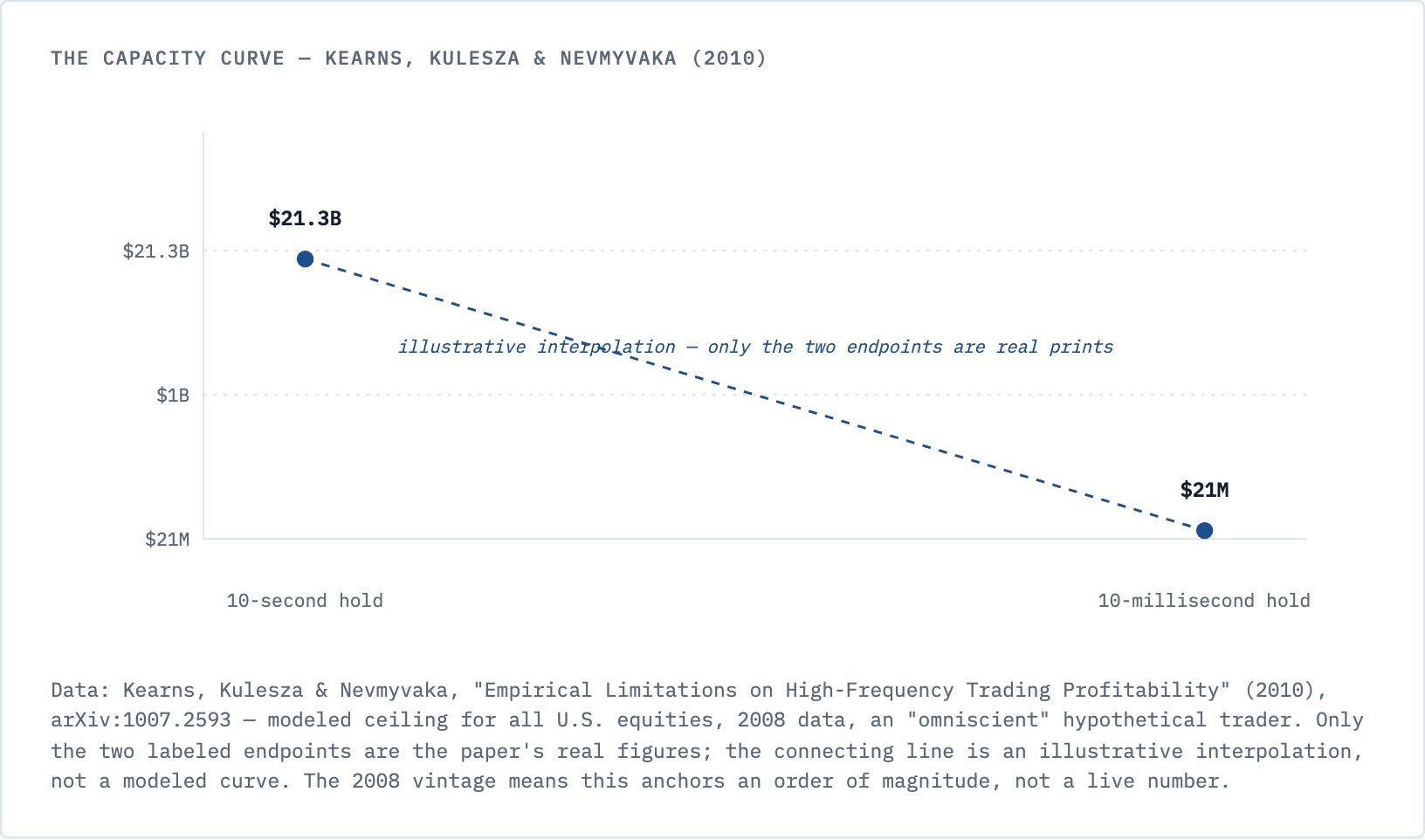
(The same capacity-ceiling arithmetic shows up whenever a strategy gets big enough to matter — trend-following hit a hard ceiling near $4 billion once the SG Trend Index sat entirely above it, and D.E. Shaw, Citadel, and Renaissance’s statistical arbitrage books run into the identical mean-reversion-speed constraint. Capacity decay is not unique to AI trading — EquiLibre is just the newest entrant discovering it.) That figure is a ceiling for the entire U.S. HFT industry combined, not for one firm, and it is eighteen years stale against a market that has grown since — so it should be read as an order-of-magnitude anchor, not a live number. But the direction it points is unambiguous: “one of the biggest [markets] on earth,” Sellers’ framing for the TAM, describes the notional size of U.S. equity and derivatives trading — hundreds of trillions of dollars changing hands — while the extractable, capacity-adjusted profit pool available to a genuinely fast strategy is, per the best public academic estimate, several orders of magnitude smaller and shrinks further the faster the edge is captured. Notional market size and addressable trading-strategy profit are different numbers, and the TAM framing conflates them.
Tower Research’s own trajectory adds a real complication here, and it cuts both ways. Per Financial Times reporting relayed in industry coverage, Tower Research is planning to launch a fund open to outside investors for the first time — holding positions for hours or days rather than the sub-second horizons of its traditional book. The stated industry motivation is competitive: slower strategies are easier to raise LP capital against and simpler to report on. That is a different, more mundane explanation than “Tower’s fastest signals hit a capacity wall” — this article will not claim more certainty than the reporting supports. But the move is still telling in the direction this piece argues: a firm builds a slower, LP-facing product specifically because its fastest signals cannot absorb more capital without degrading, and a genuinely software-like, infinitely-scalable edge would have no obvious commercial reason to trade speed for size. It also means the clean “Tower has no LPs to answer to, so it doesn’t face Renaissance’s problem” framing is no longer fully accurate — Tower is walking toward exactly that problem, on its own timeline, for its own slower strategies.
