



On 23 June Coatue’s founder, Philippe Laffont, told CNBC he owned chip equipment makers to avoid picking the winning chip. His 30 June filing put the quarter’s biggest open market buy elsewhere: 2.98 million more Micron shares, added as Micron tripled, while the equipment lines were trimmed.
Most of that filing’s chip weight came from price rather than buying. Coatue Innovative Strategies Fund (CTEK), the firm’s registered fund for qualified individual investors, hedged part of its Micron near the top. CTEK prints its shorts, and Coatue’s next 13F, due 16 November, tests whether the firm kept its Micron.
At Friday’s close the filing’s shares are worth billions less than Coatue reported, for every book that holds them.
Coatue’s June book was nearly half chips
Eleven lines did it. I call them the chip complex: TSMC, Lam Research, Micron, Applied Materials, Broadcom, Intel, Cerebras, Nvidia, ASML, Qualcomm and AMD. They were 46.4% of the June book, from 37.1% in March. A year earlier they were 17.9%. A 13F shows only the reported long book of US-listed stock, filed up to 45 days late.
Micron shows what the weight is made of: Coatue held 165,931 shares on 31 March and 3,142,269 on 30 June. Micron’s close went from $338 to $1,154 over the quarter, and a dollar column cannot tell the two effects apart.
I rebuilt the filing’s 211 rows at Nasdaq’s closes: each filed value divided by its shares gives the 30 June close to the cent on all 64 holdings with a usable close.
The book rose $19.6bn in the quarter, 67% in reported value, buying included. Tiger Global had 39.3% of its June book in the same eleven lines, the nearest of three fellow Tiger cubs. Lone Pine had 12.6% and Viking 5.1%.
A 10% move in the chip complex would move the book by $2.26bn at June’s values. This week Lam fell 17% and Applied 19%. Micron fell 15%, and any book long those names, or copied from this filing, took the same fall.
Price made the weight; Micron was the buy
Laffont runs that book: the brochure, dated 29 July 2026, gives him in Item 4 “overall responsibility for… the implementation of all portfolio transactions.” On CNBC on 23 June he gave the logic:
“All of them at the end of the day will need the same machines.”
“If I’m a supplier to the fabs, I don’t need to make an exact bet on which of the chips is going to win… That’s sort of the reasons why we own the semi caps.”
The fabs’ suppliers get paid whichever chip wins, and the 13F for 30 June, filed 14 August, agrees on the dollar column: Lam, Applied and ASML came to $7.73bn, twice the $3.63bn Micron line.
The coverage read the add as conviction. The Motley Fool headlined it on 2 September: “Billionaire Philippe Laffont Just Bought Micron Stock in Q2…” Daniel Scrivner, who blogs on managers’ holdings, called it “a strong conviction bet on memory chips as a critical AI infrastructure bottleneck.”
That holds as far as it goes, and a share count shows a count, not a motive. It leaves open how much of the weight Coatue bought, and whether the Micron line was still live when the filing was read.
The share column answers the first: March shares times the price change is the price effect, and the share change times the June close is the trading. It is the share column method we used on Tiger Global.
The chip complex’s $11.80bn rise has three parts. Price on March’s shares made $6.59bn, and Cerebras shares Coatue held before its May listing made $1.47bn. Open market buying, net of trims, made $3.74bn at June closes; bought evenly across the quarter, the same shares would have cost about $2.52bn. Outside the listing the rise is $10.33bn. Price is 64% of it on March’s shares, or $9.51bn and 92% when June’s shares weight the price change; the lower figure carries the claim on its own.
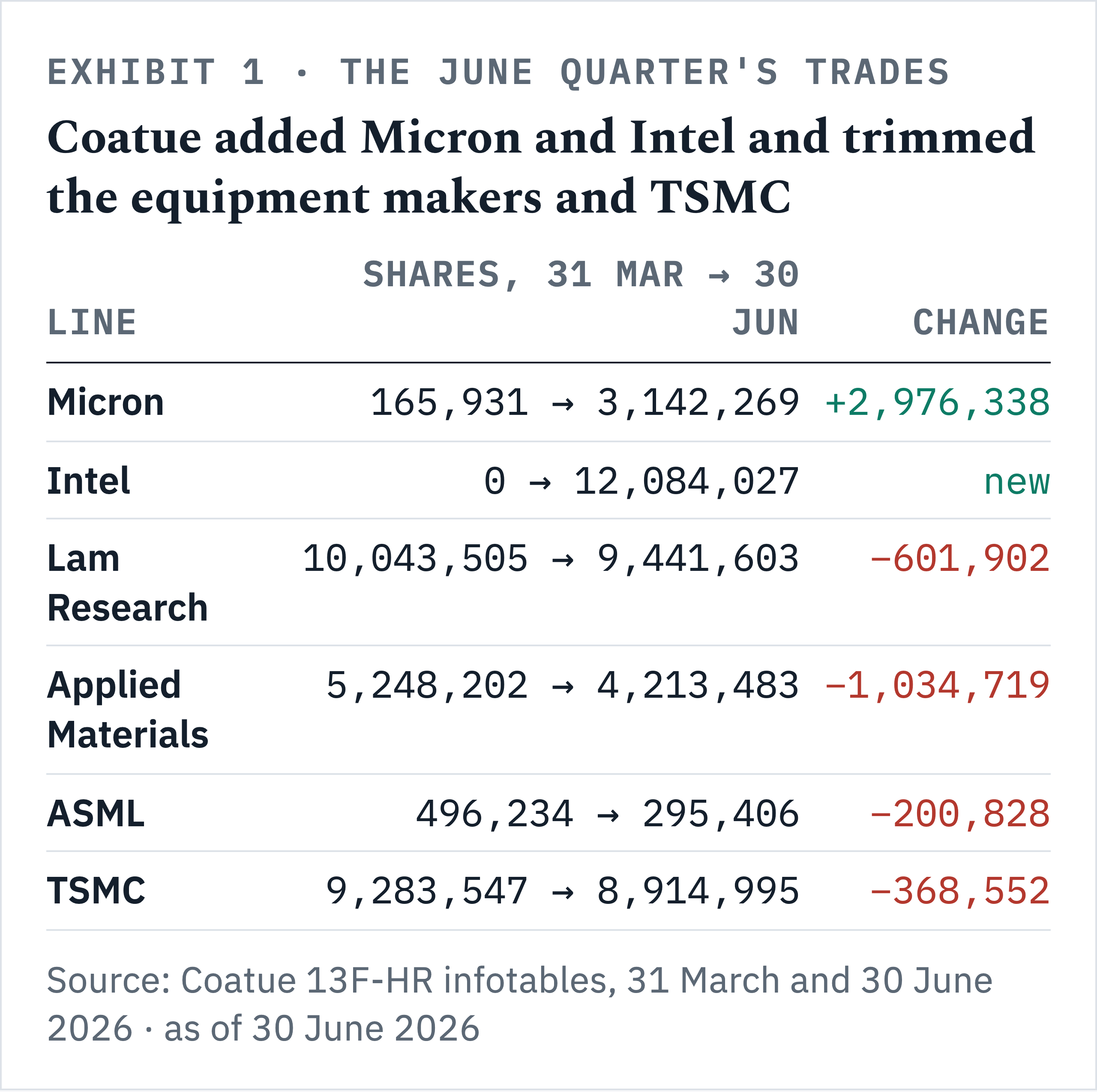
Source: Coatue 13F-HR infotables, 31 March and 30 June 2026 · as of 30 June 2026
Lam’s line rose from $2.15bn to $4.09bn on fewer shares, so its weight is all price.
The paid half settles whether to own Micron now or wait for the printed Coatue cost, and which two filings must come first.
Below the paid line:
The June book marked to 16 October, its chip lines one by one.
CTEK’s Micron cost, its short by 30 June, and its monthly cards since.
The position, with its entry tied to the two November filings.
