



Berkshire’s Form 3 of 21 September hides how its Lennar stake was built: 65% of the Class A it has added since June was bought before any form reported a trade. Anyone reading the Forms 4 as the whole campaign is working from the smaller half. After my August look at its shrinking cash, I rebuilt the campaign from its June 13G, the Form 3, which lands less than one share past the 10% line, and both Forms 4.
The claim: The 10% filing marks the point at which Berkshire’s Lennar buying became visible, well after it began, and this quarter’s buying is four times last quarter’s.
The stake: A fund that follows Berkshire into Lennar at Monday’s $82.03 close pays more than Berkshire paid on any day in the filed tape, and less than its average since April 2025.
The catalyst: Berkshire’s Schedule 13G amendment, due 7 October 2026 under Rule 13d-2(c), covers a holding above 10% at the end of September. Its 13F for 30 September is due 16 November 2026.
Wrong if: Berkshire’s 13G amendment, due 7 October 2026, or failing that its 13F for 30 September, due 16 November 2026, reports fewer than 25,160,137 Lennar Class A shares.
The press read a value play
The consensus read is a value play. CNBC quoted CFRA Research’s Cathy Seifert calling it a “classic Berkshire value play”. It counted a 93% rise from the 13.4 million shares Berkshire held at 30 June to 25.9 million across both classes, and reported $212.4 million and $136.4 million of purchases in two filings. The arithmetic is right. It leaves open how much of the rise sits on the filed tape. Berkshire’s Form 3, filed on 21 September, reports 21,050,601 Class A shares on 17 September, the day the holding crossed 10%. Its June 13G and 13F put the June figure at 13,111,741.
Nothing between those two dates required a report. So 7,938,860 shares arrived without one, and only the 4,327,533 bought since the crossing sits on a filed tape. The unfiled shares outnumber the filed ones by 1.8 to 1. Berkshire’s cash was already falling: it dropped to $359.2 billion at 30 June, the first decline since 2022. Its own 10-Q confirms the figure.
Three filings give the gap
Three counts give the gap. Berkshire held 13,111,741 Class A shares at 30 June, the figure in both its 13G and its 13F, a long only snapshot of that date. It held 21,050,601 on 17 September, per its Form 3, and 25,378,134 after its last Form 4, for trades through 25 September. The first step adds 7,938,860 shares and the second 4,327,533, for 12,266,393 since June. Set against that whole gain, 65% arrived before the reporting clock started and 35% after it. The Forms 4 show the second number and nothing else.
The June quarter added 3,012,099 shares, from 10,099,642 at 31 March. So this quarter’s 12,266,393 is 4.1 times last quarter’s with days still to run. Four times the June addition on top of the June holding is 25,160,137 shares, the count the claim above must clear. As shares of the 210,506,003 Class A that Lennar counted on 31 May, the three holdings are 6.2%, 10.0% and 12.1%, and the 13G’s own 6.2% agrees with the first.
The middle one is not a round accident. Ten percent of that count is 21,050,600.3 shares, so the Form 3’s 21,050,601 sits less than one share past the line on the last count Lennar had published. Several of Berkshire’s earlier Form 3s look different. They show round holdings just under the line at Bank of America (9.99%) and BNY Mellon (9.998%). Southwest (10.19%) and HP (10.35%) were loose crossings.1
I read Lennar’s as a reporting cut chosen with the count in hand: the first tranche runs to the edge of Section 16 and the reporting begins there. The buying itself did not pause, since 677,749 more shares followed on the same day. Lennar’s buyback had also made the May count stale. A holder may still count against the latest published report. Rule 16a-1(a)(1) takes the ten percent test from the Section 13(d) rules. Rule 13d-1(j) lets a holder rely on the issuer’s latest report.
Section 16 starts its clock partway through
Section 16 reporting begins at the line. A holder of more than 10% of a class files a Form 3 within 10 days, and under Section 16(a) it reports each later trade before the end of the second business day. Rule 16a-2(c) exempts the purchase that carries a holder across the line. The reporting clock therefore starts only once the position is 21 million shares, and Berkshire’s starts on the line. Any holder that builds through 10% has a stretch nobody reports. What is specific here is its size, 1.8 times the filed tranche, how precisely it stops at the line, and a quarter four times the last.
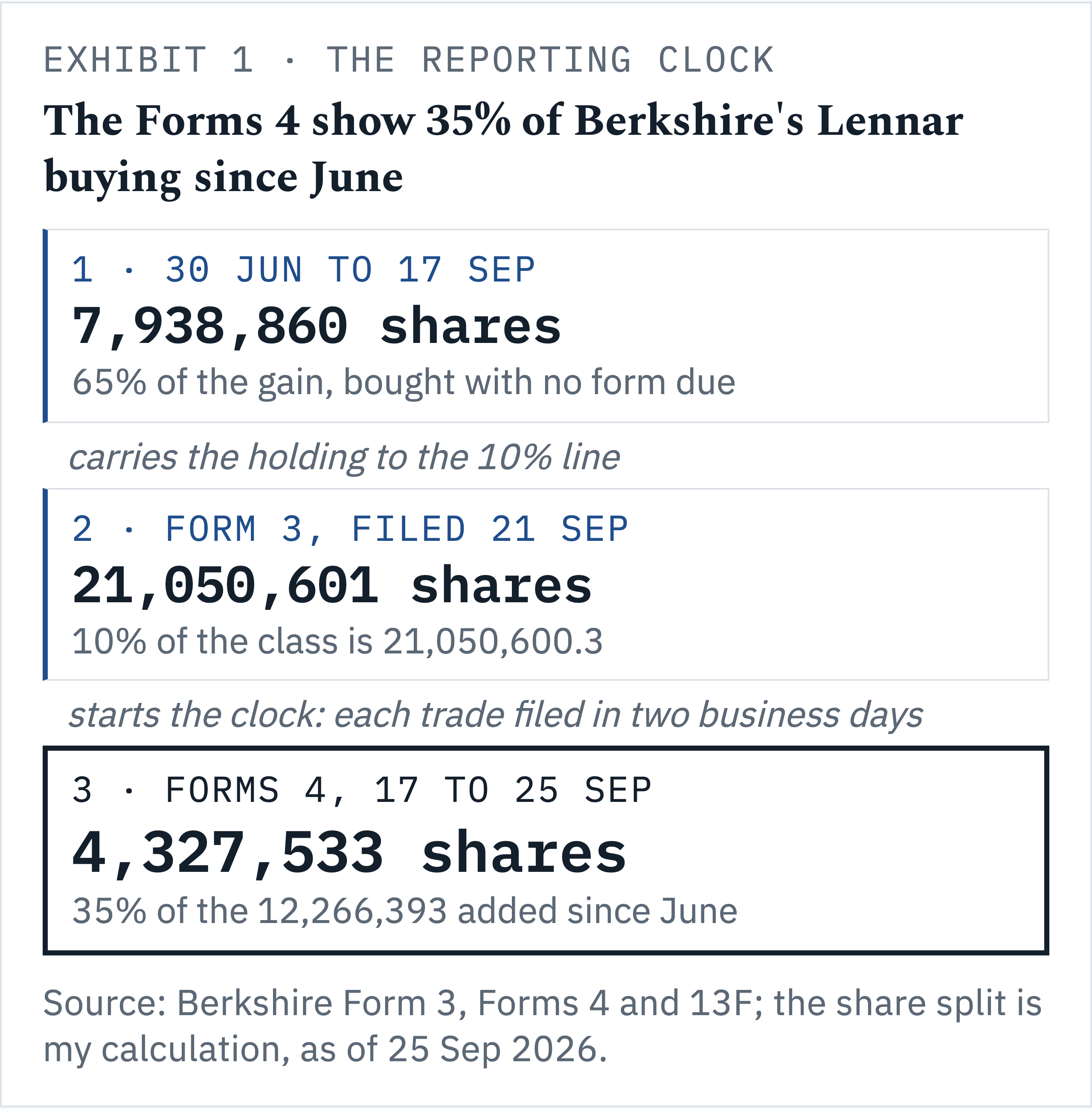
Spread evenly over the 54 sessions to 16 September, the 7,938,860 shares work out at 147,000 a session.2 That is 5.6% of Lennar’s Class A volume. The filed lots from 17 to 25 September were 9.3% of the volume across those seven sessions. No filing dates the first tranche, so the comparison holds only if it was bought evenly.
One quantity is still open. The 25,378,134 Class A shares are 12.1% of that class on Lennar’s May share count, but Lennar has a second listed class with ten votes a share. Berkshire’s share of the votes is therefore smaller, and by how much decides whether it can ever matter to the board.
The paid half settles whether to own Lennar against the home construction ETF and at what ratio, with a trigger dated to the 16 November 13F.
Below the paid line:
The table of the six sessions Berkshire bought, by class, price and volume share, and the unfiled shares’ cost.
Which of Berkshire’s six insurers holds each lot, before and after.
The vote table, Berkshire against Stuart Miller, and what Section 16(b) really costs a seller.
The position: instrument, entry, levels, size and dated exit.
