


Below the paid line:
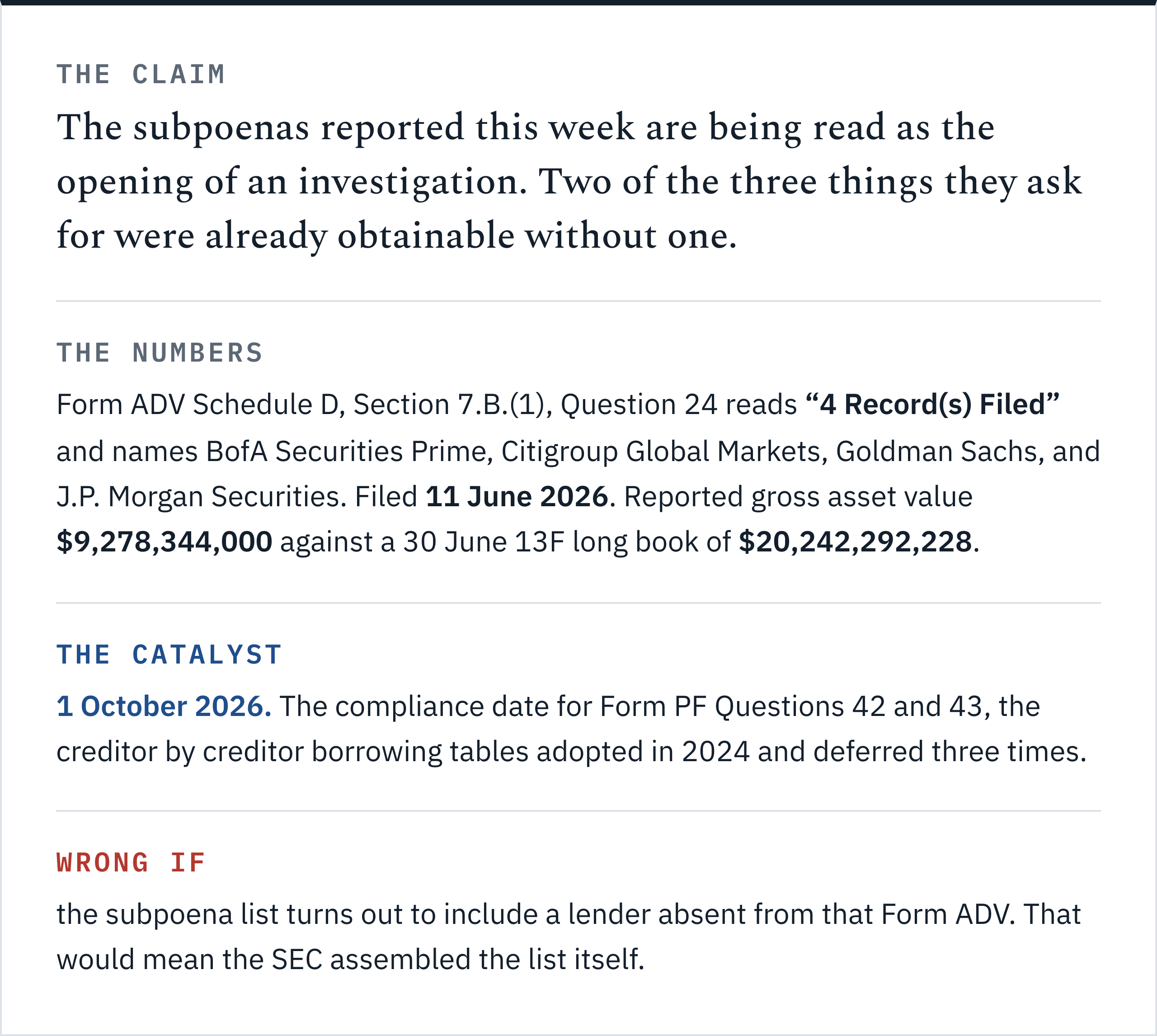
- The full disclosure inventory: each of the three subpoena asks mapped to the rule, form or system that already carries it, with the citation
- The 13F growth series read off five EDGAR cover pages, $2.12 billion to $20.24 billion, and the General Instruction 4 note that let Form ADV Items 5 and 7 stay lawfully wrong
- The proposed $10 billion Form PF threshold worked against this fund’s own $9,278,344,000, and the $721,656,000 that separates them
- The Archegos theory stated at full strength, in the SEC’s own charging language, and what survives it
- Rule 13h-1(d)(2)(xii) and the next morning route to trade timing that needs no subpoena
- Five confounds I can’t rule out, including the one that most damages this piece
The consensus, stated at its strongest
Here is the reading in circulation this week, in the form its own believers would sign. A fund built a concentrated, heavily financed book in AI infrastructure names and ran it through four of the largest prime brokers on the Street. In late July the trade went against it, margin calls landed, and the portfolio was sold into a market with no natural bid. Someone in that sequence may have done something wrong, and the SEC has gone to the lenders to find out.
That’s a coherent story and parts of it are certainly true. Reporting on the asks is specific. The subpoenas sought information on when Situational Awareness executed its trades and on how the fund communicated with its lenders about borrowed capital, and the banks were told to preserve records (Quartz, via Yahoo Finance). I read preservation notices as what a regulator sends when it wants the option to look later. Nobody has been accused of anything, the SEC declined to comment, and none of the four banks commented (CNBC). Both accounts are relays and it is worth knowing whose: CNBC is carrying Reuters, the Quartz piece is carrying the New York Times.
Situational Awareness’s own response fits the frame. “It is to be expected that regulators would closely examine any funds that are high profile, produce significant returns or have particularly dramatic drawdowns,” a spokesman said. “We are a highly regulated business and will cooperate to the fullest extent with any regulatory request.”
I don’t think that reading is foolish. I think it’s incomplete, and the thing that completes it never appears in the reporting. It sits in the filings.
What the filings say, and the part nobody checked
Quartz, summarising the New York Times account, carries a clause that is easy to skim past: the banks are known “according to a regulatory filing cited by The New York Times.”
I know of one public filing that names a private fund’s prime brokers, and I could not find a second. It is Form ADV, Schedule D, Section 7.B.(1), Question 24. I pulled it.
Situational Awareness LP, CRD 333011, SEC file 801-132039, filed 11 June 2026, signed under penalty of perjury by chief compliance officer Kimberly Summe. Question 24(a) asks whether the private fund uses one or more prime brokers. “Additional Prime Broker Information: 4 Record(s) Filed.”
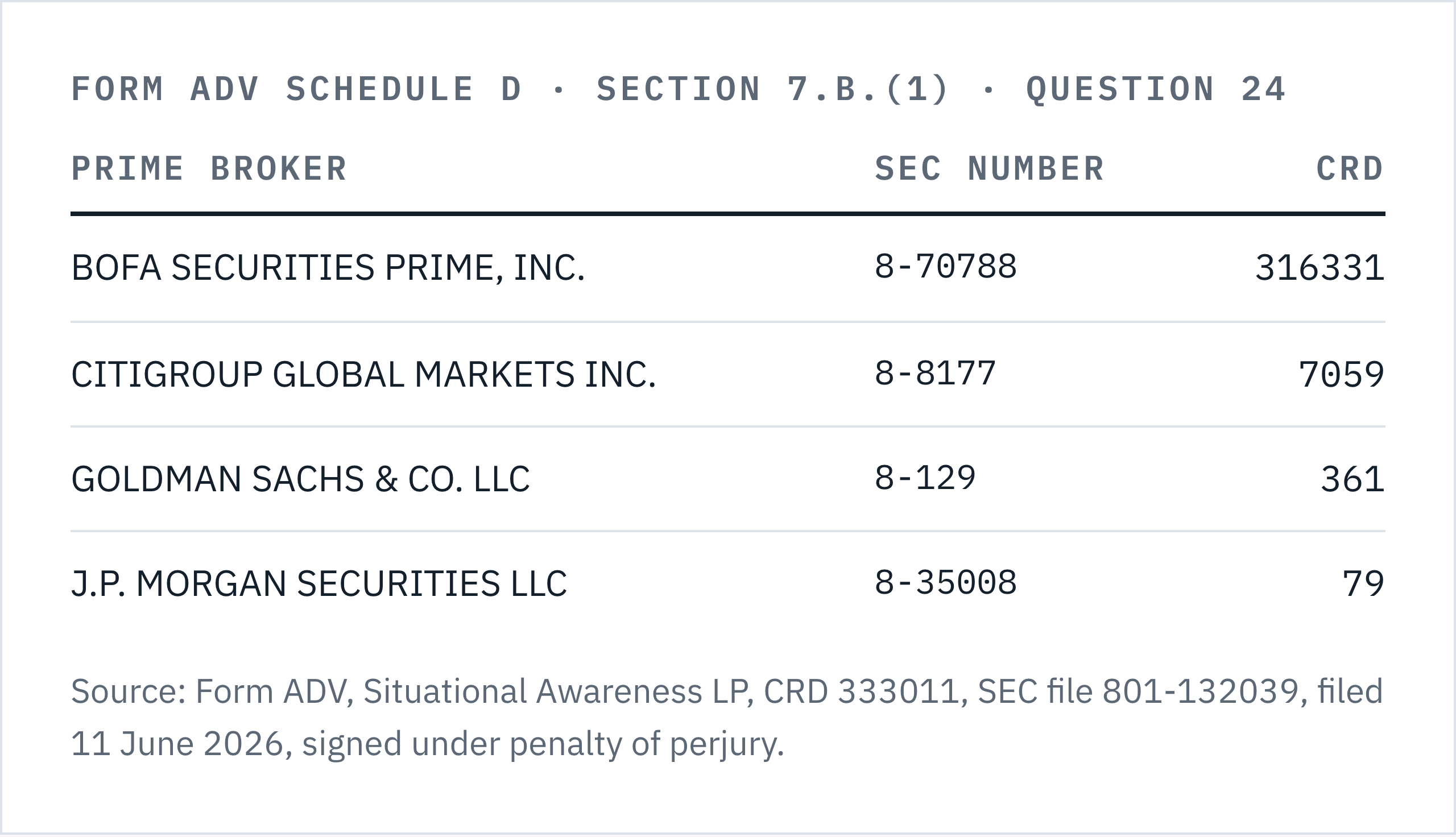
Four names. I count the same four. No addition and no omission. The reported list stops exactly where the filing stops. Morgan Stanley, a top tier US prime broker, appears on neither.
The subpoena list is a filing, not a finding. That is the first thing the documents say. The second is stranger, and I had to read it twice.
A registration record less than half the size of the fund’s own 13F
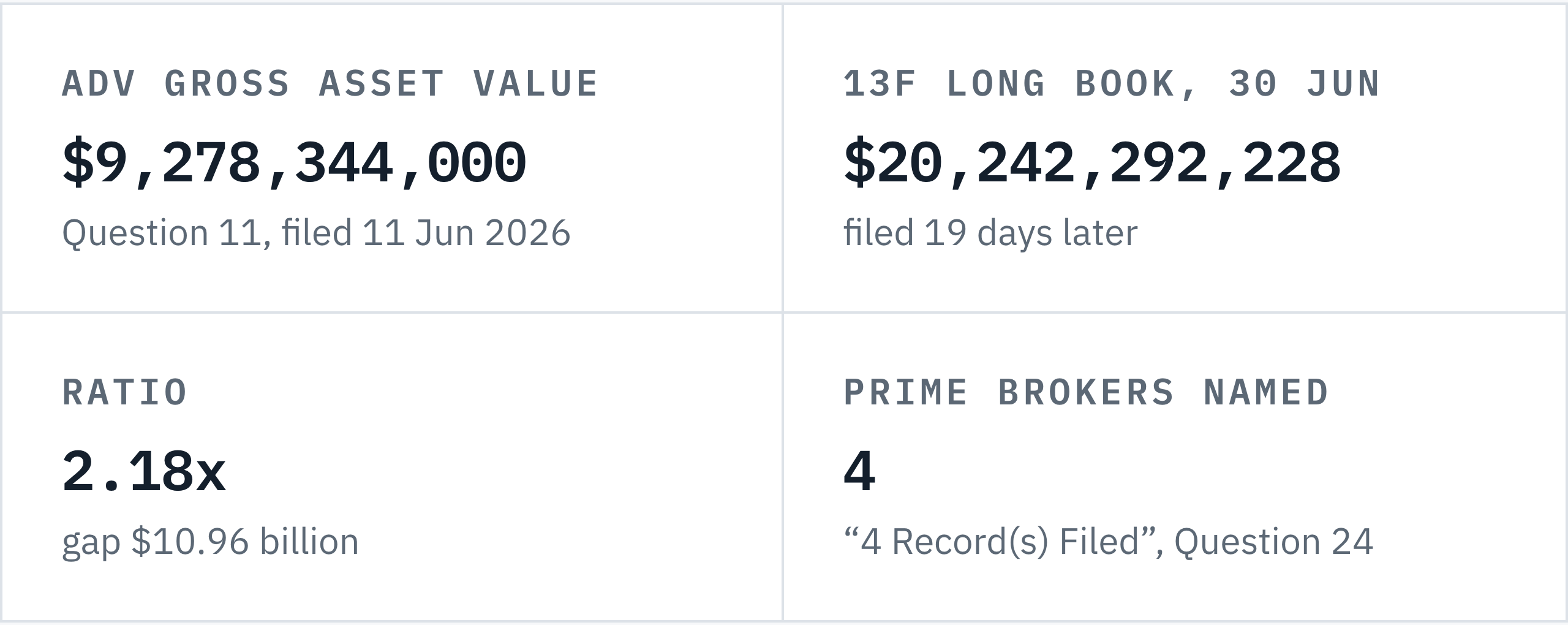
Question 11 of that same Form ADV asks for the “current gross asset value of the private fund.” Filed on 11 June 2026, the answer is $9,278,344,000. Item 5.F reports identical regulatory assets under management, across two accounts.
Nineteen days after that signature, at the 30 June quarter end, the fund’s own Form 13F reported $20,242,292,228 in US listed long equity across 26 positions. That comes straight off the cover page, and I did none of the sums in it. I make the ratio 2.1817, so 2.18 times, and the gap $10.96 billion. A gap between what an adviser files and what anyone prints is not unique to this fund. I took the same two fields apart on Citadel, where the filed number and the circulated number differ by a factor of eight.
Both figures cover the same book: the ADV reports a single master-feeder fund, the 13F the adviser’s discretionary holdings. Two limits on the comparison, and both cut the same way. A 13F reports long US listed positions at a quarter end and nothing else, no shorts, no derivatives, no non-US holdings, and it lands 45 days late, so $20.24 billion understates the book. Regulatory assets under management is a gross figure, deducting no debt and no leverage, which is precisely why it should be the larger of the two. Both corrections widen the gap. Pull the whole 13F series off EDGAR and the reason becomes obvious.
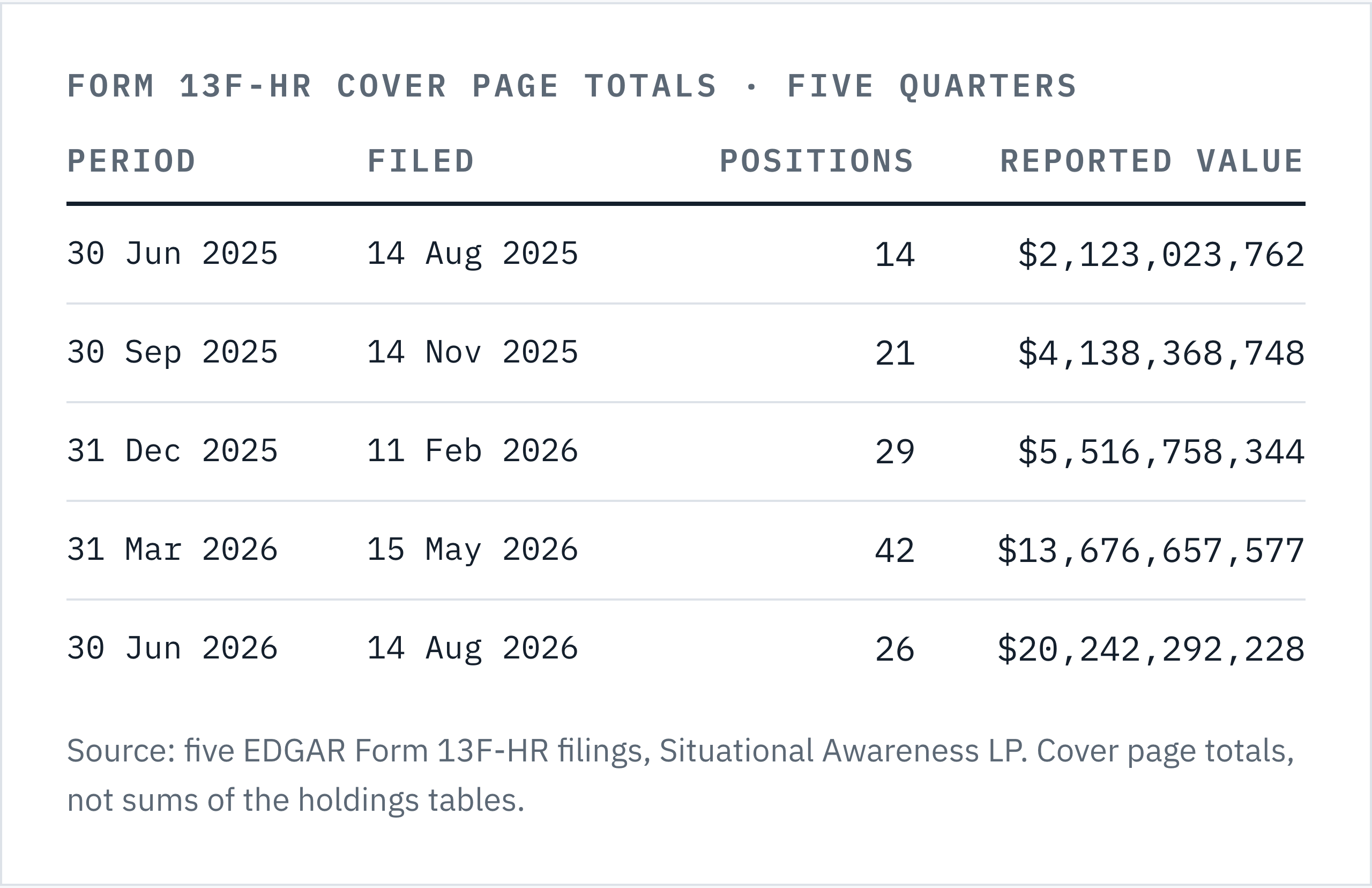
Each row is long US listed equity at that quarter end, and each is the cover page total, not my sum of the holdings.
$2.12 billion to $20.24 billion in four quarters. I make that 9.53 times. That $9.28 billion on the ADV sits between the December and March rows, which is roughly where a fiscal year end gross asset value would land for a fund whose December long book was $5.52 billion. So the number is stale. Here is the part that matters. It was allowed to be stale. The Form ADV General Instructions, Instruction 4, on what an adviser must refresh when it files an interim amendment:
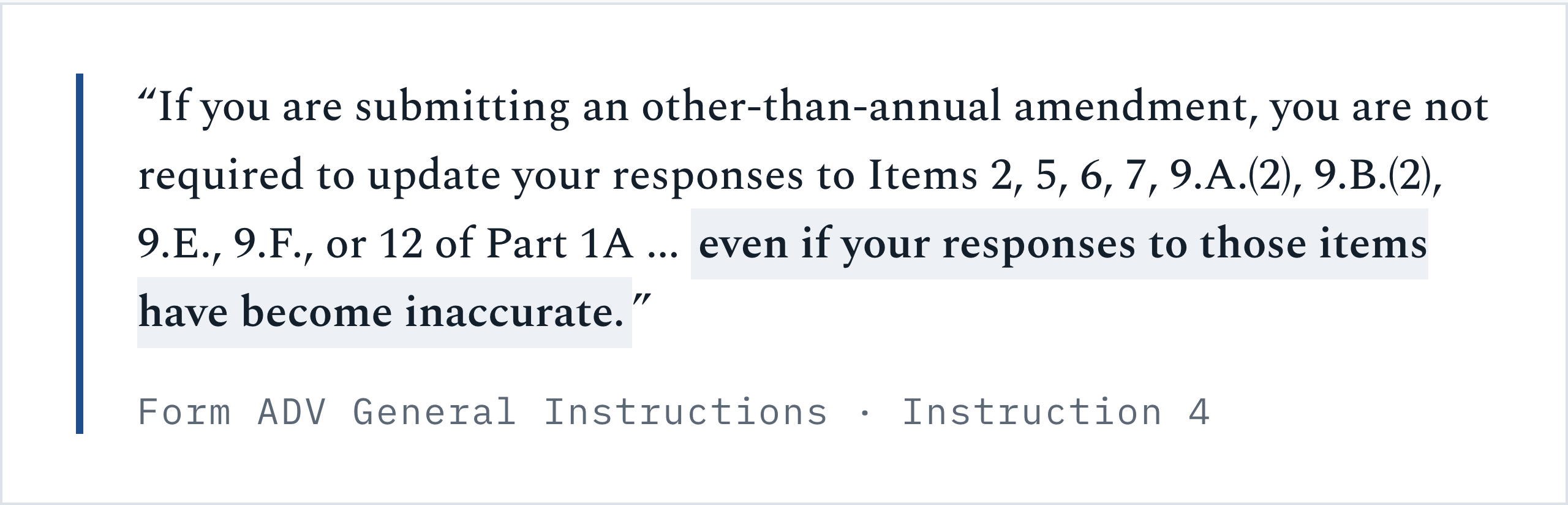
Item 5 is regulatory assets under management. Item 7 is private fund reporting, which is where Question 11 lives. The 11 June filing is captioned, in its own header, “Other-Than-Annual Amendment - All Sections.”
I re-checked that filing on 26 August, six weeks after the fund reportedly lost around $35 billion, an unwind I traced through Citadel’s own subsequent selling. It is unchanged. Nobody did anything wrong here. That’s my whole point. “Current” in Question 11 means current as of the last time the form was obliged to carry a number, and for a fund that grew ninefold inside a year, the obligation arrives once. A regime that updates annually cannot see a fund that moves quarterly. No rule was broken and the record was wrong anyway.
If you want to run this on your own book. I pulled Question 24 for six advisers this week, this fund among them, to see whether naming four prime brokers is unusual. The census, the two step recipe for pulling that field on any SEC registered adviser, and what the spread does and doesn’t tell you are in the members’ note on Patreon.
