


Pharmaceutical alpha generation operates at the intersection of regulatory architecture, financial engineering, and information arbitrage. Between 2008 and 2024, five documented methodologies emerged as persistent sources of asymmetric returns — four legal, one criminal.

The legal strategies:
Regulatory intelligence: Point72’s systematic FOIA infrastructure (56 FDA requests in 16 months)
Financial engineering: Baker Bros’ pre-funded warrant structures creating control without ownership
Scientific forensics: Independent image analysis preceding SEC enforcement by years (Cassava Sciences’ $40M settlement)
Credit architecture: Perceptive Advisors’ royalty structures capturing drug economics above equity
The illegal precedent:
5. Insider trading: Mathew Martoma’s $276 million profit from material nonpublic information (nine years in federal prison)
The distinction between legal intelligence gathering and illegal insider trading is measured in days, disclosure requirements, and source methodology. This is the documented forensic playbook — both the permitted strategies that generate persistent returns and the illegal precedent that defines the boundaries.
Part I: The Information Edge — FOIA as a Systematic Intelligence Tool
While most investors await press releases, elite funds have industrialized regulatory data extraction through the Freedom of Information Act.
Point72’s FOIA Infrastructure
Point72 Asset Management, the $140 billion hedge fund founded by Steven A. Cohen, leads the pharmaceutical FOIA ecosystem. The firm made 56 FOIA requests to the FDA in 16 months as of mid-2023 — more than any other financial institution.
The June 2023 spike demonstrated the scale of this operation: 14 financial institutions submitted 46 FDA FOIA requests in a single month. Point72 led with 14 requests, followed by Balyasny Asset Management with 10 and Farallon Capital with 7.
Target categories:
Form 483 inspection reports (manufacturing violations)
Establishment Investigation Reports (EIRs)
FDA Adverse Event Reporting System (FAERS) data
Warning letters and enforcement actions
Specific 2023 examples:
Seven requests for Apellis Pharmaceuticals’ Syfovre adverse event data (the drug later faced safety concerns)
Multiple requests for Catalent manufacturing facility inspection reports (targeting March 2023 inspections)
Two requests for WuXi Biologics plant inspection reports in China
The timing advantage: Form 483s are released via FOIA weeks before mandatory warning letters become public. This gap allows position establishment before market-moving announcements. Stock weakness that appears “unexplained” often follows FOIA-derived intelligence by 2–4 weeks.
Legal foundation: FOIA requests are public record, creating no insider trading liability. The information, once obtained, is non-material until the company discloses it. Funds can trade freely on FOIA-derived insights while the data remains in the regulatory pipeline.
Part II: The Forensic Edge — Scientific Due Diligence as Alpha
While FOIA exploits regulatory timing gaps, forensic analysis exploits scientific validation gaps. When journal peer review fails to catch data manipulation, independent experts with specialized technical capabilities can identify fraud years before regulatory enforcement.
When Quintessential Capital Management established a short position in Cassava Sciences (SAVA), the thesis was biological, not financial.
Independent Scientific Analysis
The forensic investigation relied on independent experts analyzing published research papers. Microbiologist Dr. Elisabeth Bik, a scientific integrity consultant, examined Western blot images in papers authored by Cassava’s consultants.
Specific forensic findings documented by Bik:
“Bands that look extremely similar to each other” suggesting manipulation
Bik’s analysis, published on PubPeer and her blog in August 2021, was conducted independently — she held no position in Cassava stock and received no compensation from short sellers.
Regulatory Outcome
The forensic analysis preceded regulatory enforcement by three years:
August 2021: Independent scientists flag image irregularities
September 2024: Cassava Sciences pays $40 million to settle SEC charges
September 2024: Dr. Hoau-Yan Wang charged by SEC for manipulating Phase 2b trial biomarker data (agreed to $50,000 penalty)
June 2024: DOJ charges Wang with fraud (later dropped before trial in October 2025)
November 2024: Simufilam fails Phase 3 trials; stock falls 84% in one day
Legal foundation: Analyzing published scientific papers is public research. Image forensics using publicly available journal articles creates no regulatory liability. Short selling based on published data analysis is legal securities activity.
Part III: The Structural Edge — Financial Engineering for Control Without Ownership
While FOIA and forensics extract information advantages, financial engineering creates structural advantages. The pre-funded warrant with blocker provision solves a fundamental problem: how to achieve operating control of a biotech company without triggering regulatory constraints that limit liquidity and increase disclosure obligations.
Baker Bros. Advisors, founded in 2000 by brothers Julian and Felix Baker, has engineered a biotech investment structure that provides operating influence while avoiding statutory insider constraints.
The Pre-Funded Warrant Mechanism
Structure: Warrants exercisable at $0.0001 per share with contractual beneficial ownership blockers at 9.99% or 4.99%.
Example from SEC filings: Baker Bros. purchased 11,250,000 pre-funded warrants at $3.9999 each, exercisable at $0.0001 per share. The warrant agreement states: “exercisable…to the extent that after giving effect to such exercise the holders thereof…would beneficially own…no more than 9.99% of the outstanding shares.”
The blocker adjustment clause: Holders can increase the cap to 19.99% with 61 days’ notice to the company, or decrease to any percentage including 4.99%.
Deployed Examples
DBV Technologies: 9.99% blocker structure (activist position filed)
Madrigal Pharmaceuticals: ~$105 million warrant position
Seattle Genetics: Baker Bros’ largest holding ($5+ billion); Felix Baker served as lead director from 2005
Incyte Corporation: Julian Baker serves as board representative
Economic exposure vs. reported ownership: The structure allows 20–30% economic interest while reporting only 9.99% beneficial ownership. This avoids:
Section 13(d) activist disclosure requirements (triggered at 5%)
Section 16 insider reporting burdens (triggered at 10%)
Poison pill provisions (typically triggered at 10–15%)
Change-of-control thresholds in debt covenants
Legal foundation: Pre-funded warrants are SEC-registered securities. The blocker provision is a contractual agreement disclosed in public filings. The structure uses legal ownership definitions under Rule 13d-3 to separate economic exposure from beneficial ownership.
Part IV: The Credit Edge — Royalty Structures Above Equity
While equity structures compete for position in the capital stack, credit structures with revenue participation sit above common shareholders. This fourth legal strategy provides drug commercial success exposure without operational execution risk or equity dilution.
Perceptive Advisors, founded in 1999 by Joseph Edelman, has deployed approximately $3.5 billion through credit structures that combine senior debt priority with equity-like commercial upside.
The Hybrid Mechanism
Structure: Senior secured term loans paired with capped royalty agreements on product sales.
August 2024 Example: scPharmaceuticals
Debt component: $75 million senior secured term loan ($50 million provided at close to refinance existing debt)
5-year term, no mandatory principal payments until maturity
Interest: SOFR + 6.75% (with 3.25% SOFR floor)
Reduced minimum cash covenant from prior facility
Royalty component: $50 million capped revenue interest financing
Capped at 1.6x purchase price, maximum 2.0x under certain conditions
No “make whole” or “catch up” payment requirements
Company buyout option at 1.4x purchase price (years 1–2)
Total financing access: Up to $125 million combined
Capital structure advantage: Royalties are paid on top-line sales before operating expenses. This creates:
Revenue participation senior to common equity
Insulation from management execution risk
Drug commercial success exposure without equity dilution
No board representation requirements
Legal foundation: Structured as senior secured credit facilities with revenue participation agreements. Falls under debt financing regulations, not equity securities laws.
Part V: The Illegal Precedent — Where the Line Is Drawn
The four documented legal strategies share a critical characteristic: they extract information or create structures using publicly available data, regulatory processes, or disclosed contractual mechanisms. Material nonpublic information obtained from corporate insiders who breach fiduciary duties is categorically different — and federally prosecutable.
The United States v. Mathew Martoma case provides the forensic timeline of illegal insider trading — demonstrating what separates legal information arbitrage from criminal conduct.
The Timeline of Material Nonpublic Information
July 15, 2008: Dr. Sidney Gilman, chairman of the safety monitoring committee for Elan/Wyeth’s bapineuzumab Alzheimer’s trial, is unblinded to final trial results.
Dr. Gilman receives confidential PowerPoint marked “Do Not Distribute” showing negative trial data
That evening: Gilman speaks with Martoma for 1 hour 45 minutes via phone
July 19, 2008: Martoma flies roundtrip NYC to Detroit to meet Gilman in person in Ann Arbor
Martoma emails SAC Capital founder Steven Cohen: “It’s important [that we speak]”
They speak for 20 minutes
SAC Capital liquidates entire $700 million Elan/Wyeth long position
Establishes short positions totaling 7.75 million shares
July 29, 2008: Public announcement of trial failure
Elan stock drops 42%
Wyeth stock drops 11%
The Legal Outcome
Financial result: $276 million in profits and avoided losses across the five-day trading window
Compensation: Martoma received a $9.3 million bonus at year-end 2008
Criminal penalties:
Nine-year federal prison sentence (February 2014)
Forfeiture of $9.38 million in bonuses
Permanent bar from securities industry
Corporate penalties:
SAC Capital Advisors pleaded guilty to insider trading charges (2013)
Paid $1.8 billion in criminal and civil penalties
Forced to stop managing outside investor capital
Reorganized as Point72 Asset Management (family office until 2018)
The Legal Distinction
What made this illegal:
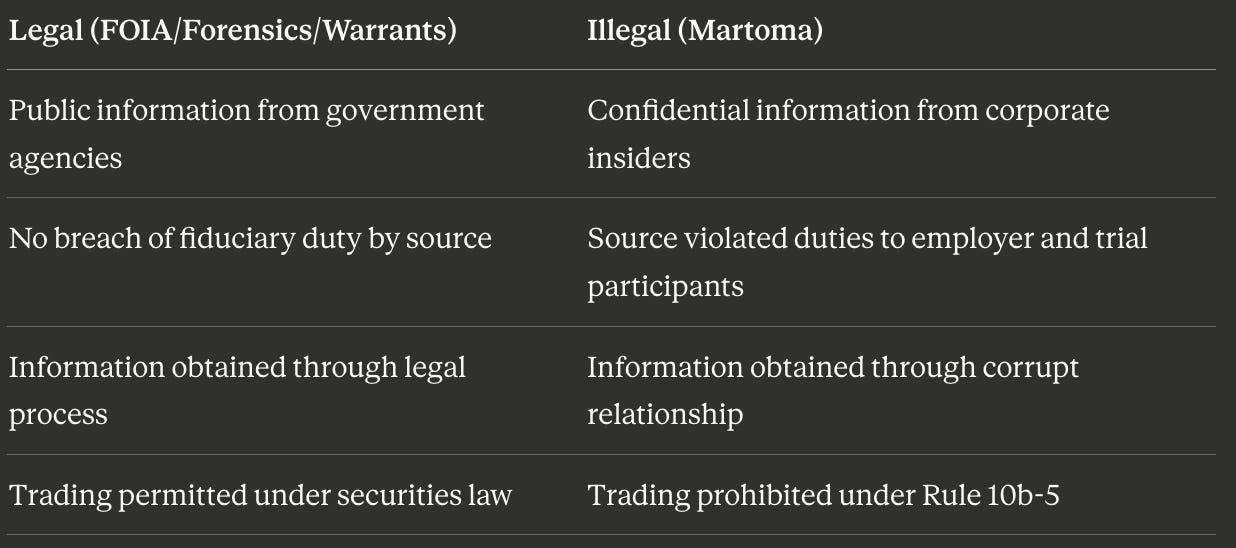
Source breach of duty: Dr. Gilman violated fiduciary duties to Elan/Wyeth and trial participants by sharing confidential data
Awareness of breach: Martoma knew Gilman was prohibited from sharing the information
Material nonpublic information: Trial data was market-moving and not publicly available
Trading on the information: Direct causal link between Gilman’s disclosure and SAC’s trading
Contrast with legal strategies:
Execution Principles: The Systematic Approach
Four legal strategies (FOIA, forensics, warrants, credit) and one illegal precedent (Martoma) demonstrate that pharmaceutical alpha generation operates within defined boundaries. The distinction is not subjective — it’s architectural.
The documented strategies share common structural elements:
1. Information Is Structural, Not Analytical
Differentiated insight derives from:
Access architecture: Systematic FOIA request infrastructure (Point72’s 56 requests in 16 months)
Technical capability: Image forensics expertise preceding regulatory action by years (Cassava analysis 2021, SEC settlement 2024)
Financial engineering: Pre-funded warrant structures enabling 20–30% economic exposure with 9.99% beneficial ownership
Capital structure innovation: Royalty agreements capturing revenue participation above equity layer
Alpha comes from building systems to access non-public but legal information, not from superior analytical interpretation of public data.
2. Timing Precision Determines Outcome
Form 483s precede warning letters by weeks: FOIA-obtained inspection reports reveal manufacturing violations before mandatory public disclosure. Position establishment during this window is legal; trading after company disclosure would be front-running public information.
Forensic analysis precedes enforcement by years: Image irregularities identified in 2021 led to SEC settlement in 2024. Early short positions capture the full valuation decline.
Material nonpublic information exists in days: Martoma’s edge lasted July 17–29, 2008 (12 days between confidential disclosure and public announcement). This compressed timeframe explains the $276 million profit.
3. Legal Boundaries Are Bright Lines
The Martoma conviction ($276 million profit → 9 years prison) versus Baker Bros. warrant structure (fully legal, deployed across dozens of positions) illustrates the binary nature of insider trading law.
Prohibited sources:
Corporate insiders with fiduciary duties (Martoma case)
Confidential trial data from safety committee members
Material nonpublic information obtained through breach
Permitted sources:
Government agencies via FOIA (Point72’s FDA requests)
Published scientific literature (Cassava image forensics)
Public SEC filings (warrant structure analysis)
Regulatory dockets and public comment periods
There is no grey area between legal information arbitrage and illegal insider trading. The distinction is source methodology and breach of duty, not information materiality.
4. Technical Capability Is Investable Edge
Elite performance requires specialized expertise:
Regulatory process knowledge: Understanding FOIA timing, Form 483 vs. warning letter hierarchy, FAERS database structure
Scientific literacy: Ability to conduct or commission image forensics, understand Western blot methodology, identify Photoshop artifacts
Corporate finance engineering: Structuring pre-funded warrants with blocker provisions, navigating beneficial ownership rules, optimizing for Section 13(d) and Section 16 thresholds
Credit structuring: Designing royalty agreements with appropriate caps, senior secured loan covenants, revenue participation mechanics
These are not auxiliary capabilities — they are primary alpha sources in sectors dominated by binary regulatory events.
The Persistent Information Gap
Pharmaceutical investing remains one of few public markets where structural information asymmetries endure:
Regulatory opacity: Clinical trial data remains confidential until sponsor disclosure. FOIA creates legal access to manufacturing and safety information weeks before public release.
Scientific complexity: Image forensics and laboratory methodology analysis require specialized expertise. Public investors lack capability to validate published research.
Financial engineering opportunity: Rule 13(d) beneficial ownership definitions create separation between economic exposure and reported ownership. Pre-funded warrants exploit this gap legally.
Credit market inefficiency: Pre-revenue biotechs cannot access traditional debt. Royalty-backed structures fill this gap at equity-like returns with debt-like seniority.
The firms that systematically exploit these gaps through legal information acquisition, financial engineering, and technical analysis continue to generate returns uncorrelated with fundamental equity research.
Conclusion: The Documented Architecture of Pharma Alpha
Five methodologies. Four legal. One criminal.
Point72’s 56 FOIA requests in 16 months demonstrate that systematic regulatory arbitrage is not just permitted — it’s industrialized. The gap between Form 483 receipt and warning letter disclosure remains structural.
Quintessential Capital’s forensic analysis three years before Cassava’s $40 million SEC settlement proves that independent scientific due diligence precedes enforcement. Image artifacts in published papers are public information.
Baker Bros’ pre-funded warrants with 9.99% blockers across dozens of positions show that financial engineering can create 20–30% economic exposure while avoiding statutory insider constraints. Rule 13(d) definitions separate ownership from control.
Perceptive Advisors’ $3.5 billion in royalty-backed credit demonstrates that capital structure innovation captures drug commercial success without equity dilution. Revenue participation sits above common shareholders.
Mathew Martoma’s $276 million profit from Dr. Gilman’s confidential trial data ended in nine years in federal prison. Material nonpublic information from corporate insiders who breach fiduciary duties is securities fraud under Rule 10b-5.
The boundary between legal alpha generation and illegal insider trading is not a grey area. It is measured in source methodology, fiduciary breach, and public accessibility. Information obtained through FOIA requests, published scientific papers, SEC filings, and disclosed contractual agreements is legal. Information obtained from corporate insiders through corrupt relationships is criminal.
This is the forensic playbook — the documented strategies that generate persistent asymmetric returns and the illegal precedent that defines where information arbitrage becomes securities fraud.
📊 Want Deeper Quantitative Analysis?
This research took very long time of data collection, verification, and analysis. If you found value in this deep-dive, I publish exclusive quantitative research, trading strategies, and institutional-grade analysis on Patreon.
By joining, you’ll be supporting my work and motivating me to publish more content like this.
→ Join the Patreon community here
For more quantitative finance analysis and systematic trading strategies:
YouTube: @TheMathematicalTrader
LinkedIn: Navnoor Bawa
Cover photograph: The U.S. Food and Drug Administration, public domain, via Wikimedia Commons.