


Scott Bessent doubled the ceiling on Treasury’s long end buyback operations on 19 August, and within a day the framing settled: Treasury is suppressing long yields, Kevin Warsh is fighting inflation and shrinking the balance sheet, and the two are colliding.
I think the collision everyone’s describing doesn’t exist in the flows. Something larger does, and it sits at the opposite end of the curve.
Below the paid line:
- The Desk’s full month by month bill purchase table, December 2025 to September 2026, $355 billion planned, and the moment reserve management purchases went to zero
- The H.4.1 line by line, both dates, showing bills at more than 100% of the growth in the Fed’s Treasury book
- The TGA at $933.2 billion and the Desk sizing rule that makes Treasury’s cash balance an input to Fed open market operations
- The TBAC charge, in which Treasury’s own advisory committee prices $540 billion of Fed bill buying and tells Treasury it can raise the bill share without the private market absorbing it
- The 2000-02 buyback programme that moved yields 95bp, and why its budget-surplus funding means it cannot repeat against $739 billion of net new borrowing
- Three confounds I cannot rule out, including the one that would most weaken this piece
The consensus, stated the way its believers would state it
Here’s the strong version, and I want to be fair to it, because it isn’t stupid.
Treasury finances the government at least cost and isn’t supposed to have a view on long rates. When it announced it was increasing “by at least double” its liquidity support buybacks in the 10-to-20 and 20-to-30 year sectors, it was announcing a view. Bessent has said for two years that he cares about the 10-year, and the 30-year had just printed above 5.25%.
Meanwhile Warsh has told reporters that rising long-term borrowing costs served a valuable purpose, tightening financial conditions with inflation at 3.4% in the year to July against a 2% target. So one arm of the state unwinds what the other relies on. Rebecca Patterson at the Council on Foreign Relations called the buybacks “more signal than substance”, noting real QE is unavailable because Warsh “opposes sustained balance sheet expansion.”
That’s a coherent story and every element is checkable. I think two are wrong.
What the schedule actually says
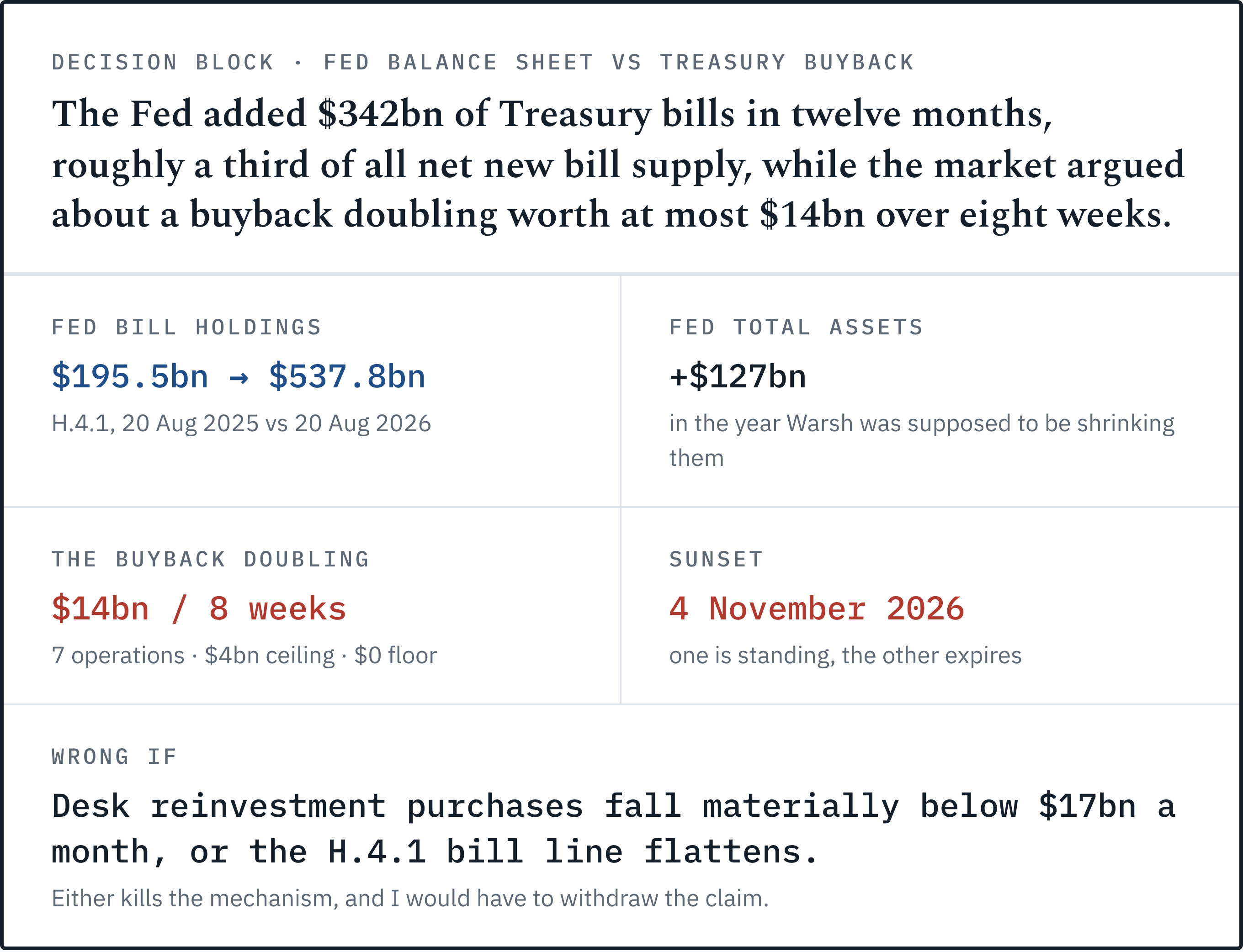
Treasury publishes its tentative buyback schedule every refunding. I pulled the Q3 2026 file and counted the operations inside the doubling’s 9 September to 4 November window. There are seven long-end nominal operations: 10 and 24 September, 1, 8, 15 and 27 October, 4 November. I make that eight weeks. Seven operations at a $4 billion ceiling is $28 billion of maximum capacity, against $14 billion at the old ceiling. So the doubling buys Treasury $14 billion of extra room across eight weeks, in a market where one August refunding sold $42 billion of 10-year notes and $25 billion of 30-year bonds.
Two details matter more to me than the headline. First, the minimum purchase amount column reads $0 on every line, so I read these as ceilings, not commitments: Treasury buys what dealers offer at prices it likes and is obliged to buy nothing. Second, the sunset. The doubling runs through 4 November 2026 and then expires, and a permanent programme of suppressing yields doesn’t come with an eight week expiry printed on the announcement. That sunset matters.
One detail nobody mentioned: the cash management buybacks on 3 and 9 September carry ceilings of $12.5 billion each, in the one-month to two-year sector. Treasury’s biggest scheduled buybacks this quarter are three times the long-end ones everybody is arguing about. Front end again.
The Fed stopped shrinking nine months ago
I went looking for the other half of the collision, expecting a balance sheet shrinking while Treasury bought. It isn’t there. So I pulled both H.4.1 releases and differenced the lines myself. The balance sheet grew.
Here the consensus isn’t just imprecise. It’s inverted.
The FOMC announced on 29 October 2025 that it would “cease the runoff of its securities holdings starting on December 1, 2025.” It directed the Desk to “roll over at auction all principal payments from the Federal Reserve’s holdings of Treasury securities” and to “reinvest all principal payments from the Federal Reserve’s holdings of agency securities into Treasury bills.”
I’d read that second clause slowly. Every dollar that comes back from the Fed’s mortgage book gets recycled into T-bills. The Fed’s agency portfolio throws off principal continuously as mortgages amortise and prepay, so it’s a standing, mechanical bid in the bill market that needs no further decision from anybody.
Then the Committee went further. Its 10 December 2025 directive ordered the Desk to “Increase the System Open Market Account holdings of securities through purchases of Treasury bills,” and to “Reinvest all principal payments from the Federal Reserve’s holdings of agency securities into Treasury bills.” The Desk implemented it as purchases in the secondary market. These are reserve management purchases, and the Desk’s own statement says the first schedule totalled approximately $40 billion in Treasury bills, starting 12 December 2025.
For context: in the period ending 11 December 2025 the Desk ran no Treasury operations at all, and through 2024 and most of 2025 it alternated between nothing and $150 million test operations. Zero to $54 billion a month. That is a regime break.
I pulled the Desk’s full monthly schedule and added it up. Planned bill purchases from 12 December 2025 through 14 September 2026 come to roughly $355 billion, split about $140 billion of agency reinvestment and $215 billion of reserve management purchases.
The balance sheet confirms it, line by line
Schedules are only plans. The H.4.1 is the receipt, and it settles the question.
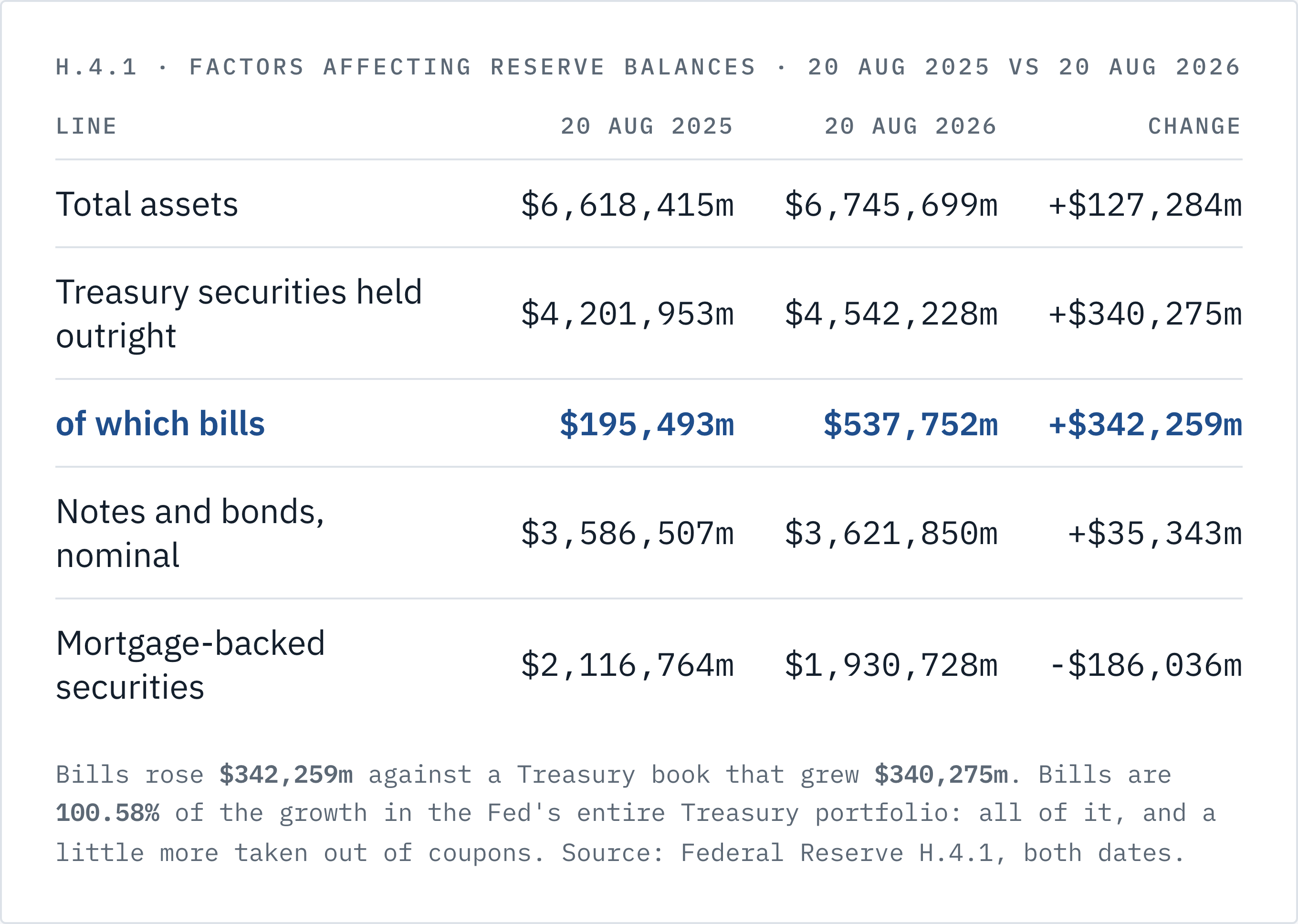
Source: Federal Reserve H.4.1, both dates. I’d read that bottom row twice.
That balance sheet grew $127 billion over the year in which Warsh was supposed to be shrinking it. Its Treasury holdings grew $340 billion. And the bill line grew $342 billion. That is more than 100% of the growth in the whole Treasury book, because the coupon book barely moved and the inflation-indexed book fell. Bills did all of it.
Bills went from 4.65% of the Fed’s Treasury book to 11.84% while the mortgage book shrank $186 billion. The Fed has been converting mortgage duration into Treasury bills, at scale, on autopilot, under a directive issued before Warsh took the chair. Nobody voted on that this year.
So I’d say the sentence “Warsh is shrinking the balance sheet while Bessent buys bonds” fails in both halves. Warsh isn’t shrinking anything, and Bessent’s long-end buying is capped at $28 billion through early November.
The mechanism: where the two balance sheets actually touch
Here’s the part I think is mispriced, and it has nothing to do with the 30-year.
Treasury’s cash sits in the Treasury General Account at the Fed. The TGA is a Fed liability competing with bank reserves, so when it falls reserves rise dollar for dollar and when it rises they drain. It’s a monetary lever Treasury operates and the Fed doesn’t. That account held $933.2 billion on 24 August, per the Daily Treasury Statement, and Treasury assumes near $950 billion at end-September. Reporting suggests Bessent has looked at drawing it down.
Now read the Desk’s sizing rule again. Reserve management purchases are “sized to accommodate projected trend growth in the demand for Federal Reserve liabilities as well as seasonal fluctuations.” The TGA is one of those liabilities, so Treasury’s cash decisions are a direct input into how many bills the Fed buys. I’m not inferring intent. That’s the Desk’s own published methodology. The rule is published.
This year, reserve management purchases ran at $40 billion a month through the first quarter, stepped to $25 billion in April, then $10 billion, and for 14 August to 14 September the Desk plans none. The mechanical reinvestment leg has climbed from $13.4 billion to $17.0 billion and is now the whole programme. Discretion off, autopilot on.
So the discretionary leg is off. The automatic leg is at its highest level since the directive began, and the Fed is still buying $17 billion of bills a month.
The honest comparison is less flattering than the one I first wrote. Treasury’s seven operations at a $4 billion ceiling run across 56 days, a maximum of about $15 billion a month. Per month the two are roughly the same size. The asymmetry is duration, not rate: the buyback is an eight-week ceiling with a $0 floor expiring 4 November, and the Fed’s bid is standing, nine months old, and needs no decision to continue.
Treasury issues bills at the margin, and its refunding statement says so: it meets variation in borrowing needs “through changes in regular bill auction sizes and/or CMBs.” The Fed is a structural buyer of bills, sized partly by a Treasury-controlled liability. Neither institution decided to build that loop.
