

Sourced from court documents, Senate subcommittee reports, FERC enforcement dockets, primary interview transcripts, Bloomberg, Fortune, and reported primary data. Every number is cited inline.
On February 18, 2026, Eni CEO Claudio Descalzi told the Financial Times something he probably did not intend to be the organizing principle of a capital markets case study: “I stopped trading in 2019 but the other big companies are all traders. BP, Shell, Total are big traders and they make billions from that.” He was describing exploratory joint-venture talks with Mercuria, calling it “a difficult exercise,” and noting that top traders at rival energy firms earn three to four times his own CEO compensation.
He was right about the opportunity. He was wrong about who controls it. The firms extracting the most durable energy-trading alpha are not primarily oil majors. They are hedge funds — operating across natural gas, LNG, European power, carbon allowances, crude oil, and related commodities. And they built the infrastructure to do it over twenty years, starting with the single most instructive trading disaster in commodity market history.
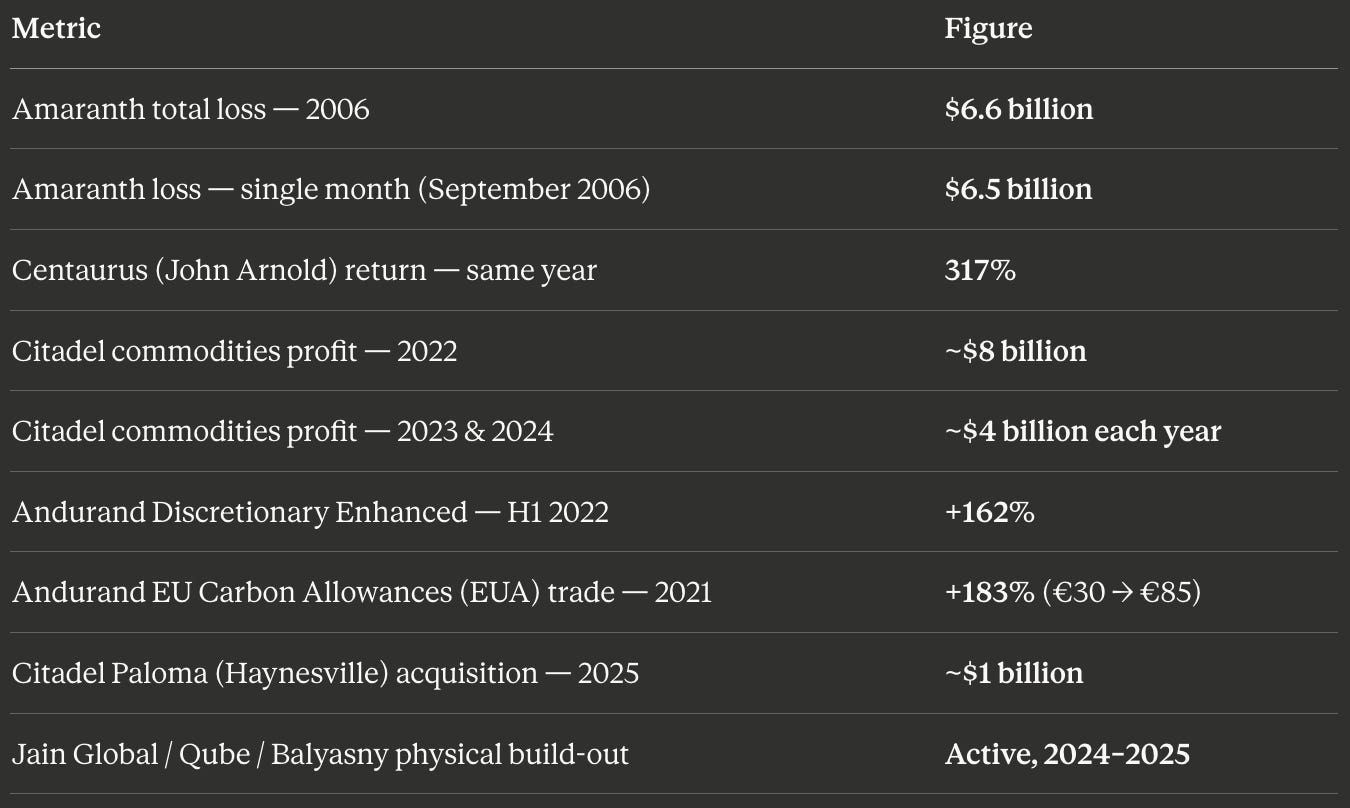
Key Numbers at a Glance
Act I — 2006: The Blueprint That Shaped Two Decades of Energy Trading Alpha
The Trade That Destroyed $6.6 Billion in a Month
To understand how hedge funds made money from energy, you must first understand how one of them lost everything — and exactly who cleaned up.
In 2005, Brian Hunter, then 31, was the lead energy trader at Amaranth Advisors. His strategy was structurally grounded: bet that winter-delivery natural gas contracts would trade at a premium to summer contracts — the calendar spread — because heating demand makes winter gas structurally more expensive than summer gas. The spread represents the economics of injecting cheap summer gas into storage and selling expensive winter delivery. Hurricane Katrina devastated Gulf Coast production in 2005, validating a long-winter thesis spectacularly. Amaranth returned ~18% that year, nearly entirely from energy. Hunter personally generated over $1 billion for the fund and took home a $100 million bonus.
In 2006, he tried to repeat it — at a scale that proved fatal.
The specific trade: long March 2007 natural gas futures, short April 2007 — a bet the winter-to-spring spread would widen. The U.S. Senate Permanent Subcommittee on Investigations (PSI) confirmed in its June 2007 report that Amaranth conducted this calendar-spread trading “on a vast scale,” long winter, short non-winter, across 2006 through 2010 maturities. By late July 2006, Amaranth’s January 2007 position represented a volume of natural gas equal to the entire amount consumed by all U.S. residential users in a single month. At peak concentration, Amaranth controlled up to 40% of all open interest on NYMEX for winter natural gas contracts.
The March/April spread stood near $2.50/MMBtu in July 2006. Then the 2006 Atlantic hurricane season came in historically quiet, demolishing Hunter’s weather thesis. By September, the spread had collapsed to under $0.60/MMBtu. Amaranth posted a $6.6 billion loss — $6.5 billion of it in a single month, erasing roughly 65% of the fund’s $9.5 billion in assets. The entire energy portfolio was liquidated in a forced fire sale to JPMorgan and Citadel.
The execution detail that rarely surfaces: FERC enforcement records establish that Amaranth accounted for 19.4%, 15.0%, and 14.4% of total NYMEX market volume during the February, March, and April 2006 settlement periods — positions so large they had begun to move the settlement price itself. Internal communications show Hunter’s traders discussing the need for the settlement price to “get smashed” to profit on their swap book. That phrase appears verbatim in the FERC enforcement docket. Hunter later settled with the CFTC for $750,000 — a rounding error against his 2005 bonus.
John Arnold: The Man Who Saw It Coming
“The story is often told like it was Brian vs. John. Reality is that it was the whole market — including John — versus Brian, because Brian was such a large long.”
— John Arnold, Tim Ferriss / Peter Attia Interview, 2025
On the other side of a significant portion of Hunter’s position was John Arnold at Centaurus Energy — a fund he had started in 2002 with just $8 million. Arnold’s thesis was sourced in fundamental supply-demand analysis, not weather speculation. As he described in a 2022 interview with Meb Faber: Katrina’s 2005 price spike had sent a clear production signal to every U.S. gas producer. Arnold could see that supply ramp building in the 2006 data. Hunter’s entire bullish thesis depended on a repeat hurricane season that never materialized.
The phone call that crystallized the trade is documented in multiple interview transcripts: Hunter rang Arnold while Arnold was in New York proposing to his now-wife, and asked whether he wanted to buy the Amaranth book. “I had a notion about what the size of it was,” Arnold recalled. “I was flabbergasted by the size of it and that his management would let him get into a position of that size.” Arnold saw the book, priced it correctly, and acted. Centaurus netted nearly $1 billion in the fall months as Amaranth liquidated — a full-year 2006 return of 317%. Citadel and JPMorgan also purchased the Amaranth energy book, reportedly making $1 billion each — marking Citadel’s institutional-scale entry into energy trading.
Arnold’s structural edge was something Hunter never built: fundamental physical market literacy. Centaurus focused on virtual swaps and futures but Arnold deeply understood the physical market from his Enron years trading against actual producers and consumers. His team included meteorologists. He also invested directly in physical infrastructure: in 2006 he formed NGS Energy, which carved storage caverns inside underground salt domes — enabling calendar-spread arbitrage unavailable to pure financial traders. By 2009, Centaurus managed over $5 billion and had never returned less than 50% in any of its first seven years.
He retired in 2012 at 38, concluding that shale oversupply had permanently compressed the structural opportunities. Centaurus averaged annualized returns in excess of 100% over its ten-year run. He gave billions back to investors because the edge had gone.
The lesson from 2006 is precise: position-size discipline, physical market grounding, and the analytical discipline to see supply responses that optimistic traders ignore are what separate the 317% from the −65%.
Act II — 2014–2025: Citadel’s Decade of Physical-Financial Integration
Building What Eni Now Wants to Buy
Ken Griffin did not make a bet in 2022. He spent eleven years building the infrastructure to dominate any year where energy markets dislocated.
After Enron’s 2002 bankruptcy, Griffin sent a team across the country to interview hundreds of energy traders, meteorologists, and quantitative researchers, then hired seven of them to seed an energy trading business. The 2006 Amaranth acquisition gave Citadel a live energy book and direct experience integrating physical commodity positions. But the defining step came in 2014: Citadel established Citadel Energy Marketing (CEM), a merchant trading operation that built one of the largest physical natural gas businesses in North America, with a portfolio of storage and transportation assets serving more than 450 clients.
This physical footprint creates three structural edges unavailable to financial-only traders:
01 — Basis Differential Capture. When a pipeline bottlenecks — routine in U.S. natural gas infrastructure — the price difference between delivery points on each side of the constraint can spike sharply and briefly. A firm holding transportation rights captures the spread through physical delivery. No NYMEX futures contract prices this specific dislocation. Citadel’s 450+ counterparty relationships mean it sees basis moves before they surface in any public data feed.
02 — Storage-Enabled Calendar Spread Arbitrage. When markets trade in contango — deferred prices above prompt — a firm with physical storage can buy spot gas, inject it, and simultaneously sell deferred futures, locking in the spread minus carrying costs as near-risk-free arbitrage. Without owned storage, the trade cannot be executed. Arnold’s NGS Energy salt-dome caverns exploited the same principle.
03 — Counterparty Intelligence from 450 Hedgers. When hundreds of producers hedge through you, you see the market’s hedging pressure in real time — where structural imbalances between hedged supply and financial demand are forming, and where the market is mispriced. This is pre-trade information no screen provides.
Citadel’s commodities team — led by former Morgan Stanley commodities chief Jay Rubenstein — also built an in-house weather modeling capability. Scientists and analysts used supercomputers to forecast weather up to two months in advance and traced gas supplies across the U.S. to predict European demand patterns — critical in 2022 as Russia throttled pipeline flows and TTF volatility hit all-time highs.
The 2022 Payoff: $8 Billion From a Decade of Preparation
European natural gas volatility hit all-time highs in 2022 following Russia’s full-scale invasion of Ukraine and the collapse of its pipeline deliveries to the EU. TTF prices surged from roughly $20–30/MMBtu pre-invasion to over $80/MMBtu, with the intraday peak on August 26, 2022 reaching approximately $97/MMBtu — a fourfold move within months. More importantly, the move was not a clean directional trend. It oscillated violently, creating calendar spread dislocations, geographic basis distortions, and cross-commodity mispricings that rewarded infrastructure-heavy traders continuously throughout the year.
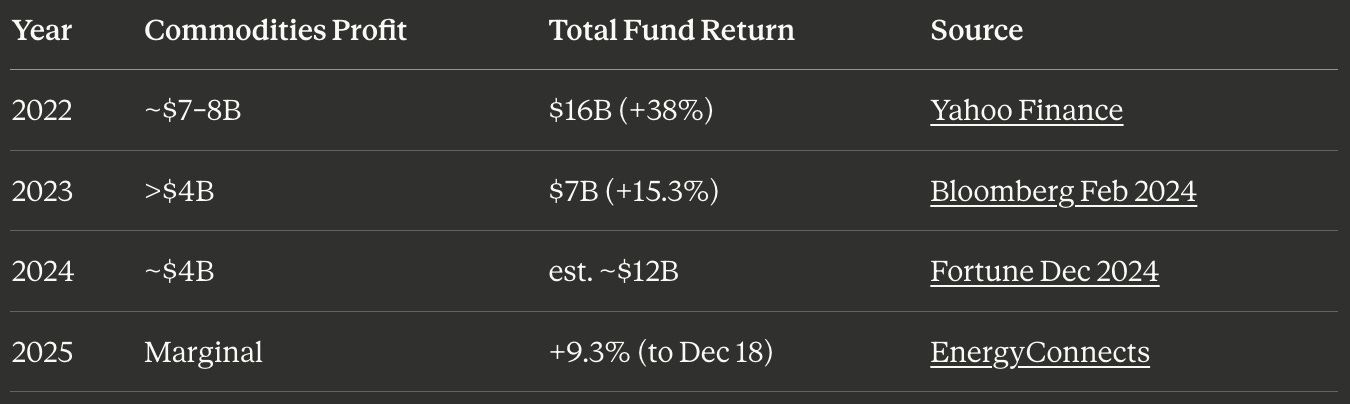
The result: Citadel generated approximately $7–8 billion from commodities in 2022, roughly half of the firm’s record $16 billion total — the largest single-year gain ever recorded by any hedge fund at the time. Top traders received bonuses of up to $100 million.
Critically, the alpha proved durable beyond the crisis. Citadel earned approximately $4 billion from commodities in each of 2023 and 2024 — roughly a third of total gross gains in both years, even as volatility normalized. That capital efficiency is only possible through the physical-financial architecture. This is not volatility beta. It is structural edge.
Citadel Commodities P&L — Verified Primary Sources
The 2025 Upgrade: Acquiring Upstream Production
In March 2025, Citadel went further than any prior hedge fund in physical energy integration. It agreed to purchase assets from Paloma Natural Gas for approximately $1 billion, acquiring acreage and producing wells in Louisiana’s Haynesville shale — 57,000 net mineral acres strategically adjacent to LNG export terminals coming online in the near term. Upstream ownership gives Citadel real-time production data, well decline curves, and reserve information that no outside financial trader can see. Also in 2025, Citadel acquired German power-trading company FlexPower, extending physical-financial integration into European power markets.
This is precisely what Eni’s CEO describes as “a difficult exercise.” Citadel built it internally over eleven years without a joint-venture counterparty.
Act III — Discretionary Global Macro: Pierre Andurand
The Track Record
Pierre Andurand runs the most publicly documented energy hedge fund strategy alive, and his approach illustrates the second major model in the alpha extraction story: not infrastructure ownership, but discretionary fundamental conviction applied across natural gas, crude oil, European carbon allowances, and cross-commodity rotation. His 2022 performance, and the trades on either side of it, are the clearest available case study of this method in action.
The Andurand Commodities Discretionary Enhanced Fund returned 162% through June 2022, after an 87% return in 2021. His flagship fund was up 41% in the same period. Combining BlueGold and Andurand Capital track records, cumulative returns ran to 600% between February 2008 and March 2015, annualized at 35.7%. Including his earlier proprietary trading at Vitol, total cumulative returns compound to more than 3,200%.
The 2022 performance was not a directional long-energy bet. Andurand profited from both long and short natural gas positions across the year, plus long oil positions — meaning he was actively switching sides as balances evolved. He also exited long nickel before the LME short squeeze destroyed other funds. Multi-directional gas positioning, long oil, and a timely nickel exit in a single six-month window is documented process, not coincidence.
Three Components of the Strategy — In Andurand’s Own Words
01 — Fundamental modeling with a noise-floor filter. As Andurand explained in the Hedge Fund Journal: “There is not enough quality data to do it based on models only, so a large part of discretion and subjectivity is required.” A directional view rises to high conviction only when the expected surplus or deficit meaningfully exceeds the forecasting margin of error: “The balance could easily be off by 500kbd due to noise, so we would need to expect a deficit or surplus larger than 1.5mbd to have a strong directional view.” This filter eliminates noise trades. In 2023, Andurand publicly admitted he was long and wrong on oil, underestimating Russian supply resilience — the intellectual honesty that makes the model function over time.
02 — Options-asymmetric position construction. Andurand buys options rather than selling them, bounding maximum loss to premium paid while preserving uncapped upside. Andurand Capital’s stated strategy explicitly targets “absolute returns with an asymmetric upside” via supply-demand forecasting combined with physical market information. The asymmetry means positions cannot be force-liquidated by adverse short-term moves — a critical structural advantage over leveraged futures traders in the violence of 2022 European gas markets.
03 — Tiered VaR drawdown discipline. At drawdowns of 3%, 8%, and 11%, the firm makes staggered cuts in Value at Risk, with a maximum VaR of 2.25%. “At down 15% we take a break of at least two weeks to ensure that we are not emotionally attached to positions,” Andurand has stated. This anti-anchoring rule is embedded in the risk framework — a formal mechanism against the cognitive error that destroyed Hunter.
Commodity Rotation as Alpha Generation
The most instructive Andurand trade of the cycle was not oil or gas. He caught EU carbon allowances (EUAs) from €30 to €85 in 2021 — a 183% move — capturing most of the up move. In 2024, when the oil supply outlook was indeterminate, he rotated to copper and cocoa — markets with structurally different supply dynamics offering cleaner opportunities. The EUA trade demonstrates the method precisely: deep energy expertise provided an informational advantage in a market that pure financial traders were treating as niche.
The 2023 Drawdown and What It Reveals
2023 was a genuine test. The flagship fund was down 10%. The Discretionary Enhanced Fund, running without fixed risk limits, pared its enormous 2022 gain to approximately 50% by year-end. But the three-year cumulative through 2023 remained up 171% for the flagship. The asymmetric construction absorbed the drawdown without existential damage — exactly as designed. The fund had rebounded 20% through March 2024.
Act IV — 2024–2026: The Infrastructure Race Now Underway
The most important data point about where energy trading alpha lives in the next decade is not who made money in 2022. It is who is spending hundreds of millions in 2024 and 2025 building physical infrastructure — knowing the next volatility cycle will reward whoever has the physical footprint when it arrives.
The Race to Build Physical-Financial Integration
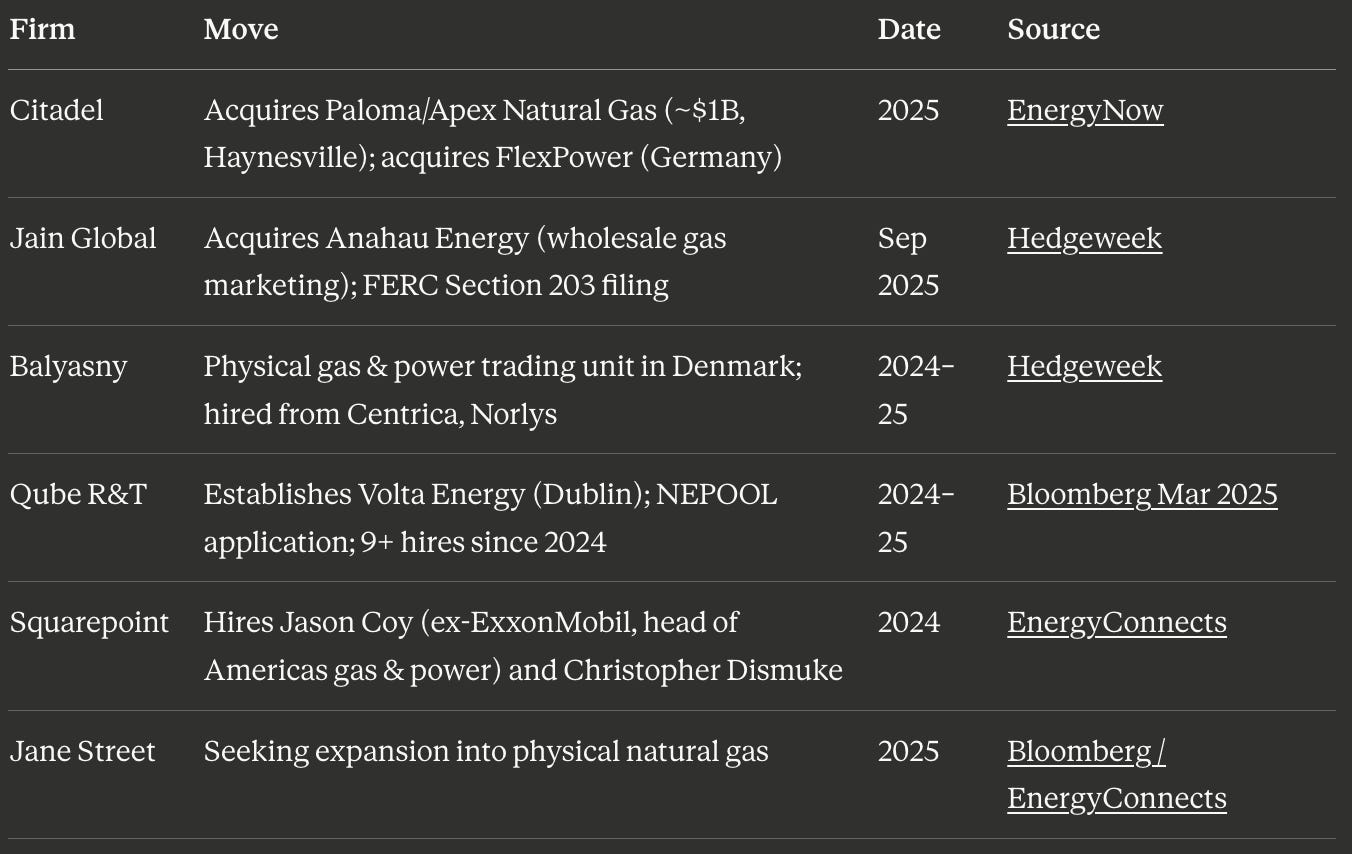
The strategic rationale, stated plainly by one industry CIO: “It’s an information gold rush. When you’re trading physical commodities, you’re privy to a lot of information and you get a sense of what is actually happening from economic shifts before the actual data comes in.” This is the advantage Citadel has held since 2014. The rest of the market is now trying to replicate it.
Synthesis: Three Structural Layers That Generated the Alpha
Strip away the names and the headlines, and hedge fund energy alpha from 2006 through 2024 decomposed into three repeatable structures.
01 — Physical Infrastructure Arbitrage. Storage tanks, pipeline transportation rights, and upstream production assets convert market dislocations into structural edge unavailable to financial-only traders. Citadel’s 450+ counterparty relationships let it see basis dislocations before they appear in public data. Arnold’s NGS Energy salt-dome storage enabled calendar-spread extraction. Jain’s Anahau acquisition purchased an existing physical network rather than building one over years. The common thread: owning the physical layer is not optional for durable energy trading alpha — it is the foundation.
02 — Options-Asymmetric Fundamental Construction. Buying options rather than selling them bounds downside to premium paid while preserving theoretically unlimited upside. Combined with a fundamental noise floor — only trade when the expected imbalance exceeds forecasting error — this portfolio absorbs adverse short-term price moves without forced liquidation, allowing fundamental theses to manifest. Arnold applied the same logic at Centaurus: on the right side of the supply analysis, sized to survive being early.
03 — Multi-Strategy Platform Risk Aggregation. The pod-based multi-manager structure at Citadel, Millennium, and Balyasny allows energy alpha to compound simultaneously across physical, futures, options, equity, and cross-commodity legs — with central risk management preventing dangerous concentration while amplifying high-conviction signals. Citadel’s commodities investment team of 260 professionals is roughly one-fifth of the total investment team but generated approximately half of all firm returns between 2022 and 2024. That capital efficiency is only possible through the cross-strategy architecture.
Forward View: Structural Conditions Are Intensifying, Not Normalizing
The backdrop for elevated energy trading returns is not reverting to the pre-2022 mean. European gas volatility, while moderating from 2022 peaks, remains structurally above pre-crisis levels — Europe now relies on LNG for supply flexibility it previously sourced from Russian pipelines. The correlation between TTF and JKM (Asian benchmark) has risen from a 60% average between 2013–2018 to over 90% since 2019 — meaning a supply shock in any major LNG market now propagates globally within hours. Basis differentials, geographic arbitrage windows, and cross-market calendar spreads all widen when correlation goes up and flexible supply goes down.
AI-driven electricity demand is accelerating pressure on power infrastructure — the same reason Citadel acquired FlexPower and Balyasny is hiring from European utilities. The Haynesville acreage Citadel acquired sits adjacent to LNG export terminals scaling up to serve this structural demand shift.
Every major multi-strategy fund is now building what Citadel proved profitable in 2022. The firms that complete this physical-financial integration first will extract the next wave of alpha. The firms still negotiating joint ventures will be where Eni is today: watching the profits accrue to someone else.
📊 Want the Full Trade-by-Trade Breakdown?
This article gives you the structural thesis. The Patreon deep-dive goes further — covering every exact trade executed by Amaranth, John Arnold, Citadel, and Pierre Andurand, with full transparency about what is confirmed from regulatory documents and what is analytically inferred. Every winning trade. Every losing trade. The exact mechanics of each.
→ Read the exclusive trade breakdown here
This research took a very long time of data collection, verification, and analysis. If you found value in this deep-dive, I publish exclusive quantitative research, trading strategies, and institutional-grade analysis on Patreon.
By joining, you’ll be supporting my work and motivating me to publish more content like this.
→ Join the Patreon community here
About the Author
Navnoor Bawa is a quantitative analyst and independent researcher focused on institutional energy markets, hedge fund strategy, and cross-commodity trading frameworks.
📺 YouTube — Quantitative analysis and trading strategy deep-dives: The Mathematical Trader
💼 LinkedIn — Connect for institutional research and commentary: Navnoor Bawa
🔒 Patreon — Exclusive quantitative research and institutional-grade analysis: Read the trade breakdown · Join the community
Primary Source Index
All links open directly.
U.S. Senate PSI — Excessive Speculation in Natural Gas, June 2007
EnergyConnects — Balyasny & Squarepoint gas/power hires, 2024
AEGIS Hedging — TTF intraday ~$97/MMBtu peak (Aug 2022) and LNG spread dynamics
Keywords: hedge fund energy trading, Citadel commodities strategy, Amaranth Advisors collapse, John Arnold Centaurus, Pierre Andurand returns, physical natural gas trading, energy trading alpha, LNG hedge fund, TTF volatility 2022, Citadel $8 billion, energy infrastructure hedge fund, commodity trading strategy, Jain Global Anahau, Balyasny energy, Qube physical gas, Andurand Discretionary Enhanced, carbon allowance trading EUA, energy market hedge fund 2022, pipeline basis trading, calendar spread natural gas
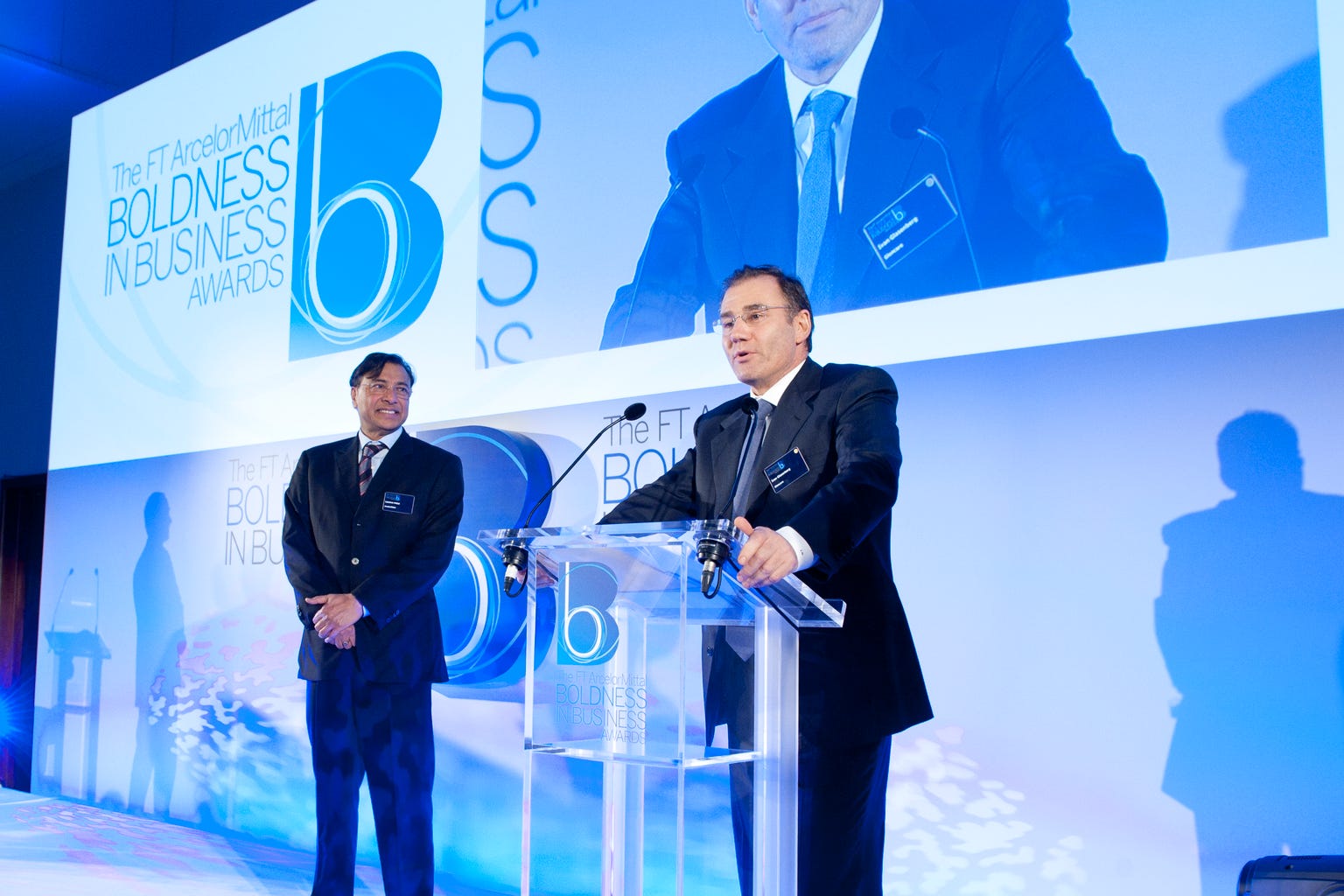
Cover photograph: Financial Times, CC BY 2.0, via Wikimedia Commons.