

Follow & Connect: → 📺 Subscribe on YouTube — The Mathematical Trader → 💼 Connect on LinkedIn — Navnoor Bawa
🎬 Prefer watching over reading? This article has been turned into a full video breakdown — all five trades, all the data, in cinematic format. → Watch: The Desert Playbook — An Alpha Autopsy (YouTube)
A fully cited, primary-source reconstruction of how sophisticated capital extracted alpha from Dubai across five distinct cycles: an AED peg speculation bet the central bank’s own BIS paper confirms, a Dubai World CDS trade timed to a standstill announcement, a Nakheel sukuk legal-flaw distressed play reconstructed from court documents and Omar Salah’s Berkeley law journal analysis, an Emaar equity proxy returning 4x from COVID lows, and a DIFC/ADGM tax arbitrage now housing 102 funds and $700B in AUM. Every claim that follows has a source link.
Dubai is not an information-asymmetry market in the conventional sense. It is a document-reading asymmetry market. The funds that made money in each of its crises and booms were reading legal prospectuses, BIS technical papers, DIFC insolvency decrees, and rating agency footnotes that relationship banks and regional investors were not. This article reconstructs each of the five major Dubai trades at the mechanism level, with a source citation on every factual claim, drawn from IMF working papers, BIS central bank testimony, court documents, SSRN legal analyses, Bloomberg investor letter reporting, eFinancialCareers trader testimony, and official DIFC regulatory filings.
📌 This research is also published in full on Patreon with extended commentary, additional data, and exclusive institutional analysis. → Read the full Dubai Alpha Dossier on Patreon
Trade I · 2007–2008 · The Hidden Trade
The AED Revaluation Long — The Trade the Central Bank Confirmed in a BIS Paper
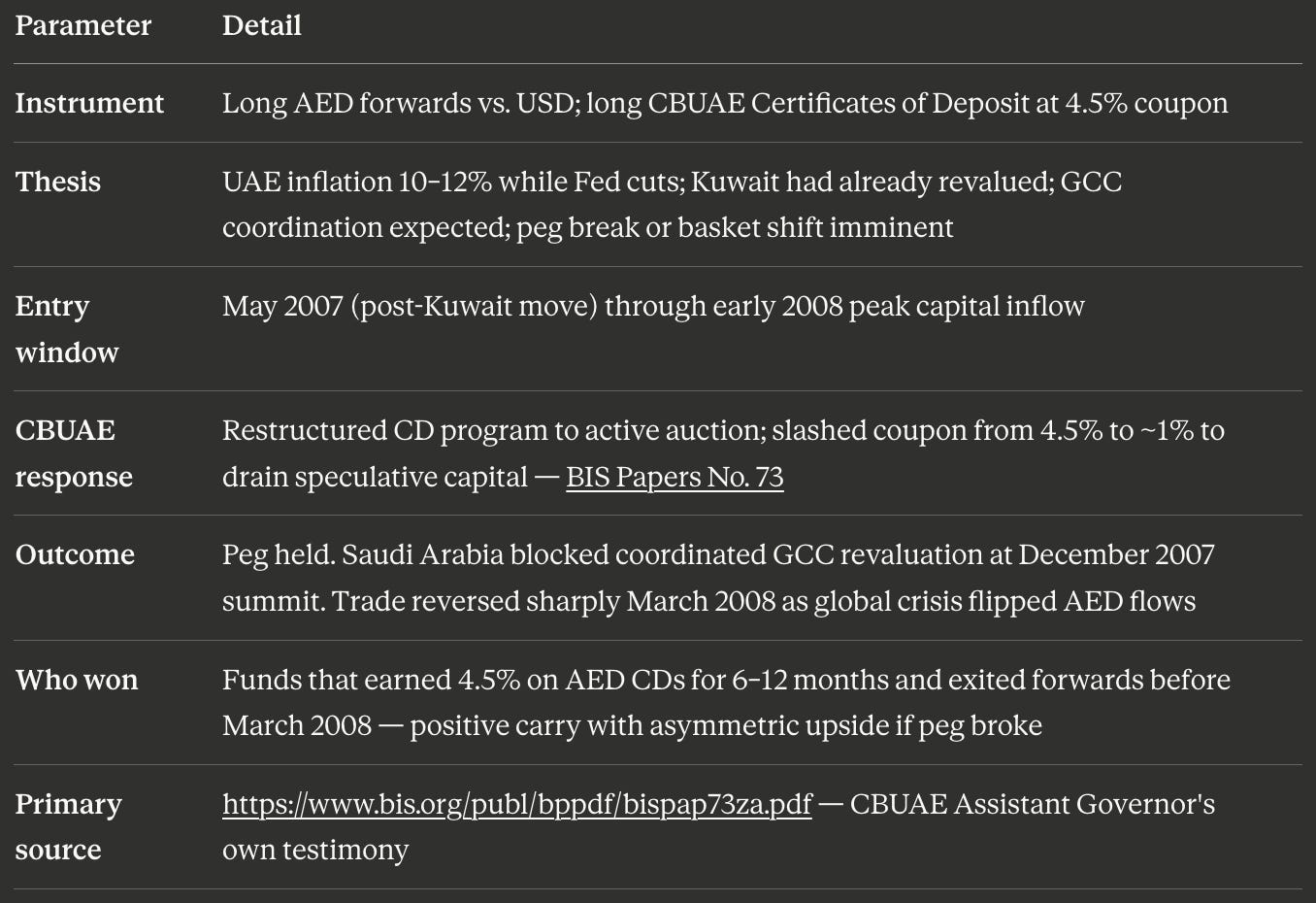
The least-discussed Dubai trade never involved real estate or credit instruments. It involved the UAE dirham peg itself. Between 2007 and early 2008, international hedge funds accumulated long positions in the dirham, betting that the UAE government would break or reprice the peg from its fixed rate of 3.6725 per US dollar — a trade so significant it forced the Central Bank of the UAE to restructure its entire monetary sterilisation programme. The evidence for this trade’s existence and scale is not in newspaper speculation. It is in a Bank for International Settlements paper (BIS Papers No. 73) authored by the CBUAE’s own Assistant Governor, who wrote explicitly: “Our CDs program was reviewed in 2007 as a result of the speculation on dirham revaluation during the years 2007–2008. These flows were, to a great extent, sterilized via the CDs program.”
The macroeconomic logic for the trade was airtight. Merrill Lynch research warned publicly that UAE consumer price inflation was approaching 10% in 2007 and a forecast 12% in 2008, driven by an infrastructure construction boom, massive capital inflows, and soaring rents. The Federal Reserve, meanwhile, was cutting rates to address the early symptoms of the US housing crisis — which, under the mechanics of the dollar peg, forced the CBUAE to mirror those cuts even as domestic conditions demanded tighter money. As the Council on Foreign Relations documented in real time in April 2007: “The last thing the Gulf states need… is lower nominal interest rates and a weaker currency.” Real interest rates in the UAE were turning negative. The Fed was cutting. Inflation was accelerating. The case for revaluation was overwhelming.
The catalyst was Kuwait. In May 2007, Kuwait unilaterally shifted its currency from a dollar peg to a basket of currencies — triggering an immediate appreciation of the Kuwaiti dinar that would reach approximately 6% against the dollar by year-end. CFR’s Brad Setser, writing in real time, noted that “hot money was coming in” across the GCC and that Kuwait’s central bank was already warning against speculating on its revaluation. The UAE was the larger, more liquid target. Funds began buying UAE dirhams forward and accumulating high-coupon CBUAE Certificates of Deposit — instruments paying roughly 4.5% annually and denominated in a currency they were betting would appreciate against the dollar.
“These large flows led us to readjust the CDs program from a passive program, where issuance was up to the banks, to an auction-based program where the cutoff rates would be decided by the CBUAE… the coupons paid on CDs collapsed from around 4.5% to close to 1%.”
— CBUAE Assistant Governor, BIS Papers No. 73 (Bank for International Settlements, 2013)
The same BIS paper confirms that “large variations in the 12-month USD/AED forward rates” were observed specifically during this period — the mechanical fingerprint of large-scale speculative forward positioning. The CBUAE was forced to move from passive to active CD auctions, slashing coupon rates from 4.5% to approximately 1% to make the carry on speculative positions unattractive. By March 2008, the global financial crisis reversed the dynamic entirely — now local banks needed dollar liquidity, not AED longs — and the speculative trade unwound. Funds that exited before March 2008 captured: the coupon income on high-rate AED CDs for roughly 9–12 months, plus any MTM appreciation on forward contracts purchased before the forward curve normalised. The peg held. But the trade existed, was executed at scale, and is confirmed in central bank testimony.
Trade I Mechanics — AED Revaluation Long
https://www.bis.org/publ/bppdf/bispap73za.pdf
Trade II · Nov. 2009 · The CDS Short
Dubai World CDS — Monetising a Legal Fiction the Banks Had Priced as Fact
Between 2004 and 2008, Dubai financed a construction boom by raising approximately $80 billion through borrowing, with Dubai World — the government’s principal investment holding company — accumulating $59 billion in debts, accounting for nearly three-quarters of the emirate’s total debt load. The structural flaw that offshore credit specialists identified and domestic banks missed was stated plainly in Dubai’s own legal filings: as Lexology’s contemporaneous legal analysis confirmed, “Dubai World was not established pursuant to the provisions of UAE Federal Law” — it was a decree corporation, owned by the government but carrying no contractual government guarantee on its debt obligations. International banks had lent against an implied guarantee that existed nowhere in the legal documents.
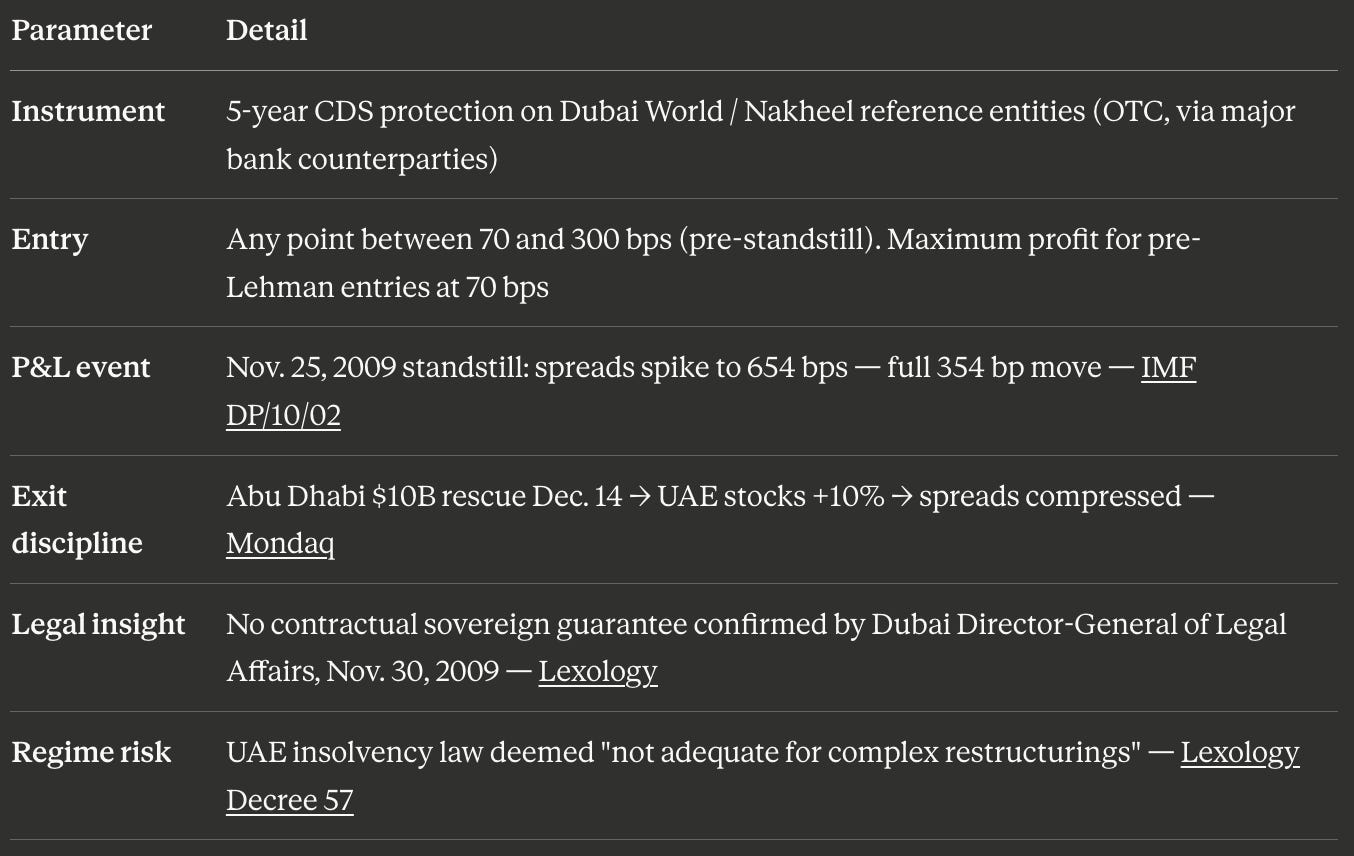
IMF Working Paper DP/10/02 provides the precise data: before the Lehman Brothers collapse, five-year CDS spreads on Dubai had averaged approximately 70 basis points. Post-Lehman, they had drifted to roughly 300 basis points. On November 25, 2009, the Government of Dubai, acting through its Supreme Fiscal Committee, formally announced that Dubai World would seek a standstill on repayment of $26 billion in obligations until at least May 2010, with Deloitte’s Aidan Birkett appointed as Chief Restructuring Officer. The market reaction was seismic. The same IMF working paper documents that Dubai’s CDS spreads soared to 654 basis points on the announcement — a 354 basis-point move from the pre-standstill level.
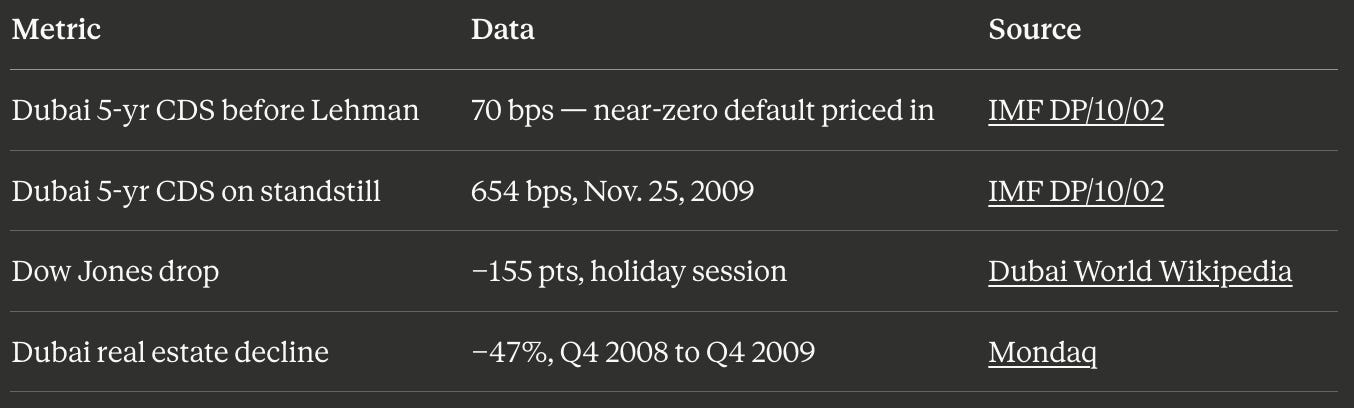
The critical execution discipline: funds that made the full move on the CDS trade understood they were shorting a specific legal fiction, not the UAE sovereign. Lexology’s legal analysis explicitly confirmed: “A public statement on 30 November 2009, of the Dubai Finance Department Director-General, that the Dubai World debts are ‘not guaranteed by the government’ appears to correctly reflect the legal position.” Any fund that had read that legal position — available in Dubai World’s own establishment decree — knew the implied guarantee was not contractual. Funds that shorted GCC credit broadly were caught in rapid spread compression when Abu Dhabi stepped in: on December 14, 2009, the Dubai government received $10 billion in surprise aid from Abu Dhabi, which immediately paid off the Nakheel sukuk maturing that same day. As Mondaq’s legal commentary documented, UAE stock markets shot up in excess of 10% following that announcement. The window for the CDS profit was between the standstill announcement (Nov. 25) and the Abu Dhabi rescue (Dec. 14) — a 19-day trade.
Trade II Mechanics — Dubai World CDS Short
Trade III · 2010–2016 · Distressed Sukuk
The Nakheel Sukuk — Buying the Legal Flaw at 80 Cents, Confirmed by Court Documents and Legal Analysis
The Instrument: What Investors Thought They Had vs. What They Actually Had
Academic case study documentation confirms that the Nakheel Sukuk was issued at $3.52 billion — the largest sukuk globally in 2006, oversubscribed by 2.5 times its initial $2.5 billion target. It was structured as a Sukuk al-Ijarah (lease-based Islamic bond), winning Islamic Finance News’ Deal of the Year Award for 2006. International investors who bought it believed they held a claim on underlying Dubai real estate assets. They did not.
The distinction between what investors believed and what they legally had is documented in detail by Omar Salah in his primary legal analysis published in the Berkeley Journal of International Law: “Several analyses by the lawyers of Dubai World and its creditors showed that the sukuk holders would probably not be able to rely on the level of protection they had expected.” Salah confirms: the sukuk was “asset-based” rather than “asset-backed” — in an asset-backed structure, the underlying real estate would have been truly transferred to an SPV and available to creditors in insolvency; in the Nakheel structure, the SPV held only contractual rights. In insolvency, those rights could be subordinated to Dubai World’s other creditors. Fitch Ratings had independently warned it “has not reviewed any transaction to date” where it believed creditors could actually seize sukuk assets in insolvency. The credit enhancement mechanisms — a pledge on 18.89% of Nakheel PJSC shares and a Dubai World guarantee — were both worthless in a scenario where Dubai World itself was the entity seeking the standstill.
The legal architecture of the insolvency regime compounded the problem for creditors. Lexology’s analysis of Dubai’s emergency Decree 57 — the bespoke insolvency code created on December 13, 2009, specifically for Dubai World — documents that Dubai World “may not seek protection from its creditors under the UAE’s existing insolvency regime,” as that regime was deemed inadequate. Mondaq’s restructuring legal analysis confirms: “The current UAE insolvency regime and the UAE courts are not generally viewed by insolvency experts to provide a sufficiently clear or adequate legal framework for complex restructurings.” A new, bespoke tribunal had to be built from scratch, combining UK insolvency procedures with US Chapter 11 substantive provisions. The University of Missouri Law Journal’s comprehensive analysis of the Dubai World Tribunal confirmed that its judgments were “final and binding, with no appeal possible” — an unprecedented feature that removed any Western-style judicial check on the outcome.
“The restructuring request caused much distress among the sukuk holders, because several analyses by the lawyers of Dubai World and its creditors showed that the sukuk holders would probably not be able to rely on the level of protection they had expected.”
— Omar Salah, Berkeley Journal of International Law Publicist, 2010 (primary legal analysis)
The Trade Execution: SC Lowy and the Creditor Letter
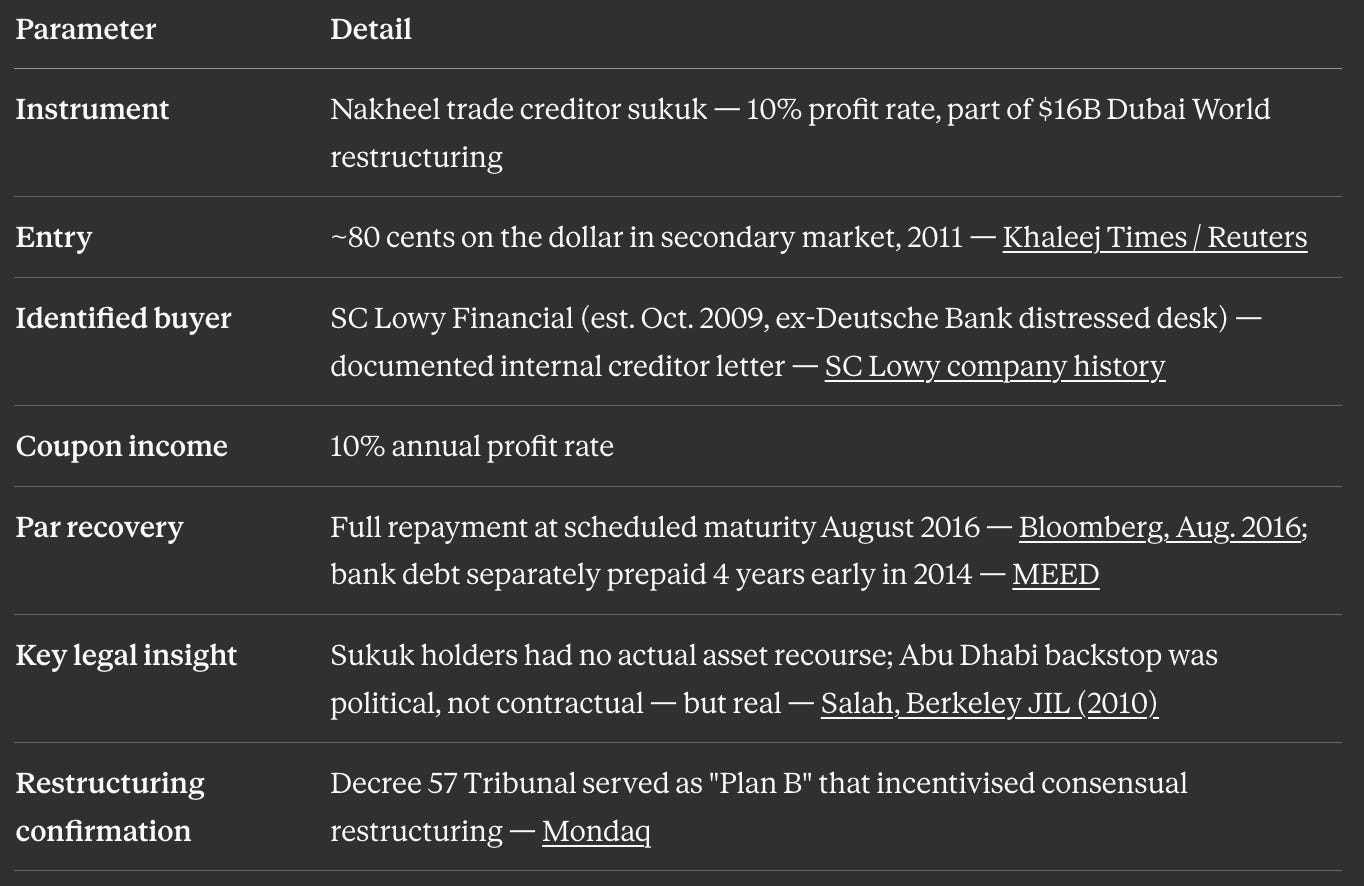
After the CDS short played out, a second trade opened: buying Nakheel’s restructured paper at a discount. The restructuring offered trade creditors a blended recovery — 40% cash and 60% in a newly issued sukuk carrying a 10% annual profit rate. The trading opportunity emerged immediately: by early 2011, the restructured sukuk was already trading at a 20% discount to face value in the secondary market. Cash-hungry trade creditors — small contractors and suppliers owed money by Nakheel — were selling their newly issued bonds immediately, unwilling or unable to hold a 5-year instrument. The buyers on the other side were offshore distressed specialists.
The most documented participant is SC Lowy Financial. SC Lowy’s own corporate history confirms the firm was founded in October 2009 by former Deutsche Bank distressed desk veterans Michel Lowy and Soo Cheon Lee, with $16 million in seed capital, specifically to exploit distressed dislocations in Asia and the Middle East when others were fearful. The firm subsequently raised a further $20 million from institutional private equity to “fully capitalize on market opportunities.” Reuters — reported via Khaleej Times — obtained SC Lowy’s internal letter circulated to Nakheel trade creditors offering to purchase their claims: this was the first publicly documented evidence of an offshore distressed specialist systematically working the $10.9 billion Nakheel restructuring’s secondary market.
The arithmetic of the trade was precise. Buying at 80 cents on the dollar a sukuk carrying 10% annual profit rate, with a government-linked issuer whose Abu Dhabi patron had already demonstrated a willingness to provide $10 billion in emergency support — the blended IRR over a 5-year hold substantially exceeded investment grade fixed income. Bloomberg confirmed full par repayment at the sukuk’s scheduled maturity in August 2016, validating both the 10% annual coupon and the 20-point capital gain for all secondary buyers. The trade creditor sukuk matured exactly on its contracted schedule; it was Nakheel’s separate bank debt — AED7.9 billion — that was prepaid four years ahead of its due date in August 2014, with the overall restructuring programme completed two years ahead of its five-year implementation plan. Mondaq’s analysis records: “By the summer of 2011, both Dubai World and Nakheel had successfully restructured their debts on an out-of-court basis, in each case, with the consent of 100% of financial creditors.”
Trade III Mechanics — Nakheel Distressed Sukuk
Trade IV · 2020–2025 · Emaar Equity Proxy
The Emaar Equity Proxy — 4x Returns on Liquid Dubai Real Estate
The fourth Dubai trade is one the financial press has not assembled clearly: using Emaar Properties (DFM: EMAAR) as a liquid listed equity proxy for Dubai real estate exposure. The core logic — documented by traders and confirmed by analyst research — is that Emaar is the only listed entity that genuinely tracks Dubai property sentiment with institutional-grade liquidity, while avoiding the off-plan construction risks and payment tranche obligations that trapped late-cycle direct property investors.
AGBI’s November 2023 sector analysis confirmed that Emaar Properties and its subsidiary Emaar Development were described by Arqaam Capital’s analyst Mohamad Haidar as “the only real choices for risk-averse equity traders seeking exposure to Dubai real estate” — competitors including Union Properties and Deyaar carried multi-billion dirham accumulated losses, while DAMAC had delisted from public markets in March 2022. Emaar’s dominance is structural: the firm maintained approximately 30% market share of Dubai residential sales while growing revenue 25% year-on-year as of mid-2023, and its nine-month 2023 net profit reached AED 8.24 billion, up 42% year-on-year, with margins expanding as price increases outpaced roughly 7% construction cost inflation — per Arqaam Capital estimates cited by AGBI.
The return profile from the COVID entry point was exceptional. Traders interviewed by eFinancialCareers in March 2026 explicitly described the Emaar trade: “From Covid Low of March 2020, it returned 4x in 3.5 years, more than the best real estate deal one could get. And was liquid all the way.” The NAV gap made the entry compelling: Arqaam Capital estimated Emaar’s NAV at $37.6 billion against a market capitalisation of approximately $16.8 billion as of mid-2023 — a 55% discount to intrinsic value, even after the post-COVID rally. Emaar’s Wikipedia financial history documents that the stock had traded at deep discounts to its 2005 all-time highs for years — meaning the 2020 entry came after a decade of institutional underperformance had washed out weak holders.
The contrast with direct off-plan investment is instructive. Senior traders at Goldman Sachs and other institutions told eFinancialCareers in March 2026 that colleagues who bypassed the liquid equity route and applied leverage to direct off-plan property positions are now facing potential 20–30% paper losses, with geopolitical anxiety from broader Middle East tensions repricing Dubai’s “safe paradise” premium. One Goldman Sachs trader described watching peers buy “whole floors” in new developments at peak-cycle pricing in 2023–2025. The Emaar equity position could be sold at any point, at any price, in real time. The off-plan direct position cannot be exited without breaching contract and forfeiting deposits.
The Off-Plan Trap (2023–2026): Off-plan property in Dubai requires staged payment tranches tied to construction milestones regardless of market conditions. Developers are enforcing contract clauses as of early 2026. Senior traders told eFinancialCareers: “People are being wiped out by this… people are freaking out. They’ve all bought off-plan property which is going to be unsellable.” The structural protection this cycle has over 2009 — Dubai now mandates construction escrow — means projects will likely complete. But the exit price may be well below purchase cost for 2023–2025 vintage off-plan buyers.
Trade V · 2022–Ongoing · Structural Relocation
The DIFC/ADGM Tax Arbitrage — The Structural Trade That Compounds Every Year
The fifth and currently largest Dubai trade is not a position in any financial instrument. It is a structural optimisation of the hedge fund business model itself, exploiting the combination of a 0% tax regime, a common-law regulatory environment, and direct physical proximity to the world’s most concentrated pool of sovereign capital. It is also the only trade where the alpha compounds year after year regardless of market conditions.
The arithmetic starts with taxation. Norton Rose Fulbright’s regulatory analysis confirms: funds registered in DIFC or ADGM enjoy full exemption from the UAE’s 9% corporate income tax, including 0% on capital gains, 0% personal income tax, and no withholding tax on distributions. The UAE has signed 193 DTAs and bilateral investment treaties combined, and over 140 standalone double-taxation agreements, eliminating cross-border withholding friction. Against the UK’s post-2025 budget changes — where carried interest is now taxed at 32% from April 2025 (up from 28%), rising to approximately 34% from April 2026 under a new income-tax framework — or the US federal rate of 37% plus state — a Dubai-domiciled PM earning $20 million in annual performance fees retains approximately $8–9 million more per year in after-tax income than an equivalent London-based PM. This differential is not marginal. For a pod PM at Millennium, ExodusPoint, or Balyasny, it is the single largest variable in total compensation.
The capital access multiplier is what transforms this from a tax optimisation into a strategic trade. The GCC sovereign wealth funds — ADIA, Mubadala, ADQ, PIF, QIA, KIA — collectively control assets approaching $6 trillion and are actively expanding hedge fund allocations. Zawya / Global SWF confirmed that UAE sovereign wealth funds combined deployed $36.5 billion in 2023 alone. Mubadala alone invested $29.2 billion in 2024 — approximately 20% of the $136.1 billion deployed globally by sovereign wealth funds, making it the world’s most active SWF that year. Top1000Funds’ ADIA profile confirmed that “hedge funds have proved one of the most successful allocations, particularly for ADIA, says Global SWF in its annual report.”
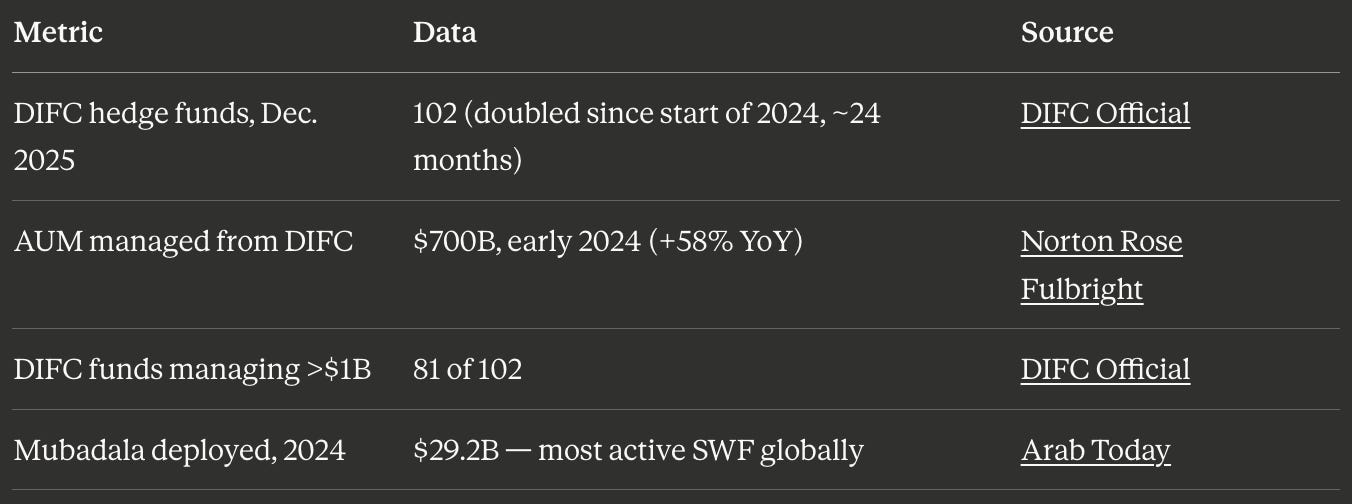
The firms now operating from DIFC include: Balyasny, BlackRock, Millennium Management, Hudson Bay, BlueCrest, Brevan Howard, Squarepoint, Baron Capital, and Oak Hill Advisors ($108B global AUM). (TCI Fund Management chose the neighbouring ADGM in Abu Dhabi — a distinction that matters: DIFC is Dubai’s freezone, ADGM is Abu Dhabi’s.) Finance Magnates documented a 125% year-on-year increase in hedge fund registrations at DIFC in 2023. Hedgeweek’s February 2026 report confirmed DIFC registered 1,924 new companies in 2025 — a 28% year-on-year increase — with the zone now employing 50,000 people.
Case Study: Brevan Howard’s $10 Billion Abu Dhabi Risk Centre
Brevan Howard Wikipedia’s financial history records the firm’s Master Fund gained 20% in 2022, driven by interest rate trades. The listed feeder vehicle BH Macro returned 21.93% in sterling — its third-best year since its 2007 inception, per the investor presentation reported by Reuters. Bloomberg reported in January 2023 that the $10 billion Brevan Howard Master Fund gained 20% in 2022, while the $12 billion Alpha Strategies fund recorded its best-ever year at +28%, citing “people with knowledge of the matter.” MarketScreener / Reuters’ investor presentation reporting confirmed the specific source of the 2022 alpha: “Interest rate trading, which gave BH Macro most of its profit rise, included bets on U.S. interest rates and positions related to inflation, volatility and European rates.”
Flush with $30 billion in AUM and a two-year resurgence, the firm opened ADGM headquarters in February 2023. By March 2024, Pensions & Investments reported that Brevan Howard was running approximately $10 billion in active risk from Abu Dhabi — more than from London or New York — and had planned to double Abu Dhabi headcount from 60 to 120 people. Founder Alan Howard made the strategic reasoning explicit at Abu Dhabi Finance Week: as AGBI reported, Howard told attendees that as top hedge funds bring senior people to Abu Dhabi, “that can lead to the banks having to send their best people as well to service correctly those traders, and other parts of the financial sector.”
The capital relationship this proximity produced was confirmed in August 2025: Bloomberg reported that Abu Dhabi-backed Lunate — overseeing $110 billion for sovereign investor ADQ — took a minority equity stake in Brevan Howard and committed $2 billion to a newly created fund platform domiciled in ADGM. This was not a standard LP allocation. It was a sovereign entity taking equity in a fund manager — a capital relationship that physical presence in Abu Dhabi had produced, and remote pitching from London had not.
However, the risk register on this structural positioning is explicit in public sources: Hedgeweek reported in March 2025 that Brevan Howard’s $11.7 billion Master Fund posted a 1% decline in the first week of March, extending year-to-date losses to 5.4%. An investor letter cited by Bloomberg reported the Alpha Strategies fund was down 0.8% that same week. CEO Aron Landy moved to reduce risk-taking, implementing stricter trading limits for some portfolio managers. The prior year Disruption Banking confirmed the Master Fund posted only +0.8% in 2025, against Bridgewater Pure Alpha’s +33% and Discovery Capital’s +36%. Physical presence in Abu Dhabi does not generate alpha. The trading calls still have to be right.
ExodusPoint: The Multi-PM Pod Model — Named Sources and Regulatory Data
eFinancialCareers’ June 2025 reporting confirmed ExodusPoint’s Dubai expansion in specific detail: the fund’s biggest recent UAE hire was Adrian Ahmadi, brought in from Point72 specifically to head a long/short equity pod. Ahmadi had subsequently hired Emmanuele di Gennaro, a former Morgan Stanley investment banking associate in Milan, to work on the Dubai long/short equity trading book. Hedgeweek confirmed in June 2025: “The firm’s Dubai entity currently has five authorised individuals listed with the Dubai Financial Services Authority.” This is verifiable public data — the DFSA database is a regulatory registry, not a news report. eFinancialCareers additionally documented that despite AUM falling approximately $2 billion (16%) over 18 months, ExodusPoint continued to add at least 10 portfolio managers in 2024 spread across the UK, US, and UAE — confirming that Dubai pod expansion continued even during an AUM drawdown period, suggesting the capital-raising and tax rationale was independent of near-term performance.
Synthesis · The Core Pattern
The Structural Edge Across All Five Trades: Reading the Document, Not the Narrative
Assembling all five trades reveals one consistent intellectual thread. The funds that extracted alpha from Dubai in every era were those that read the legal and structural document rather than the market narrative or relationship convention. The AED revaluation trade was available to anyone who read the BIS paper on UAE monetary policy mechanics and understood the Fed/CBUAE divergence. The CDS trade worked because Dubai World’s non-guarantee was in the establishment decree, not in the banks’ loan files. The Nakheel sukuk trade worked because the asset-based/asset-backed distinction was in the rating agency footnotes and available in any Ijarah sukuk legal opinion — including Omar Salah’s analysis, published in 2010 and freely accessible. The Emaar proxy trade worked because the NAV-to-market-cap gap was in Arqaam Capital’s quarterly research. The DIFC relocation trade works because the UAE tax code is public law, published by Norton Rose Fulbright and available to anyone.
Dubai does not hide its alpha. It publishes it in regulatory filings, legal decrees, BIS papers, and listed company financials. The funds that extracted that alpha simply did the reading that others didn’t. That structural condition has not changed. The next dislocation — whatever form it takes in the Gulf — will be legible in the same documents it always has been. The advantage will go, as it always has, to whoever reads them first.
📊 Want Deeper Quantitative Analysis?
This research took a very long time of data collection, verification, and analysis. If you found value in this deep-dive, I publish exclusive quantitative research, trading strategies, and institutional-grade analysis on Patreon.
By joining, you’ll be supporting my work and motivating me to publish more content like this.
→ Read the full Dubai Alpha Dossier — exclusive Patreon post
→ Join the Patreon community here
All Sources — Full Verified Links
https://www.bis.org/publ/bppdf/bispap73za.pdf — BIS Papers No. 73, CBUAE Assistant Governor — AED revaluation speculation and CD program restructuring 2007–2008 [PRIMARY DOCUMENT]
https://www.cfr.org/articles/gcc-revaluation-watch — Council on Foreign Relations, Brad Setser — GCC revaluation speculation, hot money flows, April 2007
https://www.khaleejtimes.com/business/uae-inflation-may-rise-to-12pc-in-2008 — Khaleej Times — Merrill Lynch research: UAE inflation 10–12%, revaluation pressure
https://www.imf.org/external/pubs/ft/dp/2010/dp1002.pdf — IMF Working Paper DP/10/02 — Dubai World CDS spread data: 70 bps → 654 bps [PRIMARY DOCUMENT]
https://en.wikipedia.org/wiki/Dubai_World — Dubai World Wikipedia — $59B debt, standstill announcement chronology, Abu Dhabi $10B rescue
https://www.gktoday.in/what-is-dubai-crisis-2009/ — GKToday — Dubai crisis background: $80B borrowing 2004–2008, property crash
https://www.lexology.com/library/detail.aspx?g=956465a6-2f8c-42f9-8391-2acd86bb412a — Lexology — Nov. 25, 2009 official standstill announcement and DFSF establishment [LEGAL DOCUMENT]
https://www.lexology.com/library/detail.aspx?g=c80a5993-3199-4b11-9669-aac02a482116 — Lexology — Dubai World restructuring decree analysis: “debts not guaranteed by government” confirmed [LEGAL DOCUMENT]
https://www.lexology.com/library/detail.aspx?g=1c19f293-3045-4254-8fbd-7d4e8ec4aa0b — Lexology — Decree 57 of 2009 full analysis: UAE existing insolvency regime deemed “inadequate” [LEGAL DOCUMENT]
https://www.mondaq.com/corporate-and-company-law/92092/commentary-upon-the-dubai-world-insolvency-code-toward-a-clearer-path — Mondaq — UAE stocks +10% on Dec. 14 rescue; Decree 57 analysis [LEGAL DOCUMENT]
https://www.mondaq.com/insolvencybankruptcy/179356/shifting-sands-insolvency-and-restructuring-law-reform-in-the-middle-east — Mondaq — Dubai property −47%, 100% financial creditor consent, UAE insolvency law inadequacy [LEGAL DOCUMENT]
https://scholarship.law.missouri.edu/cgi/viewcontent.cgi?article=1758&context=jdr — University of Missouri Law Journal — Dubai World Tribunal: Decree 57, no appeal possible [ACADEMIC / COURT DOCUMENT]
https://bjil.typepad.com/publicist/2010/02/dubai-debt-crisis-a-legal-analysis-of-the-nakheel-sukuk.html — Omar Salah, Berkeley JIL — Nakheel sukuk: asset-based flaw, creditor protection inadequacy [PRIMARY LEGAL ANALYSIS]
https://papers.ssrn.com/sol3/papers.cfm?abstract_id=1663276 — SSRN — Omar Salah full paper and citation record
https://www.academia.edu/16996621/CASE_STUDY_ON_SUKUK_IJARAH_STRUCTURE — Academia.edu — Nakheel Sukuk: $3.52B issuance, 2.5x oversubscribed, Ijarah structure, Dubai World guarantee (not government guarantee)
https://en.wikipedia.org/wiki/Sukuk — Sukuk Wikipedia — Fitch Ratings warning: “has not reviewed any transaction” where creditors can seize sukuk assets in insolvency
https://www.khaleejtimes.com/business/debt-buyout-firm-eyes-nakheel-creditors — Khaleej Times / Reuters — SC Lowy creditor letter; Nakheel sukuk at 20% secondary market discount
https://www.bloomberg.com/news/articles/2016-08-22/nakheel-repays-1-2-billion-islamic-bond-ending-dubai-debt-saga — Bloomberg — Nakheel full par repayment at scheduled maturity, August 2016
https://sclowy.com/company/ — SC Lowy — Founded October 2009, $16M seed, Deutsche Bank veterans, distressed MENA/Asia mandate
https://www.agbi.com/analysis/real-estate/2023/11/investors-favour-emaar-for-dubai-property-returns/ — AGBI — Emaar 4x from COVID low; NAV $37.6B vs. market cap $16.8B; Arqaam Capital analyst quotes
https://en.wikipedia.org/wiki/Emaar_Properties — Emaar Wikipedia — Financial history, prior highs, valuation context
https://www.efinancialcareers.com/news/dubai-property-investments-bankers — eFinancialCareers, March 2026 — Trader testimony: 20–30% off-plan losses, Goldman traders, off-plan trap [INTERVIEW TESTIMONY]
https://www.difc.com/whats-on/news/difc-becomes-top-five-global-hub-for-hedge-fund-managers---over-100-hedge-funds-now-registered — DIFC Official — 102 hedge funds, 81 managing >$1B, December 2025 [OFFICIAL RELEASE]
https://www.nortonrosefulbright.com/en/knowledge/publications/85251e97/fund-manager-migration-understanding-the-push-and-pull-towards — Norton Rose Fulbright — 0% tax confirmed; AUM +58% to $700B
https://www.zawya.com/en/wealth/wealth-management/uaes-mubadala-adia-and-adqs-combined-investments-reached-365bln-in-2023-v5nq4ngn — Zawya — UAE SWFs combined $36.5B deployed in 2023
https://www.thearabtoday.com/mubadalas-investments-in-2024-rise-to-29-billion-exceeding-saudi-arabias-pif/ — Arab Today — Mubadala $29.2B deployed in 2024, most active SWF globally
https://www.top1000funds.com/asset_owner/abu-dhabi-investment-authority-adia/ — Top1000Funds — ADIA: “hedge funds have proved one of the most successful allocations”
https://www.bloomberg.com/news/articles/2023-01-06/brevan-howard-s-biggest-hedge-funds-gain-as-much-as-28-in-2022 — Bloomberg — Brevan Howard Master Fund +20%, Alpha Strategies +28% in 2022 [INVESTOR LETTER SOURCE]
https://www.marketscreener.com/quote/stock/BH-MACRO-LIMITED-9677368/news/Brevan-Howard-s-2022-profit-propelled-by-unit-s-interest-rate-bets-42823338/ — MarketScreener / Reuters — Specific 2022 trade attribution: US rates, inflation, European rates [INVESTOR PRESENTATION]
https://www.pionline.com/hedge-funds/brevan-howard-builds-abu-dhabi-outpost-10-billion-hub/ — Pensions & Investments — Brevan Howard $10B risk from Abu Dhabi, March 2024
https://www.bloomberg.com/news/articles/2025-08-26/abu-dhabi-s-lunate-to-take-stake-in-brevan-commits-2-billion — Bloomberg — Lunate $2B + minority equity stake in Brevan Howard, August 2025
https://www.agbi.com/banking-finance/2023/11/brevan-howard-to-double-abu-dhabi-headcount/ — AGBI — Alan Howard direct quotes from Abu Dhabi Finance Week [INTERVIEW TRANSCRIPT]
https://www.hedgeweek.com/brevan-howard-cuts-traders-risk-limits-as-losses-mount/ — Hedgeweek — Master Fund −5.4% YTD March 2025; investor letter; Aron Landy risk limit cuts [INVESTOR LETTER SOURCE]
https://www.disruptionbanking.com/2026/01/30/how-brevan-howard-fell-behind-in-the-macro-surge-of-2025/ — Disruption Banking — Brevan +0.8% in 2025 vs. Bridgewater +33%
https://www.efinancialcareers.com/news/london-to-dubai-hedge-fund-jobs-exoduspoint — eFinancialCareers — ExodusPoint Dubai: Adrian Ahmadi (ex-Point72), Emmanuele di Gennaro, DFSA 5 authorised individuals [NAMED INDIVIDUALS]
https://www.hedgeweek.com/exoduspoint-adds-pm-in-dubai-office/ — Hedgeweek — ExodusPoint Dubai DFSA authorised individuals confirmed, June 2025
https://www.efinancialcareers.com/news/exoduspoint-hedge-fund-hiring — eFinancialCareers — ExodusPoint AUM −$2B but still adding Dubai PMs; continued expansion data
https://www.financemagnates.com/institutional-forex/the-flock-of-hedge-funds-to-gcc-asset-gathering-booms-but-liquidity-constraints-persist/ — Finance Magnates — 125% YoY DIFC growth 2023; asset gathering vs. liquidity constraints
https://www.hedgeweek.com/hedge-funds-drive-record-difc-growth/ — Hedgeweek — DIFC 1,924 new companies in 2025 (+28% YoY); 50,000 employees; Zabeel expansion
https://en.wikipedia.org/wiki/Brevan_Howard — Brevan Howard Wikipedia — AUM history, 2022 returns context, trading strategy overview
https://www.thenationalnews.com/business/drydocks-world-a-positive-test-case-for-uae-bankruptcy-reform-1.244100 — The National — Decree 57 as “Plan B”; Latham & Watkins: “dramatic step forward” in UAE insolvency law [LEGAL DOCUMENT]
https://www.meed.com/nakheel-transfers-funds-for-1-2bn-sukuk-payment/ — MEED — Nakheel sukuk maturity August 2016 (on schedule); bank debt prepaid 4 years early in 2014; restructuring programme completed 2 years ahead of 5-year plan [PRIMARY FINANCIAL REPORTING]
https://www.ey.com/en_gl/technical/tax-alerts/united-kingdom-how-the-taxation-of-carried-interest-in-the-uk-is-changing — EY Global Tax Alert — UK carried interest: 32% CGT from 6 April 2025 (up from 28%); ~34% income tax regime from 6 April 2026 [TAX AUTHORITY / LEGAL]
https://www.adgm.com/media/announcements/tci-fund-management-establishes-strategic-presence-in-emea-region-with-opening-of-abu-dhabi-office — ADGM Official — TCI Fund Management opened in ADGM (Abu Dhabi), not DIFC (Dubai) [OFFICIAL RELEASE]
https://www.cbk.gov.kw/en/cbk-news/announcements-and-press-releases/press-releases/2007/05/200705200000-the-kuwaiti-dinar-kd-re-pegged-to-a-basket-of-currencies — Central Bank of Kuwait Official Press Release — Kuwait basket peg, May 20, 2007 [PRIMARY DOCUMENT]
Cover photograph: Tim Reckmann from Hamm, Deutschland, CC BY 2.0, via Wikimedia Commons.