


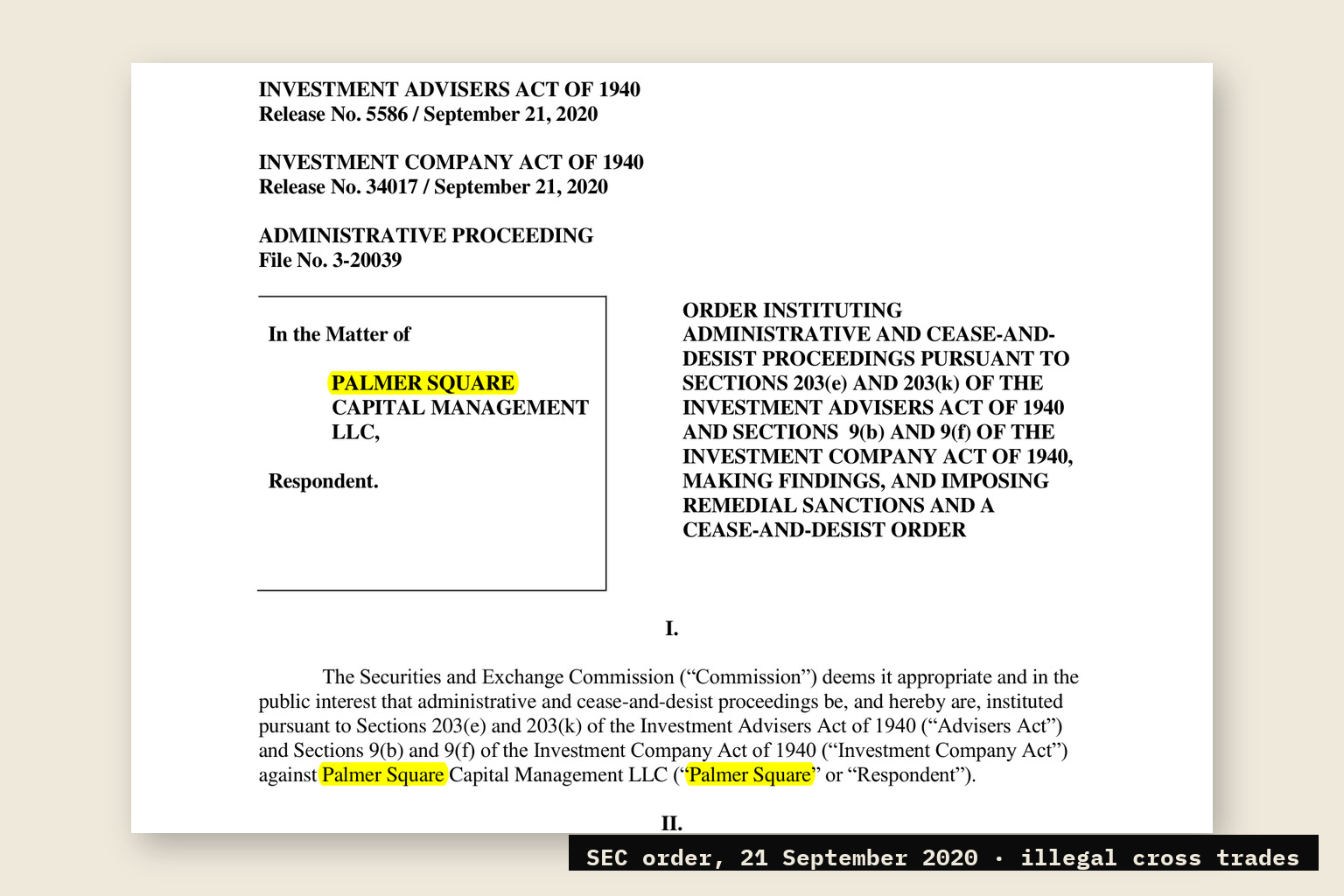
Bottom Line Up Front: Between July 2014 and September 2016, Palmer Square Capital Management executed 351 cross-trades between client accounts, generating $242,193 in markups that purchasing clients systematically absorbed — exposing how strategies marketed as “cost-saving arbitrage” can mask wealth transfers between clients when proper pricing controls fail.
The Strategy That Wasn’t
Palmer Square Capital Management built its reputation as a sophisticated credit specialist, growing from a Kansas City startup founded in 2009 to surpassing $5 billion in assets under management by 2018. But between July 2014 and September 2016 — during the firm’s rapid expansion phase — Palmer Square’s internal cross-trading operation revealed a fundamental truth about financial markets: the difference between legitimate arbitrage and client exploitation often comes down to a few critical pricing decisions.
The firm’s cross-trading strategy appeared straightforward: when one client needed to sell a security and another wanted to buy the same security, Palmer Square would “cross” the trade internally rather than executing separate transactions in the open market. This approach, they argued, would save both clients transaction costs and market impact — a classic arbitrage opportunity that benefits everyone involved.
The reality proved more complex.
Deconstructing the Mechanics
Palmer Square’s cross-trading operation centered on a simple but systematic process. When the firm decided to sell a security from one client account — whether to meet redemption requests or rebalance portfolios — traders would simultaneously arrange to purchase the same security for another client account through an independent broker-dealer.
The trades were always prearranged. The purchasing client always paid a markup. And that markup, totaling $242,193 across 351 transactions, was always retained by the executing broker-dealer.
This wasn’t random market variance — it was systematic wealth transfer.
The Numbers Tell the Story
Scale of Operations:
351 prearranged cross-trades executed between July 2014 and September 2016
Approximately 40 client accounts involved, including registered investment companies
$242,193 in total markups paid exclusively by purchasing clients
Zero instances where selling clients paid markups or fees
The Systematic Nature: Every single purchasing client paid markups while selling clients never did. In legitimate cross-trading, pricing should reflect independent market forces, not predetermined advantaging of one side over another. The mathematical impossibility of this pattern occurring randomly across 351 trades revealed the systematic nature of the violation.
Where Regulation Draws the Line
Cross-trading itself isn’t illegal — it’s a legitimate strategy when executed properly. Rule 17a-7 under the Investment Company Act specifically permits such transactions, recognizing their potential benefits for investors. But the rule establishes strict requirements designed to prevent exactly what Palmer Square did.
The Critical Pricing Requirement
Rule 17a-7 mandates that cross-trades be executed at the “independent current market price,” defined as “the average of the highest current independent bid and lowest current independent offer determined on the basis of reasonable inquiry.”
This isn’t bureaucratic red tape — it’s the mathematical foundation that ensures fair pricing. By requiring the bid-ask midpoint, the rule forces both sides of the trade to share the benefit of avoiding market impact costs.
Palmer Square’s Fatal Flaw: The SEC found that Palmer Square “failed to engage in a process to determine, on the basis of reasonable inquiry, the average of the highest current independent bid and lowest current independent offer for cross trades.” Instead, they “typically provided prices for the cross trades to the brokers, which it arrived at in various ways,” including “prices informed by the prices of comparable securities or single broker quotes.”
This approach eliminated the independence that makes cross-trading legitimate, converting it from cost-saving arbitrage into systematic client exploitation.
The Markup Problem
Rule 17a-7 explicitly prohibits cross-trades where “brokerage commission, fee, or other remuneration is paid in connection with the transaction.” Palmer Square’s systematic markups violated this requirement in every single trade.
The firm’s belief that using an independent broker-dealer somehow exempted them from Rule 17a-7 requirements revealed a fundamental misunderstanding of the regulation’s purpose: preventing affiliated persons from extracting value from the cross-trading process.
The P&L Breakdown: Who Won and Lost
The Winners
Executing Broker-Dealers: Collected $242,193 in markups with zero market risk — essentially guaranteed profit from facilitating wealth transfer between Palmer Square clients.
Palmer Square (Initially): Avoided market impact costs while maintaining client relationships and AUM during a critical growth phase when the firm was scaling toward its 2018 milestone of $5 billion in assets.
The Losers
Purchasing Clients: Systematically overpaid for securities by the full amount of broker markups — $242,193 in aggregate wealth transfer that was never disclosed or justified by independent pricing.
Palmer Square (Ultimately): Paid $450,000 in SEC civil penalties plus reputational damage and legal costs, far exceeding any operational benefits from the cross-trading program. The SEC’s enforcement action came in September 2020, by which time Palmer Square had grown to $10.2 billion in assets under management as of June 2020.
Market Integrity: The systematic nature of the pricing bias undermined the fundamental fairness that makes cross-trading beneficial for all parties.
The Broader Enforcement Context
Palmer Square’s case wasn’t isolated. The SEC has brought numerous cross-trading enforcement actions, each revealing different failure modes:
Hamlin Capital Management (August 10, 2018): Executed over 15,000 cross-trades of municipal bonds at bid prices instead of required midpoints, depriving selling clients of $414,672 in market savings while systematically favoring purchasing clients.
Macquarie Investment Management Business Trust (2024): Used cross-trades to limit investor losses in certain accounts while disadvantaging others, resulting in nearly $80 million in penalties for violations involving collateralized mortgage obligations and systematic client favoritism.
These cases demonstrate that cross-trading violations often follow similar patterns: systematic pricing biases that benefit one client group at another’s expense, regardless of the specific securities or market conditions involved.
Quantitative Lessons for Practitioners
1. Price Discovery Independence is Non-Negotiable
Legitimate cross-trading requires genuine independent price discovery. Using “comparable securities or single broker quotes” without determining independent bid-offer spreads creates legal and ethical vulnerabilities that can persist undetected for years.
Red Flag: When pricing methodology consistently favors one side of trades across multiple transactions.
2. Systematic Patterns Indicate Fundamental Problems
Random market forces don’t create systematic directional biases. When purchasing clients always pay markups and selling clients never do across 351 trades, the strategy has departed from legitimate arbitrage and entered the realm of wealth transfer.
Red Flag: Statistical patterns that would be impossible under truly independent pricing — such as 100% directional bias across hundreds of transactions.
3. Regulatory Arbitrage vs. Market Arbitrage
Palmer Square confused regulatory structure (using independent broker-dealers) with substantive compliance (independent pricing). Form doesn’t determine substance in securities regulation, and technical workarounds rarely circumvent regulatory intent.
Red Flag: Believing that intermediary involvement automatically satisfies independence requirements without examining actual pricing methodology.
4. Economic Cost-Benefit Analysis
Palmer Square’s $450,000 penalty exceeded their $242,193 in operational cost savings by 85%. Even before considering legal fees, remedial measures, and reputational damage, the violation was economically destructive.
Key Principle: Compliance costs of legitimate cross-trading programs are invariably lower than enforcement costs of improper cross-trading.
Implementation Insights
What Proper Cross-Trading Looks Like
Legitimate cross-trading programs require:
Independent determination of current bid-offer spreads through reasonable inquiry
Execution at true midpoint pricing with documented methodology
Zero commissions, markups, or other remuneration to intermediaries
Quarterly board oversight and approval for registered investment companies
Comprehensive documentation of pricing rationale for each transaction
Building Robust Controls
Effective cross-trading frameworks implement:
Real-time independent pricing verification through multiple sources
Statistical monitoring systems to detect systematic biases
Clear escalation procedures for pricing disputes or unusual patterns
Regular compliance training specific to cross-trading requirements
Periodic independent review of trading patterns and client impacts
The Strategic Context
Palmer Square’s violations occurred during a period of rapid firm growth, as the company scaled from startup to major credit specialist. This growth trajectory often creates operational pressures that can compromise compliance frameworks — a common pattern across SEC enforcement actions involving expanding investment managers.
The firm’s subsequent cooperation with SEC investigators, including self-reporting additional compliance issues and implementing comprehensive remedial measures, demonstrates how enforcement actions can drive improved practices across the industry. Palmer Square has since grown to over $34 billion in assets under management while maintaining a strong reputation in credit markets.
Current Implications
Today’s cross-trading environment faces additional complexity from:
Evolving SEC definitions of “readily available market quotations” under new valuation rules
Increased fixed-income market fragmentation affecting price discovery
Growing use of electronic trading platforms with varying fee structures
Enhanced regulatory scrutiny of internal trading practices across asset managers
These developments make robust compliance frameworks more critical than ever for firms engaging in cross-trading strategies, particularly as assets under management continue growing.
Conclusion: The Arbitrage That Wasn’t
Palmer Square’s cross-trading program demonstrates how legitimate investment strategies can become regulatory violations through seemingly minor implementation failures. The difference between beneficial arbitrage and client exploitation came down to pricing methodology — a technical detail with profound legal and ethical implications.
For quantitative professionals, the case offers essential lessons about the intersection of market mechanics and regulatory compliance. In an industry where basis points matter, understanding these boundaries isn’t just about avoiding penalties — it’s about preserving the market integrity that makes arbitrage strategies viable in the first place.
The $242,193 in client wealth Palmer Square transferred through systematic markups serves as a quantified reminder that in financial markets, how you make money is often as important as how much you make. The firm’s subsequent growth to over $34 billion in assets demonstrates that proper compliance frameworks, while initially costly to implement, ultimately support rather than hinder business development.
This case study illustrates why sophisticated quantitative analysis must always include rigorous compliance oversight — because the most elegant trading strategy becomes worthless when it violates the fundamental fairness principles that underpin market function.
Sources:
SEC Administrative Proceeding File No. 3-20039, Palmer Square Capital Management LLC (September 21, 2020)
SEC Order, In the Matter of Palmer Square Capital Management LLC, Investment Advisers Act Release No. 5586 (September 21, 2020)
SEC Administrative Proceeding, In the Matter of Hamlin Capital Management LLC, Investment Advisers Act Release No. 4983 (August 10, 2018)
SEC Press Release, “SEC Settles Charges Against Macquarie Asset Management for Overvaluing Assets and Unlawful Cross Trades” (September 18, 2024)
Investment Company Act Rule 17a-7, 17 CFR § 270.17a-7
Investment Advisers Act Sections 206(3) and 206(4), 15 USC § 80b-6
This analysis is based on publicly available SEC enforcement documents and regulatory guidance. All figures, dates, and regulatory citations have been verified through official sources.
Cover: the SEC's order against Palmer Square Capital Management, 21 September 2020 (Release IA-5586), a public record.