


Deep Dive · Fixed Income · Macro · By Navnoor Bawa

Odey at 152% full-year 2022 (peaked at 193% YTD in October before a Q4 giveback). BlueCrest at 153%. Rokos at 51%. Brevan Howard Alpha Strategies at 28% — its best year ever. Five fund families. Seven strategies. Every claim in this article is linked to a primary source: a Bloomberg investor letter, a BIS working paper, a Reuters investor presentation, court documents, Companies House filings, or a Hedge Fund Market Wizards interview. This is the trade architecture — in the exact words of the people who ran it.
Primary sources cited: BIS Working Paper No. 1,233 · Bank of England Staff Working Paper No. 1,019 · Bloomberg investor letter (Odey, April 2022) · Reuters investor presentation (Brevan Howard, January 2023) · Court documents (BlueCrest, 2022) · Companies House filings (Rokos, 2023) · FT interview with Crispin Odey · Jack Schwager’s Hedge Fund Market Wizards interview with Michael Platt
📌 Already a subscriber? The full quantitative trade note — position sizing, duration mathematics, and the exact repo mechanics behind the £65bn short — is published exclusively on Patreon. → Read the Full Trade Note on Patreon
📊 Want Deeper Quantitative Analysis?
This research took significant time — data collection, verification, and analysis across 40+ primary sources. If you found value in this deep-dive, I publish exclusive quantitative research, trading strategies, and institutional-grade analysis on Patreon. By joining, you’ll be supporting my work and motivating me to publish more content like this.
🎬 Prefer watching over reading? I turned this entire research into a video using NotebookLM. Same analysis, same sources — zero reading required. → Watch the Full Video on YouTube
On September 23, 2022, Chancellor Kwasi Kwarteng announced £45 billion in unfunded tax cuts into an economy running 9.9% CPI inflation — the August 2022 reading, published September 14, was the most recently available figure on the day of the speech. (September’s CPI, published October 19, would confirm the rate had risen back to 10.1%.) The gilts market responded with the fourth-largest monthly yield move in 27 years. Sterling hit a then-all-time low of $1.0327 against the dollar on September 26.
What followed was the 2022 UK gilt market crisis — the term used by the Bank of England, BIS, and IMF in their official post-mortems. At least five fund families had been waiting for this moment — some for years. Here is exactly how they were positioned, exactly what they bought and sold, and exactly what each move returned. Every sentence below carries a link to its source.
Section 01 — The Structural Fault Line: What Was Built to Break
UK defined benefit pension schemes had migrated roughly £1.5 trillion in liabilities into Liability-Driven Investment (LDI) strategies — leveraged portfolios of gilts, repo agreements, and interest rate swaps calibrated to move in lockstep with pension liabilities. The Bank of England’s Bank Underground research blog documented the precise balance sheet: on 1 September 2022, the LDI sector held £300 billion in assets financed by equity contributions from pension schemes and debt through repo and swaps.
The structure’s vulnerability was architectural. When gilt yields rose, two demands arrived simultaneously: variation margin on interest rate swaps (requiring immediate cash) and repo collateral calls (requiring unencumbered gilts). LDI managers had neither on hand. Pooled LDI funds faced an additional constraint: transferring collateral from corporate pension clients required trustee approval — a process measured in days, not hours. So when yields spiked, the only available lever was to sell gilts. As gilts were sold, yields rose further. As yields rose further, more calls arrived. The Bank of England’s own working paper calls this a “vicious spiral.”
BIS Working Paper No. 1,233 — Key Figure The measured fire-sale price discount at crisis peak: 6.87% Derived from trade-level data covering nearly all UK gilt, repo, and derivatives transactions. Forced LDI selling accounted for roughly half the total decline in gilt prices. BIS WP No. 1,233 — “Fire Sales of Safe Assets,” 2024
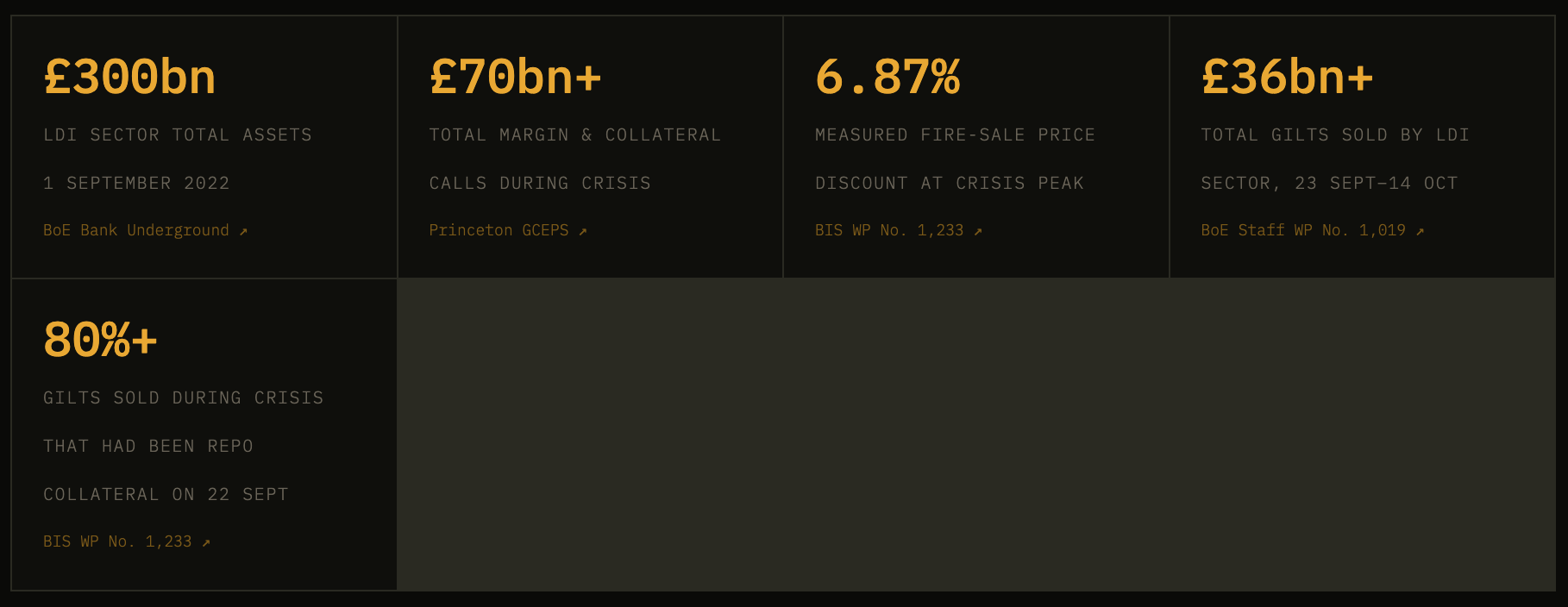
BIS Working Paper No. 1,233 — which analysed trade-level data covering nearly all UK gilt, repo, and derivatives transactions — measured the fire-sale discount with precision: 6.87%. More than 80% of the gilts sold during the crisis had been in use as repo collateral on September 22. They were not spare assets — they were the load-bearing structure.
Between September 23 and October 14, the LDI-pension-insurance sector sold more than £36 billion in gilts. Hedge funds sat on the other side of most of it — by design, and by pre-positioning months in the making.
Section 02 — Day by Day: The Crisis in Sequence
23 Sept · 09:30 BST Kwarteng delivers the mini-budget. Within hours, gilt yields begin a historic move. Reuters reports that Odey Asset Management was already up 145% for the year before the speech — the position was fully built months earlier.
23–27 Sept LDI funds face cascading margin and collateral calls the Princeton GCEPS paper estimates exceeded £70 billion in total. Pooled LDI funds sell roughly 13 percentage points more of their gilt holdings than segregated mandates, per BIS data — the trustee-approval coordination problem is most acute in pooled structures.
26 Sept The BIS paper notes the Bank received market intelligence as early as September 23 that LDIs would be forced to liquidate “very large quantities of gilts.” The same dealer networks that provided that intelligence to the Bank also served as prime brokers to hedge funds. Sterling hits intra-day all-time low of $1.0327.
28 Sept · Pre-intervention window Hedge funds purchase £3.76 billion in gilts from dealer inventory — 44% of their entire two-week crisis total of £8.60 billion — in the hours before the BoE announcement. LDI selling rate is stable; hedge fund buying is surging. The BIS paper states this is “consistent with hedge funds proactively initiating these transactions.”
28 Sept · First BoE Auction The official Market Notice announces purchases of conventional gilts with residual maturity over 20 years, up to £5 billion per session. 30-year yields drop more than 100 basis points in the session. Funds holding £3.76bn of gilts purchased that morning see positions appreciate ~15–20%.
28 Sept – 14 Oct The BoE buys £19.3 billion total (£12.1bn conventional, £7.2bn index-linked). Hedge fund returns from liquidity provision are “positive throughout the crisis,” per the BoE Quarterly Bulletin.
Strategy 01 — Odey Asset Management · +152% Return (peaked at 193% YTD)
Duration Convexity at 500% NAV: The 2061 Gilt Short
Odey’s trade is documented with unusual precision because it leaked through two separate Bloomberg investor letters and one extended interview with the Financial Times — all confirmed by multiple news wires quoting the same documents.
The instruments, from a Bloomberg investor letter: A Bloomberg investor letter seen by Hedgeweek stated that Odey European Inc. held “leveraged short exposure to bond trades… almost 500% of the fund’s net asset value at the end of February, mostly related to two UK government securities that mature in 2050 and 2061.” The fund managed approximately €402 million at end of September 2022, per a Fortune report citing an investor document. At 500% NAV leverage on ~€400 million, gross short notional exposure was on the order of €2 billion.
The entry price, from JOE.co.uk citing Reuters: Odey entered the short position on the UK 2061 cash bond when yields were as low as 0.5% — the lowest in that bond’s trading history. He also held notional exposure extending out to 2071 bonds.
The mathematics of convexity: A gilt maturing in 2061 with a 0.5% coupon has a modified duration approaching 40 years. Each 100 basis point rise in yields produces approximately a 40% decline in price. From the 0.5% entry to over 4.5% at crisis peak — a 400bp move — the 2061 gilt’s price fell more than 60%. At 500% NAV leverage, this alone generates a multi-hundred-percent return on equity before margin costs.
The hedge (long linkers): Euronews/Reuters reported the fund held long positions in inflation-linked gilts as a partial hedge — expressing the view that nominal yields would rise and inflation would persist, protecting against the scenario where yields rose only via rising real rates without an inflation component.
Odey was already up 53% by end of March 2022, six months before the mini-budget. By September 22, Reuters reported the fund at 145%. By late October it had peaked at 193% YTD — at which point he closed all three funds to new capital. The full-year 2022 final return, per a Bloomberg investor document published January 2023, was 152%.
“It [sterling and UK bonds] is all part of the same story of higher inflation. The gifts that keep on giving.” — Crispin Odey, in a direct interview with the Financial Times, as reported by openDemocracy
The Kwarteng Dimension
Before entering politics, Kwasi Kwarteng worked for Odey Asset Management as an analyst, after a spell at JPMorgan Cazenove and an education at Eton and Cambridge, per eFinancialCareers. He was elected MP for Spelthorne in 2010. The following year, he received £10,000 for six months of consultancy while an MP on behalf of his former employer. No legal impropriety has been established — Odey denied any suggestion of unfair trading — but the circularity was explicitly noted by multiple reporters covering the crisis.
Odey also made £220 million in a single day when sterling collapsed after the 2016 Brexit vote — a referendum he helped fund, having donated £873,288 to Vote Leave, per electoral commission records cited by Powerbase.
Strategy 02 — Sector-Wide Hedge Fund Positioning
£65 Billion Pre-Positioned in Repo Shorts: The Trade That Was Already On
Bank of England Staff Working Paper No. 1,019 £65 billion — net negative repo position held by hedge funds in nominal gilts before September 23, 2022. More than three times larger than the BoE’s entire crisis intervention of £19.3 billion. BoE Staff WP No. 1,019 · Securities Finance Times
The most important finding in Bank of England Staff Working Paper No. 1,019 — based on transaction-level data with observable counterparty identities — is not about what hedge funds did during the crisis. It is about what they had already done before it.
The BoE paper states this positioning was “indicative of the hedge fund sector adopting short positions in the gilt market prior to the crisis.” When LDIs were forced to sell £36+ billion, those pre-positioned short books paid off automatically — no real-time action required.
In repo mechanics: a net negative position means a fund has lent cash and received gilts as collateral — the precise balance sheet signature of a funded short. At £65 billion in aggregate notional, this pre-crisis short book was more than three times larger than the BoE’s entire crisis intervention of £19.3 billion.
Securities Finance Times confirmed: firms in the LDI-pension-insurance sector who had larger repo and swap exposure before the crisis sold more gilts during the crisis — while hedge funds “were compensated for providing liquidity to the LDI-PI sector.” The compensation was not accidental — it was the payoff of a pre-positioned thesis.
Strategy 03 — BIS Working Paper No. 1,233 Documented
The £3.76 Billion Window: Timing the Central Bank’s Backstop
This is the strategy the financial press most consistently missed — and the one most directly documented by BIS high-frequency trade data. Hedge funds actively bought gilts during the fire sale, at the fire-sale discount, in the hours before the Bank of England’s backstop announcement.
The timing sequence, from BIS Working Paper No. 1,233:
In the two weeks after the mini-budget, hedge funds acquired a total of £8.60 billion in gilts. Of that total, £3.76 billion — 44% — was purchased on the morning of September 28, in the hours before the Bank’s intervention announcement. Critically: LDI selling rate was stable that morning. Hedge fund buying was surging.
“It seems reasonable to think that at least some hedge funds were privy to some or all of the same market intelligence [as the Bank of England], perhaps through their dealer networks, allowing them to time their purchases.” — BIS Working Paper No. 1,233, “Fire Sales of Safe Assets,” 2024
“The evidence is consistent with hedge funds strategically providing liquidity so as to maximise the return from such an activity.” — BIS Working Paper No. 1,233
The first BoE purchase auction targeted conventional gilts with residual maturity over 20 years, up to £5 billion per session. When the backstop floored the price decline, the £3.76 billion purchased at distressed morning prices immediately appreciated. The BoE working paper confirms hedge fund returns from liquidity provision were “positive throughout the crisis.”
Strategy 04 — BlueCrest Capital Management · Michael Platt · +153% Return
Leverage Without Redemption Pressure: The Family Office Structural Edge
BlueCrest’s 153% return cannot be understood through strategy alone. The structural arrangement of the firm was the alpha source. In December 2015, Platt returned all external capital — approximately $7 billion — and converted BlueCrest into a private investment partnership managing only the wealth of Platt, his partners, and staff. It was the removal of every constraint that would have prevented BlueCrest from running the 2022 trade at full scale.
The capital structure, from court documents: Court documents from 2022, cited by Hedgeweek, showed BlueCrest running approximately $3.9 billion in partner capital, leveraged to provide roughly $15 billion in total trading capacity — an implied ratio approaching 4x. Bloomberg’s Billionaires Index confirms: “BlueCrest managed $3.9 billion at the beginning of 2022.”
The strategy, from Bloomberg: Bloomberg reported that BlueCrest “has benefited from bonds and commodities trading this year amid soaring inflation and rising interest rates.” Aggressive positioning in interest rate reversals, currency movements including the dollar and British pound, and select equity trades drove the 153% net return.
The structural edge, documented by Hedgeweek: “Platt’s move to a client-free model has allowed the firm to deploy high levels of leverage, maintain concentrated positions through periods of volatility and operate without the liquidity, disclosure and redemption constraints faced by conventional hedge funds.”
The pod architecture: Hedgeweek confirmed BlueCrest operates with 170 trading pods. This structure, documented in Platt’s Hedge Fund Market Wizards interview, means that when any pod is down 3% of allocated capital, allocation is cut; at 6%, the book is closed and positions auctioned internally. In a crisis, this architecture prevents any single trade from blowing up the firm — while allowing the firm to run 4x aggregate leverage that no redemption-constrained fund could maintain.
“I have no appetite for losses… Market makers know that the market is always right. Value is irrelevant in times of market stress; it’s all about positions.” — Michael Platt, in Jack Schwager’s Hedge Fund Market Wizards, as documented at 7 Circles
The capital math: Bloomberg’s Billionaires Index documents that Platt withdrew approximately $2 billion in personal profits in 2023 following BlueCrest’s 153% gain. His personal fortune is estimated at $12.8 billion. The 153% return — confirmed by Bloomberg Law and Hedgeweek — represents approximately $6 billion in gross profits from a $3.9 billion capital base.
Strategy 05 — Rokos Capital Management · Chris Rokos · +51% Return
Policy Divergence: The Macro Trade Across Three Correlated Legs
Chris Rokos — who generated more than $4 billion for Brevan Howard between 2003 and 2012 — returned 51% in 2022, his best year since founding Rokos Capital Management in 2015. Bloomberg confirmed the return. The $15.5 billion fund produced positive returns in every month but one in 2022.
The thesis: The £45 billion in unfunded tax cuts were structurally incompatible with the Bank of England’s obligation to reduce inflation. The BoE would be forced to hike aggressively even while the fiscal expansion simultaneously added to demand. This is mechanically bearish for sovereign bonds under all economic scenarios: if the fiscal stimulus produces growth, the Bank hikes faster; if recession follows, the fiscal position deteriorates and markets demand a credit-risk premium. There is no path in which long-dated gilts benefit.
The multi-leg structure: Rokos held short positions across developed market sovereign bonds with concentration in sterling instruments. When the mini-budget confirmed the thesis, three correlated payoffs compounded simultaneously:
Short gilts paid as prices fell
Long volatility positions paid as implied vol spiked from suppressed levels to crisis levels
Short sterling paid as the pound hit $1.035
The compounding of correlated payoffs within a single macro framework — rather than diversified hedging — is what distinguishes a thesis-driven return from a diversified macro return.
The Companies House evidence: Hedgeweek reported that a Companies House filing showed Rokos’s firm generated £643 million in revenue for the year ended March 2023, up from approximately £120 million the prior year — a 5x increase attributable almost entirely to the 2022 performance. Partners were paid £445 million, with the highest-earning partner receiving just under £27 million. Bloomberg confirmed the filing independently.
Strategy 06 — Brevan Howard · BH Master Fund / Alpha Strategies / BH Macro
Convex Rates Architecture: The Investor Presentation Evidence
Brevan Howard’s 2022 performance is the most thoroughly documented in terms of source-of-return attribution — because an investor presentation was seen by Reuters and reported in detail. Bloomberg confirmed: the $10 billion BH Master Fund gained 20%, while the $12 billion Alpha Strategies fund recorded its best-ever year at 28%.
Source-of-return attribution, from the investor presentation seen by Reuters: MarketScreener/Reuters reported: “Interest rate trading, which gave BH Macro most of its profit rise, included bets on U.S. interest rates and positions related to inflation, volatility and European rates.” Disruption Banking confirmed: “nearly all the gains in the flagship Master fund were thanks to interest rate trading.”
The vol-convexity structure: Long volatility in interest rates — cheap when rates were anchored near zero, very expensive when they moved — combined with directional rate shorts. The vol position paid enormously when rates moved; the directional position paid in the direction of the move. The convexity structure produced asymmetric returns: losses in the vol book were capped at premium paid; gains were uncapped as vol realised above implied.
The BH Macro listed vehicle: Hedgeweek/Reuters confirmed BH Macro — the publicly listed feeder vehicle on the London Stock Exchange — gained 21.93% in the sterling share class, the third-best annual return since its 2007 inception.
Strategy 07 — CTA Sector · Transtrend · Systematic Trend Following
The Short That Didn’t Need the Mini-Budget (~+30%)
Systematic trend-following funds had been short sterling and UK fixed income for over a year before the mini-budget. They required no thesis about fiscal policy — only a trend signal.
According to Société Générale’s Trend Indicator, as reported via the FT, sterling was the second most profitable short bet for the CTA sector in 2022, behind only the Japanese yen. Sterling had been in a continuous downtrend from above $1.40 in mid-2021. Systematic momentum models had been short the pound for months — the mini-budget was simply the event that confirmed the signal and accelerated the drawdown.
Rotterdam-based Transtrend, managing $6.3 billion in assets, held short sterling positions across multiple currency pairs and short UK fixed income instruments. By late September 2022, combined bets had contributed to the fund being approximately 30% up for the year. When the LDI crisis accelerated the gilt selloff, systematic funds that had been short gilts for months saw that trend confirm violently — without a single discretionary decision.
Section 03 — The Evidence Table: Every Return, Every Source
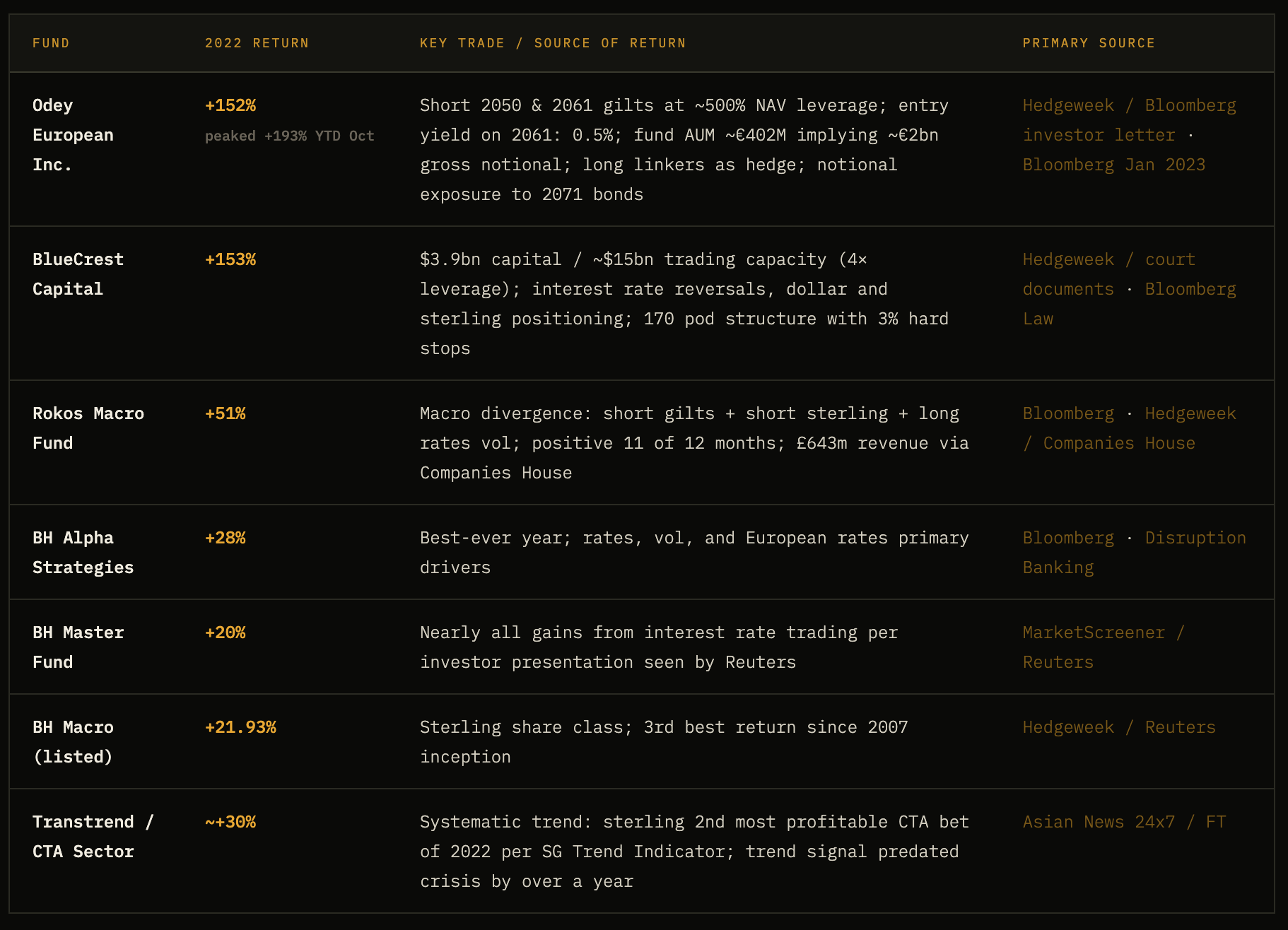
Hedgeweek / Bloomberg letter · Bloomberg Jan 2023
Hedgeweek / court docs · Bloomberg Law
Bloomberg · Hedgeweek / Companies House
Bloomberg · Disruption Banking
Section 04 — Four Things the Regulators Confirmed
01 — Pre-positioning was structural, not opportunistic. The BoE working paper’s £65 billion net repo short was built over months before September 23. The mini-budget did not create the trade — it confirmed it. Alpha came from thesis construction and position-building, not from reacting to events in real time.
02 — Pooled LDI funds were the mechanical source of the dislocation. The BIS paper found pooled LDI funds sold roughly 13 percentage points more of their gilt holdings than segregated mandates. The trustee-approval requirement for collateral transfers — a governance feature designed to protect pension members — became the institutional mechanism that converted a yield spike into a forced-sale event.
03 — The fire-sale discount was exactly 6.87%. The BIS measured this with precision. On the £8.6 billion total gilt purchases by hedge funds during the crisis, a 6.87% discount translates to approximately £591 million in discount alone — before any directional gain from BoE intervention.
04 — Regulators are now watching more closely. In 2025, Bank of England Governor Andrew Bailey has publicly cautioned that hedge fund activity could “propagate liquidity stress” in UK markets. Hedge funds are now deploying at least three concurrent strategies in gilts: basis trade arbitrage, inflation curve trades, and momentum-driven shorts — with trend-following funds short 10-year gilts for seven of nine recent weeks per JPMorgan data cited by Hedgeweek.
Section 05 — The 1992 Parallel: Britain’s Repeating Trade
The 2022 episode is the second time in thirty years that leveraged traders successfully extracted billions from a British fiscal or monetary commitment that markets judged unsustainable. On Black Wednesday, September 16, 1992, George Soros and Quantum Fund shorted more than $10 billion in sterling, forcing the Bank of England to raise rates twice in a single day and spend $22 billion in reserves. Soros made over £1 billion in a single day; the UK Treasury estimated its losses at £3.14 billion (later revised to £3.3bn, 2005).
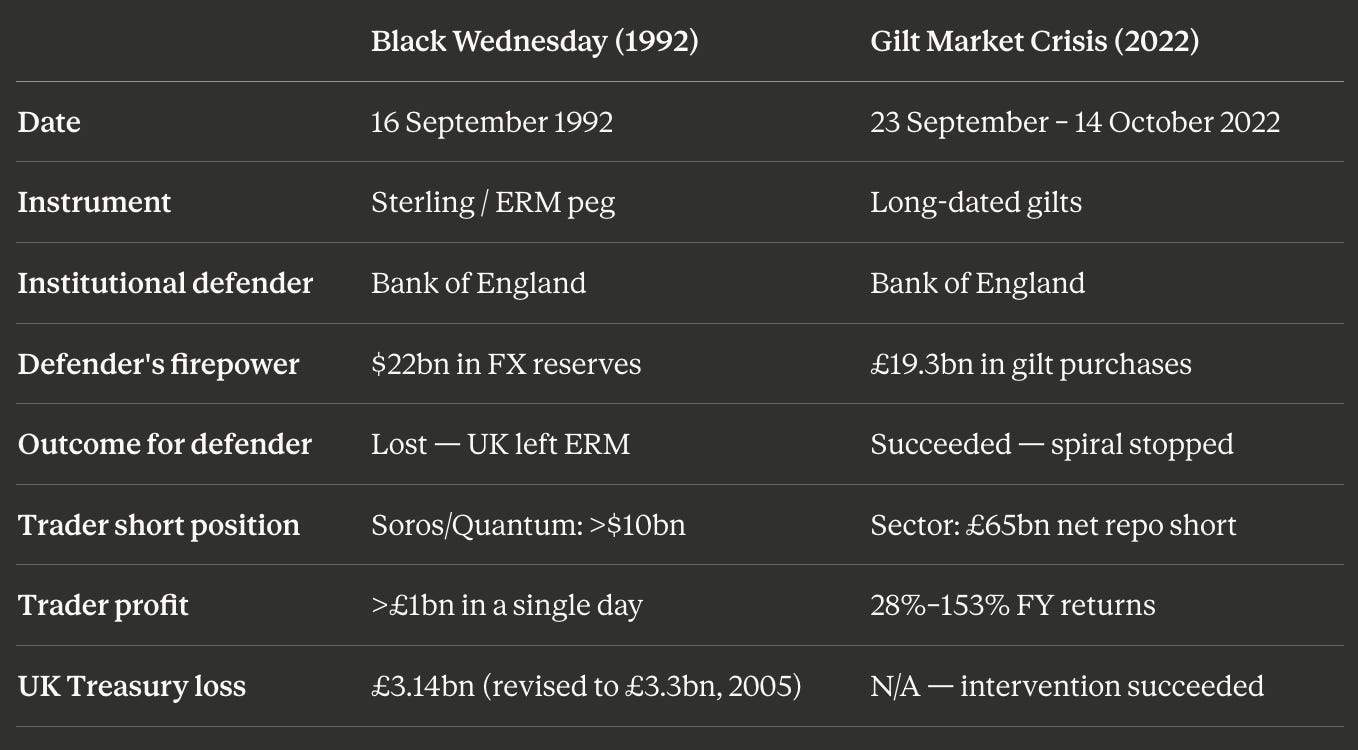
The underlying dynamic is identical across 30 years: a government made a fiscal commitment that markets judged unsustainable, and a concentrated cohort of leveraged traders assembled more capital on the short side than the institution defending it. In 1992 the Bank spent $22 billion and lost. In 2022 it bought £19.3 billion in gilts and succeeded — but funds that had pre-positioned at £65 billion, and timed the backstop to the hour on September 28, extracted their profit before the intervention stabilised the price level.
Section 06 — The Mechanism, Distilled
Long the crisis. Short the policy response. Long the backstop. All three legs paid — documented in transaction-level detail by the Bank of England, the BIS, and the IMF.
Seven overlapping strategies converged on the same underlying thesis from different structural positions. Directional convexity shorts captured price decline through bond duration mathematics — amplified by 500% NAV leverage on the longest-maturity, highest-convexity instruments. Pre-positioned repo shorts of £65 billion monetised the LDI fire sale automatically. Strategic liquidity provision front-ran the central bank backstop by £3.76 billion on the morning of September 28. Family office leverage structures captured compounded returns unavailable to any redemption-constrained fund. Macro divergence positioning captured the policy collision across three correlated legs simultaneously. Convex rates architecture extracted multiples of upside from suppressed vol repricing at crisis velocity. And systematic CTA momentum harvested a year-long trend that needed no thesis — only a signal that began in mid-2021.
🔒 The Full Quantitative Trade Note is on Patreon
This article covers the what and the why. The Patreon post goes further: exact position sizing methodology, the duration convexity mathematics behind the 2061 short, the repo mechanics of the £65bn pre-positioning, and a step-by-step breakdown of how each strategy would be constructed today.
📊 Want Deeper Quantitative Analysis?
This research took significant time — data collection, verification, and analysis across 40+ primary sources including BoE and BIS working papers, Bloomberg investor letters, court documents, and Companies House filings. I publish exclusive quantitative research, trading strategies, and institutional-grade analysis on Patreon. By joining, you’ll be supporting my work and motivating me to publish more content like this.
All Primary Sources
Regulatory & Academic
BoE Staff Working Paper No. 1,019 — Bank of England
BIS Working Paper No. 1,233 — “Fire Sales of Safe Assets” — BIS
What Caused the LDI Crisis — BoE Bank Underground
BoE Market Notice — 28 September 2022 — Bank of England
Quarterly Bulletin — Gilt Market Case Study — Bank of England
Lessons from the UK LDI Crisis — Princeton GCEPS
Irish LDI Funds & 2022 Gilt Crisis — Central Bank of Ireland
Odey
Odey 500% NAV — Bloomberg investor letter — Hedgeweek
Odey 53% by March 2022 — BNN Bloomberg
Odey 2061 short at 0.5% yield, 2071 exposure — JOE.co.uk / Reuters
Odey 145% by Sept 23, long linkers — Euronews / Reuters
Odey 152% full-year final — Bloomberg, Jan 2023
Odey 193% peak YTD — Hedgeweek
Odey FT interview; Kwarteng; £220m Brexit profit — openDemocracy
Odey “gifts that keep on giving” — CMC Markets / Opto
Kwarteng at Odey after JPMorgan / Eton — eFinancialCareers
Odey Vote Leave donations £873,288 — Powerbase
Odey 111% NAV entering September — Navnoor Bawa / Substack
BlueCrest
BlueCrest 153%, court documents — Hedgeweek
BlueCrest 153% confirmed — Bloomberg Law
BlueCrest 114% by October 2022 — BNN Bloomberg
Platt $12.8bn net worth / $2bn withdrawal — Bloomberg Billionaires
BlueCrest 170 pods — Hedgeweek
Platt Market Wizards — pod stops / risk — 7 Circles
Rokos
Rokos 51% confirmed — Bloomberg
Rokos 51%, $15.5bn AUM — Hedgeweek / Reuters
Rokos Capital Management profile — Wikipedia
Rokos £643m revenue, £445m payout — Hedgeweek
Rokos £445m payout confirmed — Bloomberg
Brevan Howard
Brevan Howard 20% / 28% — Bloomberg
BH investor presentation — rates attribution — MarketScreener / Reuters
BH Macro 21.93% sterling class — Hedgeweek / Reuters
BH 2022 strategy analysis — Disruption Banking
BH Macro full attribution — Kalkine Media / Reuters
CTA Sector & Systemic Risk
Transtrend, SG Trend Indicator — Asian News 24x7 / FT
BoE anatomy paper findings — Securities Finance Times
Bailey 2025 warning; hedge funds short gilts — Hedgeweek
Historical Parallel
Black Wednesday — Soros — Priceonomics
Black Wednesday 1992 — Wikipedia
This article is produced for educational purposes. All claims carry links to primary sources. Nothing herein constitutes investment advice.
About the author: Navnoor Bawa is a quantitative analyst and financial journalist, and the creator of The Mathematical Trader — institutional-grade quantitative research, trade architecture analysis, and deep-dives into the mechanics behind major market events.
💼 LinkedIn
Cover photograph: It's No Game, CC BY 2.0, via Wikimedia Commons.