


Susquehanna Securities says unidentified traders turned $12 million into more than $100 million by front-running a Chinese regulatory crackdown, and it filed a 100-defendant “John Doe” suit in Manhattan federal court to find out who they are. Citadel Securities has since asked to join that suit, saying it lost $28 million more on the same trades — and said so explicitly because Susquehanna’s recovery could shrink the pool left for its own. The consensus read — echoed across Bloomberg, Reuters, and the trade press — is that this is a blockbuster insider-trading bust that the SEC and DOJ will now run down. It probably is that. What it is much less likely to be is a way for either firm to get its money back. The statute they sued under caps and offsets private recovery, the likely defendants sit in a jurisdiction that does not reliably enforce U.S. judgments, and the specific channel the money moved through — brokerage platforms owned by the same companies whose confidential regulatory dealings leaked — is a structural blind spot that pre-dates this case and will outlast it. Six weeks in, as of this writing, that prediction is already visible in the public record: the case has gone quiet exactly where it would need to move for either firm to see a dollar back. For any desk pricing options in single-name China ADRs, the lesson isn’t “insider trading got caught.” It’s that getting caught and getting paid back are two different processes, running on two different clocks, and the market maker eats the loss on the first one regardless of how the second one ends.
What the trading actually looked like
On May 22, 2026, at 4:33 a.m. Eastern time, Reuters reported that China was cracking down on “illegal” cross-border securities activity, naming Futu Holdings, UP Fintech (Tiger Brokers), and Longbridge as targets. Both Futu and UP confirmed the same morning that they’d received China Securities Regulatory Commission enforcement notices — Futu’s filed with the SEC at 9:35 a.m. Eastern, UP’s at 9:16 a.m. The CSRC ultimately proposed to confiscate roughly RMB1.85 billion (about $271 million) in illegal gains and fines from Futu’s mainland and Hong Kong entities, and roughly RMB411 million from UP’s, covering both administrative penalties and confiscated income (Susquehanna complaint; Bloomberg). FUTU opened that day at $81.08, down 34.5% from the prior close of $123.86; TIGR opened at roughly $4.01, down 31.3% from $5.84 (Susquehanna complaint). By the close, the stocks had partly recovered from their lows, finishing down 27.53% at $89.76 (FUTU) and 25.34% at $4.36 (TIGR) (BigGo Finance, corroborating South China Morning Post).
Everything that follows about the trading itself comes from one source: Susquehanna’s own complaint, an adversarial pleading that hasn’t been tested in court and was written by the party claiming the loss. It should be read as Susquehanna’s account, not adjudicated fact — though the underlying numbers (trade counts, strikes, expirations, broker names) are the kind of granular, falsifiable detail a firm would risk sanctions for fabricating, and no defendant has yet appeared to contest them. Susquehanna’s complaint — filed June 29 in the Southern District of New York as Susquehanna Securities, LLC v. John Does 1-100, Case No. 1:26-cv-05474 — lays out that account in unusual granular detail for a civil pleading, because the firm had its own execution data as a market maker on the other side of the trades (complaint). Between May 7 and May 21, Susquehanna alleges, buyers purchased more than 200,000 short-dated put option contracts on FUTU and TIGR — over 50,000 on FUTU, over 150,000 on TIGR — paying roughly $12 million in premium for options that returned more than $100 million, a return in excess of 900%. For scale: Susquehanna’s complaint compares the scheme to Raj Rajaratnam’s Galleon case, citing the $53 million Rajaratnam was criminally ordered to forfeit. That figure is correct for the personal forfeiture, but it understates the broader picture: the government’s own estimate of total profits and losses avoided across the full Galleon scheme, including Rajaratnam’s co-defendants, runs closer to $72 million (SEC Litigation Release No. 21397). Even against that larger number, this case is alleged to be bigger — about 1.4 times Galleon’s total on Susquehanna’s own $100 million-plus estimate, closer to 1.9 times on Citadel’s $137 million estimate — compressed into two weeks instead of years.
The complaint’s evidentiary strength isn’t the size of the return. Announced-catalyst option trades routinely return multiples; that alone proves nothing. What it argues is coordination and specificity. Three brokers — Interactive Brokers, UP’s own TradeUP platform, and Futu’s own trading platform — accounted for about 76.5% of the market-wide purchases matching the suspicious profile, even though the qualifying trades were legal to place through any U.S. broker. At Interactive Brokers specifically, a firm with more than 5 million customer accounts, only about nine accounts were responsible for the relevant purchases. The trades clustered in specific contracts rather than spreading across the options chain: on May 7, the flagged trades made up about 87% of all FUTU near-dated put purchases market-wide; on May 13, about 98% of TIGR’s. And the expirations selected show timing knowledge, not just directional conviction — about 31% of the flagged contracts expired the day after the Crackdown News broke, and another 35% expired the following week, meaning two-thirds of the position was structured to pay off inside roughly seven trading days of a specific, then-unannounced date. Neither company had released negative news in the prior two weeks; Futu’s own quarterly earnings didn’t come until May 28, UP’s until June 2 (complaint).
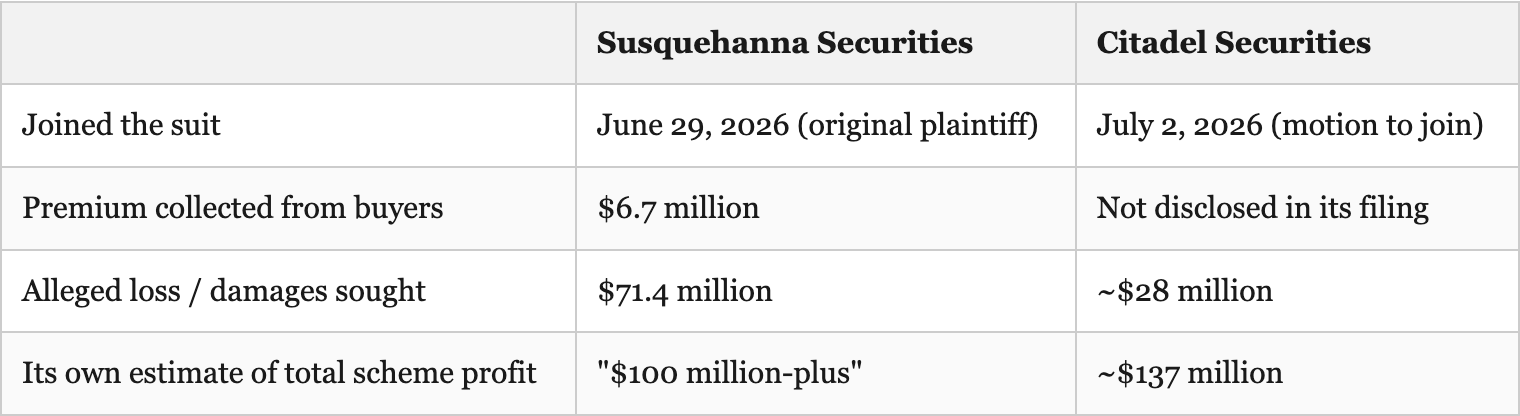
The mechanic behind that loss is ordinary options math, not anything exotic: Susquehanna and Citadel, as market makers, sold puts and collected the premium upfront, pricing the flow as if it were routine; when FUTU and TIGR gapped down more than 30% on news they didn’t see coming, they owed the buyers the difference between the strike price and the crashed price on every contract — a payout due the moment the options settled in the money, regardless of who eventually turns out to have been on the other side of the trade. Susquehanna’s own exposure: it says it was the seller on contracts where buyers paid $6.7 million in premium and made approximately $71.4 million in profit — hence the $71.4 million floor on the damages it’s seeking (complaint; Bloomberg). The firm won a court order on June 30 authorizing subpoenas to, and freezes on, accounts at Interactive Brokers, TradeUP, and Futu’s platform, to unmask the account holders (Bloomberg). The SEC confirmed by July 2 that it’s reviewing the trades, and the Justice Department’s criminal division has opened its own early-stage inquiry (Philadelphia Inquirer; Yahoo Finance).
Susquehanna was not the only counterparty. On July 2, Citadel Securities filed a motion to join the suit, saying it was “the victim of a brazen insider trader scheme” on the same FUTU and TIGR options and had lost about $28 million as counterparty to trades it, too, did not know were informed (Claims Journal/Bloomberg). Citadel’s own filing puts the total scheme profit at roughly $137 million (Finance Magnates, independently corroborating Claims Journal/Bloomberg) — higher than Susquehanna’s “$100 million-plus” estimate, a discrepancy the two firms’ pleadings don’t reconcile and that is itself a data point: even the two market makers who were on the losing side of most of the flow don’t agree on the size of what hit them, which says something about how fragmented the visibility into this trading was in real time. Between them, Susquehanna and Citadel Securities are now alleging roughly $99 million in combined losses against a scheme both peg at $100–137 million in total profit — meaning, on either firm’s number, close to the entire windfall was extracted from just two large, sophisticated options market makers, not spread across the market
.
Both figures come from each firm’s own pleadings, not a shared or independently audited count — which is itself the point: the two largest counterparties to this scheme can’t agree on its size, and both firms’ recovery is capped and offset under the same Section 20A rules regardless of whose number is closer to right.
The case has gone quiet exactly where it needed to move
As of this writing, six weeks after the complaint was filed, the public docket shows no ruling on the July 10 show-cause hearing, no unmasked defendant, and no reported outcome on Citadel’s motion to join — the last indexed filing on the public docket is the June 29 temporary restraining order itself (case docket). That’s worth sitting with, because the July 10 hearing was the case’s first real test of whether the freeze order would produce an identified defendant or simply get contested and unwound. Silence here isn’t necessarily bad news — sealed filings, ongoing subpoena compliance, or a docket-mirroring lag are all plausible — but it means the single most consequential open question in this case (does anyone actually get named, and does anything actually get frozen for keeps) remains unanswered in public exactly at the moment the story needs it to move for either firm to collect anything.
A second, separate legal front opened in the interim. On July 13, a securities-fraud class action against Futu Holdings itself — filed on behalf of Futu shareholders, not the market makers, via Glancy Prongay & Murray LLP — alleges Futu and its CEO made materially false or misleading statements by failing to disclose that the company was operating an unlicensed mainland-China securities business likely to draw penalties, covering a class period from May 24, 2023 through May 27, 2026, with a lead-plaintiff deadline of August 25, 2026 (GlobeNewswire). This is a legally distinct claim from Susquehanna and Citadel’s — a Rule 10b-5 issuer-disclosure suit brought by Futu’s own shareholders, not the Section 20A contemporaneous-trader suit brought by the market makers against the alleged inside traders — and the two should not be conflated. But it confirms the underlying fact pattern is now attracting legal scrutiny from a second, independent direction: the same regulatory-dialogue timeline Susquehanna’s complaint says leaked to options traders is also, separately, now the basis for a claim that Futu itself misled the market about its exposure to it.
The consensus read, stated plainly
Every account of this story so far — the wire reports, the aggregators, the trade press — converges on the same frame: unidentified, sophisticated traders exploited leaked Chinese regulatory information for an extraordinary payoff; Susquehanna is suing to unmask them and recover its loss; the SEC and DOJ are now investigating; justice, in some form, is likely to follow. That’s a reasonable summary of the public record, and nothing in it is wrong. It’s also not the part of the story that matters most to anyone who prices risk in these names, because it treats the lawsuit as a recovery mechanism when the statute it’s built on was written to make sure it mostly isn’t one — and it treats the surveillance apparatus that exists around U.S. options markets as more real-time than it actually is.
Section 20A was not built to make Susquehanna whole
Susquehanna’s first claim is brought under Section 20A of the Securities Exchange Act, 15 U.S.C. § 78t-1, the statute that gives a “contemporaneous trader” — someone who bought or sold the same security at the same time as an alleged inside trader — a private right of action. It’s the correct and really the only available vehicle for a market maker in this position; Section 20A exists specifically because ordinary Rule 10b-5 fraud claims are hard for a market-neutral counterparty to plead. But the statute has two built-in limits that the coverage of this case has mostly skipped past.
First, subsection (b)(1): damages “shall not exceed the profit gained or loss avoided in the transaction or transactions that are the subject of the violation.” Susquehanna isn’t suing for punitive damages or for some multiple of its loss — its own pleading caps its ask at $71.4 million, which is the ceiling the statute allows regardless of how bad the conduct was (15 U.S.C. § 78t-1).
Second, and more consequential, subsection (b)(2): “the total amount of damages imposed against any person under subsection (a) shall be diminished by the amounts, if any, that such person may be required to disgorge, pursuant to a court order obtained at the instance of the Commission... relating to the same transaction or transactions” (15 U.S.C. § 78t-1). In plain terms: Susquehanna’s private recovery and the SEC’s public enforcement recovery are not additive. They draw from the same pool. If the SEC obtains a disgorgement order against a given defendant for the same trades, Susquehanna’s own judgment against that defendant shrinks by exactly that amount. The two-track process running in parallel right now — Susquehanna’s civil suit alongside the SEC’s and DOJ’s own investigations — looks to an outside observer like redundancy, extra pressure on the defendants, more paths to justice. Legally, it’s closer to a queue. Whichever process actually collects money from a given defendant first determines what, if anything, is left for the other to collect. Since the SEC’s parallel civil enforcement process and DOJ’s criminal process have priority under the statute’s own language — notwithstanding that it was Susquehanna’s private suit, not either regulator, that produced the case’s only freeze order so far — Susquehanna’s civil case is still functionally subordinate to outcomes it doesn’t control once a regulator moves.
Want the dollar-for-dollar version of this math? In a deeper research note for paid subscribers, I run Susquehanna’s own $71.4 million loss all the way through the statutory cap, the disgorgement offset, and the cross-border enforceability discount — the same three-step chain, with real numbers at each step: Section 20A caps and offsets: the full recovery math, on Patreon.
This is why the subpoena order Susquehanna won on June 30 is the real substance of the case, not a procedural footnote. Section 20A liability requires knowing the defendant’s identity to enter judgment against; before that, discovery — subpoenaing Interactive Brokers, TradeUP, and Futu’s platform for account records — is the only thing a “John Does 1-100” complaint can actually produce. The lawsuit’s realized value in the near term is identification, which has genuine worth: it’s the mechanism that turns anonymous accounts into named defendants the SEC and DOJ can act against, and it puts confidential trading records into a public docket that deters the next attempt. But identification is not the same claim as recovery, and the statute Susquehanna sued under makes recovery contingent on facts — asset location, and who gets there first — that remain unknown seven weeks into the case. The nearest test of that was the court’s July 10 show-cause hearing, where any account holder wanting the freeze on their funds lifted had to appear and post a $100,000 bond to do it — the first mechanism, short of a successful subpoena, that could put a name to any of the John Does (Philadelphia Inquirer). As noted above, no outcome from that hearing has surfaced in the public docket as of this writing.
Citadel’s own filing is a live demonstration of the offset mechanism
Section 20A’s offset language, above, might read as a technical wrinkle until you see it playing out in real time. Citadel Securities’ July 2 motion to join Susquehanna’s suit states its rationale plainly: it is seeking party status “partly because any recovery by Susquehanna, including from the frozen funds, could reduce the amount available to compensate its own losses” (Claims Journal/Bloomberg). That is not a hypothetical about SEC disgorgement diminishing a private judgment — it is one contemporaneous trader telling a federal court, in writing, that another contemporaneous trader’s success in the same case is a threat to its own recovery, because both are drawing against the same frozen accounts and the same pool of defendant assets. This is the clearest evidence available that the “shared pool, not additive recovery” reading of the statute above isn’t just a theoretical interpretation — the two largest alleged victims are already litigating on that premise before a single defendant has been named.
It also reframes what “more plaintiffs” means here. Two large market makers pursuing the same John Does looks, from a distance, like additional pressure that should improve enforcement odds. Legally, within the frozen-asset pool specifically, it is closer to two creditors filing claims against the same limited estate: it does not enlarge what is collectible, it determines how a fixed and currently unknown amount gets divided if and when it is collected. Susquehanna’s $71.4 million ask and Citadel’s roughly $28 million claim, filed against the same frozen accounts, avoid competing with each other only to the extent the identified defendants turn out to hold assets well in excess of $99 million combined — a strong assumption for defendants the complaint itself argues are most plausibly China- or Hong Kong-based individuals, not a well-capitalized institution.
Why the money likely doesn’t come back even after identification
Assume Susquehanna’s subpoenas work and the accounts get unmasked. The next question is whether a U.S. court judgment against those individuals is worth anything, and that depends entirely on where they and their assets are. The complaint’s own theory of the case narrows this considerably: it argues the two plausible sources of the leak are Chinese securities regulators — CSRC staff, whom the complaint says are barred from trading on inside information under Article 51 of China’s Securities Law, citing the National People’s Congress’s own official English translation of the statute — or personnel at Futu or UP with knowledge of the CSRC’s pre-announcement dialogue with the companies (complaint). Both categories point toward individuals based in mainland China or Hong Kong, not the United States. That inference is reinforced by the trading pattern itself: roughly three-quarters of the flagged volume moved through Interactive Brokers, TradeUP, and Futu’s own platform — and TradeUP and Futu’s platform are subsidiaries of the very companies at the center of the leak, used heavily by mainland Chinese retail and institutional clients trading U.S.-listed names.
A U.S. federal court has personal jurisdiction here because the defendants traded on U.S. exchanges through a U.S.-based brokerage account — that’s the long-arm-statute theory the complaint pleads, and it’s a solid one for getting the case into court (complaint). It says nothing about whether a judgment can be enforced once entered. There is no bilateral treaty between the United States and China on recognition and enforcement of civil judgments, and China is not a signatory to any multilateral convention that would fill that gap (Harris Sliwoski, China Law Blog). Mainland Chinese courts can recognize a foreign judgment only under a reciprocity principle that isn’t codified in a way plaintiffs can rely on in advance, and there is exactly one documented instance of it working in China’s favor for a U.S. judgment: in 2017, the Wuhan Intermediate People’s Court recognized and enforced a Los Angeles Superior Court default judgment in Liu Li v. Tao Li and Tong Wu, reasoning that reciprocity had already been established by an earlier U.S. federal court’s enforcement of a Chinese judgment (CMS Law). That single, non-binding case is the strongest precedent available; it is not a rule a plaintiff can count on. Hong Kong is procedurally friendlier but not categorically different — the United States isn’t among the roughly 15 countries covered by Hong Kong’s statutory reciprocal-enforcement ordinance, so a plaintiff has to fall back to the common-law route: filing a fresh writ and proving the U.S. judgment is final, conclusive, and a fixed money award against a specific person, a real but slower and costlier path than the ordinance covers for judgments from, say, Australia or Singapore (Timothy Loh LLP).
None of this means recovery is impossible. If a defendant turns out to hold U.S.-reachable assets — a brokerage account itself can sometimes be frozen and attached before funds move — collection is straightforward. Susquehanna’s freeze/subpoena strategy targets exactly that possibility, and it’s the right first move for that reason. But the base case, given where the complaint itself says the informational edge originated, is defendants and assets outside the reach of a U.S. judgment. Section 20A gives Susquehanna a five-year statute of limitations to keep trying — the clock runs from the last transaction at issue, so into 2031 — which is long enough for asset locations to change, for related criminal proceedings to develop, or for a settlement to emerge under pressure that a judgment alone wouldn’t produce. That’s a real avenue. It’s a slower and less certain one than “the SEC and DOJ are on it” implies.
This isn’t a one-off tail event — it’s a structural gap with a documented precedent
The consensus framing treats this as an aberration: a uniquely brazen scheme that happened to get caught. The available evidence suggests something closer to a predictable outcome of a structural mismatch between how long Chinese insiders typically sit on price-relevant information and how U.S. market surveillance is calibrated to catch informed trading.
A study by Pengfei Ye and coauthors at Virginia Tech and the Shanghai University of Finance and Economics, published in the Journal of Accounting and Economics, examined China’s 2017 “sell-by-plan” mandate, which requires corporate insiders to pre-disclose stock sales 15 trading days in advance specifically to prevent them from dumping shares just ahead of bad news. The study found that Chinese insiders typically learn about negative news at least 25 trading days before it becomes public — ten days longer than the mandate’s waiting period was designed to neutralize, meaning insiders can schedule a “compliant” sale that still front-runs the information gap (Virginia Tech News). That’s a finding about corporate executives front-running their own company’s bad news inside a specific equity-sale disclosure regime — a different kind of insider (a company executive) and a different kind of information (the firm’s own undisclosed financial condition) than a regulator’s staff or company employees allegedly leaking a third party’s enforcement timeline to outside options traders, which is Susquehanna’s theory here. It shouldn’t be read as direct evidence about who traded FUTU and TIGR puts. What it does establish is a base rate: in the Chinese regulatory and corporate environment specifically, price-relevant information routinely leaks weeks before public disclosure, not days. Susquehanna’s own two-week trading window fits comfortably inside that documented lead time.
U.S. surveillance infrastructure is not calibrated for a 25-trading-day leak window. FINRA’s Insider Trading Detection Program monitors “100% of trading in stocks, options and bonds” using the Consolidated Audit Trail and describes itself as tracking activity “around material news events” — but by FINRA’s own account, in a 2024 podcast describing its process, a single investigation “can take anywhere from six to eight months” before it produces a referral to the SEC, and referrals, not trading halts, are the output (FINRA). That’s a detection-and-prosecution pipeline running after the news event, not a pre-trade filter. In the most recent year FINRA has publicly disclosed a figure for (2023, per that same 2024 disclosure), it generated more than 450 referrals — real evidence the system works as designed — but “as designed” means it identifies suspicious activity for later enforcement, not that it stops a market maker from being the counterparty in real time. Susquehanna was still selling puts to these accounts on May 21, the day before the news broke, despite 200,000-plus contracts of unusually concentrated flow already having accumulated over the prior two weeks. Nothing in FINRA’s own description of its process suggests that outcome is a failure of the system; it’s what the system, structured as a post-hoc referral engine, is supposed to produce.
Layered on top of that timing gap is a visibility gap the SEC has flagged in a different but related context. In a staff bulletin on foreign omnibus accounts, the SEC warns that a network of foreign financial institutions and U.S. broker-dealers can be structured so that “none of them has complete visibility into the total amount of securities deposited, trading volume and activity” behind an account, because the ultimate beneficial owner of the funds is “unknown to a broker-dealer because of the omnibus account structure” (SEC staff bulletin). That bulletin addresses low-priced-securities fraud schemes specifically, not this case — it is not evidence about FUTU or TIGR — but the structural point it describes transfers directly: a large share of the Subject Trades here ran through TradeUP and Futu’s own platform, broker-dealers owned by the companies whose confidential regulatory information was the alleged source of the leak. That is close to a worst-case configuration for a surveillance system built around cross-broker pattern detection: the entity best positioned to know when an insider is trading through its own platform is the same entity whose employees are named as one of the two plausible sources of the tip.
Why the trade was built loud, not quiet — and what that bounds
A reasonable question about the mechanics: why would traders sitting on privileged information precise enough to target expirations inside a week of an unannounced date trade in a way almost guaranteed to draw attention, rather than camouflaging the position? The academic literature on informed trading gives a direct answer, and it doubles as the decay and capacity analysis this kind of claim requires.
Kyle’s foundational model of informed trading, and the stealth-trading literature built on it, predicts informed traders split large positions into smaller trades over time specifically to avoid revealing their information before they can profit from it. A recent formal treatment, “Wealth or Stealth? The Camouflage Effect in Insider Trading” (Ma, Xia, and Zhang), models this as a trade-off governed by legal risk: insiders trading among a population of ordinary liquidity traders can camouflage their activity, but doing so caps how much of their informational edge they can extract, because size and speed increase both price impact and detection probability. The paper’s equilibrium result centers on what it calls a stealth index — a parameter pinning down how much an insider population trades, given the balance between expected profit and prosecution risk.
The Subject Trades in Susquehanna’s complaint sit at the wealth end of that spectrum, not the stealth end. Eighty-seven to 98% concentration in specific contracts on specific days, nine accounts responsible for all the relevant Interactive Brokers flow, two-thirds of the position expiring within a week of an unannounced date — none of that is camouflage; by the standard the literature uses to define stealth trading, it is close to the opposite. That is informative about the traders’ own assessment of their position, not just their recklessness. A trader confident their information window was narrow and closing fast has a rational reason to prioritize size and speed over stealth: spreading the same trades over eight weeks instead of two would have meant less price impact per trade, but it would also have required a longer information lead time than even the roughly 25-trading-day Chinese-insider base rate reliably supports, and it would have left more time for the position to leak or for the stock to drift on unrelated news. The trade’s loudness is evidence of urgency, and urgency is evidence the information had a short, specific shelf life — a stronger and more precise inference than “some buyers had material non-public information,” and one the complaint’s own strike and expiry data supports without needing the traders’ identities at all.
That mechanism sets the decay and capacity bounds directly. Decay of this specific tactic: a wealth-style, concentrated, affiliate-broker-heavy signature is now a documented pattern — named in a federal complaint, covered by Bloomberg and Reuters, and actively probed by the SEC, DOJ, and two of the largest options market makers in the country. Anyone attempting the identical playbook in a comparable name faces materially higher detection odds than the traders here did in May, precisely because this case is now the reference pattern surveillance teams and market-maker risk desks will match against; that specific signature should decay fast. Decay of the underlying edge, by contrast, should not: the source of the informational advantage — long Chinese-insider lead times on regulatory bad news, and weak U.S. enforceability against China- and Hong Kong-based defendants — is a structural feature of the jurisdictional and disclosure environment, not an artifact of one scheme, and neither the Ye et al. lead-time finding nor the treaty gap changes because a single case got prosecuted. Capacity: the fact that essentially the entire alleged profit pool — $100 million to $137 million — was extracted from just two large options market makers rather than diffused across dozens of smaller counterparties indicates the ceiling on this kind of trade is set by how much short-dated, deep-OTM put risk a small number of major liquidity providers are willing to warehouse in mid-cap, single-name China ADRs around any given expiration. Push the same trade to a materially larger size in the same names and window, and the buying pressure itself would be expected to move implied volatility enough to signal the position before expiration — the trade partially self-detects at scale, the same constraint the camouflage model formalizes. The edge is real, structural, and durable at the informational-asymmetry level; it is not scalable at the execution level much beyond what already happened here without triggering the visibility that produced this lawsuit.
That has a direct implication for who actually bears the risk. It is not the market broadly — it is specifically the handful of firms with enough capital and risk appetite to be the marginal seller of size in short-dated OTM puts on names like FUTU and TIGR. A market maker that is not among the two or three dominant liquidity providers in a given China ADR’s options chain is not exposed to this version of the risk regardless of its overall book size; this is a name-selection and flow-monitoring problem, not an AUM-scaling one.
The obvious objection
A sophisticated reader’s response to all this is predictable: the SEC and DOJ are already investigating, FINRA covers 100% of the market, and this is exactly the kind of egregious, coordinated pattern that regulatory infrastructure is built to catch and punish — so isn’t the pessimism about recovery overstated? Doesn’t “the system worked, just slower than we’d like” undercut the structural argument?
It doesn’t, because detection and recovery are different outputs measured on different clocks, and the market maker’s loss is realized on neither of them. The loss crystallizes the moment Susquehanna sells the put and the underlying gaps down — that’s instantaneous, on May 22. FINRA’s own six-to-eight-month investigation timeline, followed by whatever additional time an SEC civil case or DOJ criminal case takes to reach judgment, followed by the enforceability questions above, means the earliest plausible point at which money could theoretically flow back to Susquehanna is measured in years, not weeks, and is conditional on facts — asset location chief among them — that remain unknown, and that the docket’s silence since June 29 has done nothing to resolve. A system can work exactly as designed, generate a referral, produce an indictment, and still deliver a market maker zero dollars of recovered loss, because “working as designed” was never a promise about restitution timing or collectability. The objection conflates enforcement succeeding with the plaintiff getting paid; Section 20A’s own offset language is proof Congress understood those as separate outcomes when it wrote the statute in 1988.
A second version of the objection: doesn’t Citadel joining strengthen the case — more capital, more pressure on the eventual defendants? For deterrence and discovery, yes. For recovery, no: Citadel’s own stated motive for joining is defensive, not additive, which only makes sense if both firms already expect the collectible total to be the binding constraint. Two plaintiffs against the same frozen accounts split a fixed recovery; they don’t multiply it.
📊 Want Deeper Quantitative Analysis?
This research took a very long time of data collection, verification, and analysis. If you found value in this deep-dive, I publish exclusive quantitative research, trading strategies, and institutional-grade analysis on Patreon.
By joining, you’ll be supporting my work and motivating me to publish more content like this.
→ Join the Patreon community here
Follow more of my work on YouTube and LinkedIn.
Cover photograph: ajay_suresh, CC BY 2.0, via Wikimedia Commons.