



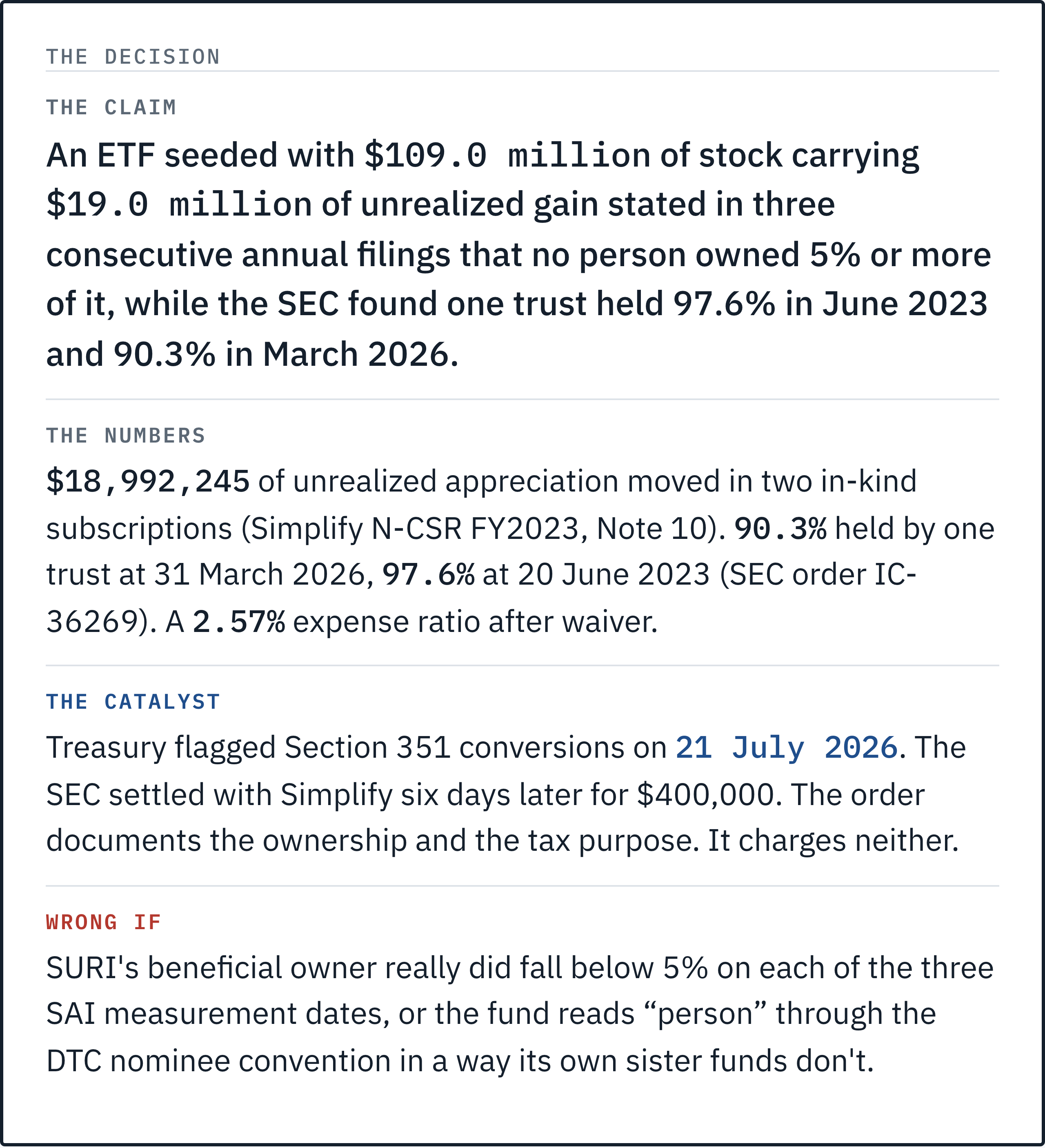

The consensus: a landmark derivatives case with housekeeping attached
Trade coverage read this order the way the SEC framed it, and that’s defensible. I want it at full strength. Pensions & Investments ran SEC fines ETF issuer Simplify Asset Management $400K over derivatives rule, compliance violations, representative of it.
They had a real story and I’d have led with it too. This is the first enforcement action ever brought under Rule 18f-4, the derivatives rule governing every registered fund since 2022. A Simplify manager took a short options position worth $3.4 million, over 13% of FIG’s portfolio, value at risk hit 291% against a 200% ceiling, and the fund lost over 8% in one day unwinding it.
One detail bothers me about that framing, and it isn’t the reporters’ doing. The SEC’s own summary is headed SEC Institutes Settled Order Against Nevada Investment Adviser for Causing Its ETF Clients’ Prohibited Transaction, Risk Reporting, and Disclosure Violations. The prohibited transaction is first in the Commission’s own title. It still came second in the coverage.
There’s a second consensus to clear, and it’s the stronger one. The tax angle is already well covered: Bloomberg ran it in February as a tax dodge for the very wealthy, Morningstar called it a loophole, and on 21 July 2026 Treasury Secretary Scott Bessent told a Wall Street Tax Association seminar that certain tax-aware products looked “too good to be true,” naming Section 351 conversions. Affiliated Managers Group fell 7%. So saying in August 2026 that 351 conversions carry tax risk is repeating the room.
My quarrel is with neither. It’s a question sitting between them that nobody has asked.
The variant view: this fund was never a pooled product
Read the order for ownership instead of derivatives and a different object appears.
Trust A “holds the largest equity position in Simplify, which currently is approximately a 25% fully diluted ownership interest.” Its preferred shares “gave Trust A the right to select two of the four directors on Simplify’s board of directors.” In a January 2023 memorandum, Simplify told its board that Trust A “is not an affiliate, or affiliate of an affiliate” of the trust, the adviser, the sub-adviser or an underwriter. Then comes the SEC’s flattest sentence: “Simplify did not share with the Board the basis for this conclusion.”
Then the seeding. Trust A contributed about $71.5 million of securities in what the memorandum called a “tax-free exchange” that “did not require Trust A to assume any obligation to pay for any accrued investment gains it received.” SURI launched the same day. Four months later a second subscription went in, which the SEC records “was not a pro-rata addition to the existing SURI portfolio because it included new securities and different position weightings.” On the day the board approved it, Trust A held 97.6% of the fund.
So I don’t think the interesting question is whether Simplify broke Section 17(a)(1). It settled that. The question is whether anyone screening the ETF universe could have seen this, and the surface built for that purpose said the opposite.
That’s the gap between the two consensus positions. Treasury is asking a tax question, and a tax remedy runs through the IRS, confidentially, which does an allocator no good. The securities law surface is the only one you can read, and on SURI it has been unusable since the fund launched.
Item 18 said no person owned 5%, three years running
Every registered fund files a Statement of Additional Information, and Item 18 of Form N-1A is where it names anyone holding 5% or more. Simplify titles the section CONTROL PERSONS AND PRINCIPAL HOLDERS. Here is SURI’s book, complete, in the SAI dated 1 November 2025:
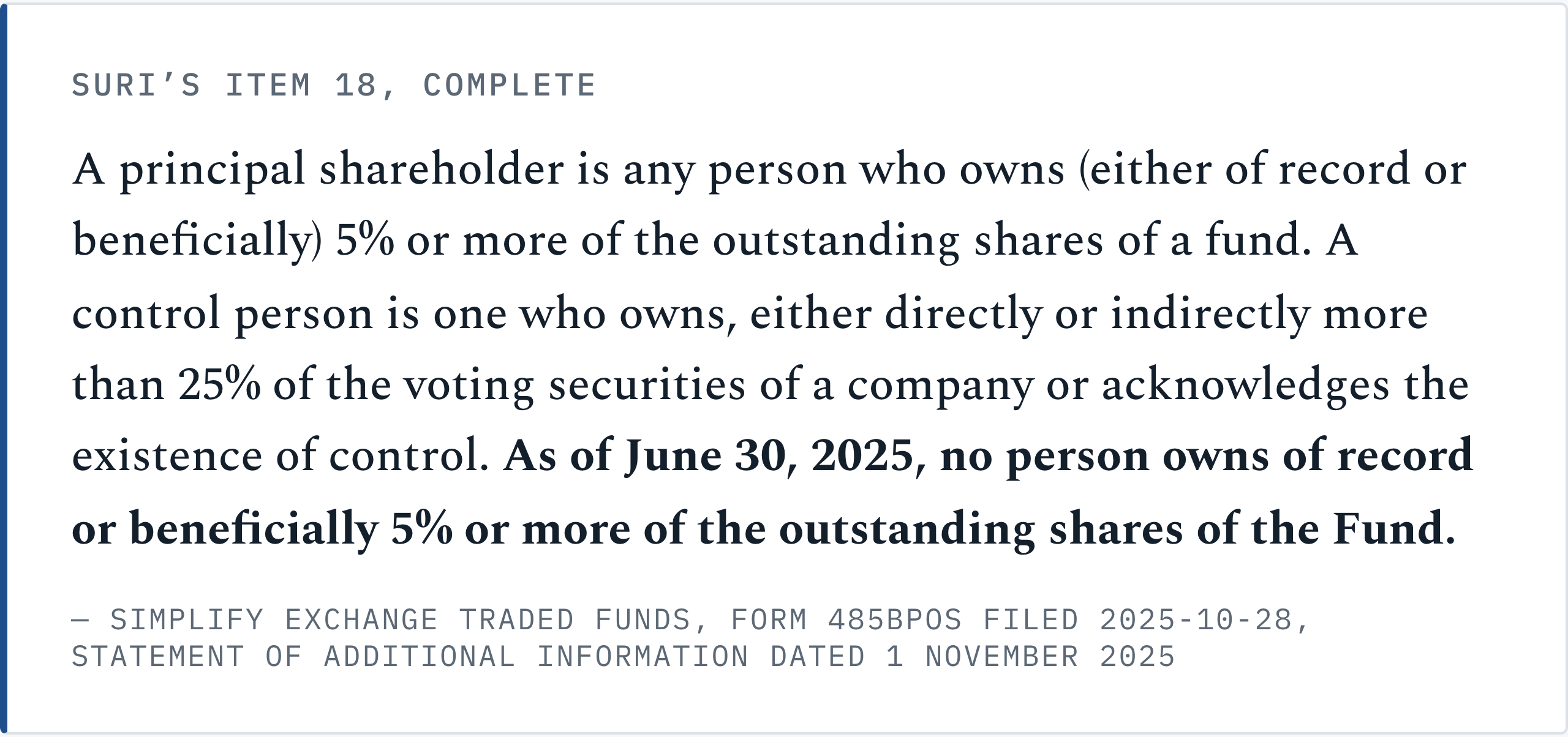
The SAI dated 1 November 2024 says the same as of 30 September 2024. The SAI dated 1 November 2023 says it “as of the date of this SAI.” That is four months after the date the SEC says Trust A held 97.6%.
Here is what makes it a finding. Open the same 2025 filing and the sister funds name their holders. Simplify Asset Management appears at 81.98% of Simplify Barrier Income ETF and 32.99% of Simplify Aggregate Bond ETF. Kayne Anderson Capital Advisors appears at 79.78% of the Kayne Anderson Energy and Infrastructure Credit ETF. Kovitz Investment Group sits at 34.22% of Simplify Opportunistic Income ETF. Jane Street, CWM, Mainstay, Napa Wealth and Encompass all appear with percentages, several plainly seeders.
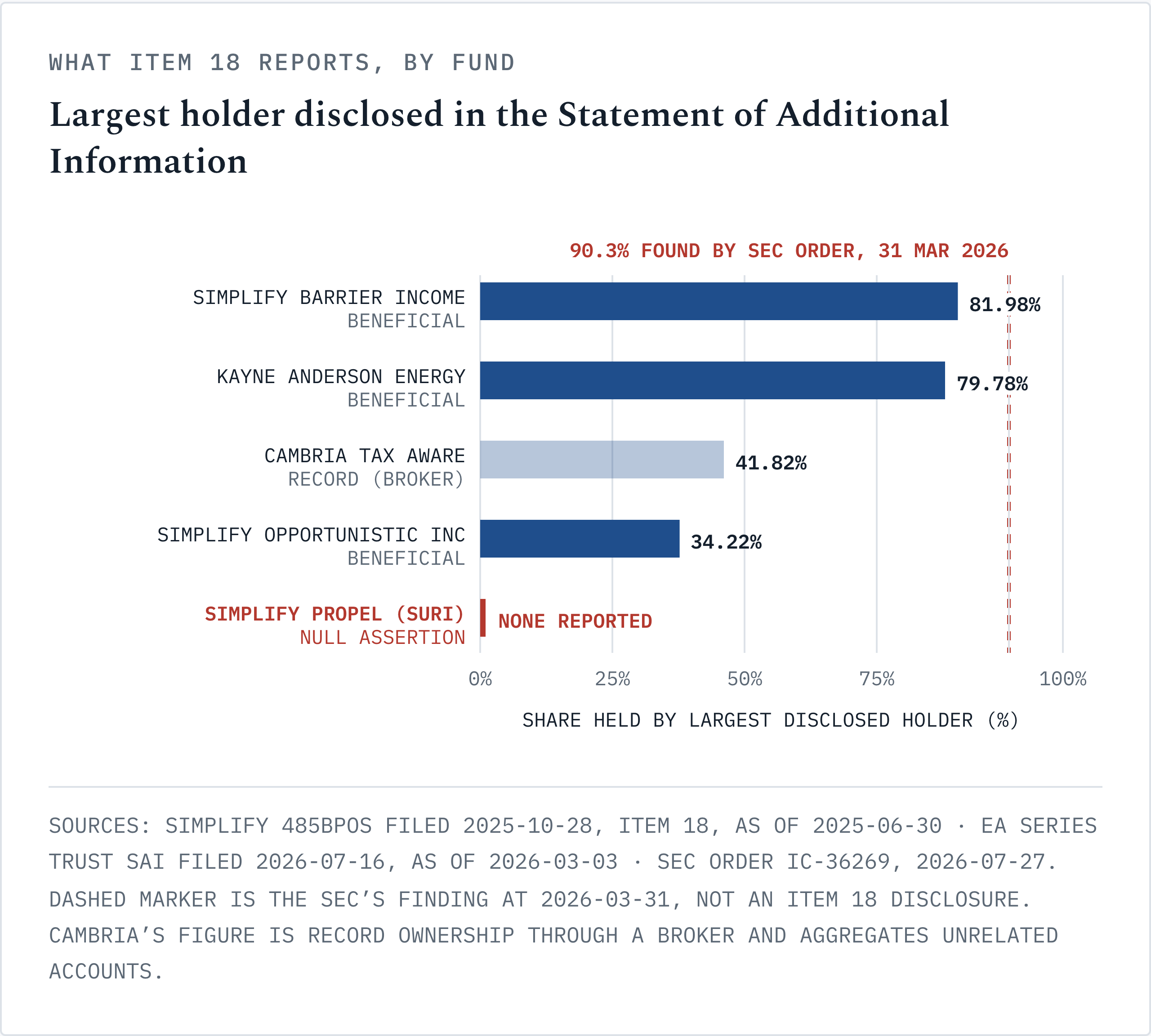
My read is that the convention is not blind. Same filing, same lawyers, same June 2025 measurement date, and the house discloses an 81.98% holder in one book and an affirmative “no person owns 5% or more” in another.
Here is the objection I would raise if I were defending this, and it’s a good one. Trust A holds in street name, so the fund may genuinely be unable to see a beneficial owner, making Item 18 a disclosure-quality question rather than a false statement. And the SEC had every fact and brought no disclosure charge.
I tested it. Cambria Tax Aware ETF, a Section 351 conversion, fills its Item 18 table as of 3 March 2026: Charles Schwab 41.82%, Wells Fargo Clearing 27.79%, National Financial Services 17.83%, each marked Type of Ownership: Record. So there are three behaviours in the wild. Name the beneficial holder, as Simplify does at 81.98% elsewhere in the same filing. Name the brokers, as Cambria does. Or say nobody holds 5%.
Only the third is inconsistent with a documented 90% holder, and it’s SURI’s. Cambria’s format identifies no beneficial owner either, and I’d still take it: 41.82% behind one broker tells an allocator to ask. A flat denial tells them to stop looking.
Let me be careful about what I am claiming. The SEC charged Sections 17(a)(1), 18(f)(1) and 19(a), plus Rules 19a-1, 30b1-10 and 38a-1, and brought no disclosure charge over Item 18. I cannot tell you whether the statements hold on their measurement dates, the staff did not look, or the settlement was scoped elsewhere. I can tell you the sentence is there, and checking it took ninety seconds.
The seeding note is the disclosure that did work
The other half of the record functioned, and it is the half I would build a process on. Note 10 of the FY2023 N-CSR, headed “In-Kind Seeding,” reports both transactions with cost, market value and embedded gain:
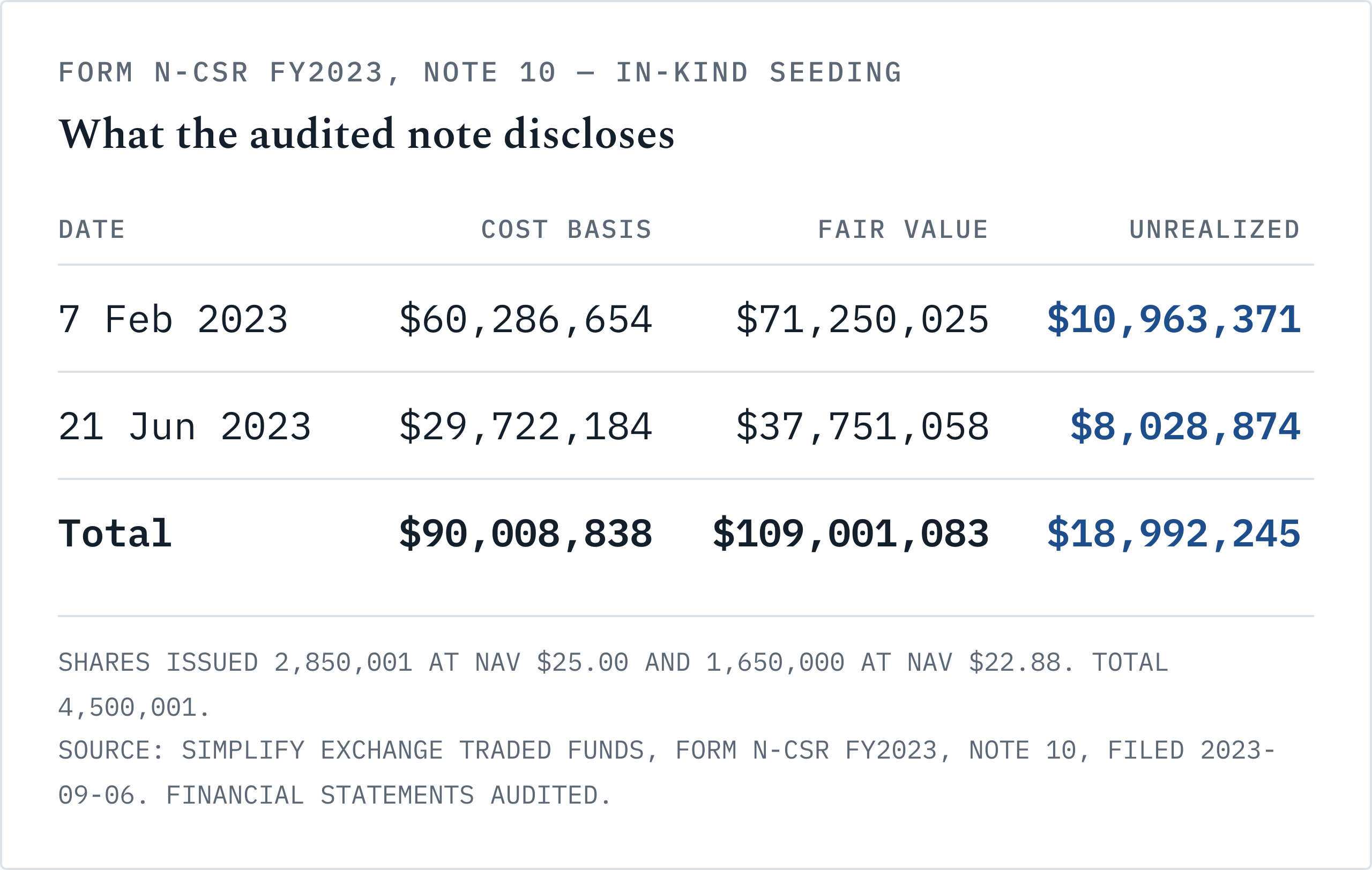
Those figures appear only in the audited FY2023 statements, whose auditors name the mechanism: “The fair value of assets contributed for Simplify Propel Opportunities ETF (SURI) became the new cost basis for financial reporting purposes.”
Triangulating against the order turned up something I did not expect. The June memorandum put the second subscription at “approximately $35.7 million.” Executed one day later, it was $37,751,058, or 5.7% larger than the board approved. February reconciles far better: “approximately $71.5 million” against $71,250,025 a week later, a 0.35% gap. Whether that’s one session of market movement or a changed basket, I cannot tell from public filings. It is a conflict between two primaries and I would rather state it than pick one.
I ran the ratio, and the second transaction separates itself. Tranche one carried embedded gain worth 15.4% of the value contributed. Tranche two carried 21.3%. The handpicked basket, the one the SEC says wasn’t pro-rata and that SURI “incorrectly documented as a ‘rebalance’ basket,” was 38% denser in unrealized gain per dollar than the seed before it.
That is not a filing slip. A custom basket is a creation basket that does not mirror the fund’s holdings; Rule 6c-11 permits it and requires written parameters for when it may be used. SURI’s policies “did not address the use of custom baskets that contained securities that were not held in the ETF’s portfolio... until June 2026.” The one mechanism letting a contributor pick which lots entered the wrapper ran three years without them, and the lots that went through were the more appreciated ones.
