


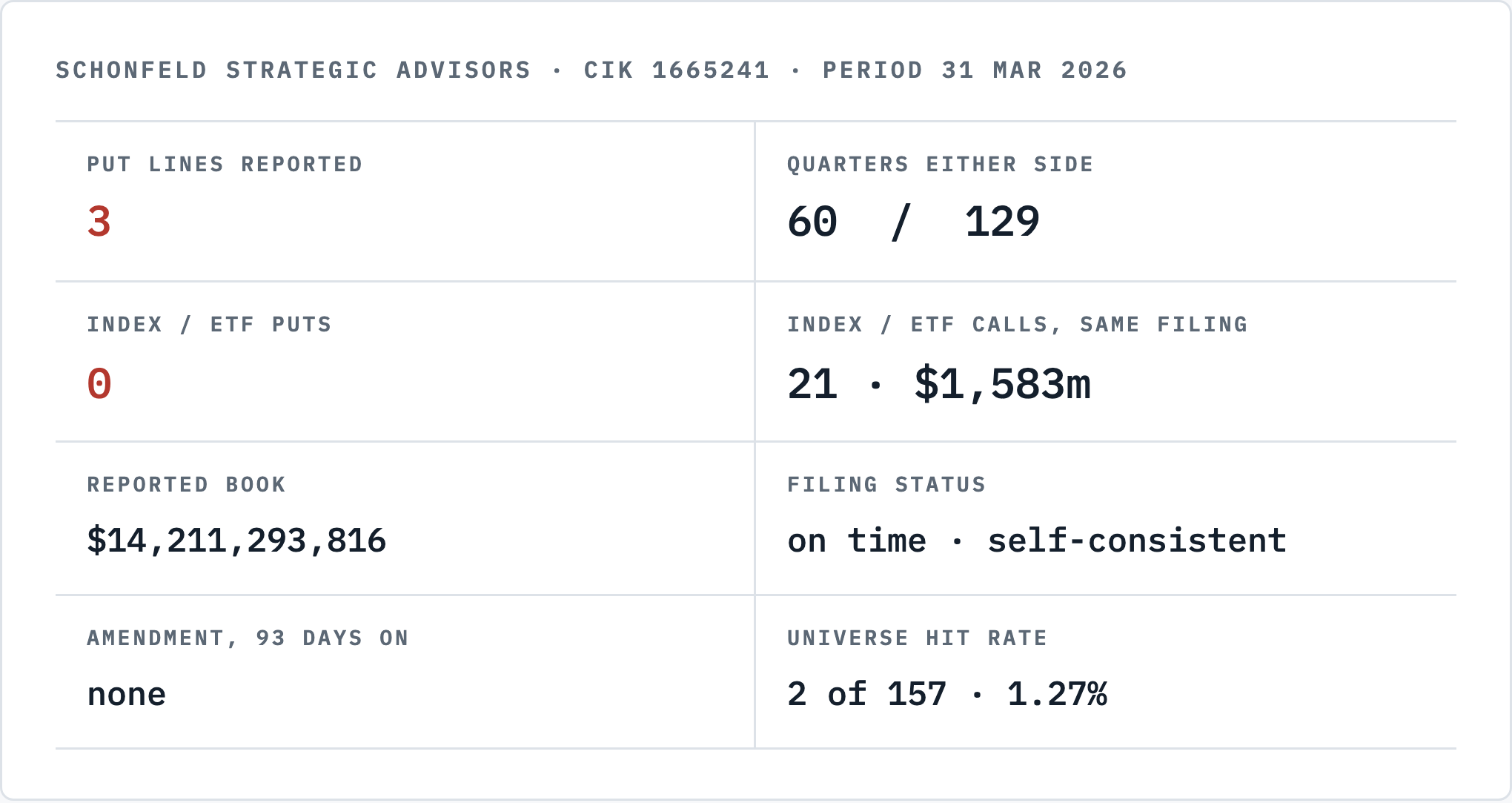
Schonfeld Strategic Advisors reported three put positions totalling $56,352,600 in its 13F for the quarter ended 31 March 2026, against a reported book of $14,211,293,816. The quarter before carried 60 put lines worth $1.310bn. The quarter after carried 129 worth $6.202bn. Inside the anomalous filing, the number of index and ETF put lines is zero, while the same document reports 21 index and ETF call lines worth $1.583bn.
The filing is on time, complete on its face, and reproduces its own declared totals to the dollar. I checked this morning and no amendment has been filed in the 93 days since. I scanned all 8,400 managers who filed original 13Fs for both quarters, and two of them show this signature. If you run any signal derived from 13F option composition, you ingested a 95% collapse in one manager’s put book, and nothing upstream of you was built to tell you whether it happened.
The consensus is right about 13F, and it is right about the wrong three things
Anyone who works with this data knows its defects and states them without prompting. The filing arrives 45 days after quarter end, so it describes a portfolio that has already moved. It covers long positions in a defined universe of exchange-traded equities and options, so short stock never appears and can never be netted against anything. And a manager can request confidential treatment under Rule 24b-2, delaying disclosure of specific positions while the rest of the filing goes out on schedule.
That is a fair and strong account, and I’d sign it. It’s also the version that supports the entire industry built on this data, because all three defects are known unknowns. A lag’s easy to model. A long-only universe can be treated as a lower bound. A confidential treatment request leaves a trace on the cover page. You can price all three, and serious users do.
My argument isn’t that the consensus underrates those three. There’s a fourth defect, it’s structurally different from the others, and nobody can price it, because the document gives you nothing to price it with.
The observation: one side of the book, one quarter
Here is what forces the claim. I counted every line myself, straight out of the filed XML. The aggregators restate whatever was filed, and what was filed is the thing in question.
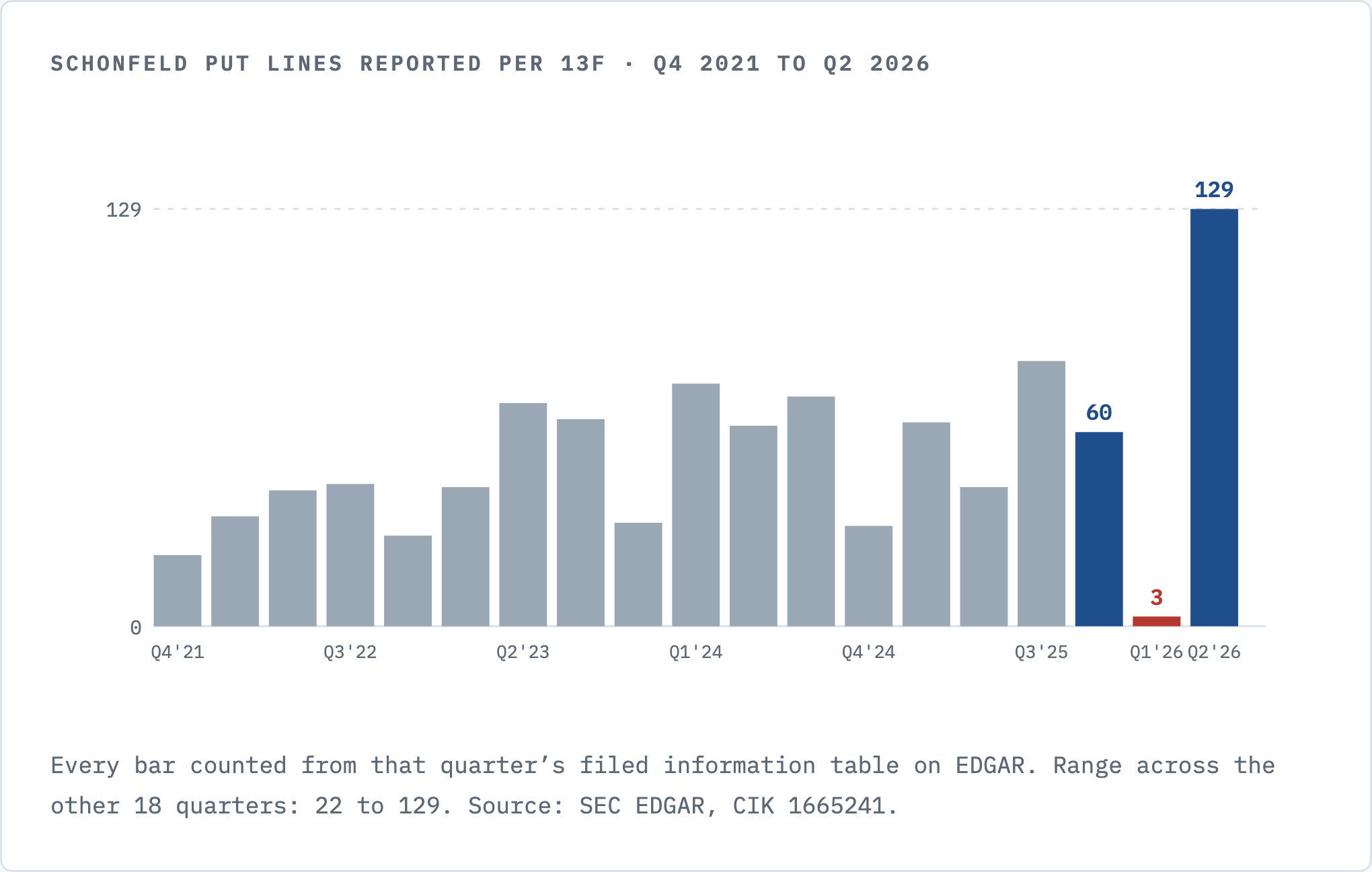
Across Schonfeld’s 19 quarters from Q4 2021 to Q2 2026, reported put lines run from 22 to 129. Every quarter. The single exception is Q1 2026, which reports three.
The window starts at Q4 2021 for a reason you should have rather than discover. Further back, four quarters report no options at all in either direction: Q4 2018, Q2 2019, Q1 2020 and Q2 2020. Both sides absent is a different shape, and one of those quarters matters later. Schonfeld’s options reporting only becomes continuous from Q4 2021. Over the same window call lines run from 37 to 172, and Q1 2026 reports 107, which sits above the 19-quarter median of 77.
So the anomaly is one-sided. In the quarter where the put book falls 95%, the call book rises 35% by value and the call line count rises from 83 to 107. A manager reducing gross exposure cuts both sides. This filing cuts one.
The index cut is sharper, and it’s the number I’d put in front of a risk committee:
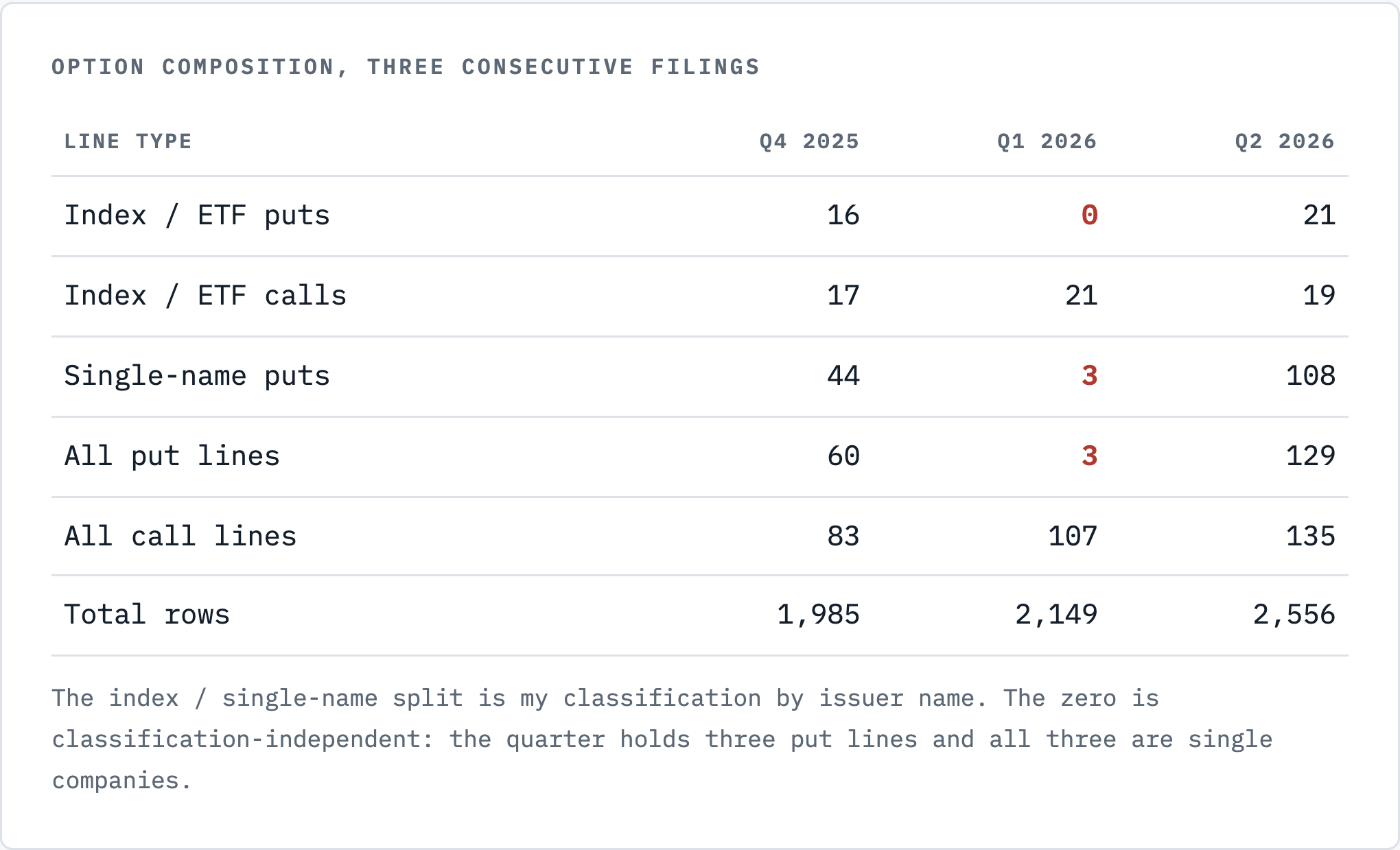
Not small. Zero. A multi-strategy manager reporting $14.2bn across 2,149 lines reported index calls on 21 tickers and not one index put.
The index and single-name split is mine, sorted by issuer name, so the 16 and the 21 would shift under someone else’s rule. The zero wouldn’t move under any rule: Q1 2026 holds three put lines and all three are single companies.
Two filers out of eight thousand four hundred
My first question was whether this is common, and I couldn’t find anyone who’d asked it. So I pulled the SEC’s own Form 13F structured data sets for both quarters and ran the diff across the whole universe.
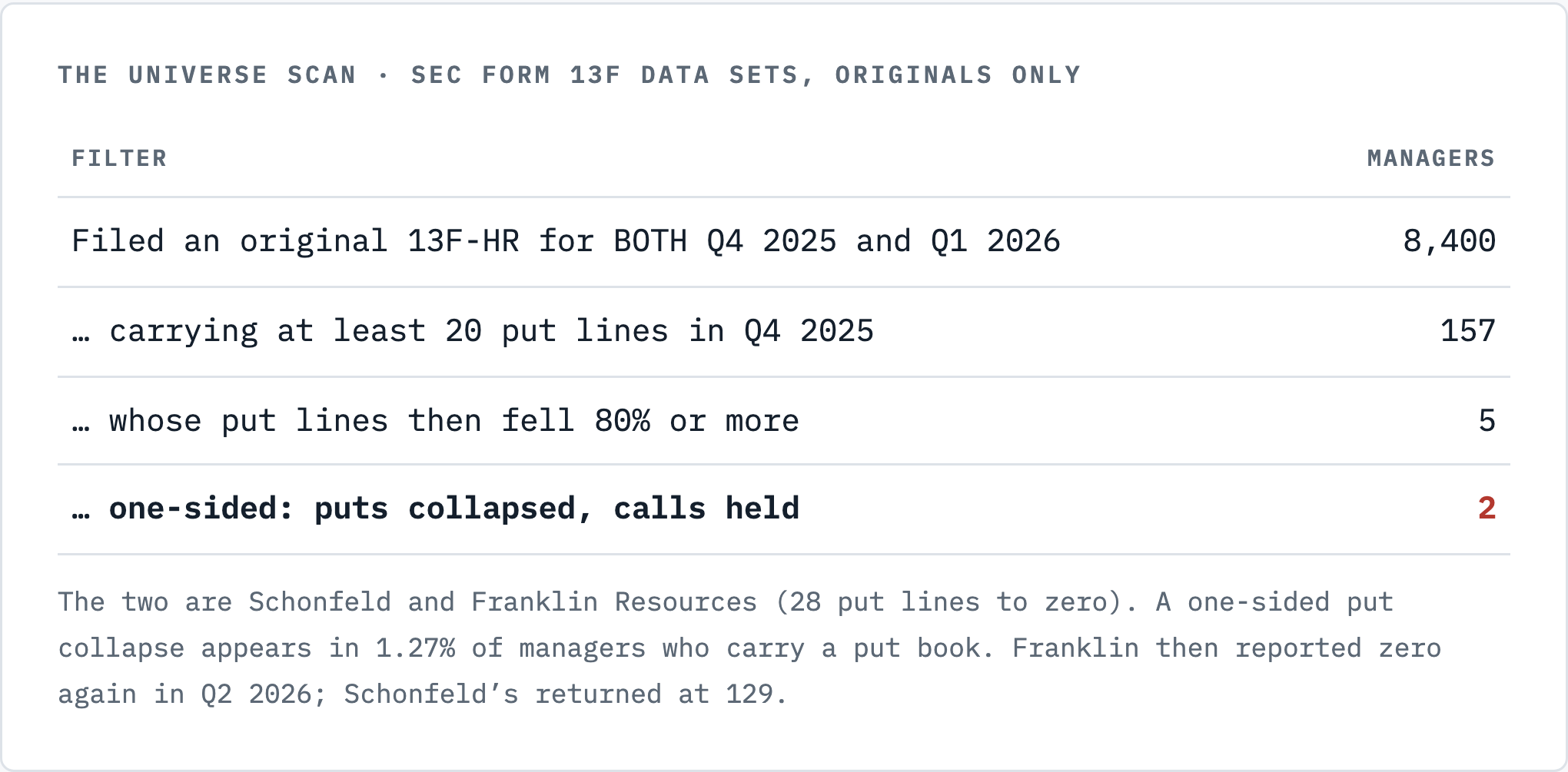
8,400 managers filed an original 13F-HR for both Q4 2025 and Q1 2026. Most hold no options at all, so I restricted the set to filers carrying at least 20 put lines in Q4, which is my proxy for having a put book to lose. That’s 157 managers. Of those, five lost 80% or more of their put lines. Only two did so while their call book held, which is the one-sidedness that separates this from an ordinary de-risking.
Those two are Schonfeld, and Franklin Resources, which went from 28 put lines to zero. That is the whole list.
I used originals only, deliberately. A 13F-HR/A isn’t one thing: RESTATEMENT replaces the book, NEW HOLDINGS merely appends rows. ExodusPoint’s Q1 2026 amendment holds 41 rows against an original book of 1,454, so reading it as the portfolio understates that manager by 97%. Originals are also what the market saw on the day.
Names aside, the rate is the part worth keeping. A one-sided put collapse shows up in 1.27% of managers who carry a put book, which is what makes the check worth running: it fires rarely enough that a hit is worth a human’s attention.
Why the document cannot answer the question it raises
Dullness is why this mechanism survives. Three properties of Form 13F combine into a gap that no single property looks responsible for.
The cover page is derived from the table, so it can never contradict it. Schonfeld’s Q1 2026 filing declares tableEntryTotal of 2,149 and delivers 2,149 rows. It declares tableValueTotal of $14,211,293,816 and the value column sums to exactly that. I checked both identities on the three surrounding filings and all four reconcile to the dollar. That reconciliation feels like a completeness check and is not one. Both figures are computed from whatever rows the filer chose to include, so a table missing an entire instrument class still produces a perfectly self-consistent document.
Nothing in the form asserts completeness beyond a signature, and nothing links a quarter to the one before it. No field for “this report is comparable to my last one”, no prior-period column, no reconciliation of opening to closing positions. Each quarter is a standalone assertion. Quarter-over-quarter differencing, which is the basis of essentially every hedge fund positioning product sold, is an inference the form was never designed to support. Nobody built that bridge. Users assumed it.
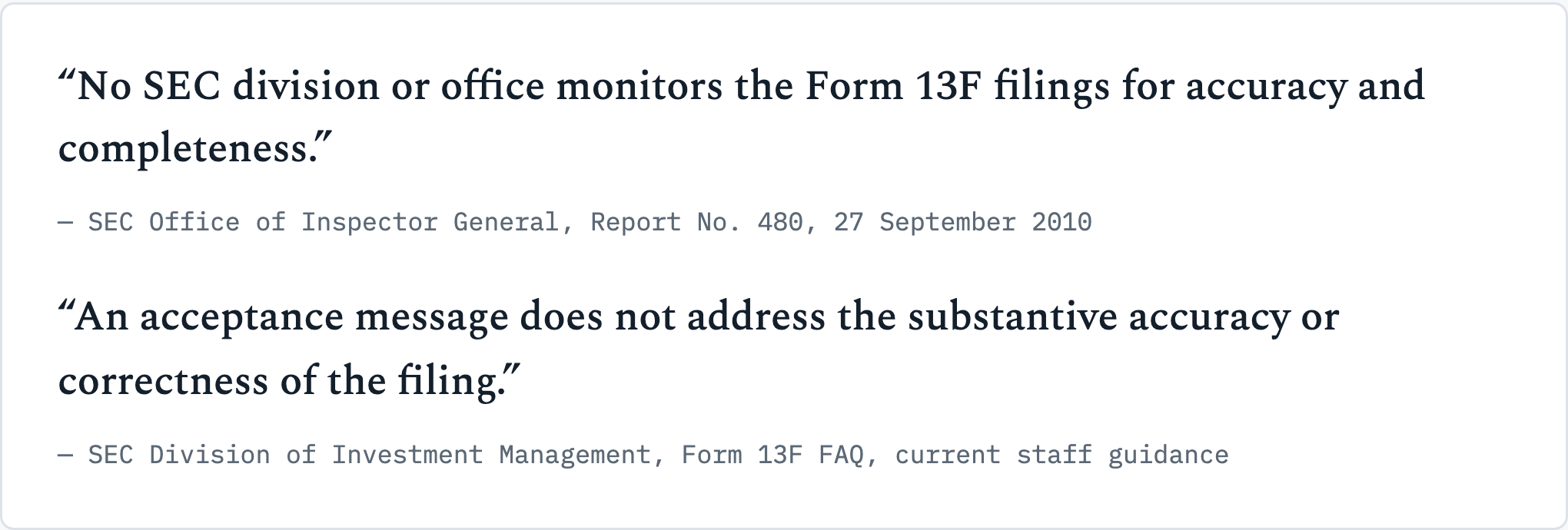
And no one checks. This is the part I expected to be out of date and found was not. The SEC’s own Office of Inspector General reported in Review of the SEC’s Section 13(f) Reporting Requirements that “no SEC division or office conducts any regular or systematic review of the data filed on Form 13F”, that “no SEC division or office monitors the Form 13F filings for accuracy and completeness”, and that “there are no checks built into the EDGAR system, through which the Forms 13F are filed, to scan for obvious errors in the forms.” I expected to find a caveat softening this and did not. The report is explicit about what is left in place of monitoring: errors “are typically detected only in connection with IM’s processing of Section 13(f) confidential treatment requests, or when a member of the public notifies IM of an error.”
That report is dated September 2010, so I went looking for its replacement. There’s none. In September 2024 the Society for Corporate Governance, NIRI and the NYSE petitioned the Commission and wrote that they “believe that it would be helpful for OIG to conduct another review of the 13F program”. Fourteen years on, the constituency that cares most about this data was still asking for the first follow-up.
I’d rather not rest a live argument on a 2010 audit, so here’s the current version in the Commission’s own words. The SEC’s Form 13F FAQ states that an EDGAR acceptance message “does NOT refer to the correctness of the content of your filing”, that it “does not address the substantive accuracy or correctness of the filing”, and that after submitting, the manager “should review your accepted Form 13F on the SEC’s website and check your filing for accuracy and correctness.” The SEC instructs the filer to audit their own filing, because nothing else will. That is not an old finding. It’s live staff guidance today.
And the Commission has been back to this form recently. On 23 June 2022 it adopted amendments, effective for filings from 3 January 2023, which added a Summary Page checkbox flagging confidential treatment requests and required managers to report additional identifiers. So Form 13F was opened, revised and re-issued three years ago, and what got added was a better flag for the disclosure gap that already leaves a trace. No completeness attestation. No prior-period field. The one defect that leaves no trace survived a redesign.
Put those three together and you get the result that matters. A filing that omits a position and a filing that reports the absence of that position are byte-identical. No signature distinguishes them. That’s why I can tell you exactly what Schonfeld’s Q1 2026 filing says and can’t tell you what it means.
There’s a fourth property that makes the first three worse, and it’s about timing. Nothing about the Q1 filing looked wrong on the day it landed. It was filed on 15 May 2026, and read on its own it is a manager with a $14.2bn book, 2,149 positions, no puts to speak of and an active call book. That is an unusual portfolio, and unusual portfolios are legal. The discontinuity only became visible on 14 August, when the Q2 filing arrived carrying 129 put lines and $6.202bn, because the anomaly is not in either filing. It is in the pair. Anyone who consumed Q1 data during those 91 days had no signal available to them even in principle. This is also why the 45-day lag and the completeness gap compound instead of adding: the petitioners want the lag cut to five business days, which would surface the raw numbers faster and would do nothing whatever to tell you a quarter was incomparable to the one before it.
