
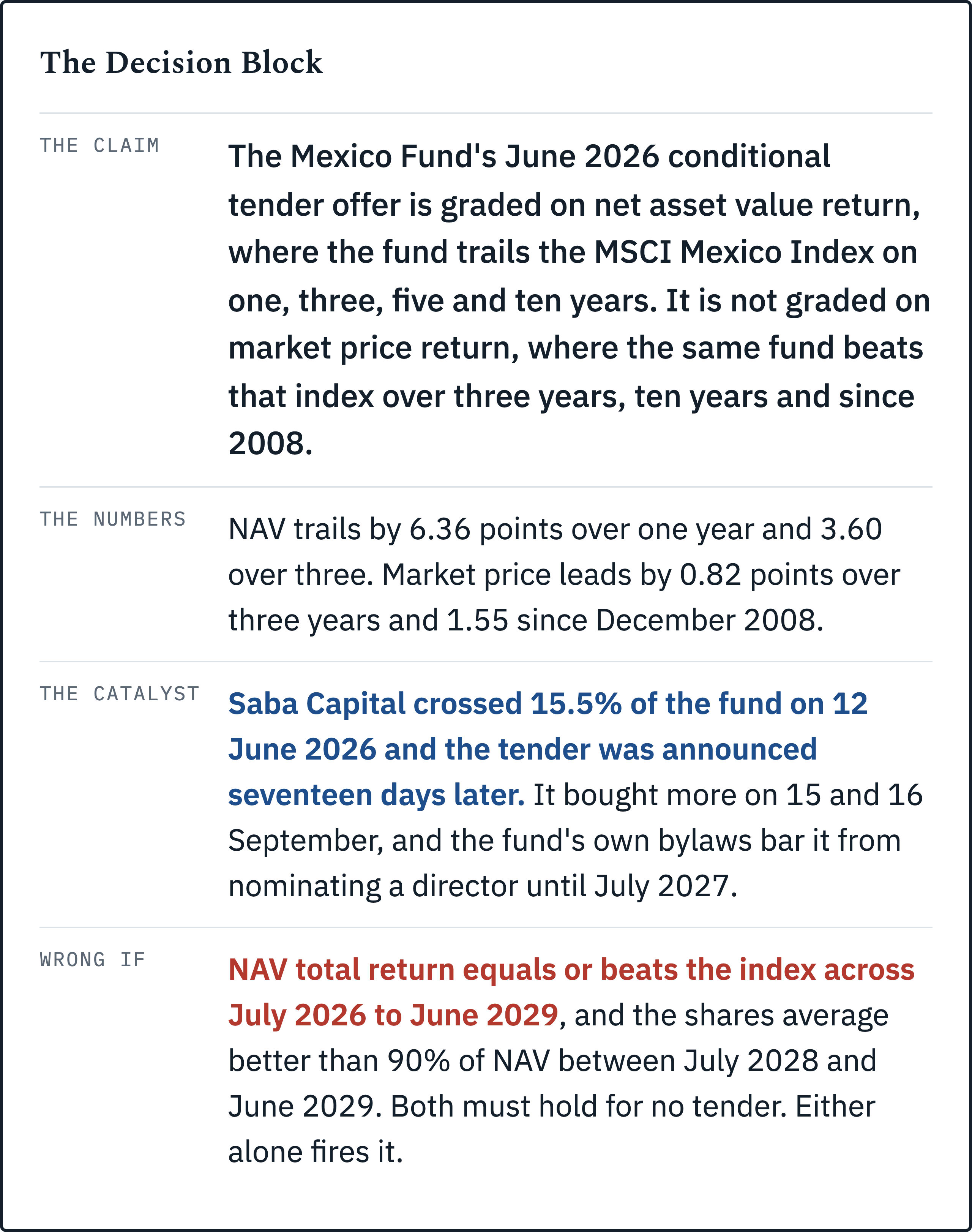
The Mexico Fund’s June 2026 conditional tender offer is graded on net asset value return, where the fund trails the MSCI Mexico Index on one, three, five and ten years. It is not graded on market price return, where the same fund beats that index over three years, ten years and since 2008.
Boaz Weinstein’s Saba Capital spent the middle of September rotating between closed-end funds, and the filings are unusually legible, because a holder above 10% reports its trades within two business days.
On September 17 and 18 Saba sold BlackRock’s ESG Capital Allocation Term Trust, 21,095 shares at $14.36, then 28,977 at $14.38. Across September 1 to 18 it sold 1,005,019 shares, continuing a reduction that had already taken the stake from 23.9% in February to 12.66%. On the same two days it bought the New Germany Fund at $11.10 and $10.82. Two days earlier it had bought The Mexico Fund at $20.89 and $20.63.
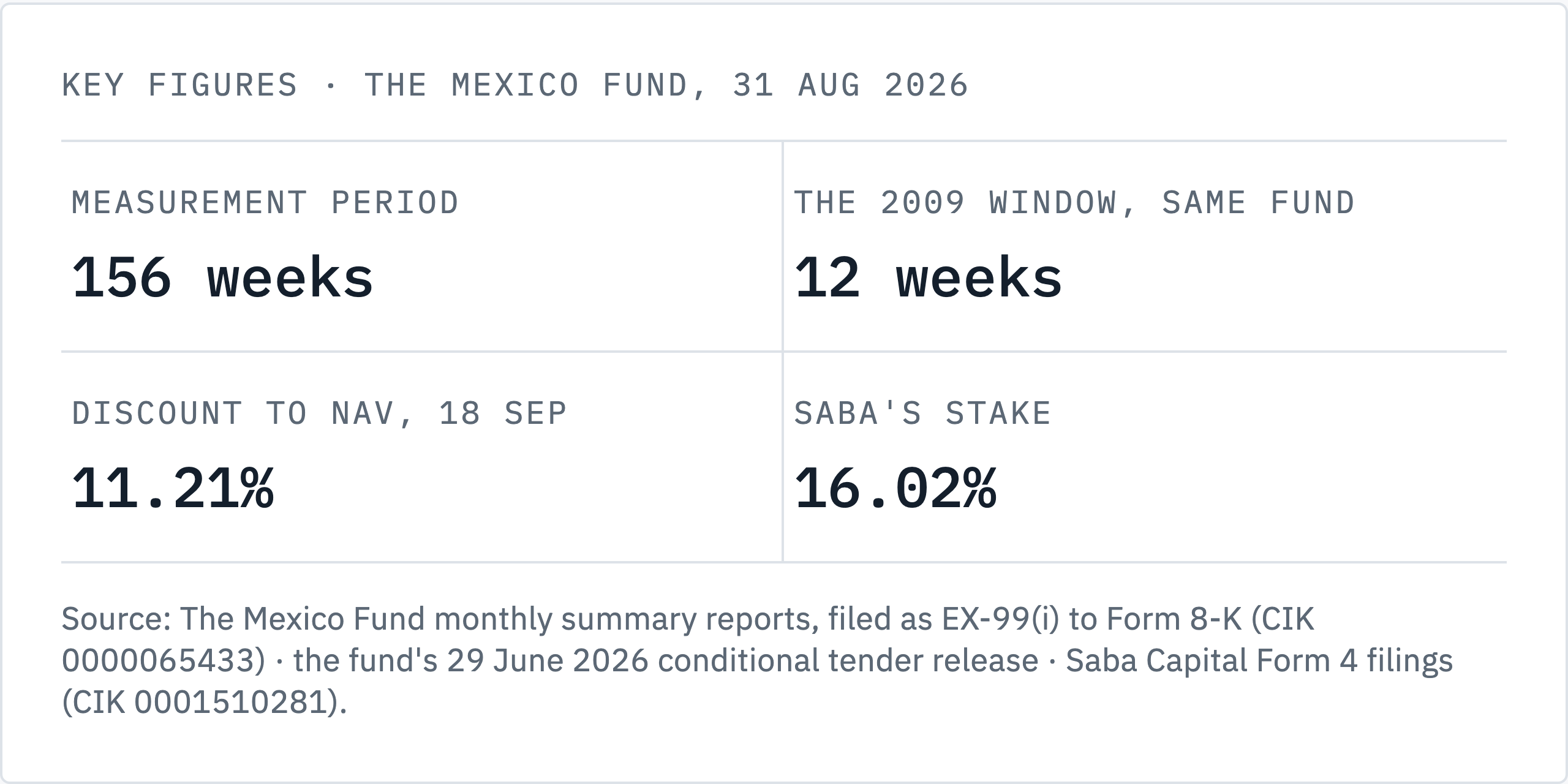
Put the discounts beside the trades. On September 18, ECAT closed at a 2.31% discount to net asset value. The New Germany Fund closed at 10.01%. The Mexico Fund closed at $20.98 against a net asset value of $23.63, subtract, divide, and that’s 11.21%. Saba’s selling where the gap has shut and buying where it hasn’t.
That’s an ordinary rotation. What makes The Mexico Fund worth an afternoon is a drafting choice in its June tender offer, and I don’t think anyone has read it closely.
First, the part of the consensus that’s simply right
I started this piece expecting to argue that MXF’s board was stalling. That argument doesn’t survive its own filings. So here’s what the record actually shows, before I say what I think is wrong with it.
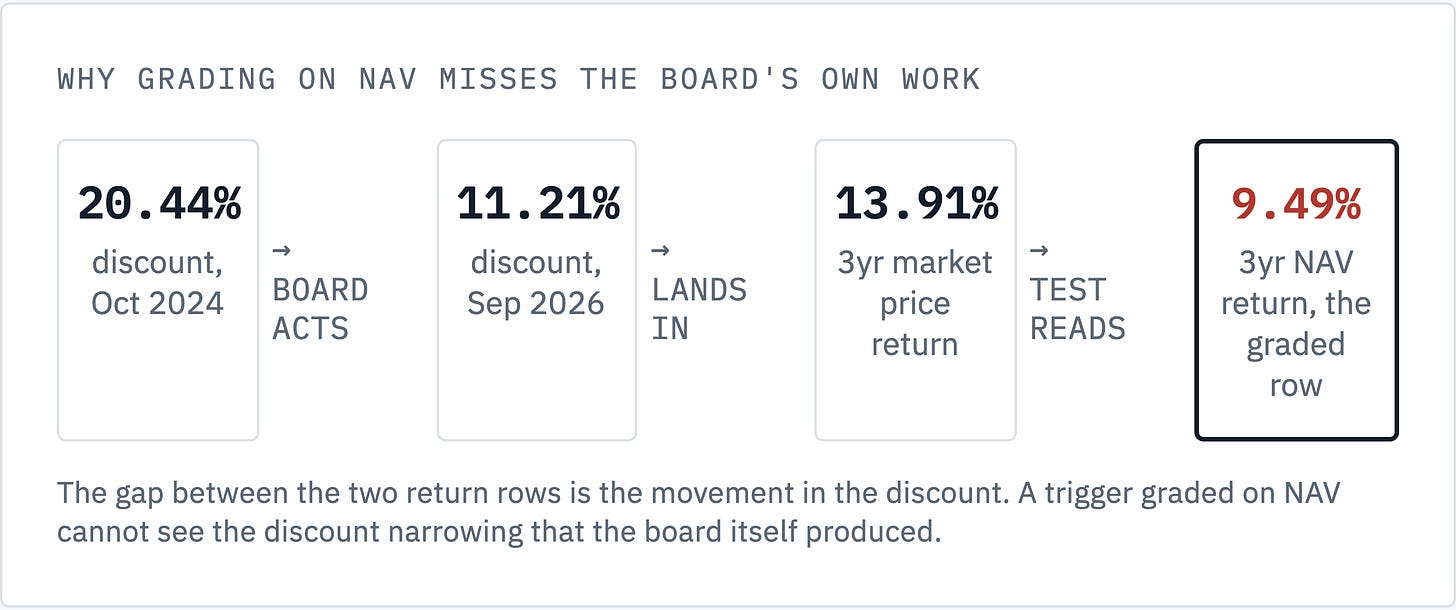
The discount has roughly halved in two years. It stood at 20.44% at the fund’s fiscal year end in October 2024, 11.94% a year later, 14.24% at April 30, 2026, and 11.21% on September 18. Call it nine points in twenty-three months, and roughly three of them after the June announcement.
The board has been doing things, too. In December 2025 it raised the quarterly distribution from $0.25 to $0.35 a share, a 40% increase. In fiscal 2025 it repurchased 351,797 shares in the open market, 2.38% of the fund, for $5,043,678. In June 2026 it added the conditional tender. Three legs, and they’re the same three legs this fund used in 2009: a distribution plan, a repurchase authority, and a conditional tender at 98% of net asset value.
So the honest version of the consensus isn’t wrong. A fund with an activist at 16%, a 40% distribution increase, a live buyback and a board-approved tender is a fund whose board is responding. Bradley, Brav, Goldstein and Jiang would predict it: their hand-collected study of activist campaigns from 1988 to 2003 found open-ending attempts “reduce the discount of the targeted funds by more than 10 percentage points on average”, and they note their own estimate is “a lower bound” because discounts narrow when attacks are merely anticipated. MXF’s tape looks like anticipation working.
I wanted that conceded properly, because what I think is wrong is narrow and specific, and it isn’t “the board is stalling.”
The trigger is graded on the wrong return
The tender fires if either of two things is true at the end of the Measurement Period. It is cancelled only if both fail to be true, that is, only if the fund performs and the discount is narrow.
Here is the performance condition, from the fund’s own SEC-filed monthly summary report and its press release, which carry it identically:
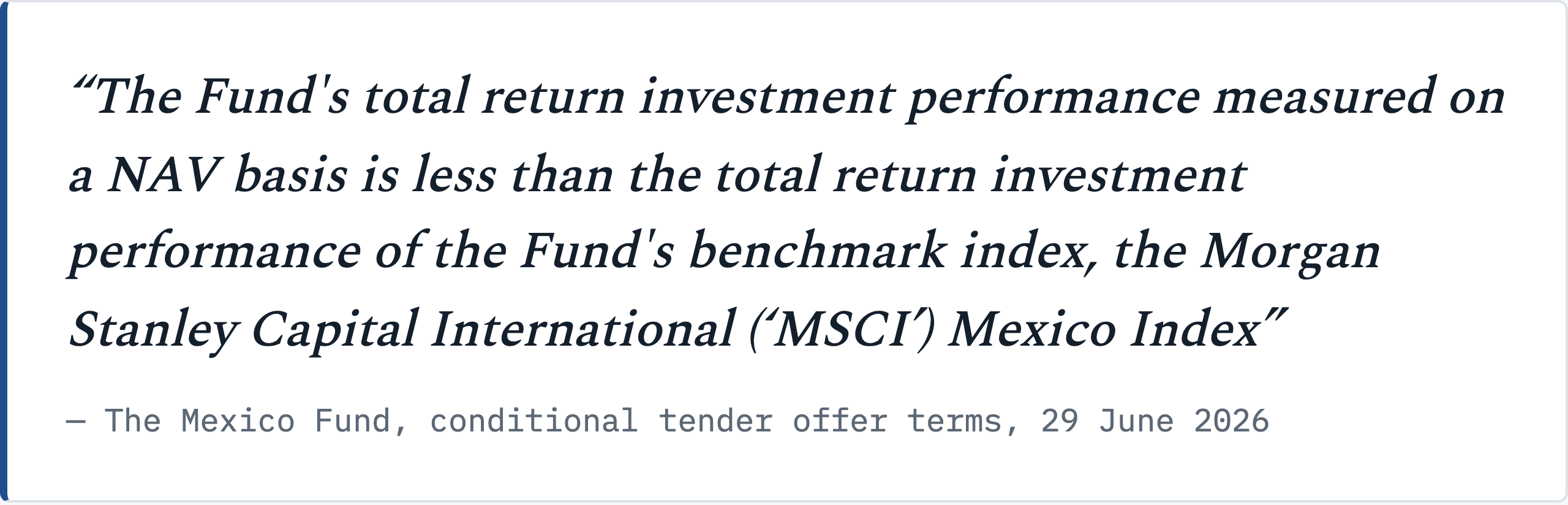
Measured on a NAV basis. Now look at what the fund publishes about itself every month. Two return rows, both to August 31, 2026:
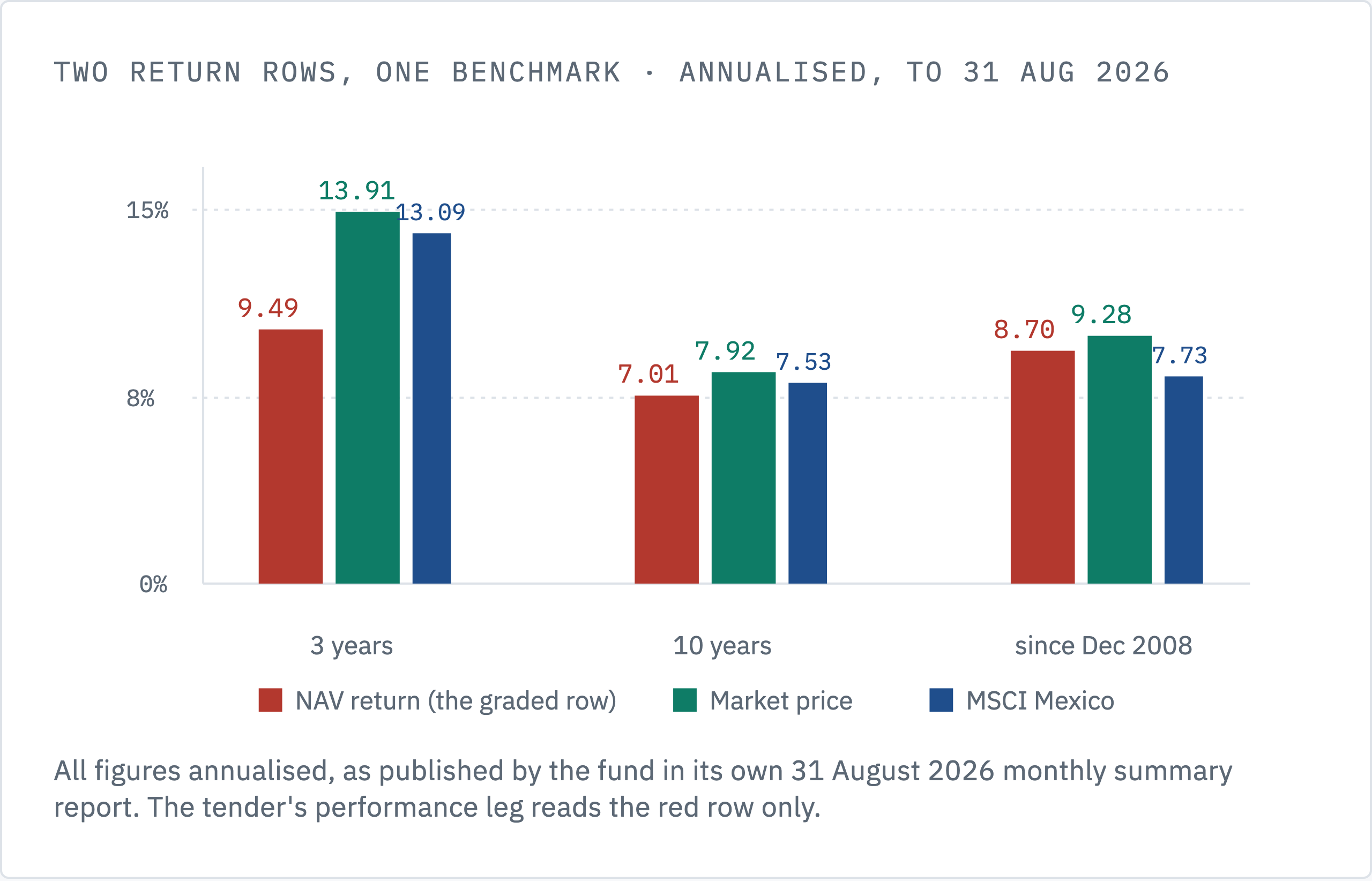
On net asset value the fund trails over one, three, five and ten years. On market price, the return a shareholder actually banked, because the discount narrowed underneath him, it beats the index by 0.82 points over three years and 1.55 since 2008. The fund’s own semi-annual report says it plainly: “the Fund’s market price has outperformed the benchmark during long-term periods of one-, three-, and ten- years and since December 2008.”
The test reads the first column. It ignores the second.
I should be careful here, because the fund does beat the index on two NAV horizons: one month, and since December 2008, the longest it publishes, and the whole tenure of the current management team. “Trails everywhere” would be false. What is true is that it trails on every intermediate horizon, and those are the horizons a three-year test lands on.
Two months in, it is already behind. Compounding the July and August monthly figures, 1.22% then 0.33% for NAV, against 2.07% then 0.09% for the index, gives 1.55% against 2.17%. That is a shortfall of about 61 basis points, on a test with 154 weeks left to run.
So the likeliest outcome is that the tender fires. The discount staying wide is not what does it. Because the adviser’s net asset value trailed a benchmark its own fee already penalises it against: in the six months to April 30, 2026 the accumulated base fee of $1,649,674 was reduced by $265,580 by the performance component.
Which leaves a strange object. A mechanism announced as discount control, most likely triggered by something other than the discount, graded on a return its own shareholders did not experience.
Below the paid line:
the full Saba Form 4 ledger for September: 7 dated trades, every share count and price
the six-fund discount table, each with its own NAV and as-of date
the pro-ration arithmetic: 2009 was 2.31x oversubscribed, and what that does to a 20% cap
the Measurement Period model: the annual NAV return MXF needs across 154 remaining weeks
## The position, instrument, entry at $20.98, levels, sizing, the dated kill line