


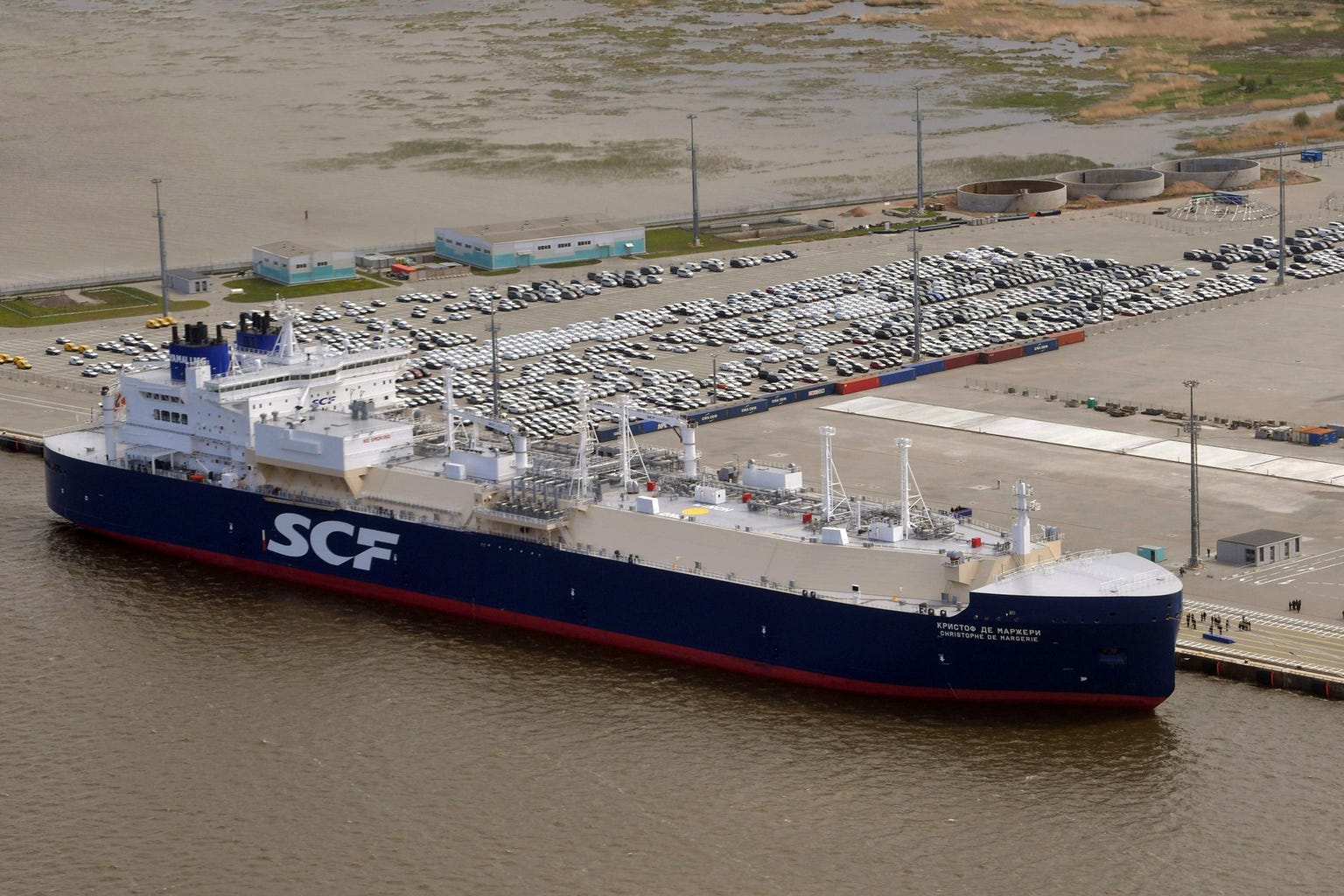
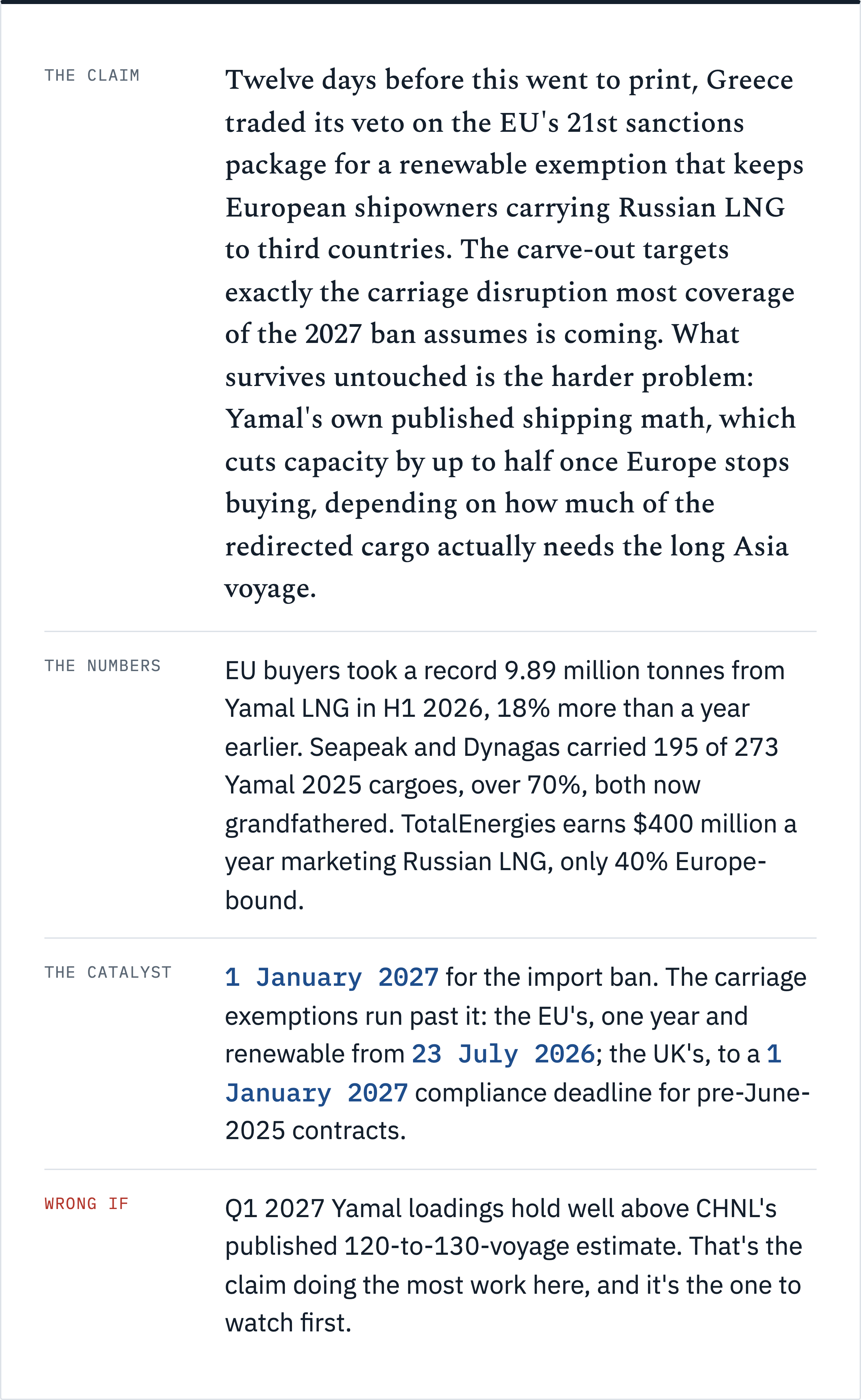
Twelve days before this went to print, Greece traded its veto on the EU’s 21st sanctions package for a renewable exemption that keeps European shipowners carrying Russian LNG to third countries. What survives untouched is the harder problem: Yamal’s own published shipping math, which cuts capacity by up to half once Europe stops buying.
Europe bought more Russian LNG in six months than it ever has
I want to start with the fact that embarrasses my own framework.
Between January and June 2026, EU countries imported 9.89 million tonnes of LNG from Novatek’s Yamal plant. That’s 18% above the same period in 2025. It happened after the EU’s own ban on short-term Russian LNG contracts took effect on 25 April 2026 (Liga.net). France, Belgium and Spain were the main buyers, on Financial Times reporting of the same Kpler data.
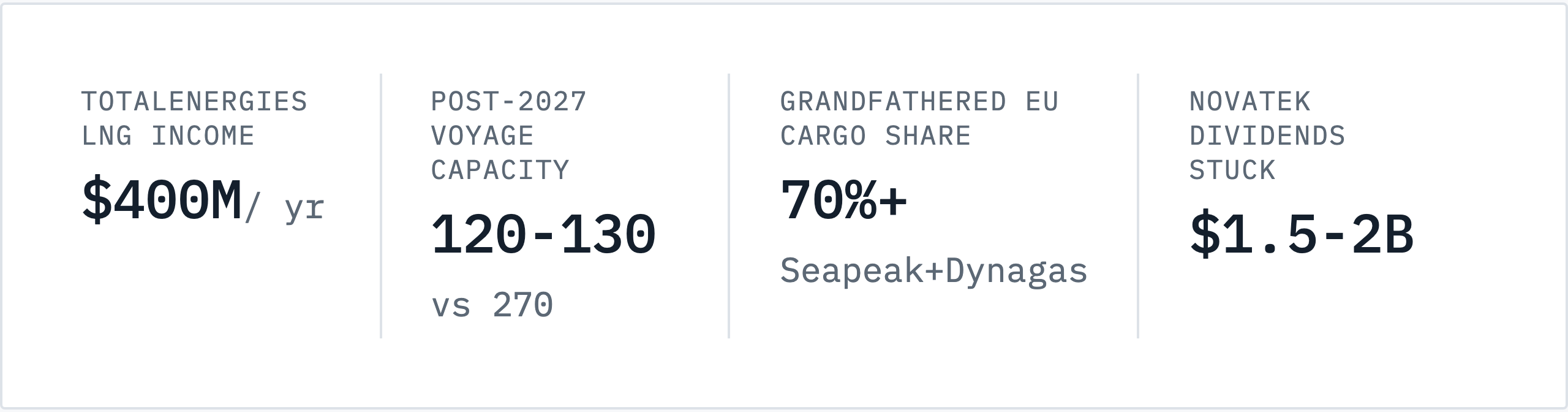
In 2025 the pattern was the same, just slower. Yamal shipped 273 cargoes. The EU took 207 of them and paid €7.2 billion, per Urgewald’s own tracking. China took 51. Eleven of Yamal’s fourteen Arc7 carriers belong to two companies: Seapeak carried 101 cargoes and Dynagas 94. Together, that’s “over 70% of the Yamal-EU shuttle trade,” in Urgewald’s own words.
I want to be fair to the consensus here, because it isn’t stupid. Its strongest version runs like this: sanctions on Russian energy leak through shipping, and the leak is engineered. The crude price cap taught that lesson at scale, and Russia is visibly running the same play in gas. Windward counted 23 vessels in a Russian LNG shadow fleet as of June 2026, and by early August the FT put it at 25, including two hulls from Zvezda shipyard. Four of them, all 19 years or older and bought from a Middle East owner in Q1 2026, were designated by the UK on 16 June and now trade as Orion, Kosmos, Merkuriy and Luch (Windward).
That reading predicts something specific. Come January, cargoes go dark, ownership goes opaque, and Russian LNG revenue survives largely intact. Part of it is even true: Windward’s own count says ten of the 23 are newbuilds delivered openly to state-controlled Russian owners, seven were bought by anonymous entities between February 2024 and May 2025, and six are recent elderly purchases. A fleet that’s 43% newbuild by hull count reads to me as a state logistics buildout, running well before January gave anyone a reason to hide. Where I think the consensus goes wrong is where the disruption actually lands, and a story from twelve days before publication is the reason why.
The Council carve-out that arrived first
Here’s the detail that reorganised my thinking. It’s dated closer to publication than anything else in this piece.
On 23 July 2026 the EU adopted its 21st sanctions package, after Greece blocked it for a week over exactly this measure. The compromise, struck at ambassador level, grants EU shipowners a one-year, renewable exemption to keep transporting Russian LNG to third countries under long-term contracts concluded before 24 February 2022, capped at 2025 volumes, with related purchases and services covered too (EU Observer; Athens News). The named and intended beneficiary is Dynagas, the Greek operator carrying 94 of Yamal’s 2025 cargoes. Its own government argued the alternative would “ruin” it.

Read that against what I’d have written a month ago: “195 of 273 cargoes, over 70%, are carried by operators being legally removed from this trade.” Dynagas isn’t being removed. It’s grandfathered, for a year, renewably, at last year’s volume. I’d hold this concession loosely. The derogation renews on annual Council review, so it’s a recurring veto fight rather than a settled fact, and it could still lapse.
The UK side tells the same story from a different statute. Its own Russian LNG transport ban took effect 20 May 2026, but it carries a parallel exception for long-term contracts concluded before 17 June 2025, running to a 1 January 2027 compliance deadline (UK P&I Club). Seapeak’s 101 cargoes likely qualify.
So here’s my honest read of the operator side: the carriage disruption I expected to be the article’s spine barely exists for legacy contracts. Both governments wrote grandfather clauses protecting exactly the companies that would otherwise have been forced out. The 1 June 2026 European Commission letter to shipbroker Poten & Partners reads the ban as reaching EU operators “regardless of the final destination” (gCaptain). That’s the Commission’s own published guidance from November 2025, restated rather than freshly invented, and it’s now qualified by a Council-level carve-out that covers precisely the contracts that mattered.
The problem that survives is geography
Where I think the real constraint lives is voyage days, and it’s better documented than I first gave it credit for.
Average sailing time from Sabetta to European ports ran 8.5 to 8.8 days in 2024. To China via the Northern Sea Route it ran 19 days (Centre for High North Logistics). The Arctic transit is seasonal, running from late June to November. Outside that window the eastern option is Suez or the Cape, both far longer.
CHNL published the calculation I’d have wanted to run myself, back in April 2026, and I’d rather cite it than re-derive a private version. Using an operational post-2027 fleet of 14 Arc7, 6 Arc4 and 5 non-ice-class carriers, it estimates 120 to 130 voyages a year against 270 completed in 2025. That’s a capacity cut of more than half (CHNL; High North News). It’s a wider, better-sourced number than the multiple I first tried to build from mismatched voyage series, and I’m using CHNL’s figure instead of my own.
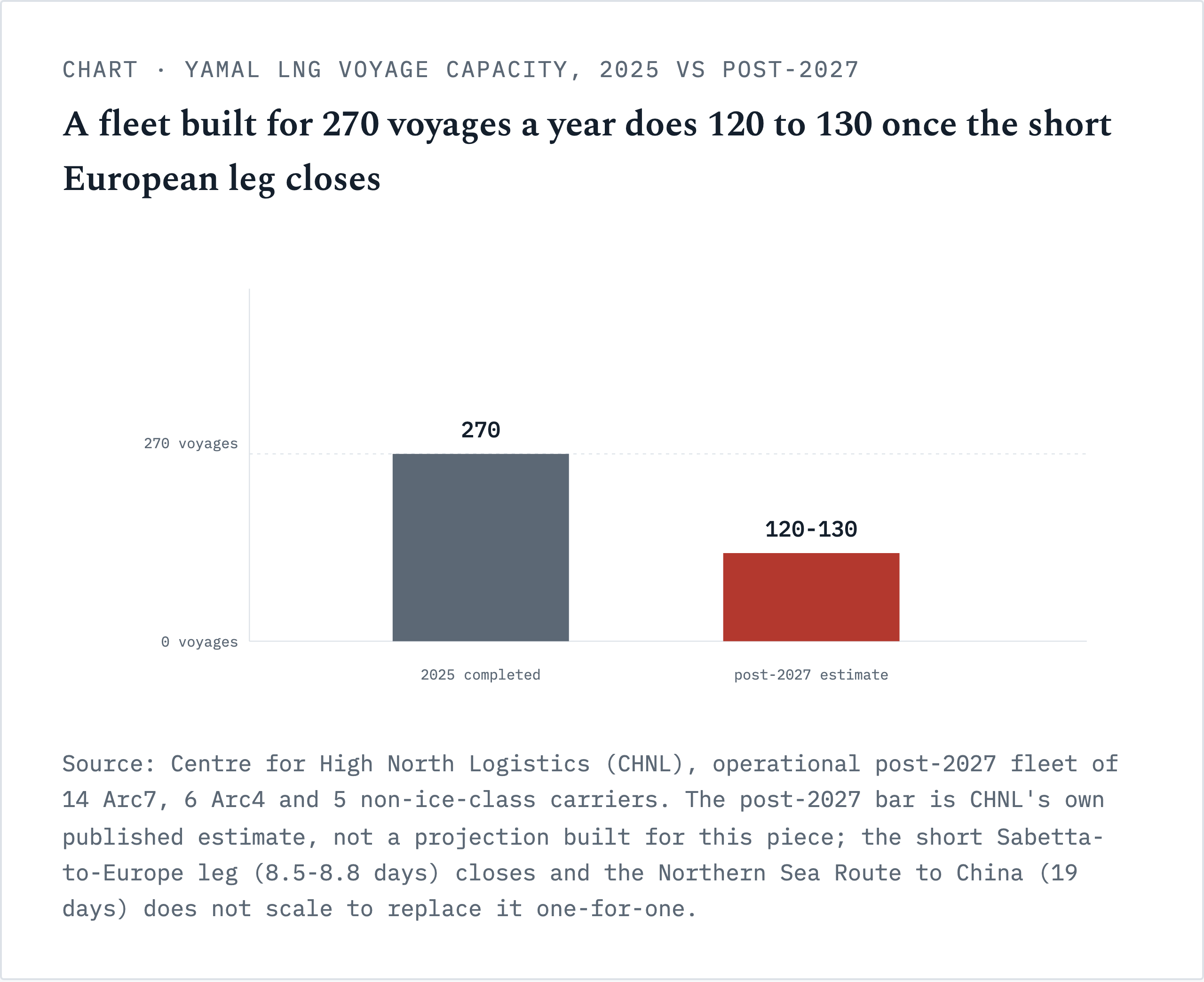
Two things follow from a fleet that can do half its current voyage count. Volume doesn’t survive intact. It roughly halves, unless new tonnage arrives faster than anyone currently expects. The plant behind it isn’t distressed: nameplate is 17.4 million tonnes a year, and CHNL’s own 2024 read puts actual exports at roughly 21 million tonnes across 287 loadings, comfortably above design. I’m confident the liquefaction survives 2027 intact, and on the current legal reading, so does most of the legacy carriage. What actually breaks is the number of round trips a fixed, purpose-built fleet can physically complete once the short leg to Europe closes.
TotalEnergies’ own numbers tell me where the redirected cargo can actually go, and China’s sanctioned berths are only part of the picture. Of the 5 million tonnes a year TotalEnergies lifts from Yamal, Pouyanné has said publicly that 2 million tonnes go to Europe, 2 million to Asia, and 1 million is destination-unrestricted. He’s named Turkey and India as the obvious homes for anything the EU stops taking (OilPrice). That matters because Yamal, unlike the project I turn to next, has never been designated by OFAC. Its cargoes aren’t pariah molecules confined to a handful of quarantined berths. They can discharge at any conventional LNG terminal willing to take them: Turkey, India, Japan, Korea, an unsanctioned Chinese port.
I’d flag one thing CHNL’s capacity study doesn’t separate out, because I can’t find a published voyage time for it either. Turkey sits on the Mediterranean, reached by the same conventional route as Europe, out past Norway rather than through the Arctic. It isn’t an Asia-bound cargo in the sense CHNL is modelling, and I have no source pinning down how many days that run actually takes. So the halving estimate is a ceiling on the capacity constraint, not a fixed number: however much of the European-displaced tonnage lands in Turkey rather than routing through the Northern Sea Route to China, the real capacity cut is smaller than 50%. I read the redirection problem as a shipping-capacity problem, not a berth-access problem, but I’d size that capacity problem as “up to half,” not “half.”
