


Prediction markets reached $2 billion in weekly volume by late October 2025. Academic research documented $39.59 million in arbitrage profits extracted between April 2024 and April 2025 — a direct analog to early crypto exchange arbitrage before institutional capital professionalized market structure.
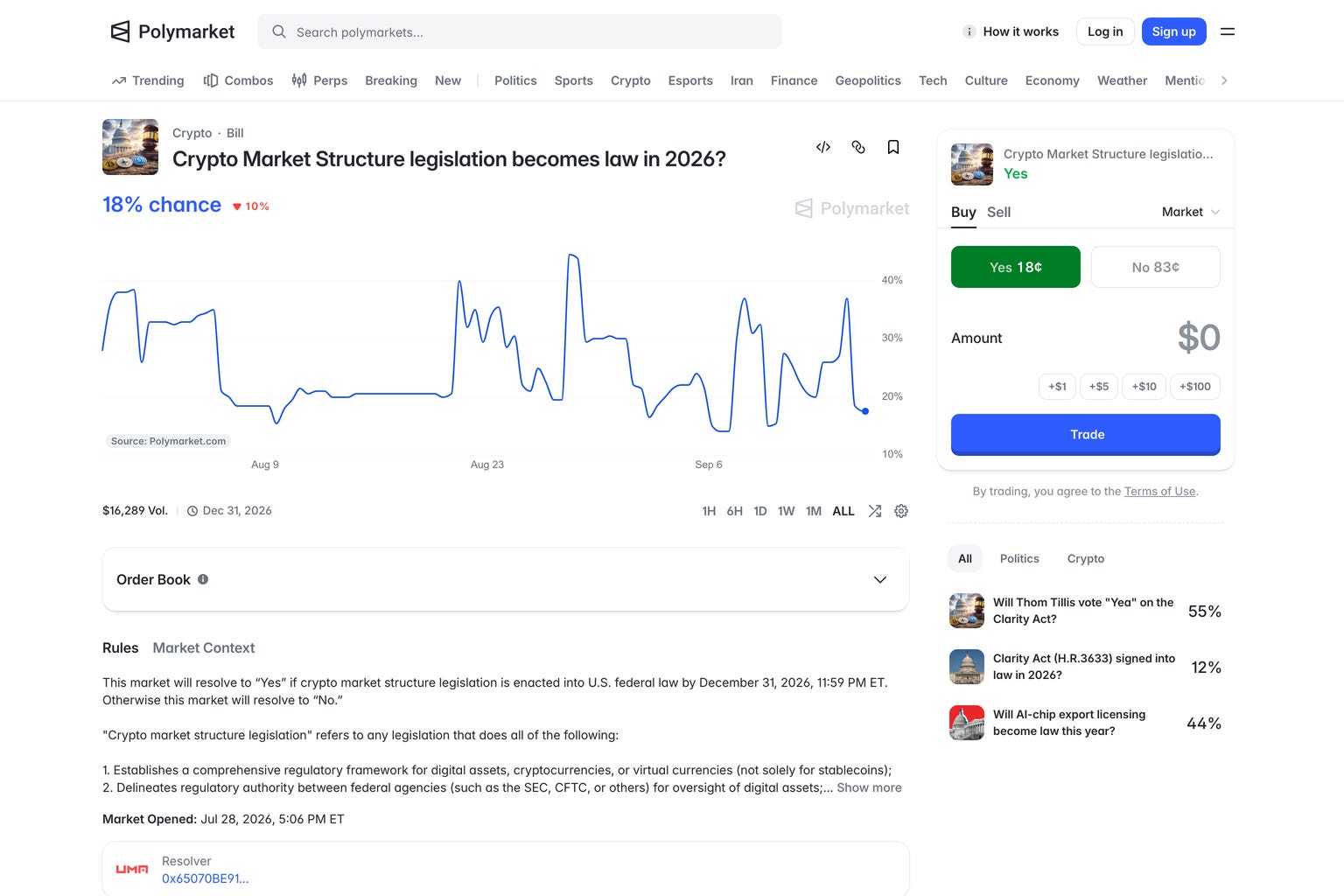
Market Structure
Intercontinental Exchange invested $2 billion in Polymarket at an $8 billion pre-money valuation in October 2025, bringing institutional capital to crypto-native prediction markets. Kalshi processed $500+ million weekly volume with $189 million open interest during the week of September 11–17, 2025, capturing 62% market share in that period. Despite billion-dollar valuations and institutional backing, these venues exhibit chronic structural inefficiencies.
Cross-platform fragmentation. Identical events trade at materially different implied probabilities. Snapshot examples show spreads exceeding 10 cents persisting for hours — Bitcoin Reserve markets showed 51% on Polymarket versus 37% on Kalshi in documented instances, creating 14-cent arbitrage opportunities.
Single-market inefficiencies. IMDEA Networks Institute researchers analyzed 86 million bets across 17,200 conditions and found 7,051 conditions with exploitable Yes + No price deviations from $1.00. The paper finds the median sum-price of YES+NO is approximately $0.60, which implies a median profit of approximately $0.40 per $1; the average maximum single-opportunity across topics is also about $0.40 on the dollar.
Resolution oracle divergence. Polymarket uses UMA’s Optimistic Oracle with governance-vote resolution; Kalshi operates under CFTC-regulated settlement mechanisms. Different resolution criteria create execution risk — positions hedged across platforms face oracle-mismatch exposure that can destroy seemingly risk-free arbitrage.
Trade Execution
The academic study identified two primary arbitrage structures:
Market Rebalancing Arbitrage. When Yes ($0.55) + No ($0.40) < $1.00, buy both positions and realize $0.05 profit at resolution. Single-condition arbitrage generated $10.58 million in extracted profits: $5.90 million from buying below $1.00, $4.68 million from selling above $1.00.
Combinatorial Arbitrage. Build hedged positions across logically dependent markets. LLM-based semantic analysis detected dependencies among 305 markets, identifying 13 logically dependent pairs during the 2024 U.S. election cycle. Only 5 dependent pairs showed realized extraction (the listed pair amounts sum to approximately $95,157) — cross-market opportunities were significantly rarer than single-market inefficiencies.
Top 3 arbitrageur addresses executed 10,558 bets generating $4.38 million profit, displaying algorithmic execution frequency. Most trades yielded 1–5% returns. Extreme outliers existed: one trader converted $0.02 into $58,983 exploiting a severe mispricing where both Yes/No tokens traded below $0.02.
P&L Mechanics
Total extracted arbitrage across all strategies: $39,587,585 over the April 2024–April 2025 measurement period.
Politics markets contributed the largest absolute profits. Polymarket recorded over $3.7 billion in total trading volume during the 2024 U.S. election cycle. Sports markets exhibited higher opportunity frequency but lower per-trade profit margins.
Top arbitrageur generated $2.01 million across 4,049 transactions. Top 10 accounts collectively extracted $8.18 million, accounting for 21% of total arbitrage profits.
Execution constraints bind capital deployment. Most conditions offered limited absolute profit even at maximum available liquidity. Deploying serious capital requires monitoring hundreds of markets simultaneously, accepting small per-trade margins, and scaling through execution frequency. Non-atomic orderbook execution introduces leg risk — one position may fill while the hedge fails.
Transaction costs matter. Polymarket operates on Polygon with gas fees. Cross-platform arbitrage requires liquidity on multiple venues plus withdrawal/deposit latency. Platform fee structures (where they exist) further compress net returns.
Quant Insight
Order book depth analysis revealed absence of sophisticated market-making infrastructure. Traditional crypto market makers would eliminate most observed mispricings within seconds. The persistence of 40-cent deviations from fair value indicates retail-dominated flow without institutional MM capital.
Arbitrage opportunities clustered during volatility events: polling releases, debate nights, economic data prints. Price discovery lagged real-world information by minutes to hours — standard latency arbitrage dynamics apply.
The parallel to 2016 crypto markets is structural: fragmented exchanges, retail-dominated orderbooks, primitive APIs, information asymmetry. Early crypto quants generated 1,000%+ returns before institutions professionalized market structure. Prediction markets are replicating this evolution.
Risk Factors
Resolution risk is non-zero. UMA governance relies on token-holder voting for disputed outcomes. Documented governance attacks exist: March 2025 incidents involved concentrated voting power forcing favorable settlements on multi-million-dollar markets. Oracle manipulation is a real P&L exposure.
Regulatory risk persists. Massachusetts sued Kalshi in September 2025 for allegedly operating unlicensed sports betting. Polymarket settled with CFTC in 2022 for unregistered activity and restructured operations. Regulatory action can freeze positions or force platform exits.
Competition intensifies. As arbitrageurs deploy specialized strategies similar to DeFi AMM bots, mispricings compress. The academic study characterizes arbitrage as “generally positive-sum MEV that promotes price alignment” — meaning the opportunity self-destructs as markets mature. Early-stage inefficiency windows close quickly once capital and sophistication arrive.
Actionable Takeaway
Prediction markets are mispriced binary derivatives trading in fragmented venues without institutional market-making infrastructure. The opportunity exists because:
Retail-dominated orderbooks lack sophisticated arbitrage mechanisms
Cross-platform liquidity fragmentation prevents price convergence
Resolution oracle divergence creates fundamental hedge risk
Volatility clustering around news creates predictable mispricing windows
For quants, the trade is pure market microstructure — not outcome forecasting. Buy when Yes + No < $1.00. Execute cross-platform arbitrage when spreads exceed transaction costs. Deploy automated monitoring across hundreds of markets. Accept small per-trade margins; scale through frequency.
The window is compressing. ICE’s $2 billion investment signals institutional interest. Kalshi’s $500+ million weekly volume and Polymarket’s $8 billion valuation demonstrate market maturation. As capital and execution sophistication increase, spreads will compress — replicating crypto’s evolution from retail arbitrage playground to institutional derivatives market.
The documented $40 million extraction over 12 months occurred during peak retail participation (2024 U.S. election cycle). Future arbitrage returns will likely require faster execution, larger capital deployment, and more sophisticated cross-venue hedging as market structure professionalizes.
Sources
Saguillo, O., Ghafouri, V., Kiffer, L., & Suarez-Tangil, G. (2025). “Unravelling the Probabilistic Forest: Arbitrage in Prediction Markets.” arXiv:2508.03474. https://arxiv.org/abs/2508.03474
Intercontinental Exchange. (2025, October 7). “ICE Announces Strategic Investment in Polymarket.” IR Release. https://ir.theice.com/press/news-details/2025/ICE-Announces-Strategic-Investment-in-Polymarket/
Yahoo Finance. (2025, October 21). “Prediction Markets Hit All-Time High of $2 Billion in Weekly Volume.” https://finance.yahoo.com/news/prediction-markets-hit-time-high-200142742.html
Rodriguez, F. (2025, September 20). “Kalshi Outpaces Polymarket in Prediction Market Volume Amid Surge in U.S. Trading.” CoinDesk. https://www.coindesk.com/markets/2025/09/20/kalshi-outpaces-polymarket-in-prediction-market-volume
Financial Times. (2025, October 7). “NYSE parent to invest up to $2bn in prediction platform Polymarket.” https://www.ft.com/content/9437b5b5-59c0-44a3-8b25-58b3b4aa1b0c
Reuters. (2025, September 12). “Massachusetts accuses Kalshi of running illegal sports wagering operation.” https://www.reuters.com/world/massachusetts-accuses-kalshi-running-illegal-sports-wagering-operation-2025-09-12/
Yahoo Finance. (2025, March 27). “Polymarket Suffers UMA Governance Attack After Rogue Vote.” https://finance.yahoo.com/news/polymarket-suffers-uma-governance-attack-101646076.html
Cover: polymarket.com, screenshot taken 15 September 2026.