


A Google software engineer made $1.2 million on Polymarket in seven weeks by trading on an internal marketing publication he previewed through a confidential company tool. A Special Forces master sergeant converted $33,000 in seven days of bets into $409,000 in profits by trading on a classified operation he was helping to plan. Both made the same tactical error: they assumed a blockchain venue’s pseudonymous wallet structure provided cover. Both were wrong. For a sophisticated desk, the interesting question is not about the defendants. It is about why these payoffs are so large in the first place, and whether the structural conditions that made insider trading so profitable also create legitimate, scalable edge.
The academic record now answers that precisely. The answer is yes, but the mechanisms are narrower than the headlines suggest.
🎬 Prefer to watch rather than read? A NotebookLM-generated video overview of this article is available here: Watch the video overview → Full analysis, citations, and data remain in the article below.
The full mechanism breakdown — infrastructure cost rankings for each of the three edges, the rebalancing arbitrage carried through to a verified net profit number, the three failure modes, and the precise misappropriation test SDNY applies — is in the extended note on Patreon.
The Statistical Portrait: An Informed Minority Runs the Market
The most important piece of research on prediction market alpha is a working paper by Roberto Gómez-Cram, Yunhan Guo, and Howard Kung of London Business School and Theis Ingerslev Jensen of Yale, published to SSRN on April 20, 2026 and revised April 25. The authors analyzed every Polymarket transaction from 2023 through 2025: 1.72 million accounts, 210,322 markets, approximately $13.76 billion in trading volume. They used a sign-randomization test, flipping each trader’s trade sign thousands of times to distinguish persistent directional skill from luck variance.
The result: 3.14% of accounts qualify as “skilled winners.” These roughly 54,000 accounts consistently positioned in the direction of final outcomes, carried that classification to out-of-sample markets at 44% persistence, compared to just 10% for skilled mutual funds, and traded across an average of 79 markets each. Together with market makers, they captured more than 30% of all platform gains while comprising under 3.5% of accounts. The remaining 96% either broke even by luck or lost money, effectively financing the informed minority.
The quantitative implication: a one-percentage-point increase in skilled-trader net buying corresponded to an 8 basis point increase in the probability of the correct final outcome. Skilled order flow is a leading indicator of both the next-period price move and the final resolution. The researchers separately flagged 1,950 accounts that met their timing and conviction criteria for suspected insider trading, including three accounts that took positions on the Maduro contract hours before Operation Absolute Resolve, collectively clearing more than $630,000. The DOJ criminal indictment of Van Dyke was unsealed three days after the paper’s original publication date.
Layer 1: The Structural Arbitrage That Requires No Prediction
Gómez-Cram et al. establish who wins and why. A separate paper by Saguillo, Ghafouri, Kiffer, and Suarez-Tangil at IMDEA Networks and the Oxford Internet Institute establishes how much systematic mispricing exists independently of any information edge.
Their paper, “Unravelling the Probabilistic Forest: Arbitrage in Prediction Markets,” presented at the 7th Conference on Advances in Financial Technologies (AFT 2025), analyzed 86 million bets across 17,218 Polymarket conditions using on-chain historical order book data covering April 2024 to April 2025. They found two distinct arbitrage forms.
Market Rebalancing Arbitrage (intra-market): Polymarket guarantees that the prices of all outcomes in a condition must sum to $1.00 because exactly one outcome resolves true and pays $1.00. When the combined cost of YES and NO dips below $1.00, a trader buying both sides locks in guaranteed profit regardless of resolution. The realized profit formula is:
Net Profit = (1 - Price_YES - Price_NO) - (Taker Fees + Network Gas)
Any net percentage below approximately 2% is consumed by Polygon gas and platform fees, making execution infrastructure the primary bottleneck, not identification of the opportunity.
Combinatorial Arbitrage (inter-market): Prediction markets with a logical dependency, for example “Team A wins by 2+ goals” implies “Team A wins,” create constraints on the joint state space. When markets price these correlated outcomes inconsistently, buying the logically implied position against the overpriced one generates profit. Saguillo et al. address the identification problem via a heuristic reduction from a naïve O(2^{n+m}) comparison space using topical similarity and combinatorial relationships.
The realized profit estimate across both types: approximately $40 million extracted from Polymarket across the one-year measurement period. The advantage was execution speed rather than predictive accuracy. On Polymarket’s Polygon network, effective execution requires bypassing the web UI entirely via the py-clob-client API and managing gas priority to front-run competing bots in the mempool. 14 of the 20 most profitable wallets on Polymarket’s public leaderboard are estimated to be bots. The structural alpha game is already algorithmic. Funds expecting edge without bespoke infrastructure will be on the losing side of these same mispricings.
Layer 2: Market Making as Delta-Neutral Options Replaying
Susquehanna Government Products, LLLP, a market-making affiliate of Susquehanna International Group, became the first dedicated institutional market maker on Kalshi on April 3, 2024, per the official Business Wire announcement. Kalshi CEO Tarek Mansour described the move as unlocking “institutional grade liquidity” that “changes everything.” The strategic logic is identical to Susquehanna’s options business: post continuous two-sided quotes, remain delta-neutral to event outcomes, extract the bid-ask spread per resolved contract. SIG, which traded more than $1.5 trillion in ETFs globally on an annual basis as of 2018, according to public records, and which Kalshi’s own announcement states trades approximately $2 trillion yearly, set up a dedicated trading division for event contracts, the first time a first-tier Wall Street market maker committed entirely to prediction markets.
By February 2026, Bloomberg reported that Jump Trading, which had assembled a team of approximately 20 traders dedicated to event contracts, agreed to receive equity stakes in both Kalshi and Polymarket in exchange for providing liquidity. The Kalshi deal grants a fixed equity stake while the Polymarket stake scales with the volume of trading capacity Jump provides to the platform’s U.S. operation. This is not a speculative bet. It is the proprietary trading firm’s standard playbook: take equity exposure in the exchange infrastructure you are making liquid, aligning incentives for platform volume growth with returns from liquidity provision.
In March 2026, BitGo Prime and Susquehanna Crypto launched an institutional OTC offering giving eligible hedge funds, family offices, and ultra-high-net-worth clients access to listed prediction markets using crypto or stablecoin collateral already held on BitGo’s platform. Susquehanna Crypto CEO Chase Lax called prediction markets “a genuine institutional asset class” in the official announcement.
Per the Reuters report from May 27, 2026, AQR Capital Management, Susquehanna, and OKX had all recently advertised specialist prediction market trader roles, with AQR declining to comment and Susquehanna and OKX not responding. Kalshi’s annualized trading volumes had more than tripled over the prior six months to $178 billion, with institutional trading volumes growing 800% over the same period according to the company’s head of institutional business, Andy Ross, as quoted to Reuters.
Layer 3: Cross-Asset Signals and Discrete Outcome Hedging
The core distinction between prediction market instruments and conventional derivatives is precise: options hedge price risk (how far something moves), while event contracts hedge outcome risk (whether something happens at all). They are not substitutes but complementary layers of the factor stack, addressing a risk dimension that derivatives cannot isolate directly.
Three execution-level applications are documented in institutional practice:
Cross-asset calibration: Prediction market odds for FOMC decisions, CPI prints, or nonfarm payrolls can be compared against implied probabilities extracted from Fed funds futures or rates options. Discrepancies between the two can inform position sizing around discrete events. A macro fund long duration ahead of a Fed meeting can use the Kalshi FOMC contract as a second source on market-implied probability, particularly when options skew may be distorted by hedging flows from other participants.
Event-driven pairs: A desk trading semiconductor equities can take a position on relative regulatory outcomes and delta-hedge against the correlated equity basket, isolating the regulatory risk factor in a way not achievable with conventional instruments.
Structured product packaging: In April 2026, Marex Group issued the world’s first bond-like note linked to a prediction market outcome, per Bloomberg. The $10 million issuance, sold to a Swiss institutional client and restricted to non-U.S. jurisdictions due to regulatory constraints, pays a 7% coupon if Nvidia remains the world’s largest company by market cap in one year and returns principal otherwise. Marex hedges its exposure by taking positions directly on Kalshi as odds shift, capturing the spread between the coupon offered to investors and the cost of hedging. Marex Solutions CEO Nilesh Jethwa stated the firm will “effectively build our own prediction market structured products, and then leverage Kalshi and other exchanges to replicate that”. Robert Romano, head of structured products Americas at TP ICAP, called it a potential first of many.
Separately, Tradeweb Markets took a minority stake in Kalshi to embed prediction markets into its institutional client workflows, and Clear Street partnered with Kalshi to give hedge funds direct access to event contracts.
The Surveillance Layer: Academic Detection Is Already Formalized
Three methodologically distinct approaches to identifying informed trading appeared in April-May 2026, as documented in the comparative paper “Per-Market Information Leakage and Order-Flow Skill: Two Methodological Lenses on Informed Trading in Decentralized Prediction Markets.”
The first is the Mitts-Ofir screen, from the paper “From Iran to Taylor Swift: Informed Trading in Prediction Markets“ by Joshua Mitts of Columbia Law School and Moran Ofir of the University of Haifa, published to SSRN in March 2026. Their composite screen, combining bet size anomalies, profitability, pre-event timing, and directional concentration, analyzed more than 210,000 suspicious wallet-market pairs across Polymarket from February 2024 through February 2026. Flagged traders achieved a 69.9% win rate well in excess of chance, and the authors estimated approximately $143 million in aggregate anomalous profit. The second is the Gómez-Cram sign-randomization classifier, which separately flagged 1,950 accounts as probable insiders via a lifecycle-and-conviction heuristic.
Most technically developed for market-level surveillance is Nechepurenko’s ForesightFlow framework (arXiv:2605.00493), which builds an Information Leakage Score (ILS) for binary event markets. The ILS quantifies the fraction of the terminal information move priced in before the public news event, using a Murphy decomposition connecting the score to the proper scoring rule literature. A critical structural finding: all 24 documented insider cases in the ForesightFlow Insider Cases inventory are “deadline-resolved” contracts, not news-resolved ones. The companion paper (arXiv:2605.02286) extends the framework to this class specifically, fitting exponential hazard baselines for military-geopolitics markets with a half-life of 2.9 days (KS p = 0.426), and applying them to the 2026 Iran conflict cluster.
The implication for compliance: the Mitts-Ofir dataset, the FFIC inventory, and the detection methodologies are public and citable. A regulator or sophisticated platform can now run near-real-time scoring against live order books.
The Legal Mechanism, Precisely Stated
The criminal charges against Spagnuolo and Van Dyke run on a three-element theory clearly articulated in Norton Rose Fulbright’s post-Spagnuolo analysis and the Sidley Austin analysis of the Van Dyke case: CEA Section 6(c)(1) and CFTC Rule 180.1 are modeled directly on Securities Exchange Act Section 10(b) and SEC Rule 10b-5. Because event contracts are swaps under CFTC jurisdiction, these provisions apply to prediction markets without ambiguity.
The applicable doctrine is the misappropriation theory. Per Norton Rose Fulbright’s analysis, liability attaches when an individual: (i) possesses material nonpublic information; (ii) misappropriates that information by trading on it in breach of a duty of trust and confidence owed to the source; and (iii) acts with scienter. The DOJ identifies Spagnuolo as “a software engineer at Google” in its official press release; the charge holds because the misappropriation theory does not require that the information relate to an “issuer” in the conventional securities law sense. The CFTC’s February 25, 2026 enforcement advisory confirmed this framework explicitly, and CFTC Division of Enforcement Director David Miller stated at NYU Law on March 31, 2026 that “those who hold MNPI are often subject to a web of legal and confidentiality obligations... chances are that trading on information you learn from work” crosses the line.
The money laundering counts in the Spagnuolo case are triggered by his post-settlement crypto mechanics. Per the criminal complaint as reported by BleepingComputer, on or about December 10, 2025, the AlphaRaccoon Polymarket account sent approximately 5.045 million USDC.e, representing the full account balance including the original stake and not only the $1.2M profit, to an external wallet. Blockchain data then showed subsequent transactions with a decentralized swapping service and a cryptocurrency privacy service designed to remove wallet addresses from the blockchain, before funds reached an Italian payment processor account opened with Spagnuolo’s government ID. Maximum exposure: 10 years on the commodities count and 20 years each on wire fraud and money laundering, per the DOJ press release.
The New Surface: Private-Company Contracts Expand the MNPI Population by Orders of Magnitude
Polymarket’s May 19, 2026 launch of prediction markets on private-company valuations, in partnership with Nasdaq Private Market as the exclusive resolution data provider, expands the insider-trading surface structurally. Contracts now price whether OpenAI exceeds a $1 trillion valuation by end-2026, whether Anthropic crosses $500 billion, and IPO timing for SpaceX, Stripe, Databricks, Anduril, and Kraken. Polymarket, which has done nearly $39 billion in U.S. volume in 2026 year-to-date, is explicitly positioning these as a real-time pricing signal for institutional investors.
The MNPI population for a Google Year in Search contract was the small team that produced one internal report. The MNPI population for a private-company valuation contract is everyone who touches the secondary transaction pricing, the term sheet, the resolution methodology at Nasdaq Private Market, the law firms papering the funding round, and the investors who see the cap table. Amanda Fischer, a financial policy expert at Better Markets and formerly chief of staff to SEC Chair Gary Gensler, put the concern bluntly on X: “Why is Nasdaq partnering with an offshore war gambling website to offer betting on illiquid, hard to value private companies?” Under the misappropriation theory applied by SDNY and the CFTC, an analyst who sees a secondary price print on a portfolio company and takes a position in the corresponding valuation contract has the same exposure as Spagnuolo.
What a Desk Should Actually Do With This
The alpha in prediction markets is real, academically documented, and concentrated in three mechanisms: structural arbitrage (Saguillo et al.’s $40M extracted from pure mispricing in one year), market-making spread capture (Susquehanna’s model, now extended by Jump), and cross-asset signal use and structured product packaging (Marex’s Nvidia note as the first executed proof of concept). None of these three require MNPI. All three are execution-intensive and currently capacity-constrained.
The academic surveillance infrastructure, including Mitts-Ofir’s $143 million anomalous-profit estimate across 210,000 wallet-market pairs, ForesightFlow’s open-source ILS scoring, and the Gómez-Cram sign-randomization classifier, means behavioral detection of informed trading is moving toward near-real-time flagging. The on-chain ledger has always been transparent. The detection methodology is now catching up to what that transparency makes possible.
The synthesis: the wallet-level per-trade signature is permanently visible on a public ledger, the academic detection is now formalized at more than 60 standard deviations of statistical significance, and two federal prosecutions in two months have made the enforcement priority clear. The legitimate edge is real but execution-constrained and narrow. The felony, per every DOJ and CFTC filing in the documented record, is visible from the moment the position is placed.
The Patreon note carries these three edges through their exact infrastructure cost rankings, works the rebalancing arbitrage to a verified net number with gas and capacity constraints accounted for, states the three failure modes precisely, and incorporates the peer-review critique of the exchange-reported volume figures that the overview above does not fully address.
📊 Want Deeper Quantitative Analysis?
This research took a very long time of data collection, verification, and analysis. If you found value in this deep-dive, I publish exclusive quantitative research, trading strategies, and institutional-grade analysis on Patreon.
By joining, you’ll be supporting my work and motivating me to publish more content like this.
→ Join the Patreon community here
Follow the research: YouTube — The Mathematical Trader · LinkedIn · Patreon
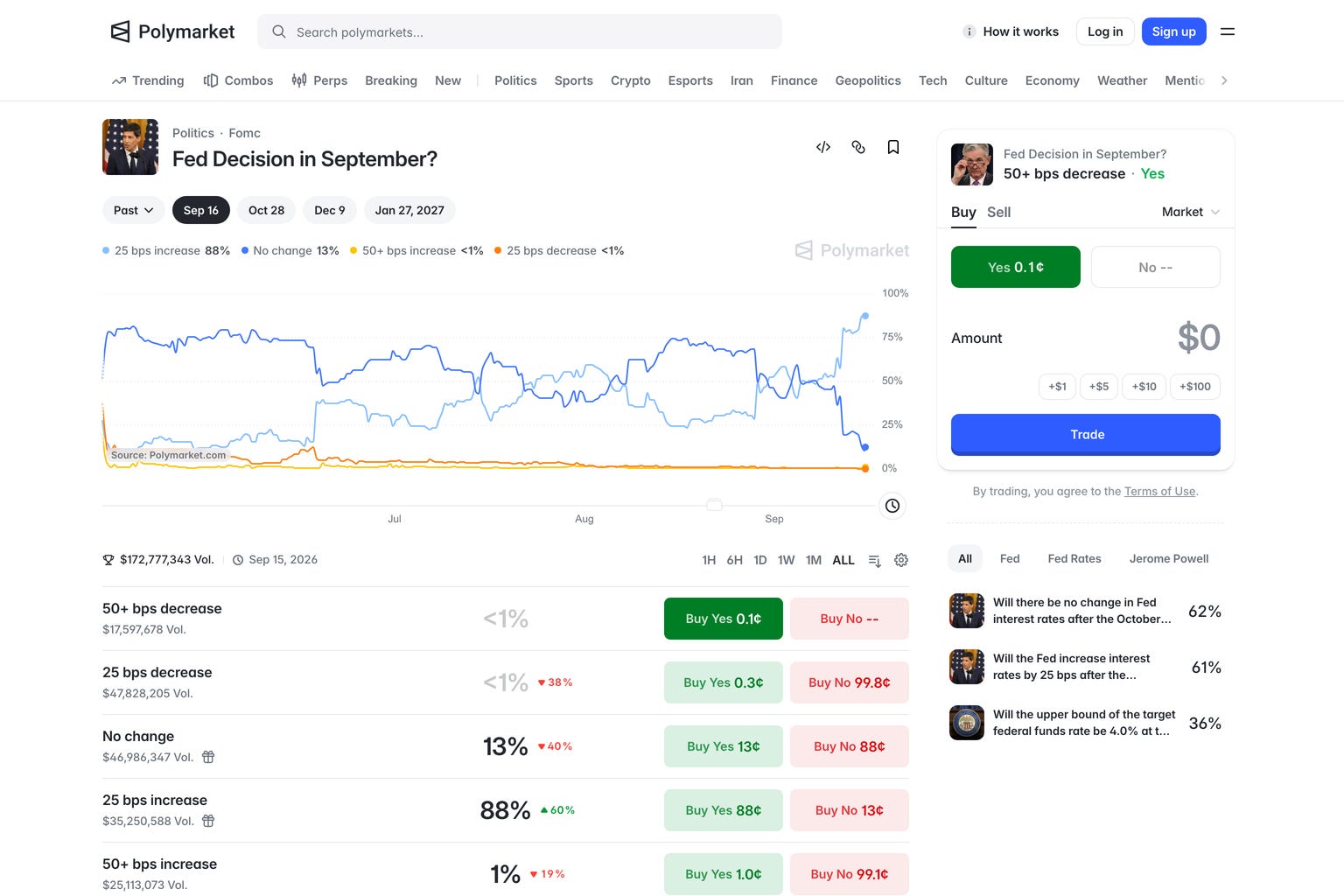
Cover: polymarket.com, screenshot taken 15 September 2026.