

Pershing Square Holdings put $1 billion of preferred into Howard Hughes’ $2.1 billion Vantage acquisition. On the certificate, that money is a seven-year call Howard Hughes holds against Ackman’s own fund, struck at the greater of 4% accreted or 1.5 times tangible book, first window March 1 to March 31, 2027. The first 27 days under Howard Hughes lost $36.0 million on the new equity book.
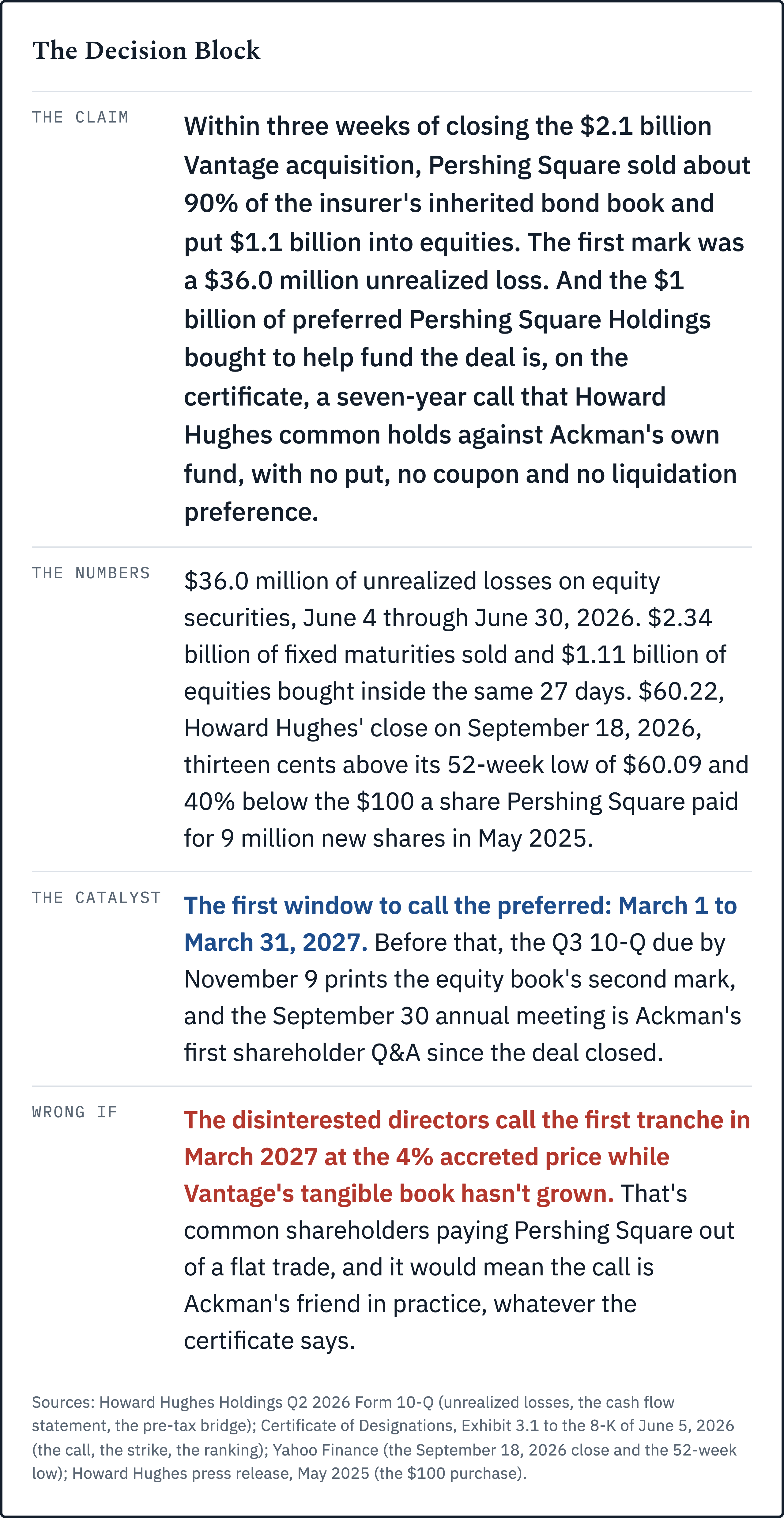
My read, after the Certificate of Designations, the 10-Q, the proxy and both rating agencies’ releases: the structure is friendlier to Howard Hughes shareholders than the coverage says, and the first month was worse than the headline numbers say. Pricing Howard Hughes at $60 means deciding which of those compounds.
Why the market reads the $1 billion as Ackman backing his own deal
Because the money is Ackman’s and the framing was set on day one. Howard Hughes bought Vantage, a Bermuda specialty insurer and reinsurer, for about $2.1 billion in cash from Carlyle and Hellman & Friedman, at 1.5 times estimated year-end 2025 book value. The deal closed June 4, 2026. Pershing Square Holdings, the London-listed fund Ackman runs, bought $1.0 billion of a new Series A preferred to help pay for it, and the day-one release carried the repurchase formula in full: the greater of the issue price plus 4% a year, or 1.5 times Vantage’s book value, in 14 tranches over seven years.
That’s how it was framed from the start: “Inside His $1B Bet” at Yahoo Finance, and Pershing Square Holdings “puts up £750m” for “Ackman’s bid to forge new Berkshire Hathaway” at QuotedData. The one crack sat inside the QuotedData piece: Winterflood called the terms “friendly but not unprofitable” from the Pershing Square Holdings side, a broker saying the friendliness runs toward Howard Hughes. AM Best, on June 16, removed Vantage from under review with developing implications, affirmed the A- rating and assigned a positive outlook. The Berkshire comparison rests on all of it.
I’d give the believers that much. Where I part company is the money. By one account of the 1967 financing, Buffett funded roughly 30% of the $8.6 million National Indemnity purchase with a 20-year note at 7.5%, senior to common. Ackman funded Vantage with pari passu equity carrying a 4% call strike. On the cost of the money Ackman’s deal is friendlier to common, with one caveat: Buffett’s note retired; an uncalled preferred stays.
What the certificate says the $1 billion actually is
It is a seven-year call that Howard Hughes holds on Pershing Square Holdings’ capital, on the words of the Certificate of Designations filed June 5, 2026.
Section 8(a): in a window 60 to 90 days after each of the first seven fiscal year-ends, from the year ending December 31, 2026, “the Corporation shall have the right to repurchase one or more full Tranches.” The 10-Q calls it “the right, but not the obligation.” That is a call option Howard Hughes holds. Pershing Square Holdings holds no put.
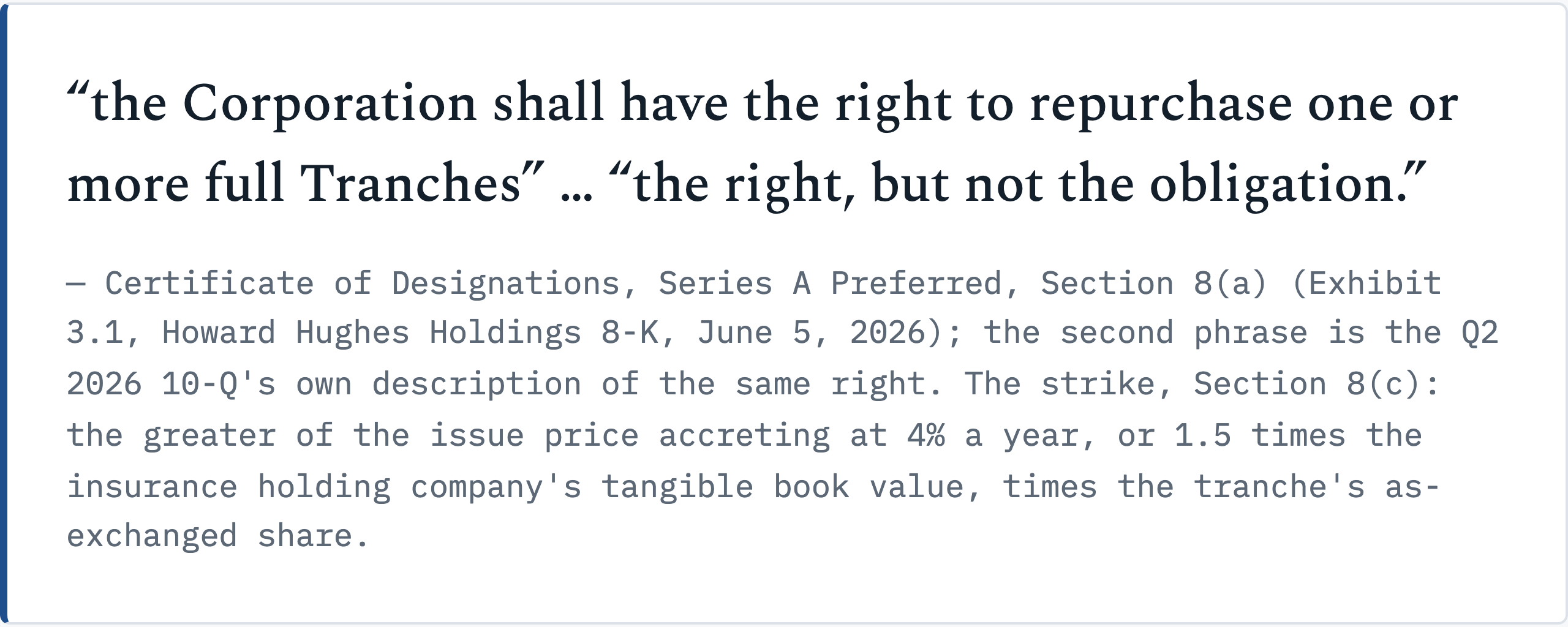
Section 8(c): the price is the greater of the issue price compounding daily at 4% a year, or 1.5 times the book value of the insurance holding company, “excluding non-controlling interests and good will or purchase-related intangibles,” multiplied by the tranche’s as-exchanged ownership share. The book leg is struck on tangible book. Howard Hughes’ own purchase premium is excluded from the strike, and I read that as the most important clause in the document.
Section 4: the preferred ranks “pari passu with all common stock,” on payment rights and on liquidation. The description of securities filed with the August shelf adds that it “carries no liquidation preference.” Dividends are discretionary and non-cumulative, capped at what the insurer actually pays up, and until June 4, 2028 any dividend from the Delaware insurance subsidiaries needs the state regulator’s approval. There is no coupon. If Howard Hughes never calls, Pershing Square Holdings’ exit is an exchange into Vantage equity that opens after fiscal 2032.
I went in expecting the 10% dividend in the same document to be the floor Ackman had written for himself. It isn’t there. Section 7(b) attaches the 10% only to a “Mandatory Repurchase Date,” and Section 9(a) confines those to a change of control, a sale of the insurer, or an uncured breach. Howard Hughes books that feature at zero: “the initial probability of triggering this feature is de minimis,” per the 10-Q. Nothing in the instrument forces a call in any ordinary year.
I make that the opposite of a backstop. A preferred that ranks with common, pays nothing unless the board says so, cannot be put back, and can be bought out at the greater of 4% accreted or 1.5 times tangible book is common-equivalent risk capital with a call sold on top, and the call belongs to Howard Hughes. A committee “comprised solely of independent and disinterested directors” approved it unanimously, per Pershing Square’s own Schedule 13D/A.
The paid half carries the 10-Q’s 27-day loss bridge, the ledger the 1.5 times leg is struck on, the three channels Pershing Square is paid through, and the position with its March 31, 2027 test.
Below the paid line:
The full 27-day loss bridge from the 10-Q: the $38.3 million investment loss, the equity mark inside it, the VOBA charge inside the 95% combined ratio, and the $17.5 million Vantage earned before the investment book
Which leg of the call binds today, computed from the 10-Q’s purchase price allocation, and how far tangible book has to grow before it flips
The three places Pershing Square is actually paid: the $3.75 million quarterly fee and its frozen share count, the 46.7% stake bought at $100 a share, and the equity book itself
The position: Howard Hughes at its 52-week low, with the March 2027 window as the mark, a price stop, and two dated invalidations
