


Nasdaq’s Night Session doesn’t create new overnight liquidity on December 6. It legally clears exchanges to enter a market Blue Ocean ATS already scaled to $382 billion in 2025 volume, at the exact moment none of the arriving venues will be required to avoid trading through a better price sitting on another book.
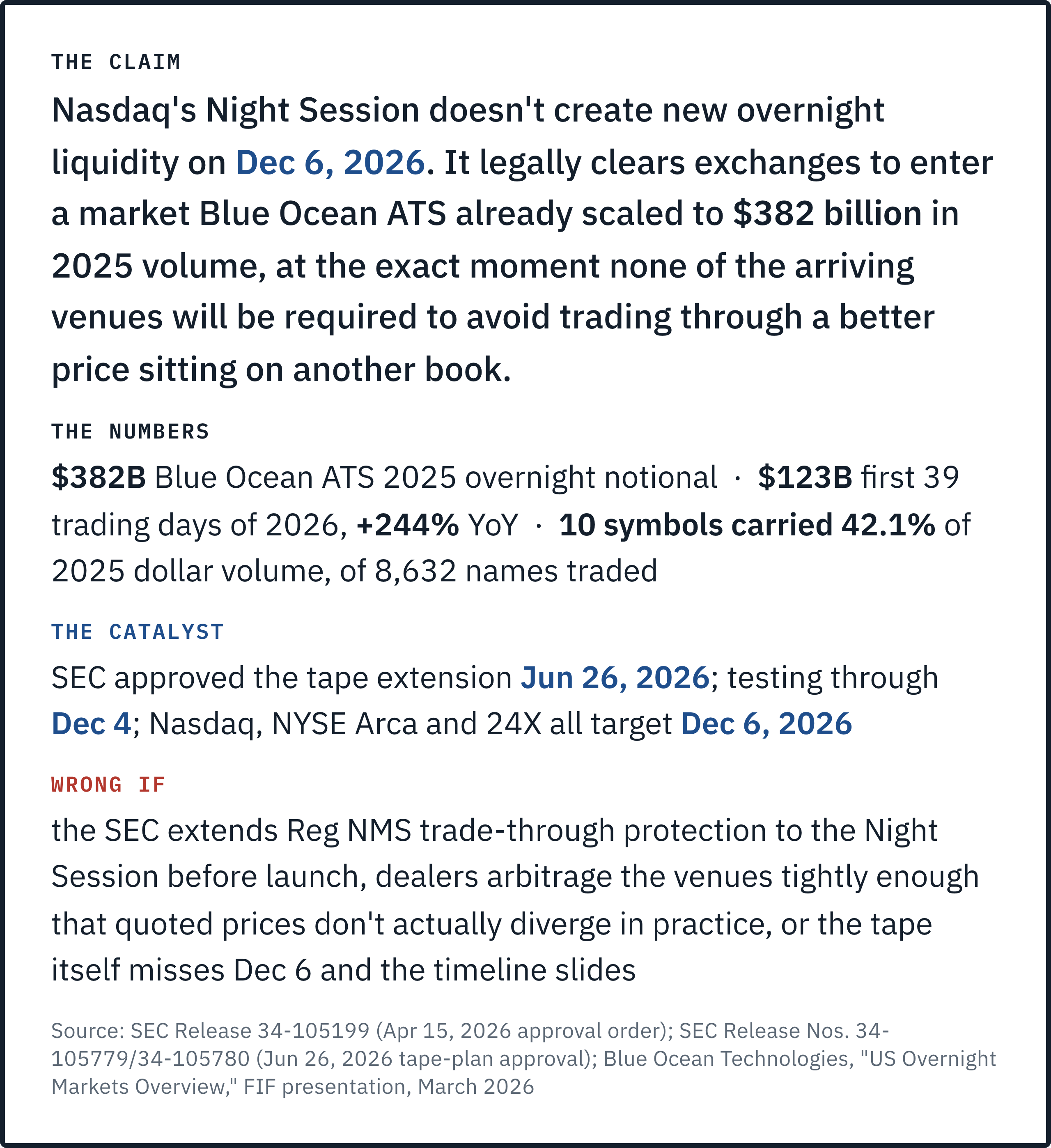
Nasdaq filed to trade U.S. equities 23 hours a day, five days a week. The SEC approved it on an accelerated basis on April 10, 2026. The exchange is targeting December 6 for a 9:00 p.m. to 4:00 a.m. ET “Night Session” that leaves the market closed for exactly one hour a day.Nasdaq Night Session Approval Order, SEC Release 34-105199 I read the filing the way I’d read a prospectus. My eye goes to what it admits, and I mostly ignore what it announces. What it admits is that Nasdaq is not opening a market. It is entering one, five years after somebody else built it, under a rulebook that stops mattering at 4:00 p.m.
I walk through the filing itself, and the arithmetic behind it, on screen in the film version of this piece.
What Nasdaq’s own filing admits
Nasdaq’s case deserves to be stated at its strongest before I depart from it, because it is not a weak case. Investors outside the United States, especially in Asia, want to trade Nasdaq-listed names during their own business hours. Right now they cannot; the exchange is closed. Demand for access around the clock is real, digital asset markets already trade continuously, and Nasdaq wants “to compete for order flow from these investors” and “to position itself favorably in the future to participate in markets that trade digital assets.”SR-Nasdaq-2025-109, original filing The SEC agreed the proposal serves the Exchange Act’s mandate to keep markets free and open. The wire coverage ran the same core frame, nearly 23 hours a day, five days a weekInvesting.com, “Nasdaq plans nearly 23-hour trading day from December”, with one outlet adding the sharper line that the exchange “races to compete with round-the-clock crypto and tokenised markets.”Euronews, “Nasdaq confirms 23-hour trading from December”
I don’t think that frame is wrong so much as it is told from the wrong end of the clock. It reads as though December 6 is when overnight U.S. equity trading begins. It is not. December 6 is when the exchanges are finally let in. Someone else has been running this session since 2021, and their numbers are sitting in a presentation deck that almost nobody covering this story seems to have opened.
Blue Ocean already ran the experiment
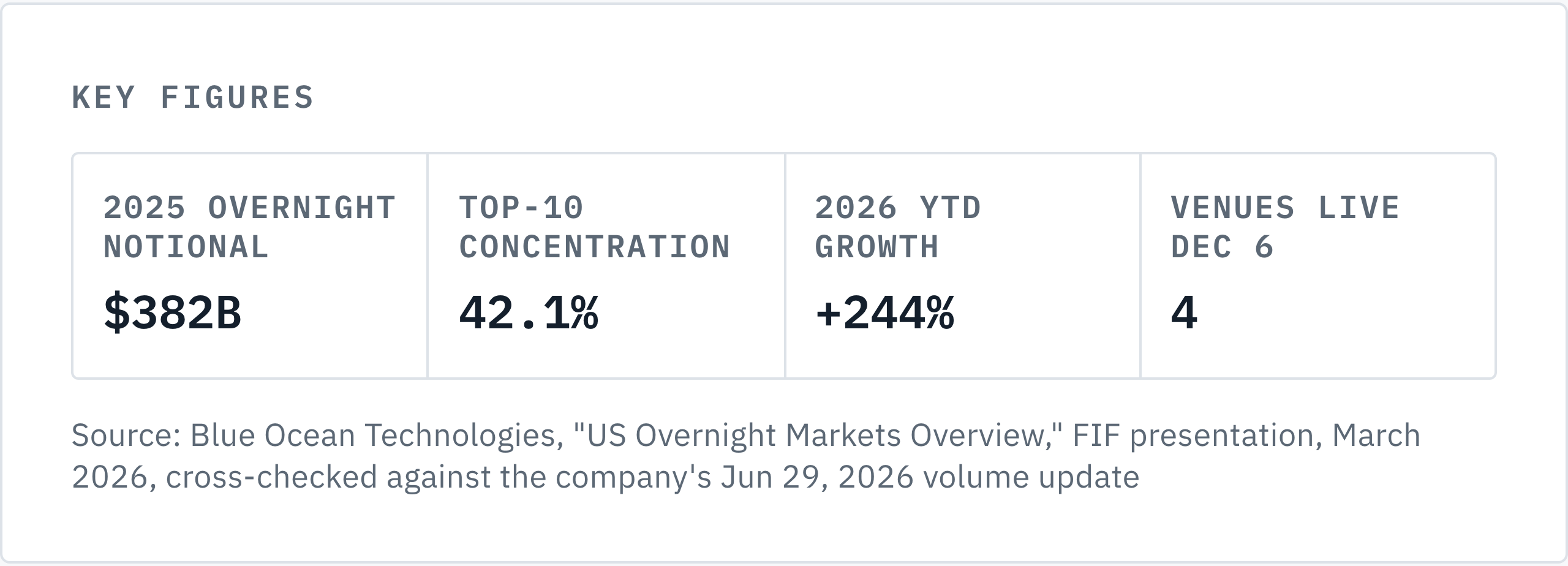
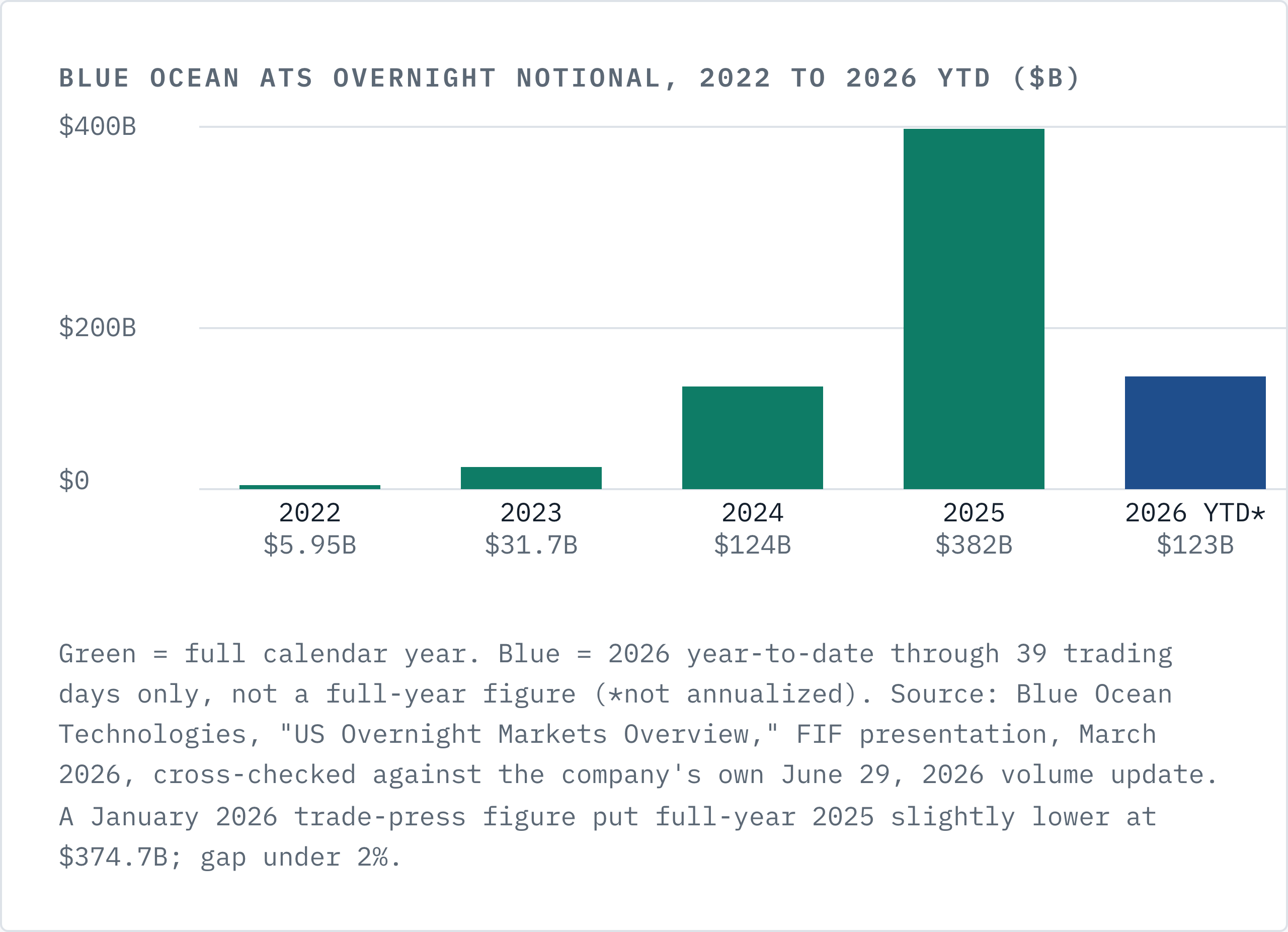
Overnight trading in NMS stocks has been legal since 2021, through alternative trading systems, not exchanges. One operator ran away with it. Blue Ocean ATS, a FINRA member and a subsidiary of Blue Ocean Technologies, has traded U.S. equities from 8:00 p.m. to 4:00 a.m. ET continuously since June 2021.Blue Ocean Technologies, “US Overnight Markets Overview,” presented to the Financial Information Forum, March 2026 I pulled the company’s own published trajectory: $5.95 billion in 2022, $31.7 billion in 2023, $124 billion in 2024, $382 billion in 2025. Roughly 64 times the volume across three years. Through the first 39 trading days of 2026 it’s already cleared $123 billion, 244% ahead of the same stretch a year earlier, by the company’s own count. A January 2026 trade-press figure put the 2025 total slightly lower, at $374.7 billion. I’m using the company’s later, direct disclosure; the gap is under 2%, immaterial to everything that follows.
That scale is real, and the concentration inside it is the part nobody selling the “global access” story mentions. Of the 8,632 distinct symbols that traded on Blue Ocean at some point in 2025, the top ten by notional carried 42.1% of the dollar volume against just 22.8% of the share count. Ten names, about a tenth of one percent of everything that traded, carried 42 cents of every dollar Blue Ocean processed. I did the arithmetic on the two biggest: Tesla alone was $77 billion of that $382 billion, close to a fifth of the whole book from one ticker, and Nvidia was another $58 billion. Add them and two symbols carry more than a third of a $382 billion market. I’ll flag one thing here: Blue Ocean’s own bar chart of its ten biggest names sums to about $271 billion. That doesn’t cleanly reconcile with the same slide’s 42.1%-of-notional figure against the $382 billion annual total. Both numbers come from the identical company presentation, and I can’t referee between them from the outside. Neither figure is invented. I’m using each exactly as the company states it, instead of pretending the arithmetic ties out.
That’s a narrow, recognizable basket, not diversified global demand spread across the S&P 500: mega caps plus leveraged and inverse ETFs like SOXL, TQQQ and SQQQ, trading around the clock because traders in Seoul, Tokyo and Hong Kong want exposure to the same handful of names Americans already trade obsessively.Blue Ocean Technologies, FIF presentation, “2025 Top Symbols and Composition” It’s a real market. It just isn’t the market the press release implies is waiting on Nasdaq.
My read is that this matters for positioning, not just for trivia. Whatever exchange volume shows up on December 6 lands, at least at first, on top of a book that’s already this concentrated, in the same handful of names.
The SEC’s own comment file names the concern plainly. One commenter told the Commission that retail investors “do not have the resources to monitor their portfolios 23 hours a day” and would be put at a disadvantage against institutional firms; another warned that continuous trading could undermine retail investors who are, in the commenter’s words, still “in early stages of developing disciplined risk management practices.”SEC Release 34-105199, public comment summary Leveraged and inverse ETFs already carry 11.8% of Blue Ocean’s overnight notional, and those are precisely the instruments where a retail trader without a stop loss can lose a multiple of the daytime move overnight. Nasdaq’s answer is more disclosure, not fewer hours. Whether disclosure is the right fix for a market that never sleeps is a fair question, and it isn’t one this filing actually answers.
December 6 is a regulatory date, not a demand date
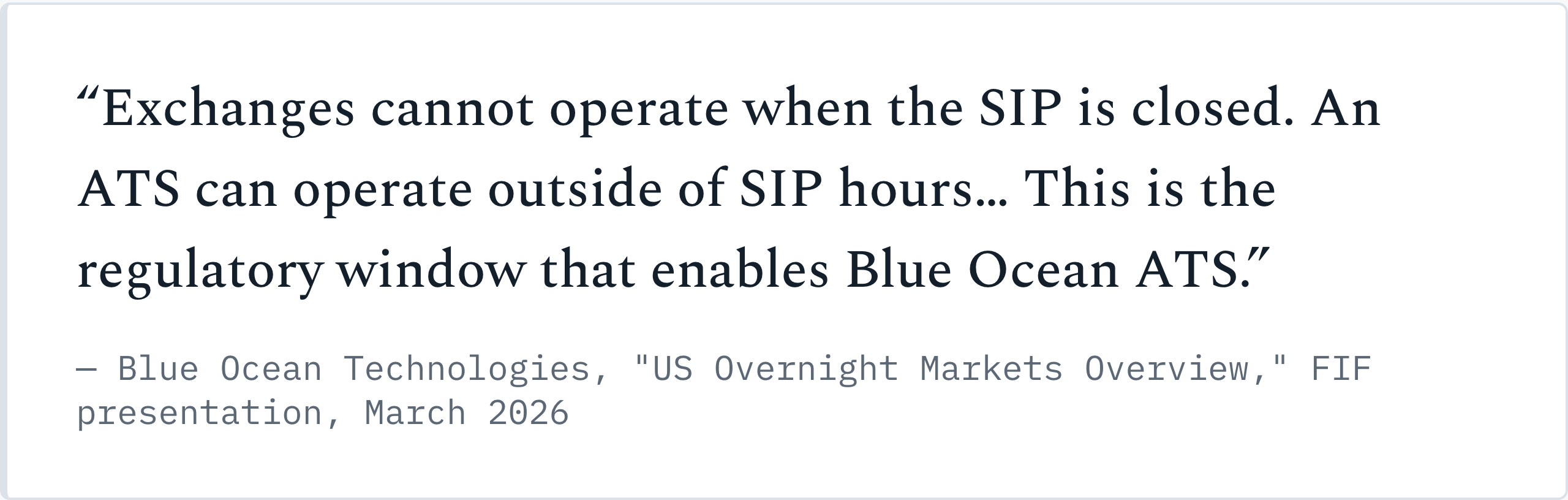
Here’s the mechanism the consensus framing skips. Blue Ocean states it in its own investor materials, with a bluntness I did not expect from a company that benefits from it: “Exchanges cannot operate when the SIP is closed. An ATS can operate outside of SIP hours. Firms may use ATS proprietary data overnight. This is the regulatory window that enables Blue Ocean ATS.”Blue Ocean Technologies, FIF presentation, “Securities Information Processors (SIP)”
The SIP is the consolidated tape: the utility that merges every exchange’s quotes and trades into one public feed and produces the National Best Bid and Offer. Its current hours run 4:00 a.m. to 8:00 p.m. ET. National securities exchanges have to publish to it in real time. ATSs do not. So for five years, the one venue type allowed to trade all night has been the one venue type not required to prove its prices to anyone outside its own subscriber base. Blue Ocean did not discover a loophole; it’s the rule as written, and the company states it on a slide.
In late June 2026, the SEC approved amendments from both the CTA/CQ and UTP tape plans.SEC Release 34-105780 (UTP Plan) and 34-105779 (CTA/CQ Plan), 91 FR 40058 and 40082 Published in the Federal Register July 1, the amendments extend SIP hours to near continuous coverage: Sunday 9:00 p.m. through Friday 8:00 p.m. ET, with a one hour maintenance gap each night. Six industry test weekends run October 2 through December 4. Production launch: December 6. Nasdaq cannot even set its own timeline here. Its own rule requires a further filing confirming the SIP is actually ready before the Night Session can open at all.SEC Release 34-105199 Nasdaq is not choosing December 6. The tape plans are choosing it, and Nasdaq is queued behind them, alongside two rivals.
24X National Exchange has run an approved daytime extended session since September 2025. Its own Night Session sits fully built, waiting on the same trigger: “contingent on SIP.”Blue Ocean Technologies, FIF presentation, “Current Overnight Competitive Landscape” NYSE Arca has now lined its own overnight filing up to the same December 6 date.Federal Register, NYSE Arca overnight session filing Nasdaq’s own approval order concedes the point outright: “at least two other exchanges have obtained Commission approval for operating on an extended hours basis,” before Nasdaq had even filed.SEC Release 34-105199 Three exchanges. One shared utility. One shared launch date. The story is not that Nasdaq built something new. A utility finally opened a room three exchanges had been waiting outside for years.
