


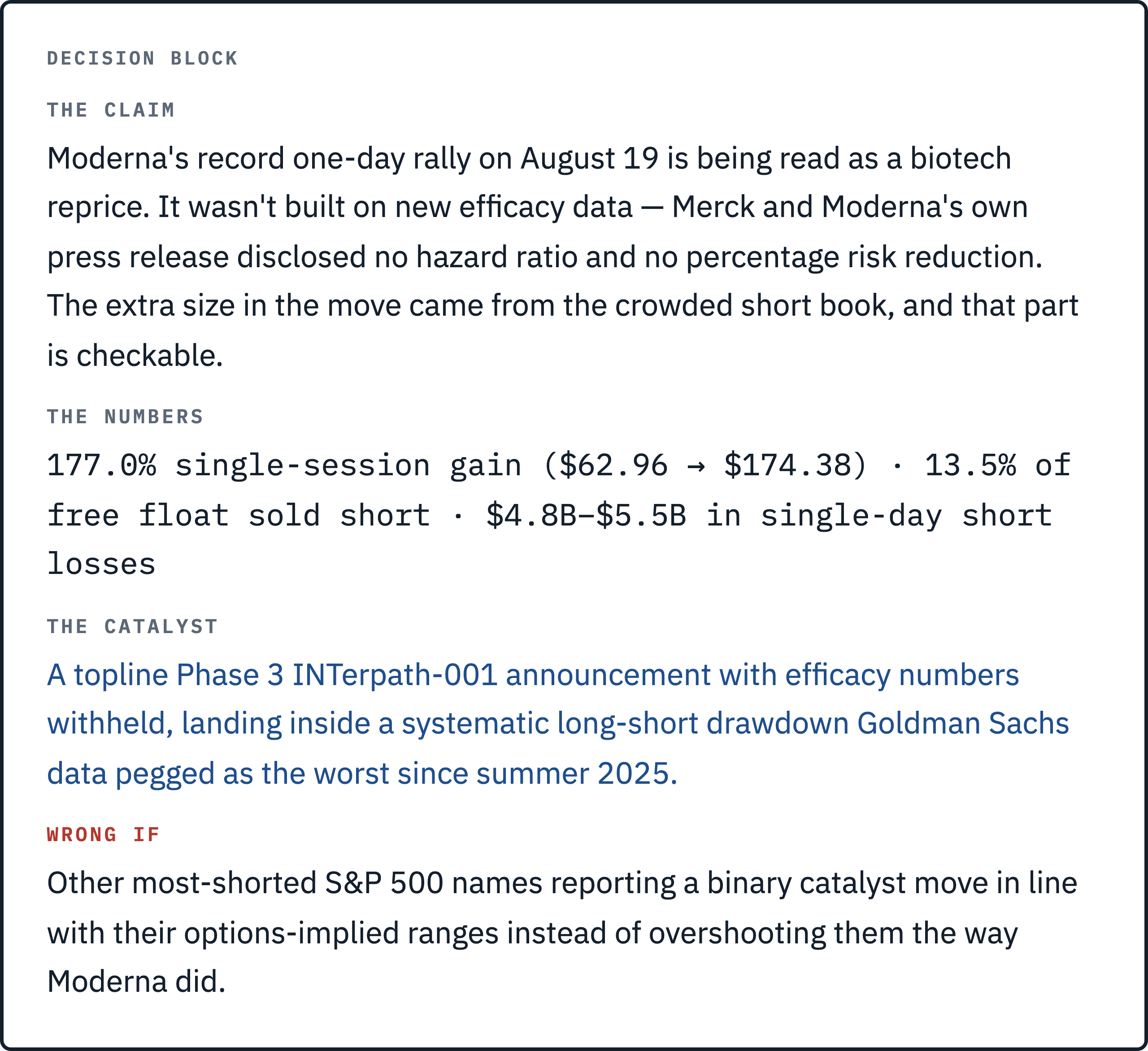
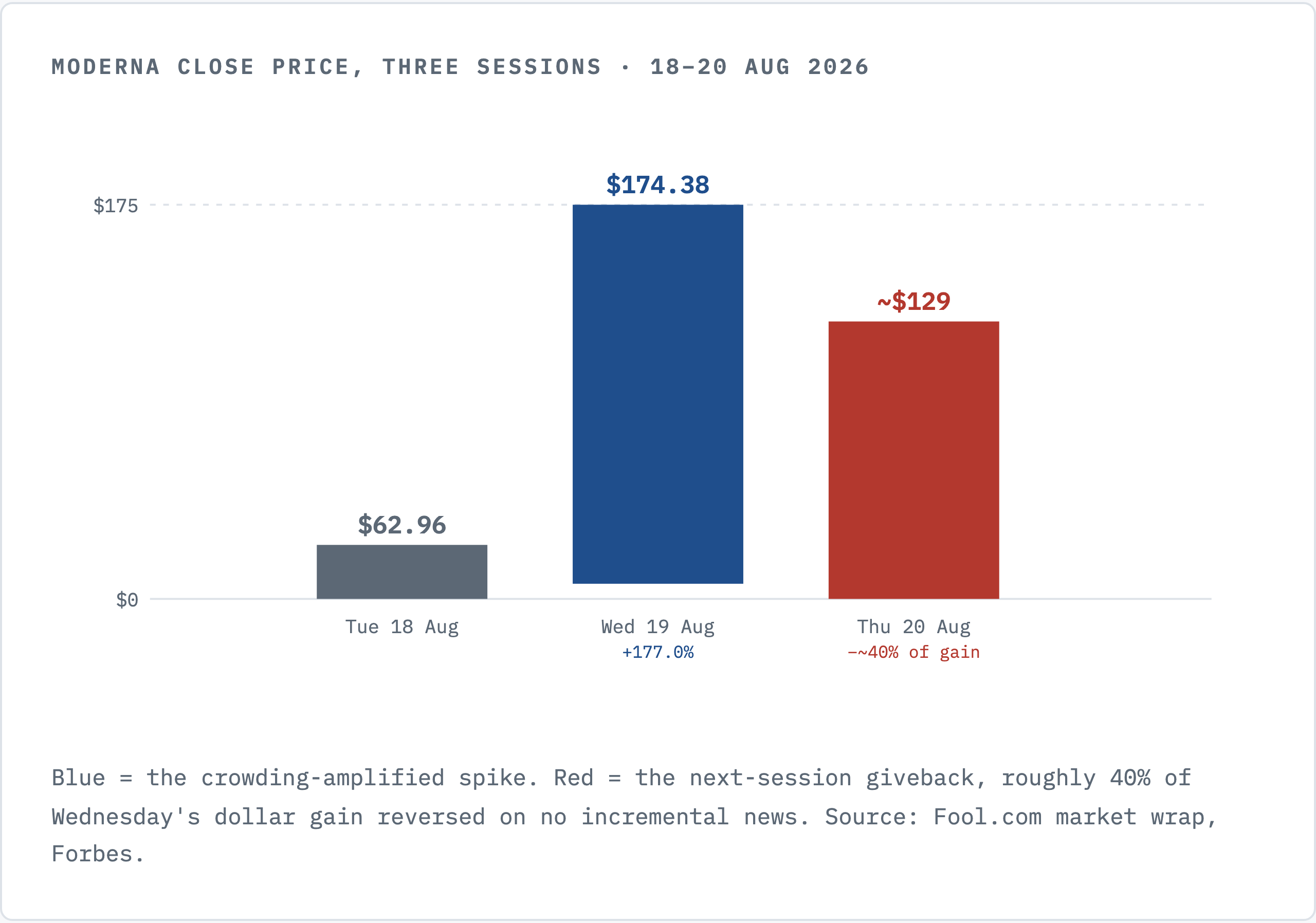
I want to open with the number most of Wednesday’s coverage buried. Moderna fell more than 25% on Thursday, giving back over $18 billion of the new market value it had gained a day earlier, a decline that runs closer to 40% measured against the whole dollar gain instead of the closing price alone. That’s the number that matters. A stock that reprices on durable new information doesn’t usually do that. A stock that got squeezed does, once the forced buying behind the overshoot runs out of sellers left to force.
The consensus, stated at its strongest
The dominant read treats August 19 as a legitimate scientific and commercial reprice, and on the surface it’s a fair one. Merck and Moderna announced that intismeran autogene, an individualized neoantigen therapy, combined with Keytruda met the primary endpoint of recurrence free survival and the key secondary endpoint of distant metastasis free survival in the confirmatory Phase 3 INTerpath-001 trial, a randomized study of 1,137 patients with completely resected, high risk melanoma, the first positive Phase 3 readout ever recorded for an mRNA cancer therapy. Bank of America’s Alec Stranahan called it a watershed moment and raised his price target more than fourfold, to $170 from $40. Brookline modeled potential worldwide sales of $4.67 billion by 2030. None of that is wrong on its face.
Here’s the company’s actual condition heading in. Four years of a collapsing COVID franchise. Cash burn from an unproven pipeline. US vaccine revenue down to roughly $1.2 billion in fiscal 2025. Against that backdrop, Moderna just produced the first hard proof, in a randomized controlled trial, that its core cancer platform works at all. The strongest version of the bull case doesn’t need a squeeze to justify a large move. I take that case seriously. My argument isn’t with the direction. It’s with the size. Full stop.
What Moderna’s own press release didn’t say
Here’s the observation that forces a different read, straight from the company’s own words. Merck and Moderna’s press release did not disclose a hazard ratio for the Phase 3 result, or a percentage risk reduction. It said the trial met its endpoints, full stop, with complete data reserved for an unnamed medical meeting later this year. Every 49% and every 59% figure that ran across financial media on August 19 belongs to KEYNOTE-942, the Phase 2b trial reported back in 2023, cited by the companies themselves, explicitly as historical context, inside the same release that withheld the new numbers. That distinction did not survive contact with most of the day’s coverage. Read the release itself. I think it matters more than almost anything else in this story.
A trial that discloses a bigger effect than before is new information a market has never priced. A trial that says “it worked,” without saying how well, resolves a narrower kind of uncertainty: call it replication risk, the probability that a Phase 2b signal holds up when retested in a larger, harder, randomized Phase 3 population. I’d put oncology near the top of the list of therapeutic areas where that signal most often fails to hold, which is exactly why a positive readout is worth celebrating. Resolving that risk in your favor is worth something real. It isn’t, on its own, obviously worth pricing a $69.6 billion market cap on a company that traded at roughly $25.1 billion the day before (399.24 million shares at Tuesday’s $62.96 close: I make that $25.1 billion, and at Wednesday’s $174.38 close the same share count makes $69.6 billion), off a release that named no magnitude at all. My own read is that the gap between what a bare “it worked” announcement should be worth and what the stock actually did is exactly where the crowding premium lives. Most of that premium, I think, traces to Moderna’s short book. Not all of it, and I correct that in the next section.
How a crowded short book turns a headline into 177 percent
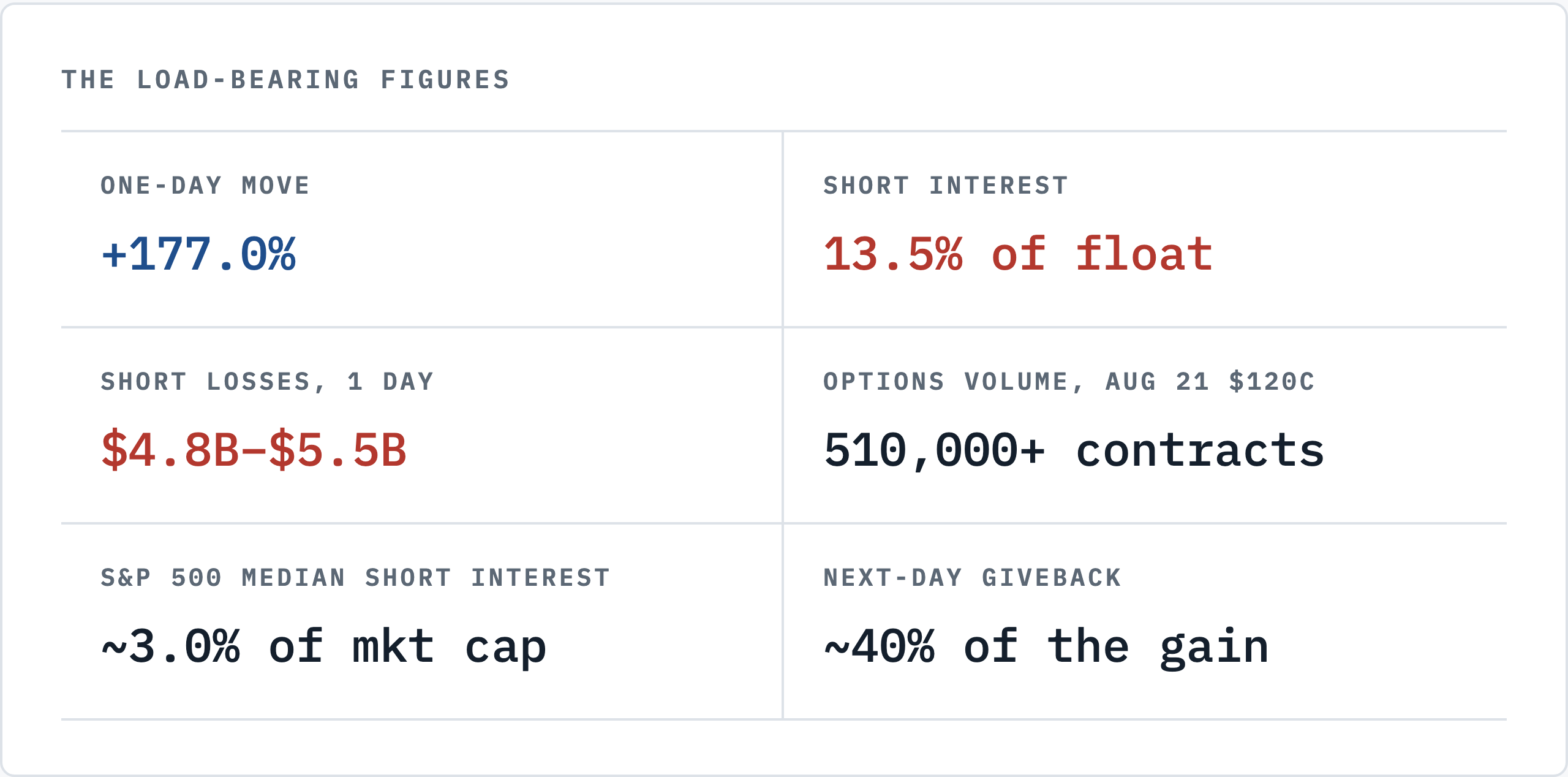
Start with the setup going into Wednesday. Moderna carried 13.5% of its free float sold short, per ORTEX, among the most heavily shorted large caps in the index and several times the S&P 500 median, a position already shrinking through the year as roughly a quarter got covered since January. That is a crowded trade sitting inside a market that had, just weeks earlier, been through its worst systematic long short drawdown since the summer of 2025. Goldman Sachs’ prime brokerage desk had systematic managers giving back roughly a quarter of their year to date gains between late June and early July, down 3.6% and up 10.8% for the year against a 14.4% peak, with Bloomberg separately putting systematic funds down 2.1% in one week on top of a 3.1% five day slide, the weakest two week stretch since December 2023. AI and memory chip momentum sat at the center: SK Hynix fell more than 40% in July alone, its worst month since October 2008, and SK Hynix, Samsung, and Micron together shed roughly $460 billion of market value at once. One dating flag: this drawdown data is six to seven weeks old relative to Moderna’s print, with no fresher figure confirming whether it had deepened, eased, or persisted by August 19. Old data, real setup.
Here is why that backdrop matters for a biotech name most of that coverage never mentioned in the same breath. My own read is that a momentum unwind is never only a long side event, whatever the headlines that week were about. When systematic long short books derisk, they cut both legs at once. The short leg on names like Moderna, deteriorating fundamentals with a heavily crowded bet against it, can get trimmed defensively even absent company news, because VaR limits and gross exposure targets force the trim regardless of what any single manager thinks about a trial. Jordi Visser at 22V Research put the broader mood bluntly in early July, roughly six weeks before Moderna’s print: momentum volatility, running hotter than the dot com era by his own read, was flushing out “hedge funds with VAR limits and retail traders chasing breakouts.” I take that as evidence of the mood. Nothing sharper than that. It isn’t proof the short book was still primed to shrink six weeks later, on the specific day Moderna reported. A real gap I don’t fully close: the funds in that evidence read as systematic, momentum driven books, while Moderna’s own short base reads as fundamentally motivated biotech bears betting against a shrinking COVID franchise. I can’t show those are the same funds. Same direction, unconfirmed identity. What I can show is that both were leaning short and derisking in the same broad window, and a catalyst this size gives any crowded position a reason to move all at once, whichever funds were actually holding it.
A second mechanical amplifier the short book alone doesn’t explain
MSCI’s own factor research on the comparable summer 2025 episode is the closest thing to a peer reviewed account of the mechanism. Stocks that combine high short interest with high residual volatility “systematically exceeded the prediction of a linear model” during a crowding unwind. The amplification is non linear. I would call that the documented mechanism here, on a different set of names, in a comparable episode roughly a year earlier. A linear model says a stock should move in rough proportion to the surprise in its fundamentals, and it undershoots exactly these setups, because the second order effect, forced buying from funds that are short and derisking on the same clock, was never something an information only model was built to capture. The math misses the crowd.
The per share arithmetic makes it concrete. Peter Hillerberg at ORTEX put it plainly: each shorted share down almost $100, exactly the kind of pressure that can trigger a squeeze. ORTEX marked the single day loss for shorts at $4.8 billion; S3 Partners put it closer to $5.5 billion, bringing year to date losses to roughly $7.7 billion. Neither figure rounds to zero against a $69.6 billion repricing. Real money. Real pain. Real leverage. A short book that size, forced to cover into a thin, gapping tape, does not add a proportional amount to the move. It adds a multiple.
I owe this section one correction on my own initial read. I went looking for what could break it, expecting the short book to be the whole story. It wasn’t. The short book was not the only mechanical amplifier running that day. The Aug 21 $120 call was the single most traded options contract in the name, more than 510,000 contracts, a record, moving from a penny to $54.20. Deep out of the money calls that cheap don’t just reflect a squeeze. They cause a second one: market makers who sold those calls must buy the underlying stock to stay delta neutral as the price runs, its own source of mechanical, non fundamental buying. I can’t cleanly separate how much of the 177% came from shorts covering versus dealers hedging their own book, and I doubt anyone outside the market makers can. Genuine uncertainty, stated plainly. Both are crowding. Neither is the trial data.
