



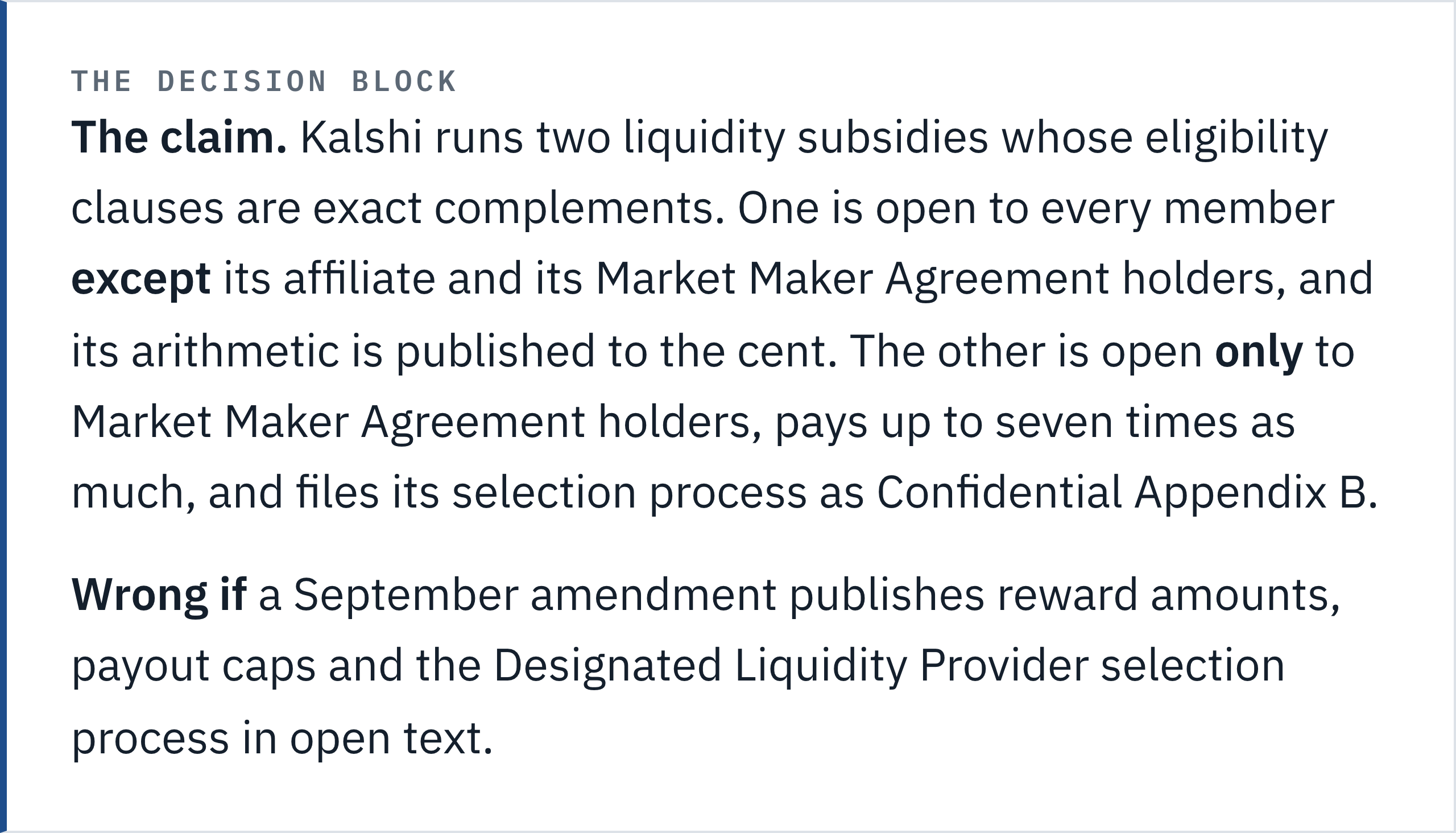
The claim: Kalshi runs two liquidity subsidies whose eligibility clauses are exact complements. One is open to every member except its affiliate and its Market Maker Agreement holders, and its arithmetic is published to the cent. The other is open only to Market Maker Agreement holders, pays up to seven times as much, and files its selection process as Confidential Appendix B. The tier you can read is the tier without a contract.
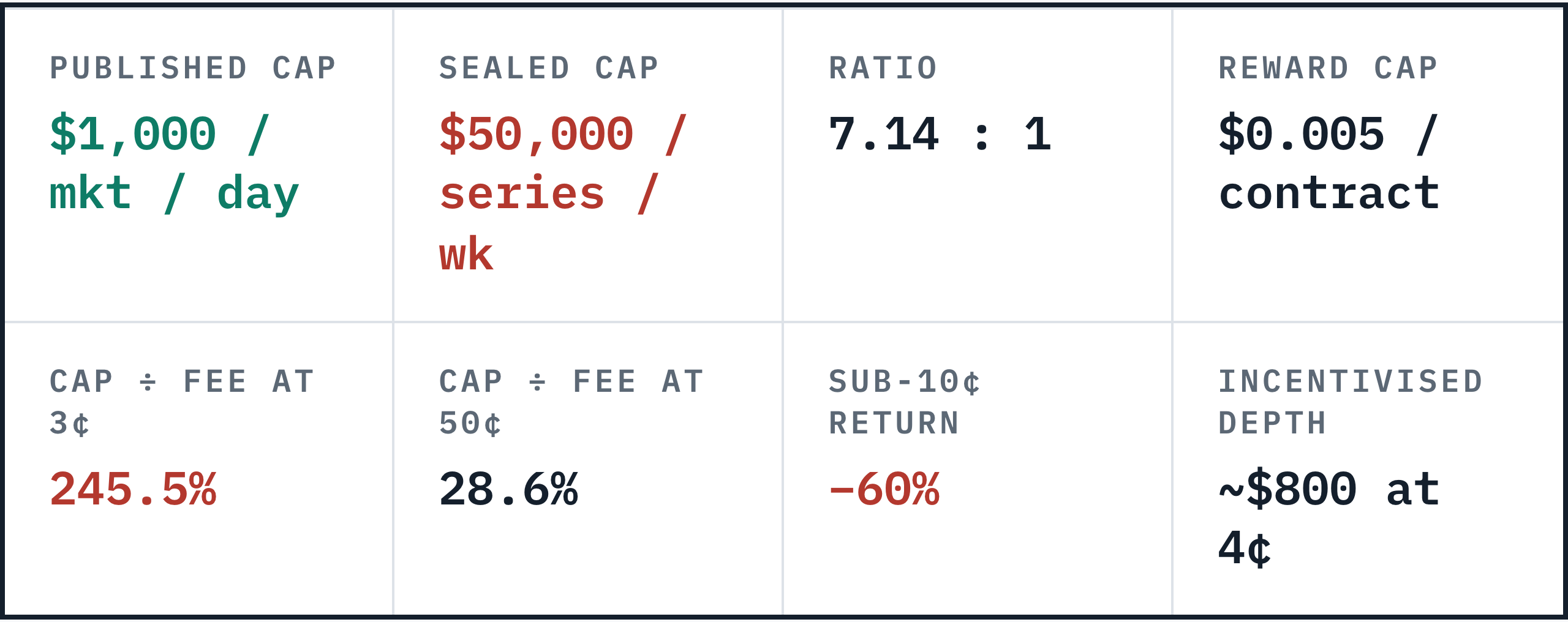
The numbers: the open tier caps at $1,000 per market per calendar day; the Market Maker tier caps at $50,000 per series per week (Liquidity Provider Program, 4 May 2026). Inside the open tier, a flat $0.005 reward against a taker fee of $0.00204 on a three cent contract is 245% of the whole fee. Buyers of sub-10¢ contracts “lose over 60 percent of their money” across 46,282 contracts (Bürgi, Deng and Whelan, 2026).
The catalyst: DMO staff asked every DCM to review and amend its incentive filings by 14 September 2026 (CFTC Letter 26-23). Kalshi refiled its Volume Incentive Program on 4 August, eight days earlier, and extended it to September 2027. Comments on the affiliate rulemaking close 5 October.
Wrong if: the September amendments publish reward amounts, payout caps and the Designated Liquidity Provider selection process in open text. Then the record becomes readable and my thesis dies.
The consensus, stated the way its holders would state it
On 12 August 2026 the CFTC’s Division of Market Oversight told designated contract markets their incentive filings have been sloppy: staff “have observed an increase in incentive program rule filings relating to event contract products under Rule 40.6(a), including filings that are procedurally or substantively deficient.” Volume based rewards “with steep tiers or threshold bonuses” can push participants “to trade solely to reach volume targets, heightening risks of wash-trading, pre-arranged trading, or other... disruptive trading practices.”
The coverage read this as a wash trading warning, and I think that reading is defensible. It is what the document emphasises. The implied fix is procedural: file better, disclose what Appendix A lists, and the Commission recovers the visibility it lost.
The advisory says what it is: it “represents only the views of DMO staff.” No rule changed on 12 August.
My view is that the reading is right about the advisory and wrong about the market. The deficiency staff describe is real and it is being addressed. It is also not the reason a macro desk cannot tell how much of a prediction market price is bought.
The filings are enumerable, and almost nobody enumerates them
Rule 40.6(a)(2) makes a DCM publish every submission on its own website concurrently with filing, and that obligation is load bearing. The CFTC’s own site surfaced nine Kalshi incentive filings; the bucket behind Kalshi’s regulatory notices page holds 456 documents, 52 of them incentive or fee filings, and two of my nine were superseded by documents that search never returned. The exchange’s own site is the complete index. Its regulator’s is not.
One word needs pinning down first. These programs are self certified: under Rule 40.6(a) an exchange files its own certification that a program complies with the Act, and a ten business day clock runs unless the Commission intervenes. Nobody approves them. “Certified” here means the exchange said so, in writing, to its regulator.
Two programs, complementary by construction
Kalshi’s Volume Incentive Program and its sibling Liquidity Incentive Program are drawn fully in public. Eligible volume is trades “executed on the central limit order book at prices between $.03 and $.97”; rewards come pro rata from a fixed per market pot and “shall be capped at, and shall never exceed, $.005 per contract traded for each participant”; the liquidity program publishes its scoring algebra down to the geometric discount on a resting bid. I have read a lot of exchange filings, and this is more disclosure than most DCMs offer.
I read the same clause on both: Eligible Participants are all Kalshi members “except the following: (i) affiliates of Kalshi; (ii) members who have executed a Market Maker Agreement with Kalshi,” plus brokers and their customers.
Then I found the May 2026 Liquidity Provider Program, running to December 2027. Its eligibility clause, which I read twice, is one sentence: “Eligible Participants are all Kalshi members who have executed a Market Maker Agreement with Kalshi.” How much it pays any one of them is set by a reverse auction: Kalshi’s own program page asks a provider to “share the minimum amount you’re willing to receive as an Incentive Period Reward.”
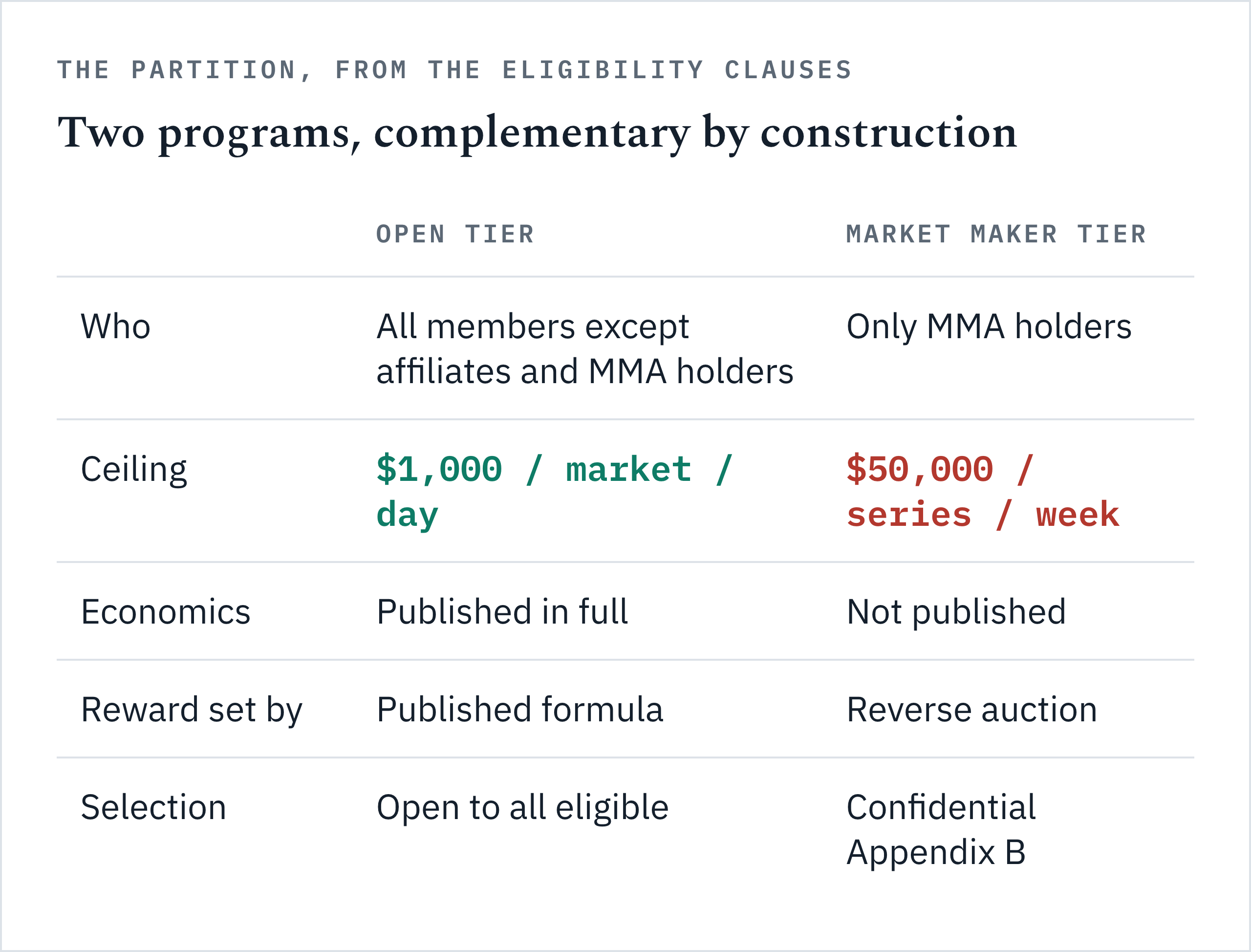
$1,000 a day is $7,000 a week, so that is seven times the ceiling per market, and a series spans many markets while the $1,000 does not. Kalshi states the Market Maker tier’s targeting itself: it “incentivizes liquidity provision in markets that are new or would otherwise have more limited trading activity.”
And the two compensation disclosures, from one exchange, sit like this. The open tier: “capped at, and shall never exceed, $.005 per contract.” The Market Maker Program, in its entirety, on what it pays: “Predetermined incentives will be available upon satisfying all Program obligations as determined by the Exchange.” No amount. No rate. No cap.
That filing’s enclosure list names “Confidential Appendix C - Market Maker Agreement,” and its cover letter says members “must execute a separate Agreement with Kalshi that will describe the relevant obligations, requirements, and benefits.”
The geometry: a flat cap on a curved fee
Kalshi charges takers round up(0.07 × C × P × (1-P)), P being the price in dollars, with index markets at half that (fee schedule). That is a parabola peaking at 50¢ and collapsing toward both ends, which is the correct shape, because P(1-P) is also the payoff variance of a binary contract. A contract at 50¢ costs $0.0175 to take and carries eight and a half times the risk of a contract at 3¢, which costs $0.00204. The fee tracks the risk.
The reward does not. The cap is flat. Half a cent per contract, everywhere inside the band.
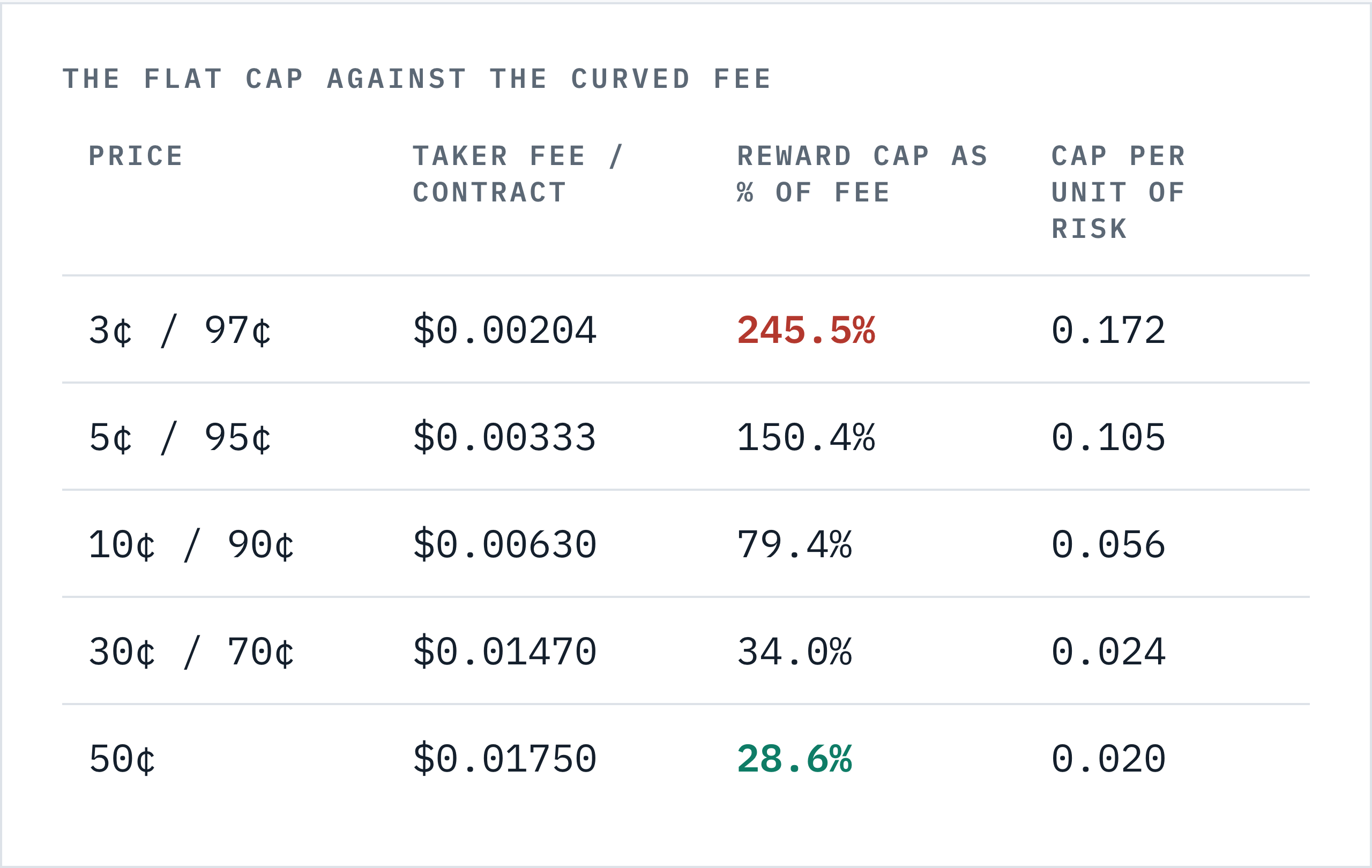
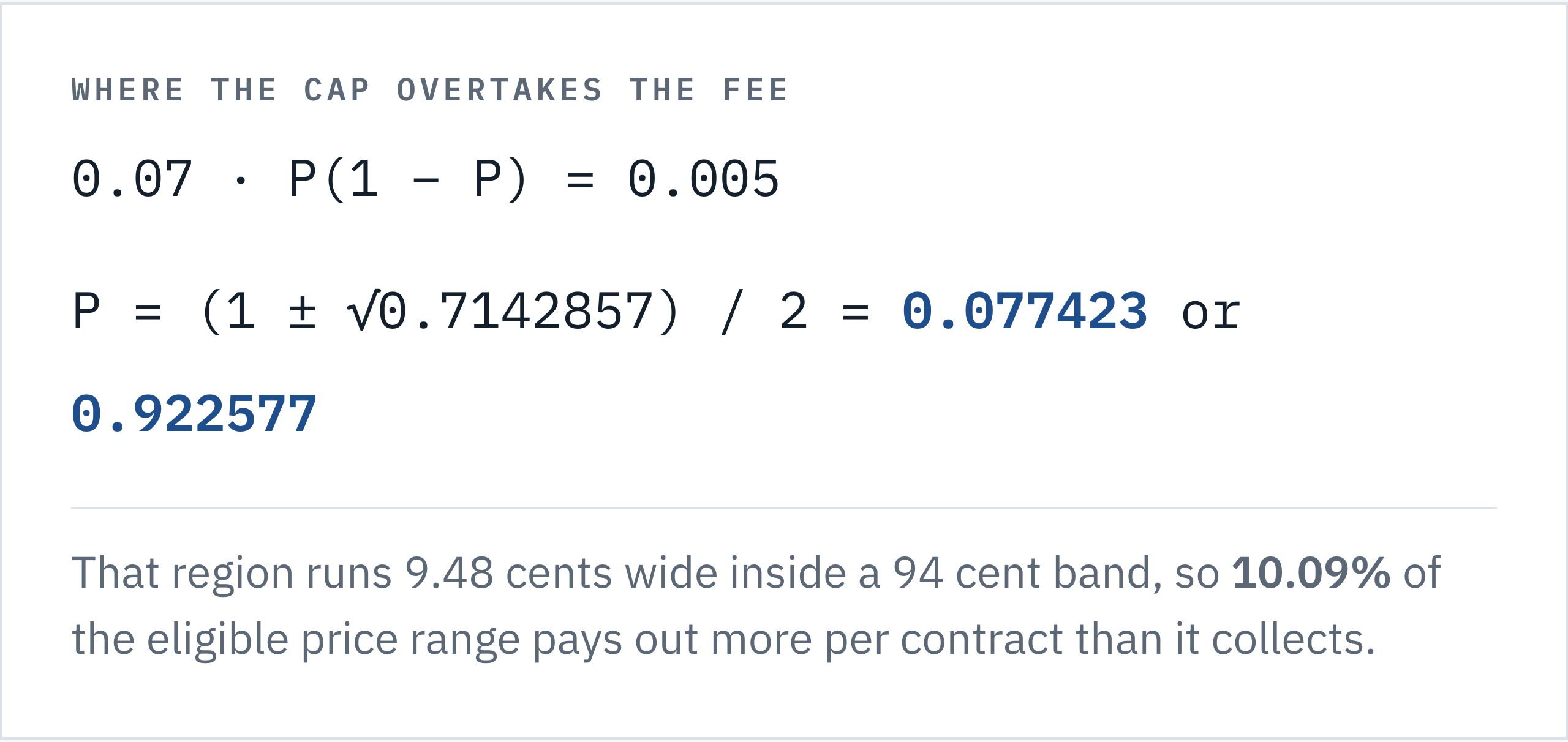
Solve 0.07 × P(1-P) = 0.005 and I get roots at 7.74¢ and 92.26¢. Below and above those, the certified maximum reward exceeds the whole fee the exchange collects. That region runs 9.48 cents wide inside a 94 cent band, so 10.1% of the eligible range pays out more per contract than it takes in. At the inner edge the ratio hits 245%, or 8.59 times the ratio at the midpoint, which is exactly the ratio of the variances. Same curve, twice.
Here is why I read that as a design choice and not an artifact. The filing gives a rationale for the cap: it exists “in order to help avoid price distortion caused by these Volume Incentives.” It gives none for the 3¢–97¢ band, which on a book quoting 1¢ to 99¢ excludes exactly two ticks at each end. A cap that actually neutralised distortion would have to scale with P(1-P), which is to say it would have to look like the fee schedule. Kalshi knows how to write a per contract amount that scales with price, because it wrote one for what it charges.
A second gradient stacks on the first, and I nearly read it backwards. Rewards come pro rata from a fixed pot, so the realised reward per contract is that pot divided by total eligible volume, and the cap binds only when volume is low. A $500 pot pays more than $0.005 per contract on any market trading under 100,000 eligible contracts. The subsidy peaks precisely in the thin markets, which is where the Market Maker tier says it is aimed too.
What actually happens at 4¢, measured
Somebody has measured this zone. Bürgi, Deng and Whelan took data on 46,282 Kalshi contracts across 12,403 events, 2021 to April 2025, into a George Washington University working paper. Their result is a favourite longshot bias: cheap contracts price above their worth. The magnitude isn’t textbook. Buyers of contracts under 10¢ “lose over 60 percent of their money.” Contracts above 50¢ earn a small positive return, and the average across everything is about minus 20%. Separate work finds the bias is domain specific, strongest in political markets, so I wouldn’t carry it uniformly across every category.
Two details in that paper matter more to me than the headline.
The first is who wins. Kalshi records which side initiated every trade, so the authors could split returns without inferring anything, and “Makers earn higher returns than Takers.” Part of that gap is simply that takers pay the fee. The rest is price. Either way, the participants Kalshi’s open tier excludes are the ones already on the better side of it.
The second is timing. The sample ends April 2025, and the current Volume Incentive Program text was filed 4 August 2026. So this is a clean pre period baseline for the exact zone the geometry points at, and nobody has run the post period. The authors note “some evidence that the bias in prices is diminishing over time,” which cuts awkwardly: as the natural mispricing shrinks, a subsidy on top of it becomes a larger share of what remains.
Then the capacity question a principal asks first.
Kalshi’s own filing answers it. The Liquidity Incentive Program sets a “Target Size” that “will be greater than 100 contracts and less than 20,000 contracts”, the depth above which resting size stops earning. Twenty thousand contracts at 4¢ is $800 of premium. Real books can be deeper; that is my ceiling on the depth the program pays for.
A share threshold is a headcount cap wearing a percentage
A third structure I nearly missed, and the one I’d push hardest on in a comment letter.
Kalshi’s 2023 Maker Order Protections Program gives qualifying members a safety net: if a group of resting orders moves your position by a set delta inside 15 seconds, the rest cancel.
Qualification is where I stopped. A member must account for “at least a minimum percentage of all maker volume on Kalshi over each of the prior two calendar months,” and the exchange sets that percentage on its website, not in the filing. The stated range is “between 1% and 7%, with the goal to have at least more than one qualifying member.”
I did the arithmetic the filing does not. A threshold of s percent of total maker volume caps the number of qualifying participants at 1/s, by construction. At 7%, no more than fourteen members can hold the benefit at once. At 3%, the figure the filing uses in its own worked example, thirty three. The exchange’s stated ambition is “more than one.” That is a bounded club whose size the exchange sets unilaterally, on a webpage, between filings.
The same shape sits in Kalshi’s June 2026 perpetual futures fee schedule, whose top maker rungs are reachable by holding a minimum share of the exchange’s own maker volume, up to 10.0%. At the top rung, ten participants can qualify. Not ten thousand. Ten.
Appendix A asks a DCM to “discuss any limitations on program enrollment or the maximum number of program participants.” A share threshold is exactly that limitation, in a unit that hides it from me. No filing I read does the division.
The same shape at the other venues
Polymarket US, which is QCX LLC, filed a Market Incentive Program on 5 March 2026 and asked that Appendix B stay confidential. Its request letter enumerates what is inside: “the specific reward amounts, volume multipliers, payout caps, and program parameters that the Exchange found necessary to incentivize volume,” with confidential treatment requested “in perpetuity.”
Set that beside Appendix A, which requires a filing to “specify the economic terms and amounts of each available form of compensation” and to identify all incentives “and whether they are capped or unlimited.” The four items named as trade secrets are the four named as mandatory public content. FOIA Exemption 4 is real, and both statements are lawful.
The public half says rebate rates and caps are “communicated in writing to Program Participants,” adjustable “on a prospective basis with seven (7) days’ notice,” and that applicants may be waitlisted “indefinitely.” Section III says programs letting a DCM amend terms without a fresh 40.6 filing “may conflict with Part 40.” I expect that to matter in September.
ForecastEx files the programs whole under seal. Its 2 March 2026 submission states that “the incentive rates for the Market Maker Program are being amended to account for the new transaction fee structure.” The attachment list reads: “Exhibit C (Confidential) – Volume Incentive Program. Exhibit D (Confidential) – Market Maker Program.” The rates moved. Where they moved to, I cannot tell you.
Kalshi has done a version of this too, and I found it the most striking line in the set. In June 2024 it amended the Volume Incentive Program and wrote that the amendment complies with the core principles “as discussed in confidential appendix C.” The compliance analysis itself went in the sealed envelope.
Three objections, and what I think of each
“Market makers are a small share of volume, so calling them the price setters is wrong.” The strongest objection, and it measures the wrong quantity. Share of volume is not share of quote. The Liquidity Incentive Program pays for resting orders, and the Market Maker tier pays for maintaining “continuous two-sided markets” at a “maximum bid/offer spread” and a “minimum quote size.” A modest share of volume can still be most of the depth at the touch. Volume is what happened; the quote is what a desk copies.
“These venues are just young and under lawyered.” My control refutes it. Bitnomial is a crypto derivatives DCM with no event contracts, and its June 2026 incentive filing reads: “Exhibit 1 sets forth the updated terms of the Program (Confidentiality Requested).” Coinbase Derivatives files its equivalent as 2026-27 Crypto Market Maker Program_REDACTED. I read that as ordinary DCM practice, inherited and not invented, and I had been half expecting the opposite.
“Manufactured volume is not actually large, so where is the harm?” On the one venue anybody has measured, it is not large. A May 2026 microstructure study of the Polymarket order book ran a self counterparty wash detector across 600 markets and 6.4 million trades and found a median wash share of 0.97%, with 22.2% at the maximum. Unregulated token exchanges run 25% to 70%, which its author calls “a sanity bound rather than an apples-to-apples reference.” Roughly one percent, not seventy. It is a preprint, it measures Polymarket and not Kalshi, and its author calls the figure a lower bound.
The harm I see does not run through wash volume. It runs through concentration: the subsidy is largest in the thinnest markets and at the edges of the band, where the measured return is worst, on books the exchange pays to keep a few hundred dollars deep. And the output of these venues is a probability consumed as data by people who never trade on it. Nobody reads a Bitnomial bitcoin future as a forecast. A great many people read Kalshi’s 4¢ as a 4% chance.
What I can’t rule out
I still can’t see the realised numbers. I have both ceilings now, $1,000 a day and $50,000 a week, and no venue publishes a single realised payout. A ceiling tells you what an exchange has permitted itself, never what it spent. So everything I’m saying about relative size rests on the filed caps, and that’s a real limit.
Confidentiality may be doing exactly what it claims. Reward parameters are real competitive information, and an exchange that published its market maker economics would hand rivals a recruiting sheet. Every request here is lawful and I’m not alleging otherwise. My problem is narrower: the record can’t answer what a price consumer needs, and September won’t change that, because procedural compliance and economic legibility are different properties.
The favourite longshot bias predates all of this. Bürgi and his coauthors reproduce it with a model needing only modest disagreement and a mild tendency to overstate small probabilities, so the sub-10¢ losses aren’t evidence anyone engineered them. My claim stays narrow: the certified subsidy per unit of risk is largest where the measured return is worst.
What would change my view
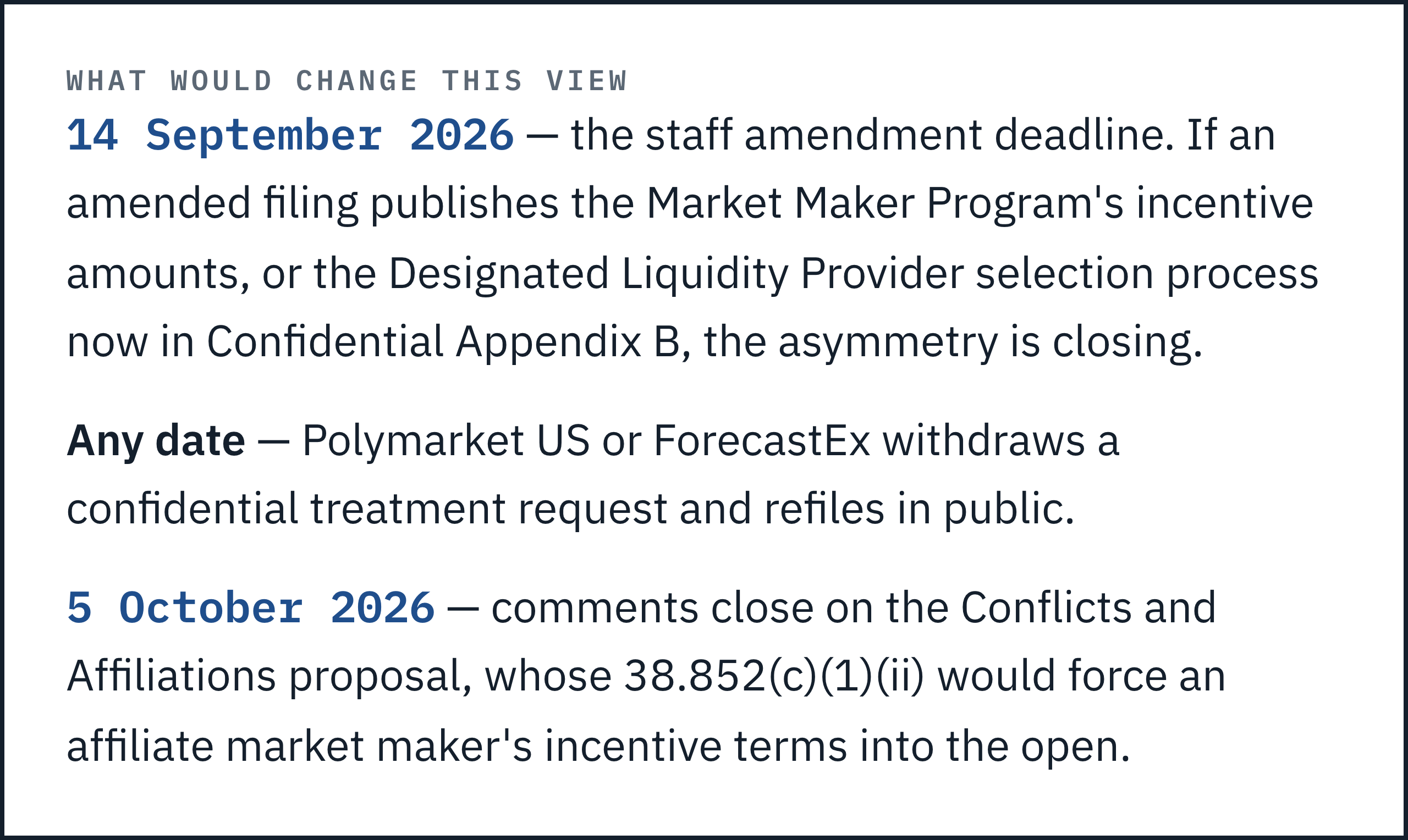
Three dated, public, resolvable tests. I’ll hold myself to them. Diary them.
14 September 2026 is the staff amendment deadline, and Kalshi refiled its Volume Incentive Program on 4 August, eight days before the advisory landed. If an amended filing publishes the Market Maker Program’s incentive amounts, or the Designated Liquidity Provider selection process that’s now sitting in Confidential Appendix B, then the asymmetry I’ve described is closing and I’m wrong about its persistence.
If Polymarket US or ForecastEx withdraws a confidential treatment request and refiles in public, same conclusion. I’d take either as a clean refutation. No hedging.
And comments on the Conflicts and Affiliations proposal close 5 October 2026. Proposed Regulation 38.852(c)(1)(ii) would make any incentive program covering an affiliate market maker enumerate its obligations “on terms no less favorable to the DCM than those offered to unaffiliated” firms, with 38.852(c)(1)(i) forcing the affiliate to be “filled last at every price level.” Kalshi’s 2023 filing already says “Kalshi Trading LLC, an affiliate of the Kalshi Exchange” participates, so it’d bite on a structure that’s live today.
What I’d actually do with this
If you’re pricing off event contract quotes, my adjustment is narrow and cheap. Discount the 3¢–8¢ and 92¢–97¢ zones on thin Kalshi markets specifically. That’s where the two gradients compound and where the measured return is minus sixty. Everything from roughly 20¢ to 80¢ on a deep contract looks fine to me. I’d keep using the prices. I’d stop using their tails as though they were the same instrument as the middle. They aren’t.
Name the cost of being wrong about this, because it is not zero. Discounting a tail print that was in fact correct means leaving a real risk unhedged, and the 3¢–8¢ band is exactly where a cheap hedge lives. The adjustment is a haircut on confidence, never a reason to skip the hedge.
Size accordingly. At $800 of incentivised depth, a tail print on Kalshi is a data point, never a position.
I set out to measure what share of headline volume is purchased. It isn’t answerable from public sources. What is answerable is which tier gets to see the terms, and the answer sits on the exchange’s own website: the subsidy published to the cent is the one Kalshi’s market makers are barred from claiming, and the subsidy set by auction is the one only they can. One test would settle the rest, and nobody has run it. Re-run that wash detector on Kalshi’s post-September-2025 tape and on Polymarket US since January, and see whether a certified volume tied rebate moves 0.97% at all. If you’ve got the data, I’d like to see it. I tried. I couldn’t.
📊 The Decision-Grade Version
Two of mine on the same beat: Chainlink Gave Polymarket 30 Seconds, on settlement manipulation at the other end of a contract’s life, and The Math of Prediction Markets.
This piece is complete on its own: the thesis, the evidence, and what would kill the view are all above, and nothing was held back to sell you a next step.
The Patreon note is a separate piece of work rather than a deeper cut of this one. It takes the pricing haircut from inside this story and writes it the way a desk would act on it: a reconstruction in six steps you can run on any event contract DCM in an hour, the crossover solved in closed form, and the capacity bound. Written for people who put capital behind a view.
→ Read the Kalshi subsidy trade note
→ Or join the Patreon community for every note
One institutional trade a week on video: The Mathematical Trader. Shorter reads and the filings I am working through go on LinkedIn.
Cover photograph: Web Summit, Diarmuid Greene, CC BY 2.0, via Wikimedia Commons.