



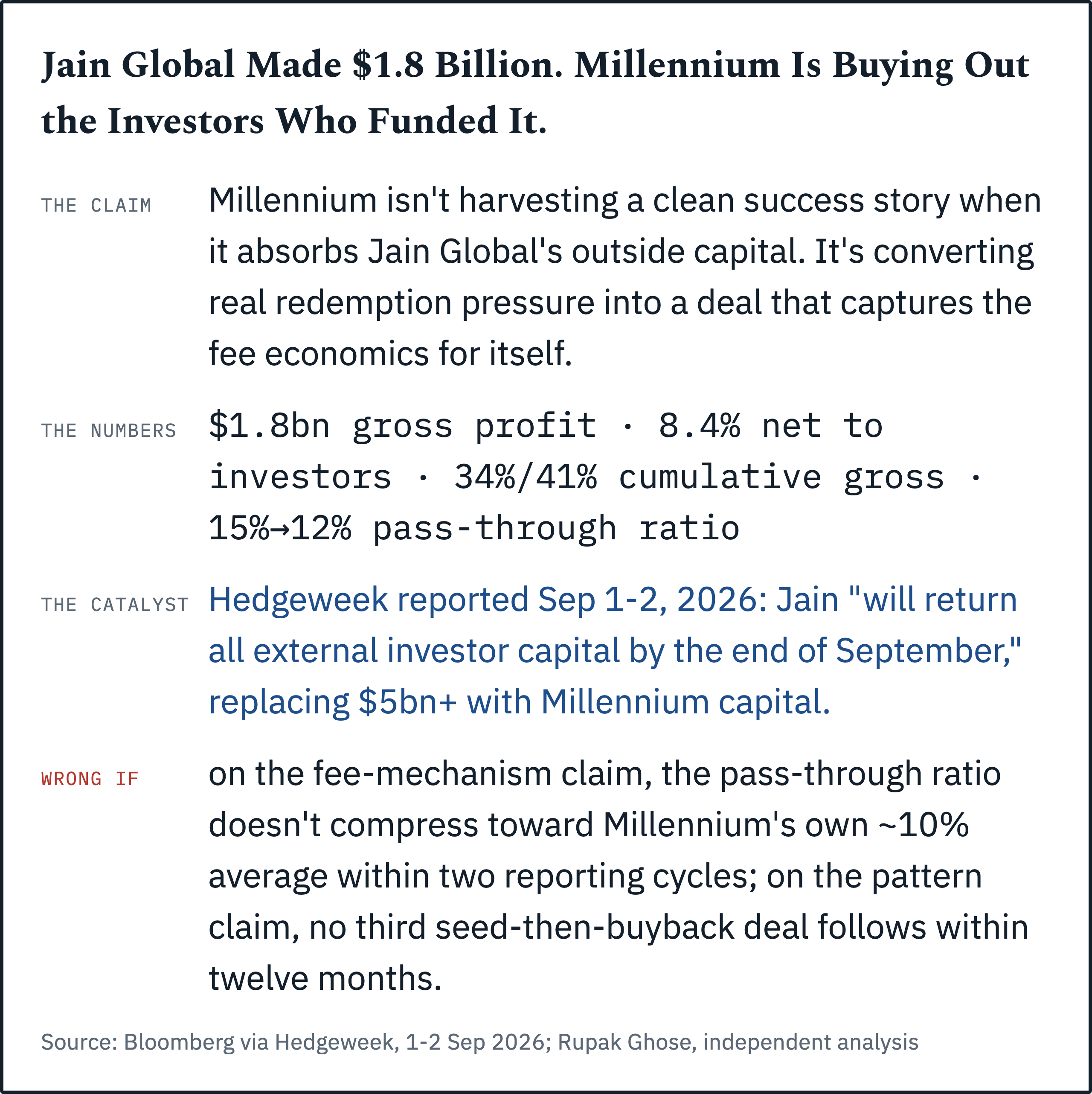
Millennium isn’t harvesting a clean success story when it absorbs Jain Global’s outside capital. It’s converting real redemption pressure, a $250 million sovereign-fund withdrawal and a fund’s own admission that it couldn’t reach scale alone, into a deal that captures the fee economics for itself. The trading was never broken. The vehicle that housed it was.

Below the paid line:
The redemption pressure the headline “harvest” story leaves out: GIC’s $250 million withdrawal, a January 2026 drawdown, and Jain’s own analyst-source naming redemption risk as the reason for the deal
The corrected arithmetic separating the two real gaps in Jain’s own numbers: the ~7-point capital-timing gap and the ~33-point fee-drag gap, with the fee-waterfall caveats stated plainly
Kodai Capital's April 2025 wind-down, a $690 million Millennium-backed manager run by Citadel alumni, and why its market-driven collapse complicates any claim of a clean pattern
The industry pass-through comparison table: Jain, Balyasny, Citadel and ExodusPoint, each with its own disclosed gross-to-net gap
Jain Global's tiered performance-fee schedule (10% at $250 million-plus commitments) and its 18-month lock-up plus 5% redemption-fee terms, correctly sourced
The falsifier: what I’m watching for in the next twelve months to know if this is a repeatable playbook
I’ve covered pod shops on this desk before. This is the first time one let me see, in its own disclosed numbers, exactly how much of its investors’ money it took to build the thing before someone else decided it was worth owning outright.
Below: the 32.6-point Jain gap split into its two causes, Millennium and Citadel's own ~10% mature pass-through ratio, the four-fund comparison table, and my September 2027 falsifier date.
The consensus: platform seeding is a smart, symbiotic trade
Talk to anyone who allocates to multi-strategy funds and you’ll get roughly the same account of why Millennium, Citadel and Point72 back independent launches like Jain Global. The platform gets diversification without building a new desk from scratch. The founding portfolio manager gets a credible anchor investor and instant credibility with the rest of the capital-raising circuit.
Outside LPs get early access to a launch that would otherwise be closed to them, priced at whatever terms the manager can command in a hot market. The endowments, sovereign funds and family offices that filled out Jain’s $5.3 billion raise in 2024 are sophisticated allocators who understand pass-through fee structures going in (Business Today). Not first-time buyers.
Frame the seeding relationship as a long-term partnership, and a later decision to consolidate that manager’s book reads as a natural next step, never an extraction. A tidy story, on paper.
I think that account is broadly right about the incentives on day one. My read is that it stops being the whole story once you have two years of numbers in front of you, and I want to walk through why.
The variant view: a redemption story and a fee-harvest story, at once
Here’s the observation that complicates the clean version of this story. Jain Global wasn’t simply thriving when Millennium moved to absorb it, and it wasn’t simply failing either. Both things were true at once, and the article that only tells one half is missing the mechanism.
On the trading side: the fund generated $1.8 billion in gross trading profit against $5.3 billion raised, a cumulative gross return in the mid-thirties to low-forties depending on which capital base you measure against (Hedgeweek). That is not a broken strategy. Profitable, the whole way through.
On the LP side, the picture looks different. Singapore’s GIC, one of Jain’s earliest and largest backers, pulled $250 million in February 2026 (Hedgeweek). That same month, the fund was down 0.9%. A sovereign investor, heading for the door. Rupak Ghose, the analyst whose pass-through estimates this piece leans on, states plainly what was actually driving the Millennium conversation, in his own words:
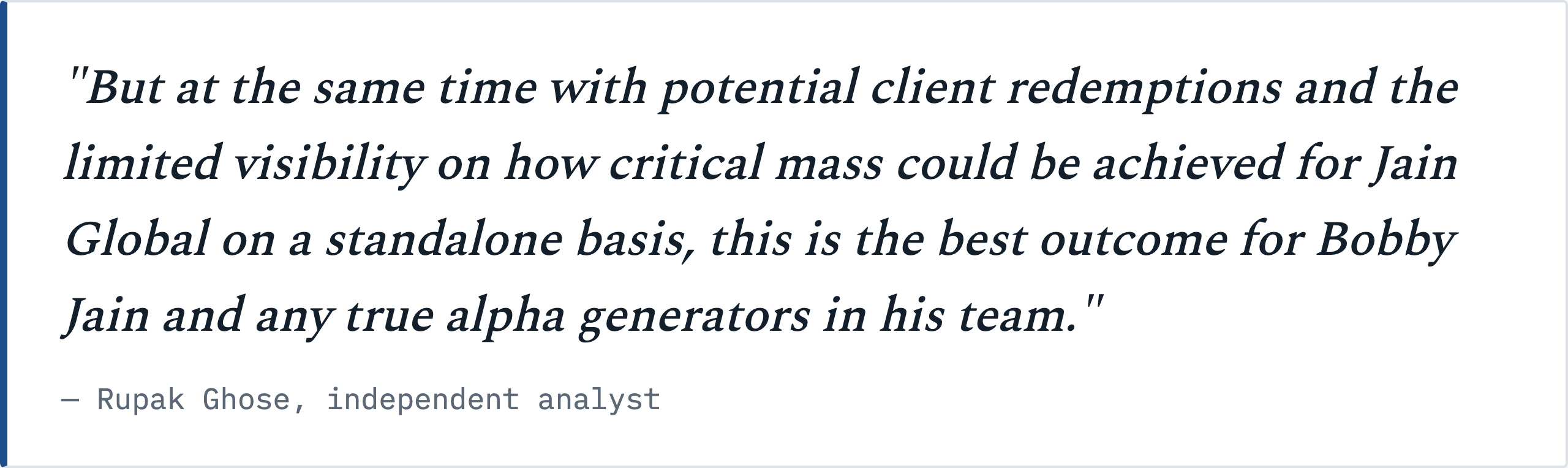
That’s the article’s own best source, and it cuts against my own framing more than I’d like: on redemption risk, as the actual trigger, I’m not going to dress it up or write around it. I don’t think it kills the fee-harvest thesis either. The two readings don’t cancel out, and the arithmetic below is what shows why.
Jain isn’t the only recent case, either, though the pattern is messier than a clean two-for-two. About four weeks before Jain’s deal closed, in consecutive calendar months, Millennium struck a similar arrangement with Albar Capital Partners, a $1.5 billion market-neutral equities manager run by Javier Velazquez, a former Millennium portfolio manager. Albar’s deal was disclosed August 7, 2026; Jain’s was reported complete September 1-2, twenty-five days later. Albar is returning all outside capital and will run exclusively for Millennium going forward (Hedgeweek, Aug 7, 2026).
Hedgeweek’s own framing of the Albar deal names the pattern directly, unprompted: Millennium is “identifying successful portfolio managers, backing them with external capital and subsequently bringing those relationships into its own capital base” (Hedgeweek).
There’s an earlier case too, and it cuts the other way. In April 2025, Millennium-backed Kodai Capital Management, a roughly $690 million manager run by Citadel alumni Neville Shah and Joon Park, wound down and returned its non-Millennium capital amid a brutal stretch for tech names (Bloomberg). Kodai doesn’t fit “harvest of mature success” at all. A weak-market wind-down, plainly.
Laid out by date, the three read as a widening pattern, not a single template: Kodai in April 2025, driven by markets. Albar in August 2026, closer to a clean harvest. Jain in September 2026, both at once.
The honest count is three cases, not two, and they don’t all rhyme. What connects all three is simpler and less flattering than “playbook”: Millennium absorbs a seeded manager’s book whenever the manager’s outside capital becomes a liability, whether the reason is weak markets, LP anxiety, or a fee structure eating the fund alive.
The capital-timing gap: 34% versus 41%
Start with the piece of the arithmetic that is actually about timing, not fees. Real, but not the story. I want it addressed on its own, and I do not want it buried inside the bigger one that follows. Jain raised $5.3 billion in commitments, but a fund cannot deploy $5.3 billion on day one. Capital ramps in as the team hires, the risk book fills out, the operational plumbing gets built.
Hedgeweek’s own reporting draws exactly this distinction: gross return on capital raised comes to 34%, gross return on capital actually deployed comes to 41% (Hedgeweek). That seven-point gap is the cost of holding uninvested dry powder during a roughly twenty month ramp. A real drag. Nobody’s fault. What a launch this size looks like in its first two years.
I am raising this gap first because it is the one a skeptic can wave away easily, and I would rather it get waved away correctly than folded silently into the bigger number that follows. Every large multi-strat launch of the past decade has carried some version of this drag, ExodusPoint’s own 2018 ramp included. None of it tells you anything except that raising $5 billion faster than you can prudently deploy it costs early investors a few points of blended return. That part of the story is boring. It should stay that way.
The fee-drag gap: 41% versus 8.4%
This is where the story turns. Even measured on the more generous deployed-capital basis, gross return still runs 41% against a compounded net return to investors of 8.4%. I checked that 8.4% against the three annual numbers Hedgeweek reported separately: 0.5% for the six months from launch in July 2024 and 3.7% for full-year 2025 in one piece (Hedgeweek, Jan 2026), and roughly 4% year to date in 2026 in a second, later piece (Hedgeweek, Sept 2026). The January piece predates 2026 entirely and cannot support that third figure on its own.
Compound those three: 1.005 times 1.037 times 1.04. I make that 1.0839, an 8.39% cumulative net return. Close enough to the disclosed 8.4% that I trust this is a real geometric compounding of reported NAV numbers. Not a rounded talking point someone pulled from a press release.
So the gap that actually needs explaining is 41% gross against 8.4% net, 32.6 points on the precise arithmetic. Call it 33. Two separate charges sit inside it. Neither one is small.
The first is the uncapped pass-through expense structure that has become standard at the largest multi-strat platforms: trading technology, compliance, data licenses, portfolio manager compensation, office costs, billed straight to the fund instead of absorbed into a flat management fee. Rupak Ghose estimates Jain’s pass-through ratio ran as high as 15% of assets in 2025 alone, against an average deployed AUM in the $3.5 to $4 billion range that year, and projects it falling to roughly 12% in 2026 as the cost base spreads over a larger book (Rupak Ghose). Fifteen points of expense ratio in a single year, against a fund that gained mid-teens gross that same year, is close to the whole story by itself. Almost the whole gap, in one line. I can’t reconstruct the exact fee-waterfall order that turns those two figures into the reported 3.7% net (see the limits section below).
The second charge is the fund’s own performance fee, tiered by ticket size at launch: 10% for commitments of $250 million or more, dropping in steps for smaller tickets, alongside an 18-month lock-up before any redemption right opens (Hedgeweek). That same lock-up structure explains why outside LPs, GIC included, largely didn’t exit before 2026: an early withdrawal carried a further performance-fee step-up plus a separate 5% redemption fee on top of whatever the market had already taken (Hedgeweek). Staying in was the cheaper option even for an unhappy LP. A lock-up, doing quiet work. Exit was expensive too.
Jain Global has not disclosed the exact order in which pass-through costs and performance fees come out of gross trading gains, and I am not going to pretend I know it. What I can say: an expense ratio running close to gross returns in a strong year, plus a performance fee stacked on top of whatever survives it, is large enough on its own to close most of a 33-point gap. No third explanation needed.
