



JSCC wants to fold six separately calculated futures default funds into one pool by summer 2027. ISDA’s 6 August 2026 letter names what that creates: a pro rata draw that can reach a JGB futures member’s money for a commodity default it never traded. Over 95% of the combined fund is already Index and JGB futures money.
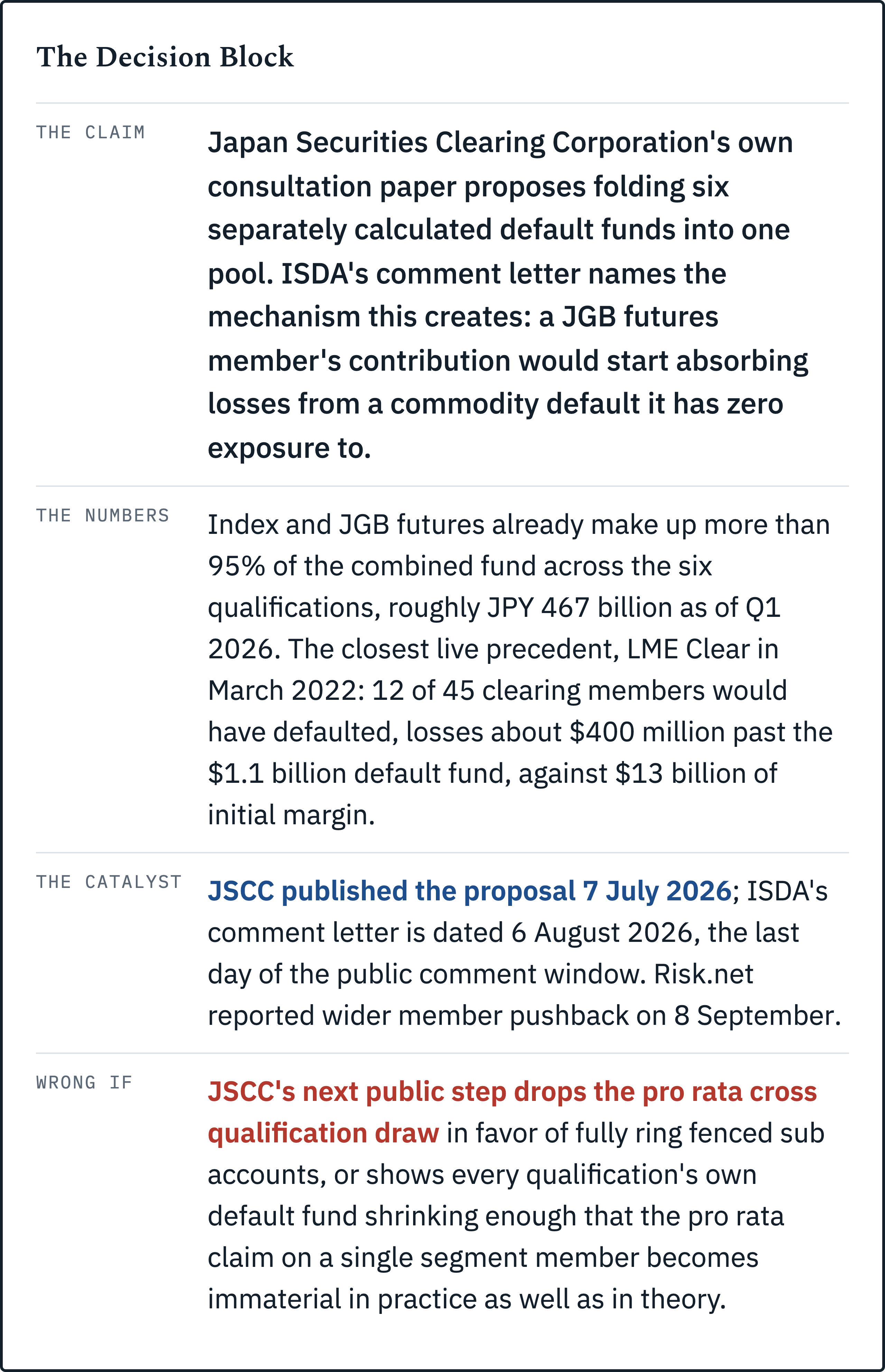
I think this is one of the cleanest live tests available of a question every clearing member eventually has to answer: when a central counterparty pools resources across products to get more efficient, who is actually subsidizing whom, and does the subsidizer get paid for it. You do not need a JSCC relationship to use this. It travels. The same question applies at CME, Eurex, LCH, or any clearinghouse weighing the same trade, and JSCC’s own paper is the clearest worked example of it currently on the table anywhere. One template. Every CCP.
The consensus, stated at its strongest
JSCC’s own July 2026 proposal states its purpose plainly: the six funds are separated today “due to historical background of the reorganization of Japanese domestic market functions,” and JSCC wants to “further achieve both stability and efficiency” by integrating them “in light of the recent market demands for greater capital and funding efficiency.” That’s a narrower, more honest rationale than “matching global peers.” Domestic history. Not a peer claim.
A larger, pooled fund needs less collateral in total to cover the same tail risk, because losses in uncorrelated product lines partially offset each other under stress. ISDA’s own letter says its members broadly support that objective. It’s real. A member holding contributions to six separate pools is capitalized against six independent worst case draws instead of one diversified worst case, and ISDA’s letter records that JSCC’s own backtesting shows the reduction is not confined to the aggregate: every one of the six qualifications sees its own required contribution fall under the proposed framework, commodity segments included. Every segment. Lower bill. That’s the strongest fact in JSCC’s favor, and the article I drafted first left it out.
I want to give this its strongest form before I depart from it. If commodity futures and JGB futures rarely stress at the same time, for the same reason, a shared pool really can be smaller than the sum of six separate ones and still cover the same loss at the same confidence level, and every contributor pays less for the same protection. That is the entire economic case for mutualization. Not a theory. JSCC has already disclosed the number.
The variant view, and the letter that forces it
Here is what the “everyone wins” framing leaves out. ISDA is not disputing that contributions fall. It is asking whether the ones that fall the most are the ones best placed to absorb what they are newly exposed to. Cheaper is not the same question as safer.
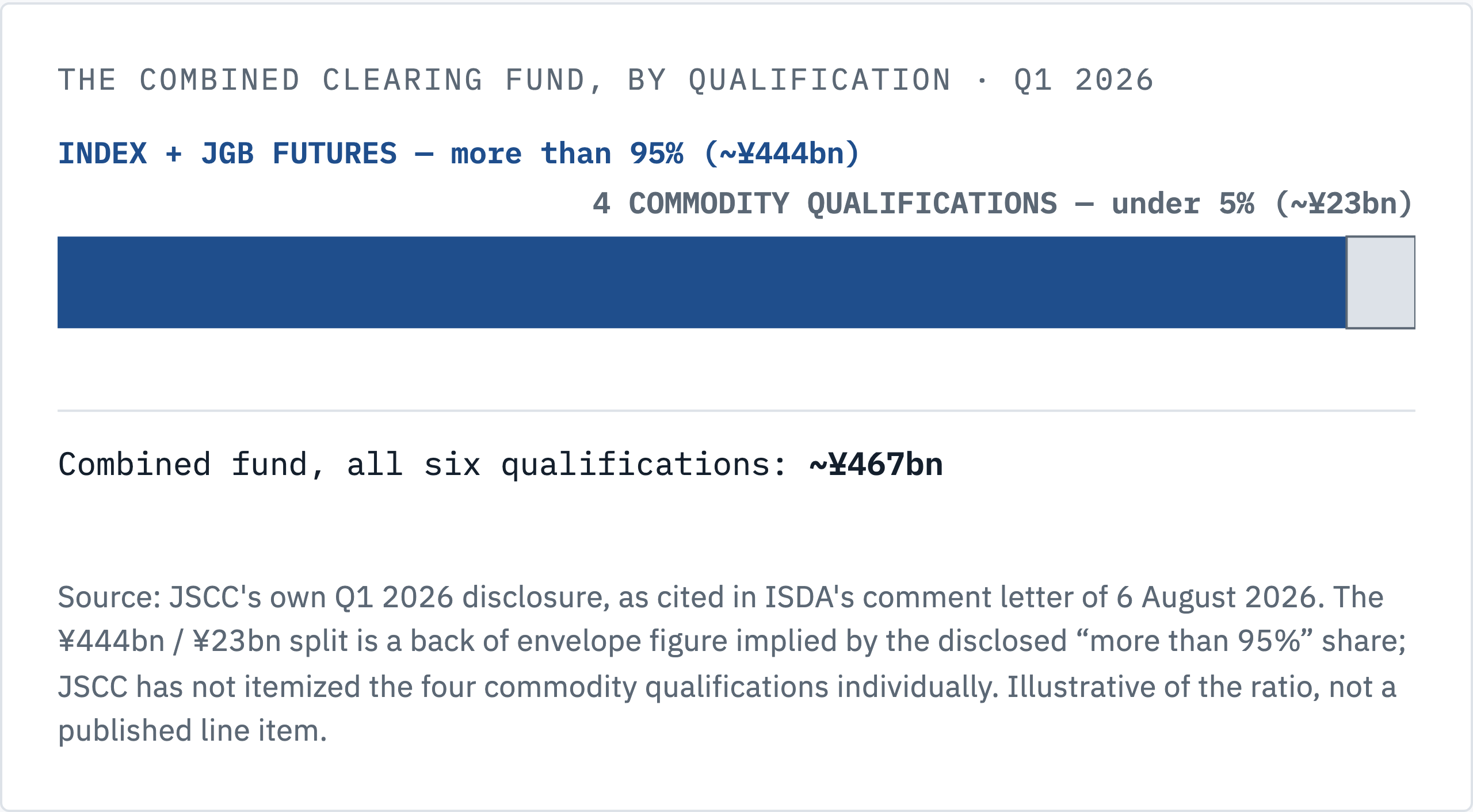
ISDA’s letter names the mechanism in specific, mechanical terms, and JSCC’s own rulebook confirms the same structure independently. When a member defaults, other members’ contributions for that same qualification get used first, what ISDA calls the juniorisation layer. The problem sits one step further down. Once that layer is gone, the mechanism draws on every surviving member’s remaining contribution across all six qualifications, pro rata, regardless of which segment that member actually trades. A firm active only in Index Futures and JGB Futures, the two qualifications that ISDA says already make up more than 95% of the combined fund, could be called on to help absorb a Precious Metal or Petroleum Futures default it has no exposure to. Zero exposure. Still on the hook.
The reverse holds too, and it carries its own separate stake: a small commodities only member, one that trades nothing but rubber or agricultural futures, now sits behind a pro rata claim sized overwhelmingly by the financial futures book, a book it has never touched and cannot see the risk in. That member is not just exposed to a bigger pool. It is exposed to a pool whose SIZE, and therefore whose CLAIM on that member’s own capital, is set almost entirely by a business it does not do. Someone else’s book sets the bill.
ISDA isn’t asking JSCC to drop the project. Its members are broadly supportive of the efficiency goal, and the letter notes a pooled fund can also cut how often JSCC needs to call for emergency assessments from surviving members. What it asks for is a participant overlap analysis, weighted by trading volume and risk exposure, before the merger proceeds, and it recommends that if the overlap between commodity members and financial futures members turns out to be limited, JSCC should keep two funds rather than one. Two funds if the members do not overlap. One if they do.
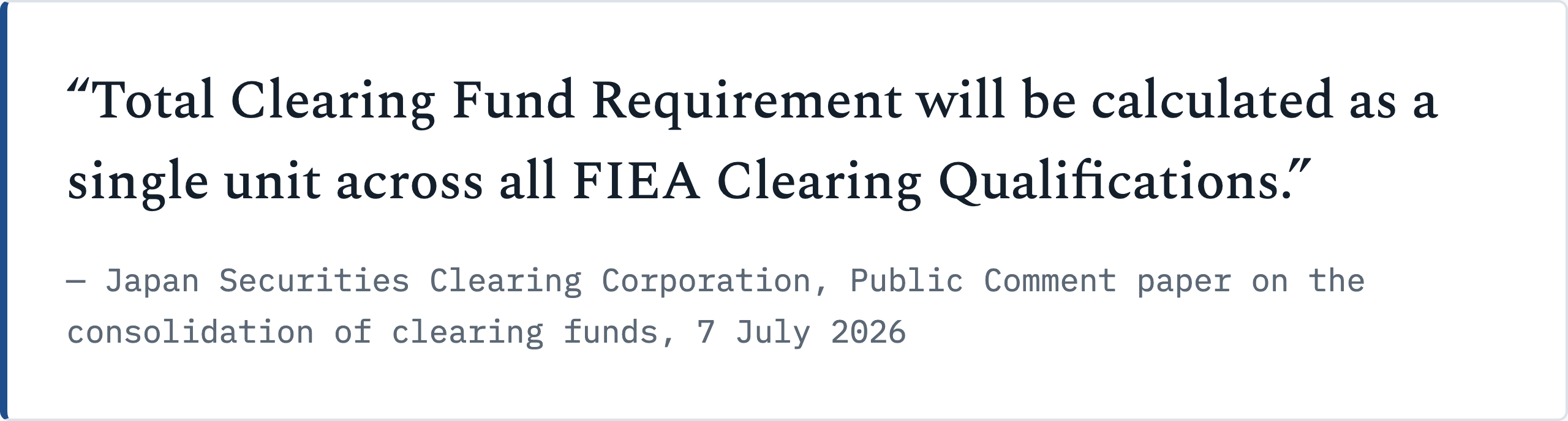
JSCC’s own rulebook shows why the ask matters. Right now, under Article 2 of JSCC’s Rules on Required Amount of Clearing Fund, JSCC calculates six separate required amounts, one each for JGB Futures, Index Futures, Precious Metal Futures, Rubber Futures, Agricultural Futures and Petroleum Futures qualification, every business day, off a shared futures and options base date. A firm that only clears JGB futures currently owes nothing toward a rubber futures default. Nothing. Its contribution sits in its own pool, sized off its own inputs. Consolidation is not an accounting relabel: JSCC’s own July proposal states the total requirement will be “calculated as a single unit across all FIEA Clearing Qualifications”: one pool where six sit today. It changes what that firm’s posted capital is actually on the hook for.
My read: the two sides don’t actually disagree about whether the fund gets smaller, or about whether every segment benefits from that. They disagree about whether “everyone’s bill goes down” is a full answer to “who bears a tail they didn’t choose to hold,” and JSCC’s own paper, which I read directly instead of relying on ISDA’s summary, argues the first question well and does not address the second at all.
Below: the pro rata mechanism worked line by line against JSCC’s own rulebook, the LME 2022 waterfall mapped onto a JSCC-scale shock, what CME and Eurex actually do internally, the backtesting shortfall behind the precious metals margin change, and three questions to put to a JSCC relationship contact this week.
Below the paid line:
The full pro rata mechanism worked line by line from JSCC’s own rulebook, including the yen deduction JSCC applies before sizing each member’s contribution
The LME Clear waterfall from March 2022, mapped onto what a merged JSCC fund would face in an equivalent scenario, and the one number JSCC has already disclosed that argues the other way
What CME and Eurex actually do internally, and why the comparison is weaker than a first read suggests
The backtesting shortfall behind JSCC’s precious metals margin change, and the half of it most write ups leave out
Three questions worth asking a JSCC relationship contact regardless of the comment window already being shut
