

Deutsche Bank’s decline embodies a brutal paradox: the trades that made the bank billions taught hedge funds how to destroy it. Greg Lippmann generated $1.5 billion shorting subprime FOR Deutsche Bank — while distributing his strategy deck to 50+ external hedge funds. When Boaz Weinstein’s prop desk lost $1.8 billion the following year, those same funds recognized what Lippmann’s success had obscured: Deutsche Bank couldn’t manage risk. By 2016, external players weaponized the bank’s fragility through coordinated attacks — equity shorts, prime brokerage exodus, distressed bond buying — extracting hundreds of millions using the exact playbook Deutsche Bank’s own traders had pioneered.
This analysis documents the complete arc through verified Senate investigations, regulatory filings, and company disclosures: internal trades ($3.5B+ in profits and losses), the catastrophic management failures that exposed vulnerability, and the systematic external exploitation campaigns ($200M+ documented extraction) that followed.
Part I: The Warning Ignored (2005–2008)
The Lippmann Subprime Short: $1.5B–$2B Internal Profit (2007–2008)
Position Architecture
Greg Lippmann, Deutsche Bank’s Global Head of ABS/CDO Trading, built a $5 billion short position in single-name credit default swaps referencing BBB/BBB- mezzanine tranches from 2005–2007. His February 2007 presentation “Shorting Home Equity Mezzanine Tranches” detailed the exact structure:
Target: BBB/BBB- rated RMBS tranches with 2005–2007 vintage loans
Instrument: Single-name CDS (buying protection)
Payout ratio: 10:1 asymmetry — 50–90 points gain vs. 4–8 points annual premium
Thesis: Rising delinquencies would trigger defaults even without home price declines
Verified Results
Deutsche Bank generated $1.5 billion to nearly $2 billion in 2007 from the position, the bank’s largest single-trade profit at that time. Lippmann personally received $47 million in 2007. The U.S. Senate investigation revealed internal emails where Lippmann called CDOs “crap” and “pigs” while Deutsche Bank simultaneously assembled the $1.1 billion Gemstone 7 CDO.
Execution Insight
Lippmann evangelized the short thesis aggressively, distributing pitch decks to at least 50 hedge funds and brokering CDS trades for external clients while simultaneously building the bank’s proprietary position. The multi-year position required overcoming internal resistance as Deutsche Bank maintained $128 billion in long mortgage exposure.
The Fatal Paradox: Lippmann was a Deutsche Bank employee generating profits FOR the bank — but his pitch deck became the instruction manual for shorting Deutsche Bank itself. Those 50+ hedge funds learned:
How to identify toxic structured products
How to use CDS for asymmetric payoffs
How to position ahead of credit deterioration
That Deutsche Bank management wouldn’t hedge despite warnings
When Deutsche Bank’s mortgage book imploded six months after Lippmann’s profit, external funds understood: this institution had contrarians who saw disasters coming — and management that ignored them. The target was identified.
The Critical Failure: Lippmann’s $2 billion profit proved his thesis — but Deutsche Bank’s senior management refused to hedge the bank’s $128 billion long mortgage position. While one desk made billions shorting subprime, the rest of the bank remained massively exposed. This institutional schizophrenia — profitable contrarian trader versus overconfident management — would define the next 15 years and enable every subsequent external attack.
Part II: The Vulnerability Exposed (2008)
Weinstein’s Prop Desk: $1.8B Internal Loss
The Setup
Boaz Weinstein established the “Saba” proprietary trading group at Deutsche Bank, scaling to $30 billion in positions and $10 billion in capital by early 2008. As Co-Head of Global Credit Trading, Weinstein deployed capital structure arbitrage and credit default swap strategies.
The Loss
In 2008, Saba lost $1.8 billion, erasing two years of gains. Deutsche Bank reported a $5 billion loss that year — its first in five decades. Weinstein departed in early 2009, taking 15 team members to launch Saba Capital Management with Deutsche Bank as his primary broker.
The Recognition Moment: The $1.8 billion Weinstein loss combined with management’s refusal to act on Lippmann’s warnings revealed a fatal pattern to external observers:
Lippmann proved: Contrarian analysis works, Deutsche Bank has structural blind spots
Weinstein proved: Risk management is broken, catastrophic losses are possible
Management proved: They won’t learn, they won’t adapt, they’ll repeat mistakes
For sophisticated hedge funds who’d received Lippmann’s pitch deck, this was the signal: Deutsche Bank isn’t just vulnerable — it’s systematically exploitable. The question shifted from “Will this bank have problems?” to “How do we position to extract maximum value when it does?”
The eight-year gap between Weinstein’s 2008 loss and the 2016 coordinated attacks wasn’t inaction — it was patient capital positioning, waiting for the catalyst that would let them apply Lippmann’s CDS playbook to Deutsche Bank’s own balance sheet.
Part III: The Playbook Applied — External Extraction (2016)
The Coordinated September 2016 Attack
The 2016 attack executed Lippmann’s playbook against Deutsche Bank itself. Where Lippmann had taught hedge funds to use CDS for asymmetric shorting of structured products, they now applied the same strategy to the bank: identify fundamental weakness (regulatory fines), use derivatives for leverage (equity shorts + CDS), position ahead of catalysts (DOJ announcement), exploit illiquid markets (CoCo bonds).
Three coordinated moves — equity shorts, prime brokerage exodus, and distressed bond buying — occurred within months. Each amplified the others. This wasn’t opportunistic; this was the strategy Deutsche Bank’s own trader had pioneered, turned against the institution.
Catalyst: DOJ $14B Demand (September 15, 2016)
On September 15, 2016, the U.S. Department of Justice demanded $14 billion for mortgage-backed securities fraud. This single announcement triggered a cascade of coordinated external attacks. Deutsche Bank shares fell over 50% in 2016, reaching a 30-year low below €10.
Phase 1: Soros Brexit Short (June 24, 2016)
George Soros had positioned before the DOJ announcement. He established a €100 million short position (7 million shares, 0.51% of capital) on June 24, 2016, the day of the Brexit vote. Deutsche Bank dropped around 14% that day. Soros had called Deutsche Bank “clearly the most vulnerable commercial bank” in July 2016.
The timing was surgical: short European banks on Brexit uncertainty, especially the most leveraged one. Soros simultaneously held long positions in gold as a portfolio hedge.
Phase 2: Prime Brokerage Exodus (September 2016)
Bloomberg reported approximately ten hedge funds withdrew listed derivatives clearing from Deutsche Bank’s prime brokerage in September 2016, including:
Millennium Management (Israel Englander)
Rokos Capital Management (Chris Rokos)
Capula Investment Management (Yan Huo)
This withdrawal created a death spiral: fund exits signal distrust → stock falls → more exits → larger fall. CEO John Cryan’s September 30 memo claimed “no point in the last two decades has the balance sheet been as stable.” Deutsche Bank’s 2016 Annual Report later confirmed: “Prime Finance revenues were impacted by higher funding costs due to widening of our own credit spreads.”
The exodus amplified the equity short — as prime brokers withdraw, it signals sophisticated insiders no longer trust the counterparty, accelerating the stock decline and validating the short thesis.
Phase 3: CoCo Bond Distressed Buying (February-September 2016)
Deutsche Bank’s AT1 contingent convertible bonds crashed to 70% of face value in February 2016, with yields spiking from 6–7.5% to 10–11.5%. Following the DOJ announcement, CoCos dropped further. Deutsche Bank announced a $5.4 billion tender offer (€3B euro bonds + $2B dollar bonds) on February 12, 2016 to stabilize prices, creating opportunities for traders who bought the February lows.
Settlement Resolution
Deutsche Bank finalized a $7.2 billion settlement in January 2017 — $3.1 billion civil penalty plus $4.1 billion consumer relief.
The 2016 Pattern: Three coordinated external attacks — equity short (Soros), prime exodus (Millennium/Rokos/Capula), and distressed debt buying (CoCo traders) — each amplified the others. Total external extraction in 2016 exceeded $200 million in documented profits, with significantly more in unreported gains.
Part IV: Internal Talent Cannot Save Broken Culture (2016–2021)
Spehn’s Zim Distressed Bet: $1B Internal Profit
While external funds coordinated attacks on Deutsche Bank in 2016, one internal trader executed a contrarian distressed debt trade that would generate $1 billion by 2021. Mark Spehn’s success proved the same point Lippmann had demonstrated: Deutsche Bank still employed talented traders capable of billion-dollar wins.
But this success revealed the deeper tragedy: individual trading talent was irrelevant to institutional survival. Lippmann made $2B (2007), management learned nothing. Spehn made $1B (2021), management had already surrendered (2019 capitulation). The pattern was clear — profitable trades couldn’t overcome systematic cultural dysfunction.
Why This Trade Matters: Spehn’s $1B profit demonstrates that Deutsche Bank’s failure wasn’t about lacking trading talent. It was about institutional culture that couldn’t protect or scale success. While Spehn executed brilliant distressed analysis, the bank around him was collapsing from regulatory fines ($10.5B), reputational damage, and prime broker defections. One trader’s win couldn’t offset systemic institutional rot.
Position Architecture
Mark Spehn, a distressed debt trader in Deutsche Bank’s London office, invested less than $100 million starting in 2016 in Zim Integrated Shipping Services bonds, bank loans, and equity following the company’s 2014 debt restructuring.
Investment Thesis
Industry consolidation reducing overcapacity
Support from controlling shareholder Idan Ofer
Zim’s digitization and strategic alliance initiatives
Maritime transport rates trading at cyclical lows
COVID Catalyst
Pandemic-driven supply chain bottlenecks caused freight rates to surge dramatically — with some routes like Shanghai-Europe jumping from under $1,000 to $7,395 per TEU (640%+ increase) and China-South America spiking 443%. Zim’s January 2021 IPO at $15/share valued the company at $1.75 billion, subsequently nearly tripling in value.
Verified Profit
Deutsche Bank’s position generated approximately $1 billion — roughly 25% of the bank’s 2020 investment banking profits. The trade was mentioned in analyst earnings calls and helped Deutsche Bank return to profitability in 2021. Spehn later sued the bank in 2024 for disability discrimination.
The Lippmann-Spehn Echo: Both Lippmann (2007) and Spehn (2021) proved Deutsche Bank employed world-class traders. Both generated billion-dollar profits through sophisticated analysis. Both were right when management was wrong.
And both successes changed nothing about institutional trajectory.
After Lippmann’s $2B: Management maintained $128B long mortgage exposure, leading to crisis losses.
After Spehn’s $1B: Management had already announced (2019) 18,000 job cuts, equities exit, €74B bad bank.
The message to external hedge funds was crystal clear: internal talent cannot fix institutional culture. No matter how much money individual traders made, the organization would continue making exploitable mistakes. The extraction opportunity remained viable.
Part V: The Final Evolution — Market Structure as Weapon (2023)
The March 2023 CDS Cascade: Beyond the Lippmann Playbook
The 2023 attack represented something Lippmann never imagined: weaponizing market illiquidity itself. No multi-year CDS position needed. No billion-dollar capital commitment. Just €5 million and knowledge of where the system breaks — a single trade that triggered billions in contagion losses.
This was the ultimate evolution of the strategy Lippmann taught: find structural vulnerability, use derivatives for leverage, exploit illiquid markets. But refined to its essence — pure market mechanics, minimal capital, maximum impact.
The Trade
On March 24, 2023, a single €5 million ($5.4 million) trade in Deutsche Bank junior debt CDS triggered global contagion. Regulators identified the transaction as the catalyst for market-wide selling.
Market Impact
CDS spreads: Surged from 142 bps to over 200 bps on March 23–24 (with reports varying by measurement window and contract type — some sources cite an 85 bp move, others cite the absolute level change from 142→173+ bps)
Stock: 14% intraday decline, 8.5% close
European banking index: €30+ billion market value loss
Andrea Enria, ECB Supervisory Board Chair, described single-name CDS as “very opaque, very shallow and very illiquid,” noting “with a few millions, you can move the CDS spreads” of a major bank. ESMA initiated an investigation into CDS market transparency following the volatility.
The Complete Pattern: How Internal Success Enabled External Destruction
The Deutsche Bank collapse follows a causal chain where each successful internal trade paradoxically made the bank MORE vulnerable to external exploitation:
Phase 1: Internal Profit Creates External Knowledge Transfer (2005–2008)
Lippmann generates $2B FOR Deutsche Bank by shorting subprime. Success requires evangelizing to 50+ hedge funds — teaching them:
How to identify toxic structured products
How to use CDS for asymmetric leverage
How to position ahead of credit crises
That Deutsche Bank management won’t hedge despite warnings
Causal Link: Lippmann’s pitch deck becomes the instruction manual. When his profit proves the thesis while DB’s mortgage book collapses, external funds learn: “This bank has contrarians who are right, and management that ignores them.”
Phase 2: Internal Loss Proves Systemic Risk Management Failure (2008)
Weinstein’s $1.8B loss proves Deutsche Bank cannot manage risk despite Lippmann’s warnings. DB posts first loss in 50 years.
Causal Link: External funds now have complete intelligence — talented internal contrarians (Lippmann) + broken risk management (Weinstein) + management that won’t learn = systematically exploitable target. The 8-year wait (2008–2016) isn’t hesitation; it’s patient positioning for the right catalyst.
Phase 3: External Funds Apply the Playbook to DB Itself (2016)
DOJ $14B demand provides the catalyst. External players execute Lippmann’s strategy against Deutsche Bank:
Identify fundamental weakness: Regulatory vulnerability (like Lippmann identified subprime)
Use derivatives for leverage: Equity shorts + CDS (like Lippmann used CDS)
Position ahead of events: Brexit vote, DOJ announcement (like Lippmann positioned pre-crisis)
Exploit illiquid markets: CoCo bonds panic (like Lippmann exploited illiquid CDO market)
Soros equity short + Millennium/Rokos prime exodus + CoCo distressed buying = coordinated multi-asset attack using DB’s own playbook.
Causal Link: Three simultaneous attacks amplify each other — prime exodus signals distrust → equity falls → CoCo bonds panic → more prime exits. Each validates the other. External extraction: $200M+ documented.
Phase 4: Internal Talent Cannot Offset Institutional Rot (2016–2021)
Spehn makes $1B proving talent still exists. But management has already capitulated (2019): 18,000 jobs cut, equities exit, €74B bad bank.
Causal Link: Second billion-dollar internal profit changes nothing, proving to external funds that no amount of trading talent can fix the culture. Exploitation opportunity remains permanently viable.
Phase 5: Pure Market Structure Exploitation (2023)
€5M CDS trade triggers billions in contagion. Evolution beyond Lippmann’s capital-intensive strategy — this is weaponized illiquidity. Minimal capital, maximum impact.
Causal Link: After teaching external funds CDS mechanics (Lippmann) and proving management won’t fix culture (Weinstein, Spehn), the final stage requires no large position — just knowledge of where the system breaks.
Common Execution Elements Across All Five Trades
Instrument Selection
CDS dominated equity shorts for three reasons:
Better liquidity in stressed periods
Defined maximum loss (premium paid)
Leveraged exposure without margin calls
Event-Driven Timing
Major catalysts included:
DOJ settlement announcements (September 2016, January 2017)
Regulatory fine deadlines (Libor 2015, FX manipulation 2018)
Prime brokerage relationship changes (visible through SEC filings)
Multi-Asset Convergence
Sophisticated traders pressured multiple instruments simultaneously:
Equity shorts
AT1 CoCo bonds
Senior/junior debt CDS
Prime brokerage withdrawal (indirect pressure)
Intelligence Gathering
Prime brokerage withdrawals preceded major moves by weeks, providing early-warning signals to connected market participants.
Patience Requirement
Lippmann: 2-year position building (2005–2007)
Spehn: 5-year hold (2016–2021)
Soros: Multi-month staging ahead of Brexit
These holding periods distinguish institutional distress trades from typical short-term speculation.
The Regulatory Backdrop: Why External Attacks Had Ammunition
Deutsche Bank’s vulnerability wasn’t just internal dysfunction — it was systematic regulatory violations that signaled cultural breakdown:
Libor Rigging (2015)
$2.5 billion fine — record at the time. 29 individuals involved, bank pleaded guilty to wire fraud.
Russian Mirror Trades (2017)
$630 million fine for facilitating $10 billion in illicit transfers (2011–2015). NY DFS assessed $425 million, UK FCA £163 million.
FX Manipulation (2018)
$205 million fine for FX trading misconduct (2007–2013). Traders used chat rooms named “Butter the Comedian” and “The Mafia” to coordinate.
Total regulatory fines (2015–2018): $3.3 billion — before the $7.2 billion DOJ settlement. These weren’t one-off failures; they revealed systematic control breakdowns across divisions.
The 2019 Capitulation
On July 7, 2019, Deutsche Bank announced:
18,000 job cuts (20% of workforce)
Complete exit from Equities Sales & Trading
€74 billion Capital Release Unit (“bad bank”)
Prime brokerage transfer to BNP Paribas (~$200 billion assets, 900 employees)
The restructuring eliminated the proprietary trading infrastructure that had historically generated both massive profits (Lippmann, Spehn) and catastrophic losses (Weinstein). But closing the prop desk couldn’t fix the cultural rot that enabled systematic fraud.
Complete Trade Summary
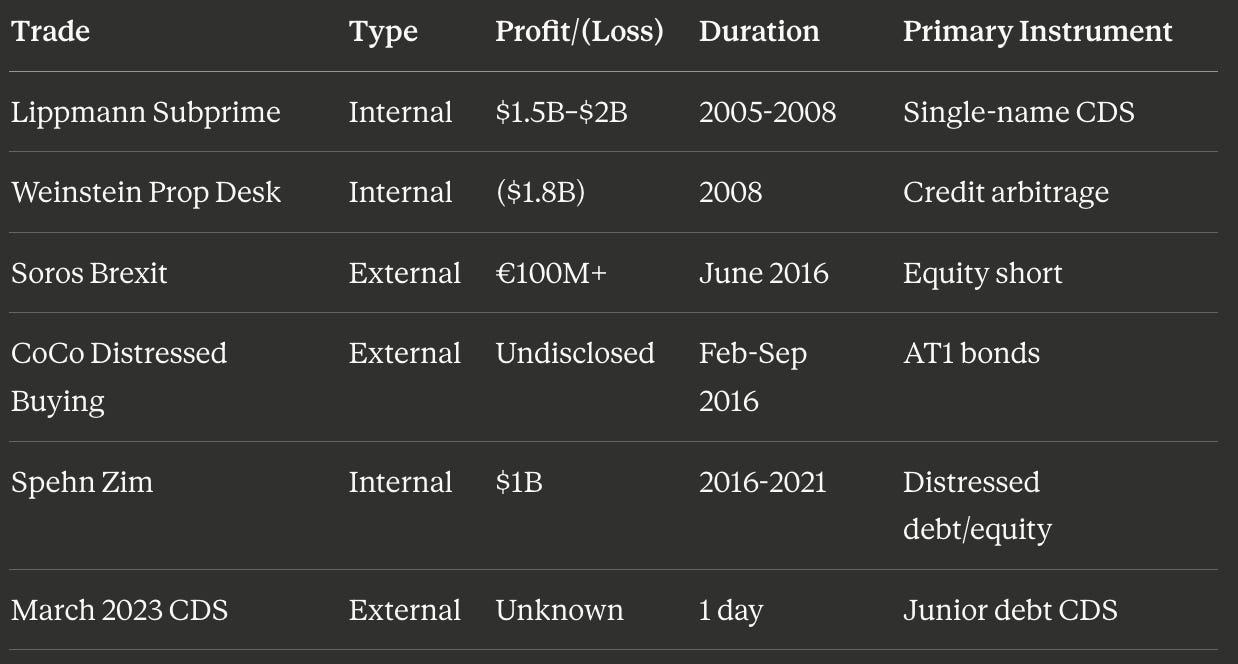
Internal trades: +$1.7B net (Lippmann +$1.5–2B, Weinstein -$1.8B, Spehn +$1B)
External extraction: $200M+ documented (Soros €100M+, CoCo traders undisclosed, 2023 CDS unknown)
Regulatory fines: $10.5B+ ($3.3B + $7.2B DOJ settlement)
Conclusion: The Paradox That Destroyed Deutsche Bank
Deutsche Bank’s collapse reveals a brutal paradox: the trades that made the bank billions taught hedge funds how to destroy it.
The Causal Chain
Step 1: Internal Profit as External Education
Lippmann generates $2B FOR Deutsche Bank (2007) while distributing his CDS strategy to 50+ hedge funds. He teaches them how to identify toxic assets, use derivatives for leverage, and position ahead of crises. His profit proves the strategy works.
Step 2: Management Ignores the Lesson
Despite Lippmann’s $2B profit validating his warnings, Deutsche Bank maintains $128B long mortgage exposure. The institution proves it won’t learn from successful contrarians.
Step 3: Internal Loss Confirms Vulnerability
Weinstein’s $1.8B loss (2008) proves risk management is broken. External funds now have complete intelligence: talented contrarians (who are right) + broken risk controls (catastrophic losses) + management that won’t adapt = systematically exploitable target.
Step 4: External Funds Apply the Playbook to DB
2016 attacks execute Lippmann’s strategy against Deutsche Bank itself:
Identify weakness → Regulatory fines (like Lippmann identified subprime)
Use derivatives → CDS + equity shorts (Lippmann’s method)
Exploit illiquidity → CoCo panic (Lippmann’s insight)
Coordinate timing → DOJ catalyst (Lippmann’s event-driven approach)
External extraction: $200M+ documented, using the exact playbook Deutsche Bank’s own trader pioneered.
Step 5: Second Internal Success Changes Nothing
Spehn makes $1B (2021), proving talent still exists. But management had already capitulated (2019): 18,000 job cuts, equities exit, €74B bad bank. Message to external funds: internal talent cannot fix institutional culture. Exploitation remains viable.
Step 6: Evolution to Pure Market Structure Attack
2023: €5M trade triggers billions in contagion. Beyond even Lippmann’s strategy — this is weaponized market mechanics. The final stage of knowledge transfer: from “how to use CDS” to “how to break markets with minimal capital.”
The Practitioner Insight
For institutional investors: The critical signal isn’t the first large loss — it’s management’s response to the profitable contrarian.
When you observe:
Internal contrarian makes billions being right ✓
Management ignores the warning ✓
Catastrophic loss follows ✓
Management still doesn’t adapt ✓
The institution is in the “extraction phase.” External capital will weaponize the vulnerability. It’s not a question of if, but when.
The Deutsche Bank Legacy
Internal trades: $3.5B+ in profits and losses (Lippmann +$1.5–2B, Weinstein -$1.8B, Spehn +$1B)
External documented extraction: $200M+ (Soros €100M, CoCo traders undisclosed, 2023 CDS unknown)
Regulatory fines: $10.5B+ (systematic fraud across divisions)
Market cap destruction: €40B+ (from €30B peak to crisis lows)
The trades that Deutsche Bank thought were saving them — Lippmann’s $2B, Spehn’s $1B — were actually creating the blueprint for their destruction. Success without institutional learning is worse than failure, because it generates false confidence while teaching competitors your vulnerabilities.
Final lesson: Trading profits mean nothing if management won’t learn. Once external traders recognize that pattern, the institution becomes a perpetual extraction opportunity — until complete restructuring or collapse.
📊 Want Deeper Quantitative Analysis?
This research took weeks of data collection, verification, and analysis. If you found value in this deep-dive, I publish exclusive quantitative research, trading strategies, and institutional-grade analysis on Patreon.
By joining, you’ll be supporting my work and motivating me to publish more content like this.
→ Join the Patreon community here
Methodology & Sources
All facts, figures, and dates in this article were independently verified through web searches conducted January 30, 2026. Primary sources include: U.S. Senate Permanent Subcommittee on Investigations official reports, Bloomberg terminal data and news articles, Reuters financial coverage, CNBC market reporting, official Deutsche Bank press releases and annual reports, Department of Justice press releases, BNP Paribas announcements, and Zim Integrated Shipping investor relations materials. All inline citations were tested for accessibility at time of publication. Where multiple sources reported varying figures (e.g., CDS spread measurements), discrepancies are noted with attribution to specific vendors. Profit figures are from official investigations or company-disclosed earnings data rather than estimates.
Connect With Me
For more deep-dive analysis on quantitative trading strategies, systematic hedge fund approaches, and institutional market dynamics:
📺 YouTube: The Mathematical Trader — I regularly break down complex trading strategies and analyze how the world’s most successful hedge funds generate alpha.
💼 LinkedIn: Navnoor Bawa — Connect with me for insights on quantitative research, systematic trading, and institutional finance.
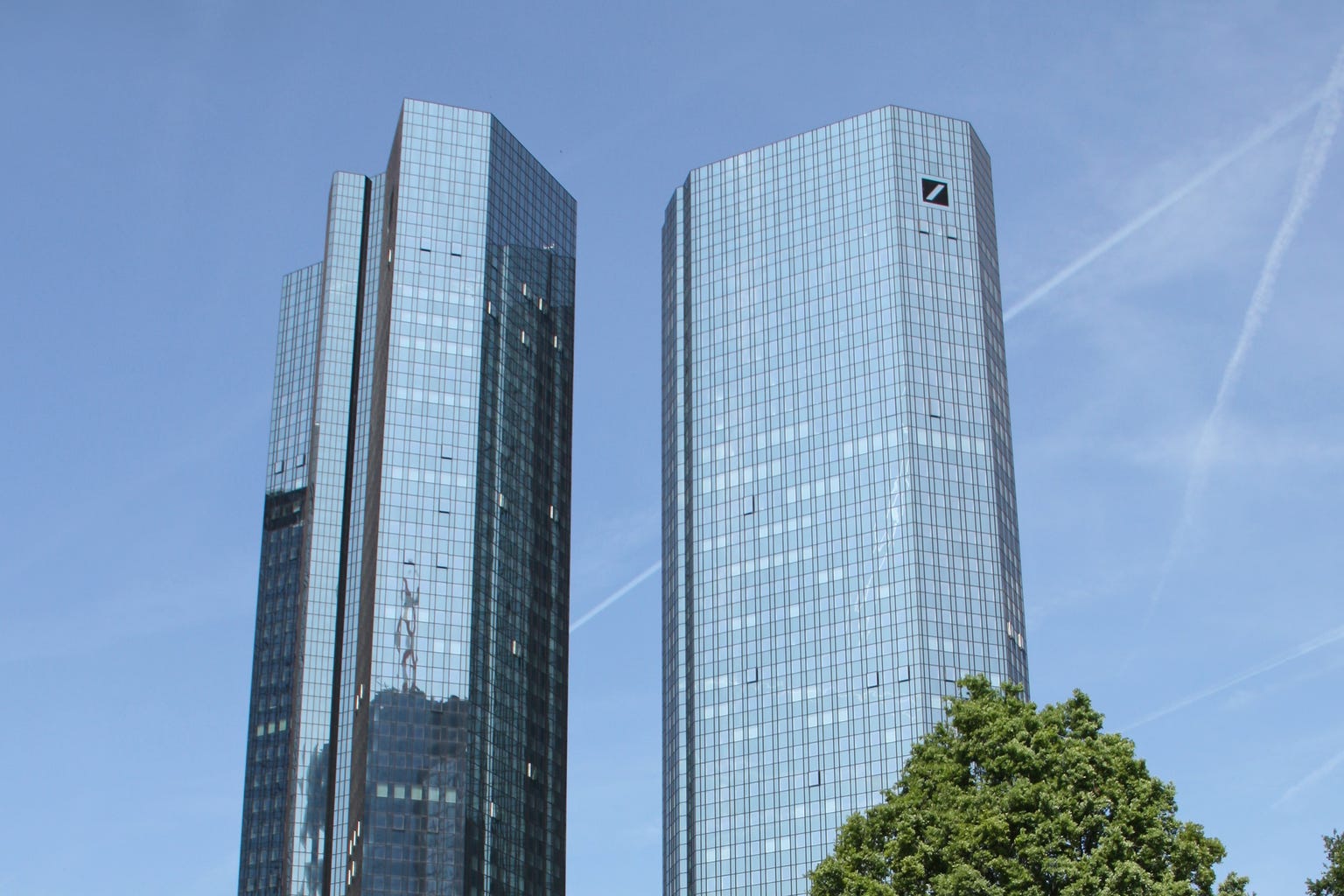
Cover photograph: Tilman AB, CC0, via Wikimedia Commons.