


A primary-source reconstruction of the most documented activist campaign of 2025–26: the exact positions, verified financials, legal agreements, concessions already extracted, the precise mechanics by which two of Wall Street’s most sophisticated funds expect to get paid — and the credible bull case on the other side.

Fact-checked against SEC EDGAR · D.E. Shaw Primary PDF · CoStar IR · StockTitan. All financial figures sourced from primary documents and cross-verified.
Written by Navnoor Bawa · YouTube — The Mathematical Trader · LinkedIn
At a Glance
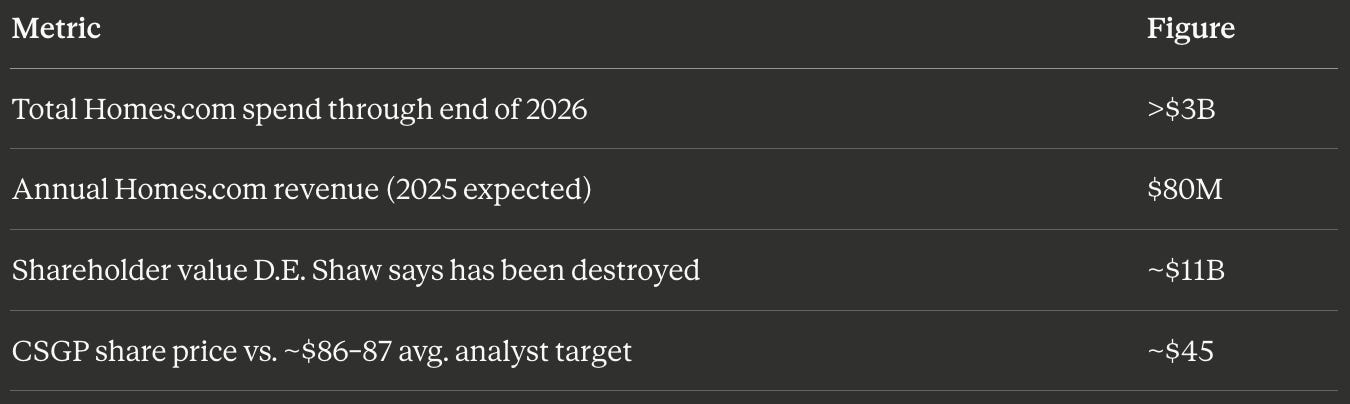
The activists’ thesis is six words: one bet is suppressing the company’s value. Third Point and D.E. Shaw have spent the better part of eighteen months building the documentary record to prove it — primary letters, SEC filings, a detailed analytical presentation — and the math behind the distortion is not in dispute. CoStar Group’s commercial real estate data business generates compounding, high-margin revenue that activists and analysts estimate — based on peer information-services multiples and the CRE segment’s pre-Homes.com margin trajectory — could be worth more than $35 billion as a standalone entity. The market cap of the entire company, as of mid-February 2026, is roughly $19 billion. The gap between those two numbers is named Homes.com. Not everyone agrees the gap is permanent or that the cure is abandonment — a credible bull case exists, and this article documents both.
What follows is a verified reconstruction — every claim tied to a primary document — of how two of the most analytically rigorous funds in alternative asset management built their positions, what concessions they have already extracted, the precise sequence by which they expect the trade to pay, and why a major long-term CoStar shareholder believes they are wrong.
I. The Exact Position: What the SEC Filing Says
The single most important number is buried in a legal agreement on the SEC’s EDGAR database. When Third Point and CoStar signed their standstill agreement on April 6, 2025, the document states that Third Point and its affiliates “beneficially own or have economic exposure to 8,353,000 shares of common stock of the Company.”
The phrase “economic exposure” is load-bearing. It means the position includes equity derivatives — options or total return swaps — not only outright stock. Activists use these instruments to build exposure below the 5% Schedule 13D disclosure threshold before converting to voting shares. With 416 million diluted shares outstanding — CoStar’s own figure from its January 7, 2026 guidance filing — 8.353 million equals approximately 2% of the company. At CSGP’s current price of approximately $44.99–$47.87, the position is worth roughly $375–$400 million — a significant paper loss from the $68–75 range where the stock traded near the April 2025 agreement date. CSGP’s all-time intraday high was $101.05 on October 26, 2021 — the year CoStar first began building Homes.com in earnest.
D.E. Shaw, which as of February 2026 manages more than $85 billion in investment capital per its own press release, has never disclosed an exact stake size. Its February 4, 2026 letter states only that it “currently hold[s] a significant economic position in the Company” — language that mirrors Third Point’s pre-settlement posture and almost certainly implies a derivatives-based position below the 5% disclosure threshold. What D.E. Shaw did disclose was its analytical framework, and it is more precise and more damaging than anything Third Point published.
II. The Capital Destruction Case — Exact Numbers from Primary Sources
Both funds quantified the Homes.com destruction with more precision than any sell-side analyst. The confirmed figures, drawn directly from the letters and CoStar’s own filings:
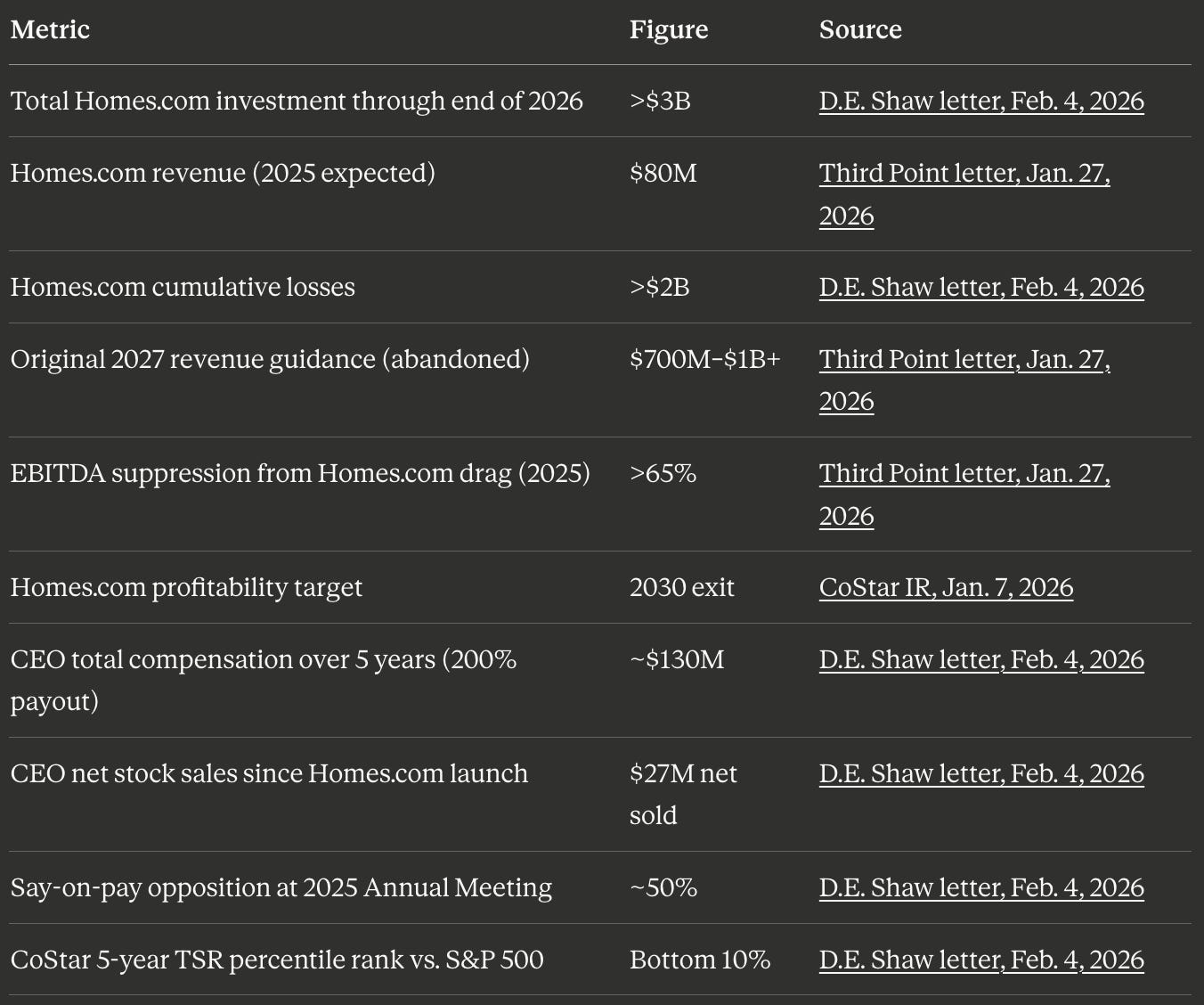
The CEO compensation figure is structurally damning. D.E. Shaw’s letter documents that over five years, Andy Florance’s annual cash and equity incentive awards paid out at 200% of target — every year but one, when the cash portion paid out at only 150% — generating approximately $130 million in total compensation while the company’s TSR ranked in the bottom decile of the S&P 500. Simultaneously, Florance net sold $27 million of CoStar stock since November 2022, when Homes.com was relaunched. A founder who is net selling while arguing his residential experiment will create billions annihilates the conviction argument.
“By the end of this year, CoStar will have spent more than $3 billion on Homes.com and diverted the majority of core business earnings over the last four years to fund this venture.” — D.E. Shaw letter to CoStar Board of Directors, February 4, 2026
D.E. Shaw made two distinct financial claims that the research community has conflated. The fund estimates that the Homes.com drag has already destroyed as much as $11 billion in shareholder value — the discount at which CoStar’s core trades relative to peers — and that separating or dramatically curtailing Homes.com could generate more than $10 billion in new shareholder value going forward. These are separate calculations, not the same number recycled.
“Every shareholder who has purchased CoStar’s stock in the last five years has lost money.” — D.E. Shaw letter to CoStar Board of Directors, February 4, 2026
📊 Want Deeper Quantitative Analysis?
This research required extensive data collection, primary-document verification, and cross-referencing across SEC filings, earnings transcripts, and institutional letters. If you found value in this deep-dive, I publish exclusive quantitative research, trading strategies, and institutional-grade analysis on Patreon — the kind of work that doesn’t make it into a free article.
By joining, you’ll be supporting independent research and motivating more content like this.
→ Join the Patreon community here
III. The 2025 Standstill: What It Produced — and Why It Wasn’t Enough
Third Point spent the first half of 2025 in private engagement. The standstill agreement signed April 6, 2025 secured three new independent directors:
Christine McCarthy — former Disney CFO
John Berisford — former President of S&P Global Ratings (the designated Third Point Nominee)
Rachel Glaser — former Etsy CFO
Simultaneously, Michael Klein, Christopher Nassetta, and Laura Kaplan retired from the board. Louise Sams was named independent board chair. The board became 7 of 8 directors independent.
The most structurally significant concession was a Capital Allocation Committee (CAC) with board members linked to the activists. The CAC was not cosmetic — CoStar’s own January 7, 2026 strategic update noted all new initiatives had been “unanimously approved by the Board and Capital Allocation Committee.” The activists had seats at the table where capital decisions were being made.
When the standstill expired approximately one year later, Third Point’s verdict was blunt: “So little progress has been made that we are convinced the Company never intended to do any of the things we discussed when we entered into the agreement.” That sentence — an explicit accusation of bad faith — escalated the fight from governance negotiation to full proxy war.
IV. What CoStar Actually Conceded
CoStar’s January 28, 2026 response mixed theater with real concessions. Separating them matters for understanding the trade mechanics.
The $2 billion in capital returns is real. CoStar accelerated its existing $500 million buyback and authorized a new $1.5 billion share repurchase program. At roughly $45/share and 416 million diluted shares outstanding, $2 billion retires approximately 44 million shares — roughly 10% of the float. This is mechanically accretive to any remaining shareholder who bought above current price. It does not make Third Point whole but it puts a floor under the stock while the activists press for more.
The $300 million Homes.com spending cut in 2026 is real. CoStar confirmed it would reduce net Homes.com investment by $300 million in 2026 and $100+ million annually thereafter. At a 25x information-services multiple, every $100 million in recovered EBITDA is worth $2.5 billion in market cap. Third Point called this “flatly unacceptable” for not going far enough — but the $400 million total cut over two years is a real concession, not theatrics.
The 2026 EBITDA guidance is real but contested. CoStar’s January 7, 2026 strategic update guided 2026 adjusted EBITDA in a range of $740–$800 million (midpoint ~$770M) — an 83% increase over 2025 and the highest in company history at a 20% margin. The longer-horizon target — $2.3 billion in adjusted EBITDA at 35% margins by 2030 — was articulated in CoStar’s January 28, 2026 response to Third Point. D.E. Shaw directly challenged the nearer-term guidance, arguing the numbers reflect a “poorly disguised shift of expenses” from Homes.com to the core rather than genuine margin recovery.
Compensation reform is real. Following the near-50% say-on-pay revolt, CoStar committed to a redesigned executive compensation program with more rigorous, quantitative targets. If Florance’s pay becomes TSR-linked in any meaningful way, his economic interests shift toward the activists’ position — the most durable form of governance improvement.
V. The Six Mechanisms That Generate the Alpha
Mechanism 1 — EBITDA Restoration × Information-Services Multiple CoStar’s CRE core is capable of 50%+ EBITDA margins at scale. Consensus estimates declined more than 70% since 2021. Partial reversal at a 25x multiple equals billions in market cap recovery. This is the primary mechanism.
Mechanism 2 — Buyback Arithmetic $2 billion of buybacks at ~$45 against a ~$86–87 analyst consensus target retires shares at a roughly 48% discount to fair value. Every dollar spent is arithmetically accretive to remaining holders.
Mechanism 3 — Proxy Vote as Optionality Board control at the June 2026 Annual Meeting unlocks authority to force strategic alternatives for Homes.com: sale, spin-off, or structured wind-down. Each path raises the probability of unlocking D.E. Shaw’s $10 billion figure. The proxy filing itself forces the market to begin pricing those probabilities now.
Mechanism 4 — Strategic Acquirer Premium CoStar at a $19 billion market cap — a 94% renewal rate for customers with 5+ years on platform (per Q3 2025 earnings), 143 million monthly visitors across all brands, world’s largest proprietary CRE database — is a genuinely scarce asset at distressed prices. Public activist pressure raises the probability of inbound strategic conversations.
Mechanism 5 — Governance Arbitrage Already Captured Board composition, CAC formation, compensation redesign, three capital-focused directors — these are locked in regardless of proxy outcome. The governance baseline has improved irreversibly.
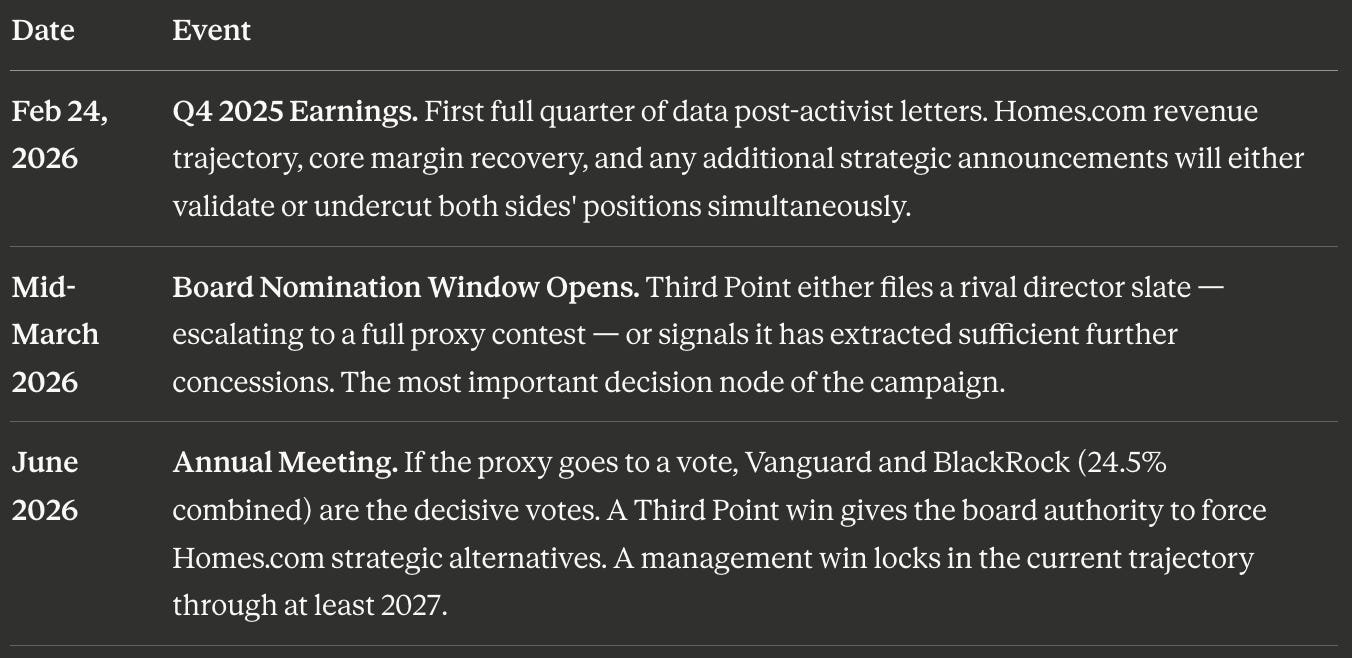
Mechanism 6 — Catalyst Sequencing Q4 2025 earnings (February 24) + mid-March nomination window + June proxy vote. Three binary events in four months compress the timeline and force the market to price scenario probabilities now rather than waiting.
Fifteen to sixteen analysts currently rate CSGP a Buy with a 12-month consensus price target of approximately $86–87 — roughly 90–95% upside from the current ~$45 price — with a top-end estimate of $105. Those targets assume only partial EBITDA recovery, not a full strategic separation of Homes.com.
All six mechanisms converge on a single chokepoint: the June 2026 Annual Meeting. Which institutions vote — and how — determines whether any of them pay.
VI. The Decisive Votes
Vanguard and BlackRock together hold approximately 24.5% of CoStar’s shares. These two institutions are the deciding votes in any proxy contest. Both have historically voted with management absent operational catastrophe — but a ~50% say-on-pay rejection at the 2025 Annual Meeting signals that the institutional base’s patience has limits. The activists will spend the next three months making the case that Homes.com is exactly that catastrophe.
CoStar’s counter-argument is equally pointed: its January 28 response noted that Third Point has “underperformed the Russell 3000 in nine of the past 10 years” and that all the January 2026 strategic initiatives were the direct result of the CAC review process the activists requested. The process worked, the company argues; Third Point simply wants faster and more radical action than the board is willing to take.
VII. The Counter-Case — Why Baillie Gifford Is Not Wrong
No honest analysis omits the bull case. Baillie Gifford, a CoStar shareholder for nearly a decade and its seventh-largest investor, told the FT on February 15, 2026 that Homes.com has “become a national brand with a rapidly expanding audience and subscription base” and that AI capabilities launching in early 2026 “will further strengthen its position and help establish CoStar’s next billion-dollar business.”
The data they cite is real. Homes.com has 26,000 paying members — up nearly 150% since Q3 2024 (per CoStar’s Q3 2025 earnings release, verbatim from CEO Florance) — and the Homes.com Network specifically attracted 115 million average monthly unique visitors as of Q3 2025, distinct from CoStar Group’s total website footprint of 143 million across all its brands. CoStar’s 2024 revenue was $2.74 billion, up 11.45% year-over-year. Apartments.com, which was called a “distracting money loser” for years, now generates hundreds of millions in annual profit.
The difference between Baillie Gifford and the activists is a single variable: whether the terminal value of Homes.com justifies the opportunity cost of suppressing the CRE core’s margin for 8+ years. That is a legitimate empirical disagreement, not a dispute about facts.
VIII. The Catalyst Calendar
Third Point and D.E. Shaw are currently sitting on significant paper losses relative to their entry levels. The stock is down approximately 38% over the past twelve months and 46% over five years. Neither fund has made money on the equity yet. What they have made is a documented record of extractable concessions — board composition, capital allocation oversight, $2 billion in buybacks, $400 million in Homes.com spending reductions, compensation reform — that have permanently altered the company’s governance structure regardless of proxy outcome.
The activist thesis at CoStar is not a stock tip. It is a years-long structural arbitrage against a valuation distortion created by one founder’s bet on residential real estate. The math of that distortion — $3 billion invested against $80 million in revenue and $2 billion in losses — is not in dispute. The only question is whether governance pressure, a February 24 earnings report, and a mid-March nomination decision can accelerate the market’s recognition of that distortion before the next quarterly narrative rewrites the story.
📊 Want Deeper Quantitative Analysis?
This research required extensive data collection, primary-document verification, and cross-referencing across SEC filings, earnings transcripts, and institutional letters. If you found value in this deep-dive, I publish exclusive quantitative research, trading strategies, and institutional-grade analysis on Patreon — the kind of work that doesn’t make it into a free article.
By joining, you’ll be supporting independent research and motivating more content like this.
→ Join the Patreon community here
About the Author
Navnoor Bawa publishes quantitative research and institutional-grade market analysis at the intersection of finance and data.
This article is for informational purposes only and does not constitute investment advice. All figures are as of publication date. Positions and prices change; verify current data before acting on any information herein.
Primary Sources
SEC EX-10.2 — Third Point Cooperation Agreement (April 6, 2025)
CoStar Jan. 28, 2026 Response to Third Point — $2.3B/35% 2030 target (Business Wire)
CoStar Q3 2025 Earnings Release — 26,000 Members / 150% growth sourced here
CoStar Homes.com Inman Award — 115M Homes.com Network visitors confirmed
Cover photograph: ajay_suresh, CC BY 2.0, via Wikimedia Commons.