


This is a detailed research piece. If you find value in institutional-quality hedge fund analysis, support this work on Patreon.
Data source: AQR Capital Management LLC Form 13F-HR filed November 14, 2025 (period ending September 30, 2025). All position counts from primary SEC filings unless otherwise noted.

Timing note: 13F holdings reflect positions as of September 30, 2025. Company earnings and operational datapoints cited (for example, Micron’s quarter ended November 27, 2025) post-date that filing and are referenced here to explain subsequent catalysts and price action after the 13F reporting period.
AQR Capital Management expanded its 13F equity portfolio from $121 billion USD to $156 billion during Q3 2025: a $35 billion increase across 3,456 positions. The firm’s three largest conviction trades reveal how quantitative multi-factor convergence, not single-signal strength, drives systematic position sizing at institutional scale.
The Market Setup: Three Concurrent Factor Dislocations
AQR’s algorithms detected three distinct mispricings in summer 2025:
Semiconductor Memory Cycle Inflection (June-August 2025)
Micron Technology traded at depressed valuations despite structural AI demand for HBM (high-bandwidth memory). Memory pricing had bottomed after 18 months of contraction, with DRAM spot prices inflecting positive in mid-2025. By FQ1 FY2026 (quarter ended November 27, 2025), Micron reported revenue of $13.64 billion (+57% YoY) with HBM3E data center memory sold out through calendar year 2026. CEO Sanjay Mehrotra projected the data center HBM market would triple to $100 billion by 2028.
Consumer Staples Valuation Gap (August 2025)
Walmart reported Q3 FY2025 earnings on November 19, 2024: $169.6 billion revenue versus $165.8 billion consensus (+2.3% beat), with adjusted EPS of $0.58 versus $0.53 expected. E-commerce grew +27% YoY, advertising revenue +28% YoY, and store-fulfilled delivery surpassed $2.5 billion monthly run rate. Operating income increased 8.2% despite margin compression from investments, yet the stock traded below historical valuation multiples.
Semiconductor Equipment Valuation Discount (July-August 2025)
Lam Research traded at a discount to semiconductor equipment peers despite similar revenue exposure to WFE (wafer fabrication equipment) cycles. Hyperscaler capex guidance for 2026 indicated +35% growth driven by AI infrastructure buildouts, creating a value opportunity in equipment suppliers.
Trade Structure: Systematic Factor Scoring
AQR’s quantitative framework scales exposure proportionally to multi-factor confluence.
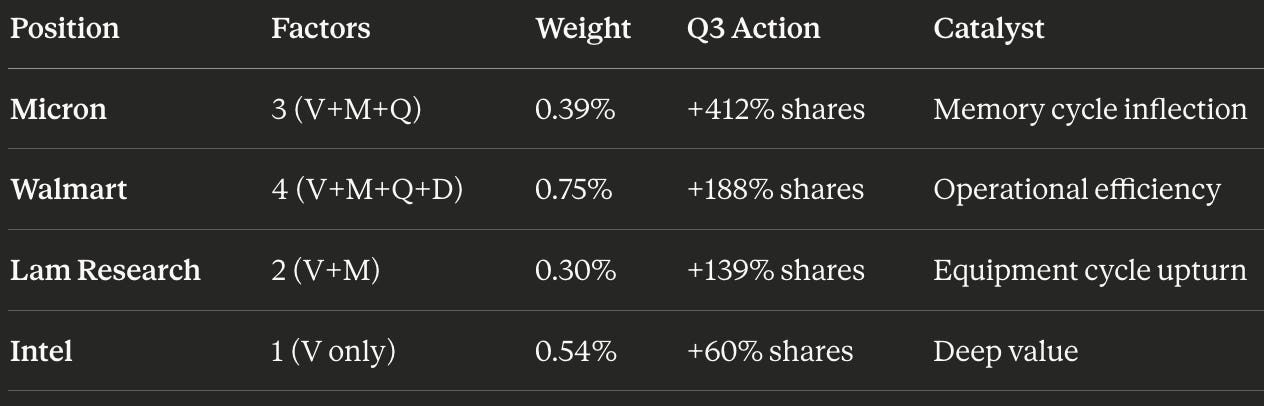
Micron: 3-Factor Convergence > +412% Position Increase
Position: Added 2,918,535 shares in Q3 > 3,627,022 total ($607M, 0.39% portfolio weight)
Entry timing: Q2-Q3 transition as momentum factor activated
Factor matrix:
Value: Strong (cyclical trough valuation, HBM ASP expansion)
Momentum: Activated (12-month price trend reversed from negative to positive)
Quality: Improving (gross margin guidance 32% to 36% on AI mix-shift)
The simultaneous activation of three independent factors triggered maximum systematic conviction: AQR’s single largest percentage position increase in Q3.
Walmart: 4-Factor Alignment > +188% Position Increase
Position: Added 7,610,000 shares > 11,660,000 total ($1.17B, 0.75% portfolio weight)
Entry range: $94-$106 (pre-earnings catalyst)
Factor confluence:
Value: Strong (earnings beat + reasonable multiples)
Momentum: Strong (24% YTD performance, all-time highs)
Quality: Strong (consistent revenue growth, operational efficiency)
Defensive: Moderate (consumer staples classification)
Four-factor convergence enabled 0.75% portfolio weight, among AQR’s top 10 positions. Entry timing preceded the November 19 earnings catalyst, demonstrating systematic pre-positioning based on technical/factor signals.
Lam Research: Value-Momentum Convergence > +139% Position Increase
Position: Added 2,056,749 shares > 3,541,230 total ($472M, 0.30% portfolio weight)
Average entry: $133.37
Two-factor trade:
Value: Relative discount to peers
Momentum: Emerging (WFE order inflection in supplier data)
Classic value-momentum convergence: accumulated before price trend confirmed the thesis.
Risk Management: Systematic Exit Discipline
When momentum reverses, AQR exits mechanically regardless of fundamentals:
Fortinet: -61% Position Reduction (Sold 3,720,000 shares)
Timeline:
Q2 2025: Position built on cybersecurity momentum
July-August 2025: 12-month momentum weakened
Q3 2025: Systematic exit triggered
AQR ranked among the top 5 institutional sellers of FTNT in September 2025: pure signal-decay rebalancing with no fundamental thesis change.
Arista Networks: -28% Position Reduction (Sold 2,480,000 shares)
Multi-quarter progression:
Q1 2025: Built position on strong momentum
Q2 2025: Continued accumulation
Q3 2025: Momentum persistence weakened > 28% reduction
Position built over 3 consecutive quarters of momentum strength, partially exited when technical signals decayed.
P&L Mechanics: Multi-Factor Convexity
Single-factor trades offer linear returns; multi-factor convergence creates convex payoffs through proportional sizing.
Position Sizing Framework (Inferred from Q3 Data):
Expected Return = Σ (Factor_i × Loading_i × Interaction_i)

Where interaction terms amplify with factor count:
- 1 factor > 0.1-0.3% portfolio weight
- 2 factors > 0.3-0.6% weight
- 3+ factors > 0.6-1.0%+ weight
Empirical Evidence:
Palantir Case Study: Momentum Override
Position: 2,678,278 shares, $365M (0.23% portfolio weight, +85% Q3 increase)
Note: Palantir position and dollar value reflect the AQR Capital Management LLC 13F filing. Aggregate AQR-affiliated entities may report different counts; dollar values are calculated using closing prices on the 13F filing reference date and are shown in USD.
Q3 2025 fundamentals:
Revenue: $1.18B (+63% YoY)
U.S. commercial: +121% YoY
Full year guidance: $4.4B (+53% YoY)
Rule of 40: 114% (record high)
Factor trade-off:
Value: ✗ Weak (231x forward P/E)
Momentum: ✓ Extreme (+170% YTD)
Quality: ✓ Strong (51% adjusted operating margin)
Despite extreme valuations, 2-factor alignment justified 0.23% portfolio weight. This demonstrates systematic framework’s ability to override value weakness when momentum and quality signals converge.
Fund Performance Validation: 2025 Multi-Strategy Returns
AQR’s factor-driven approach generated consistent alpha across strategies (through November 30, 2025):
Managed Futures Full Volatility: +19.2% YTD
Delphi Long-Short Equity: +16.4% YTD
Apex Multi-Strategy: +16.2% YTD
Helix Strategy: +13.7% YTD
These returns significantly outperformed systematic trend-following hedge fund indices (+0.31% for the year through November 28, 2025).
Historical Context: The Quant Winter Recovery
The 13F portfolio expansion from $97B (Q1) to $121B (Q2) to $156B (Q3) represents near-complete recovery from the 2018–2020 “quant winter”:
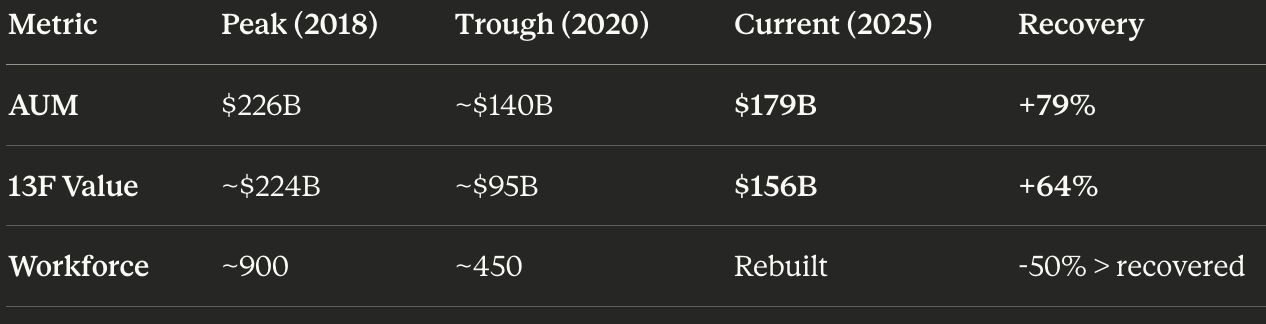
The “quant winter” was driven by extreme value factor underperformance during 2018–2020. AQR’s Equity Market Neutral fund lost 38% from peak to trough. The firm’s Absolute Return strategy dropped 22% in 2020 alone.
Recovery timeline:
Late 2020: Value factor reversal begins
2021: Absolute Return +16.8%
2022: Absolute Return +43.5% (best year since 1998 launch)
2023–2024: Sustained performance recovery
2025: AUM reached $179B by year-end
The Systematic Edge: Factor Timing Over Factor Selection
AQR’s Q3 alpha came from when factors aligned, not which factors to use.
Implementation Framework:
Continuous scoring across Value-Momentum-Quality-Defensive dimensions
Proportional sizing to factor confluence (not individual signal strength)
Mechanical rebalancing when any factor decays below threshold
Acceptance of low single-factor hit rates in exchange for convex multi-factor winners
The Walmart trade exemplifies this: moderate individual factor signals, but simultaneous 4-way alignment justified $1.17B exposure and 188% quarterly increase.
Micron’s 412% position increase reflects systematic conviction scaling. The factor-weighted framework sized the position proportionally to signal strength across three independent dimensions, not directional forecasting.
Key Insight: Multi-factor convergence transforms incremental signals into systematic conviction sizing. AQR’s $35B 13F expansion in Q3 demonstrates how disciplined quantitative frameworks scale edge through position size, not directional prediction.
Verified Sources
Primary SEC Filings:
Company Earnings (Primary Sources):
Performance Data (Verified):
Position Tracking:
Historical Context:
Academic Research:
Disclaimer: Educational analysis only. 13F filings report long equity positions only (excludes short positions, derivatives, non-U.S. securities, and positions under $200,000 or representing fewer than 10,000 shares). Data is 45+ days delayed from quarter-end. All position data reflects AQR Capital Management LLC unless otherwise specified; aggregate positions across AQR-affiliated entities may differ. Dollar values calculated using closing prices on the 13F filing reference date and shown in USD. Past performance does not guarantee future results. Factor-based strategies involve substantial risk of loss.
📊 Support this research: https://www.patreon.com/c/NavnoorBawa
Cover photograph: Mx. Granger, CC0, via Wikimedia Commons.
Cover photograph: Mx. Granger, CC0, via Wikimedia Commons.