


This is a detailed research piece. If you find value in institutional-quality hedge fund analysis, support this work on Patreon.
By the numbers: Israel Englander earned $4 billion in 2024. Ken Griffin’s net worth: $48–51 billion. Jeff Yass: $65 billion. These aren’t lottery winners. They followed replicable patterns.
Data verified January 9, 2026. Net worth figures vary by source/date (Bloomberg Billionaires Index vs. Forbes Real-Time). Earnings from Institutional Investor’s 24th Annual Rich List (March 21, 2025). See methodology note below.
The Billion-Dollar Club: 2024–2026 Rankings
Tier 1: The $50B+ Founders
Jeff Yass | Susquehanna International Group
Net Worth: $65B (Forbes, December 2025)
Entry: Professional poker player/horse racing gambler → Co-founded SIG directly (1987) with college friends from AMEX/Philadelphia Stock Exchange trading circles
Ken Griffin | Citadel
Net Worth: $48.3B-$51.3B (Bloomberg Jan 8: $48.3B; Forbes Jan 9: $51.3B) | 2024 Earnings: $3.3B
Entry: Traded from Harvard dorm (1986, age 18) → Glenwood Partners post-grad (1989–1990) → Founded Citadel (1990, age 21–22)
Tier 2: The $10B-$25B Club
David Tepper | Appaloosa
Net Worth: $23.4B (Bloomberg, Jan 8, 2026) | 2024 Earnings: ~$800M
Entry: Republic Steel analyst → Equibank credit analyst → Goldman Sachs high-yield trader (8 years) → Founded Appaloosa (1993)
Steve Cohen | Point72
Net Worth: $17.5B (Bloomberg, Jan 8, 2026) | 2024 Earnings: $3.0B
Entry: Gruntal & Co. junior options trader (1978) → Made $8,000 first day, eventually $100k/day → Founded SAC Capital (1992)
Israel Englander | Millennium
Net Worth: $26.2B (Bloomberg, Jan 8, 2026) | 2024 Earnings: $4.0B (highest-earning manager)
Entry: AMEX floor broker/specialist (1977) → Founded I.A. Englander & Co. → Millennium (1989)
Michael Platt | BlueCrest Capital
Net Worth: $12.9B (Bloomberg, Jan 8, 2026)
Entry: JPMorgan fixed income derivatives trader → Founded BlueCrest (2000)
Alex Gerko | XTX Markets
Net Worth: $11.7B-$14.6B (Bloomberg Sept 2025: $13.4B; varies by source)
Entry: Deutsche Bank equities trader → GSA Capital Head of FX → Founded XTX (2015)
Tier 3: The $5B-$15B Founders
David Shaw | D.E. Shaw
Net Worth: $12.3B (Bloomberg, Jan 8, 2026) | 2024 Earnings: ~$500M
Entry: Columbia CS professor → Morgan Stanley VP Technology → Founded D.E. Shaw (1988)
John Overdeck & David Siegel | Two Sigma
Net Worth: ~$8B each (Forbes 2025 estimates; not in Bloomberg top rankings) | 2024 Earnings: ~$420M each
Entry: D.E. Shaw Managing Director/CIO → Overdeck worked for Bezos (early Amazon) → Founded Two Sigma (2001)
Paul Tudor Jones | Tudor Investment
Net Worth: ~$8.1B (Forbes 2025 estimate) | 2024 Earnings: ~$375M
Entry: NY Cotton Exchange floor clerk → E.F. Hutton broker → Founded Tudor (1980)
O. Andreas Halvorsen | Viking Global
Net Worth: ~$7B (Forbes 2025 estimate) | 2024 Earnings: $970M
Entry: Navy SEAL → Williams BA → Stanford MBA (not Wharton) → Morgan Stanley investment banking → Tiger Management analyst → Founded Viking (1999)
Philippe Laffont | Coatue
Net Worth: ~$6B (Forbes 2025 estimate) | 2024 Earnings: ~$600M
Entry: McKinsey consultant → Tiger Management analyst (Julian Robertson protégé) → Founded Coatue (1999)
The Six Archetypal Entry Routes
Path A: Floor Trader/Exchange Position to Billionaire
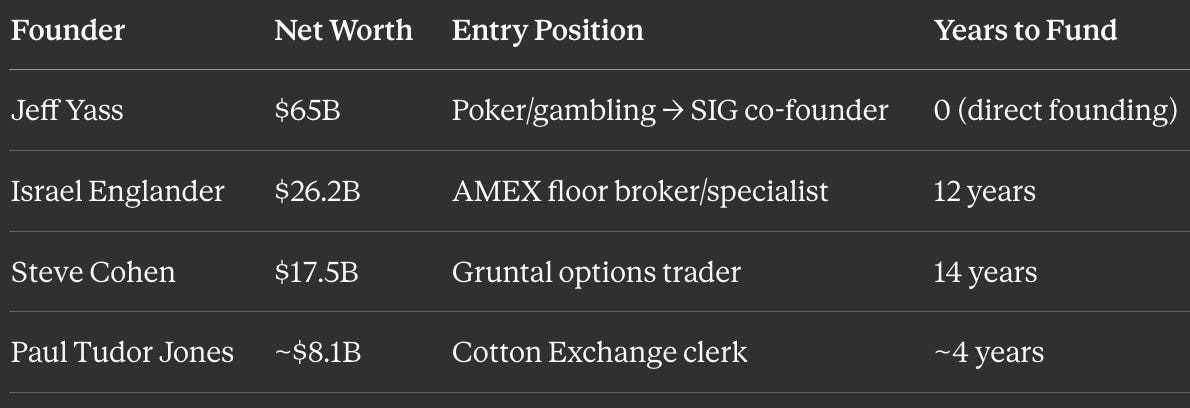
Multiple ultra-wealthy founders began on trading floors or at exchanges, learning risk management through direct market exposure.
Modern equivalent: Junior trader at prop firms (Akuna Capital, IMC Trading, DRW) with $80k-$200k base, $150k-$400k total comp
Path B: PhD/Academic to Systematic Fund
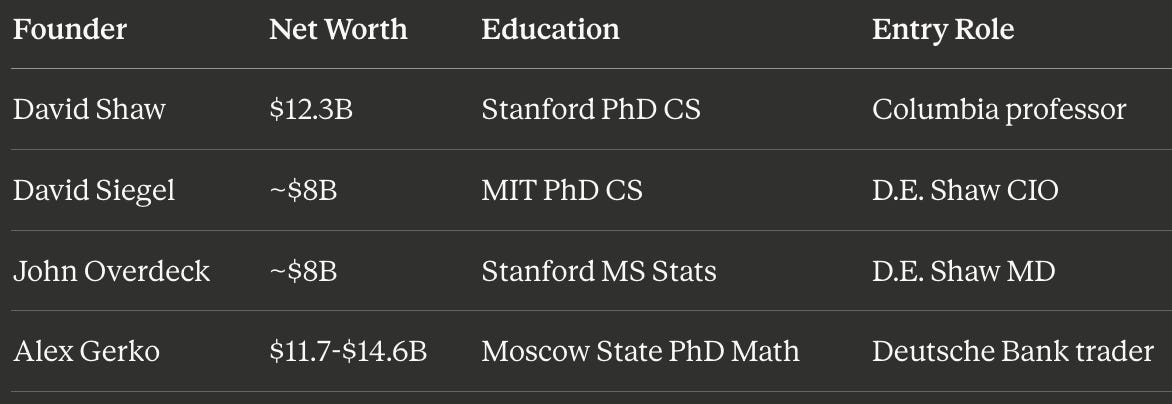
The dominant path for quantitative fund founders. All major systematic hedge funds were founded by PhD holders or academics.
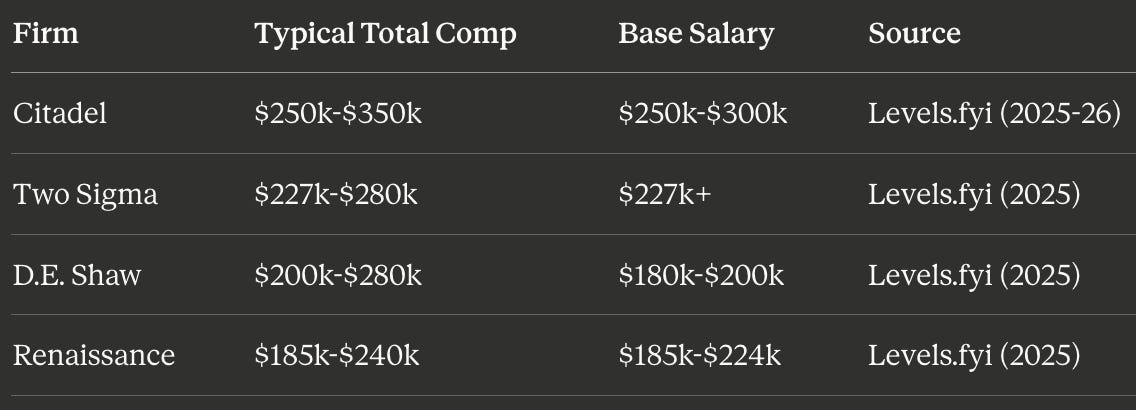
Modern equivalent: Quantitative Researcher at Two Sigma, D.E. Shaw, Citadel with $180k-$350k total comp
Path C: Investment Bank to Spin-off
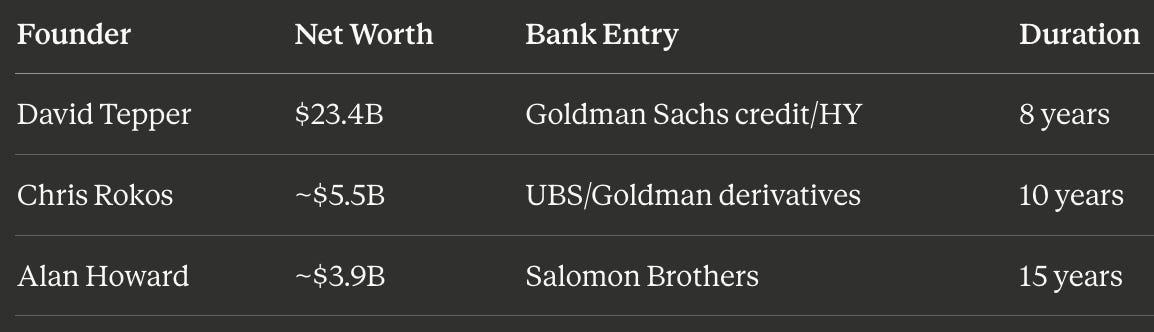
The institutional incubation path, where traders build track records at bulge-bracket banks before launching.
Modern equivalent: S&T Analyst at Goldman Sachs, Morgan Stanley, JPMorgan with $100k-$150k total comp
Path D: Tiger Cub Path (Julian Robertson’s Legacy)
Julian Robertson’s Tiger Management produced more billionaire hedge fund founders than any other single training ground.
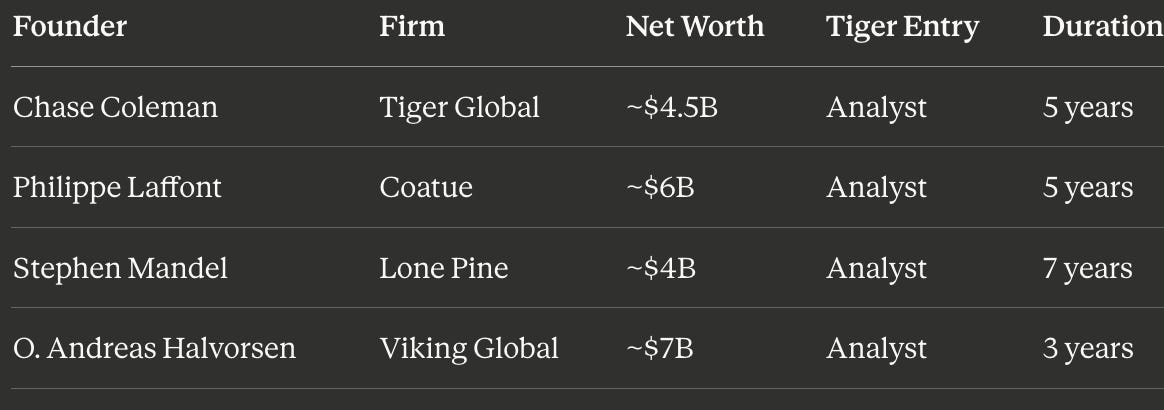
Modern equivalent: Investment Analyst at L/S equity funds with $100k-$150k total comp
Path E: Self-Funded Trading (Highest Variance)
Ken Griffin: Harvard dorm trading (1986) → Glenwood Partners (1989–90) → Citadel (1990, age 21–22)
Steven Schonfeld: Saved capital as stockbroker → Founded prop firm (1988)
Path F: Tech/Academic Background
Igor Tulchinsky (WorldQuant): UT Austin CS → AT&T Bell Labs scientist → Millennium PM → WorldQuant
2025–2026 Entry-Level Compensation (Verified)
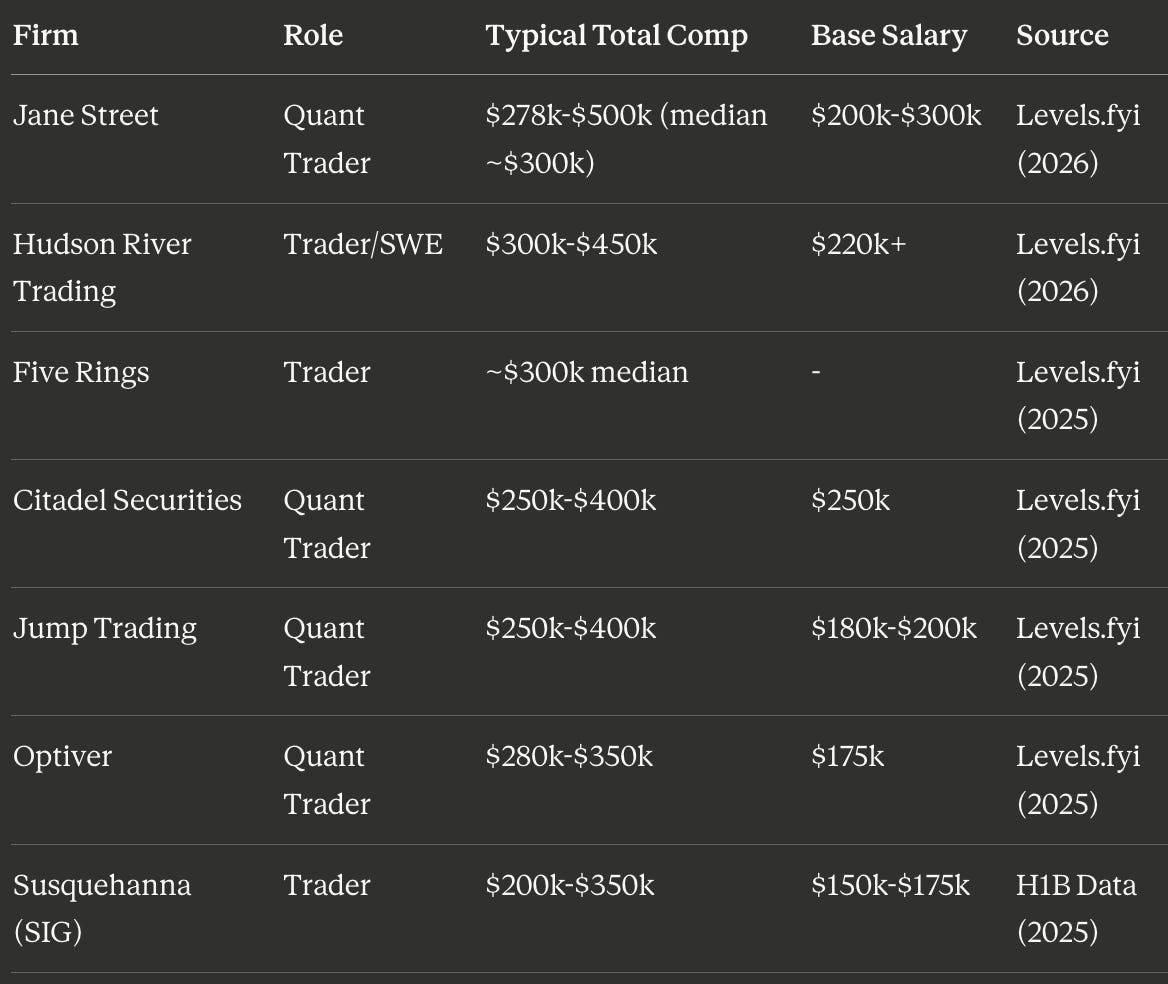
Data sources: Levels.fyi (January 2026), H1B Salary Database (2025), official firm career pages. Note: Ranges reflect self-reported data and vary by role, level, location, and performance.
Prop Trading / Market Making (New Grad)
Hedge Fund Quant Researcher (New Grad)
Hedge Fund Analyst (New Grad) — UPDATED FOR 2026
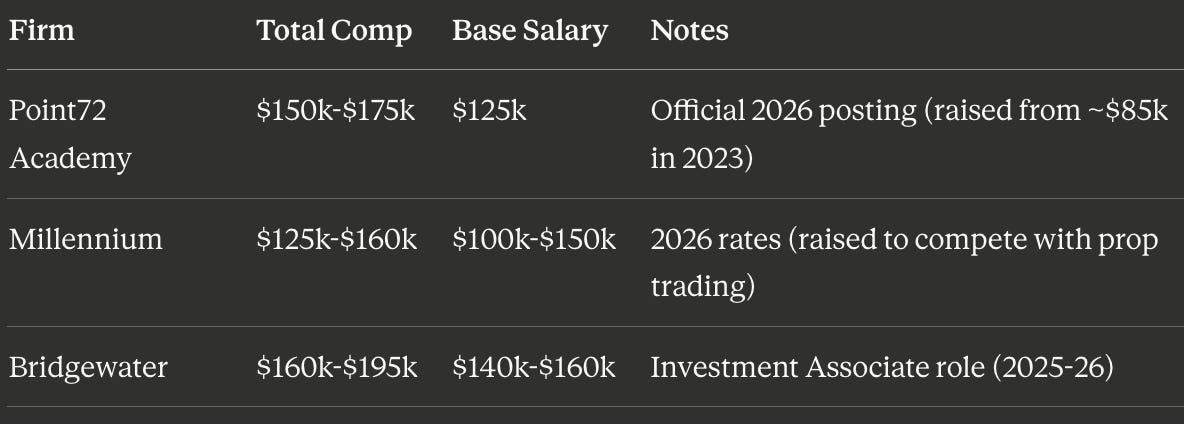
Note: Multi-manager hedge funds increased analyst base salaries 40–120% in 2024–2026 to compete with prop trading firms. Point72’s base salary jumped from ~$85k to $125k; Millennium raised entry floors from ~$80k to $100k-$150k.
2024 Rich List: Top Earners
Source: Institutional Investor’s 24th Annual Rich List (published March 21, 2025)
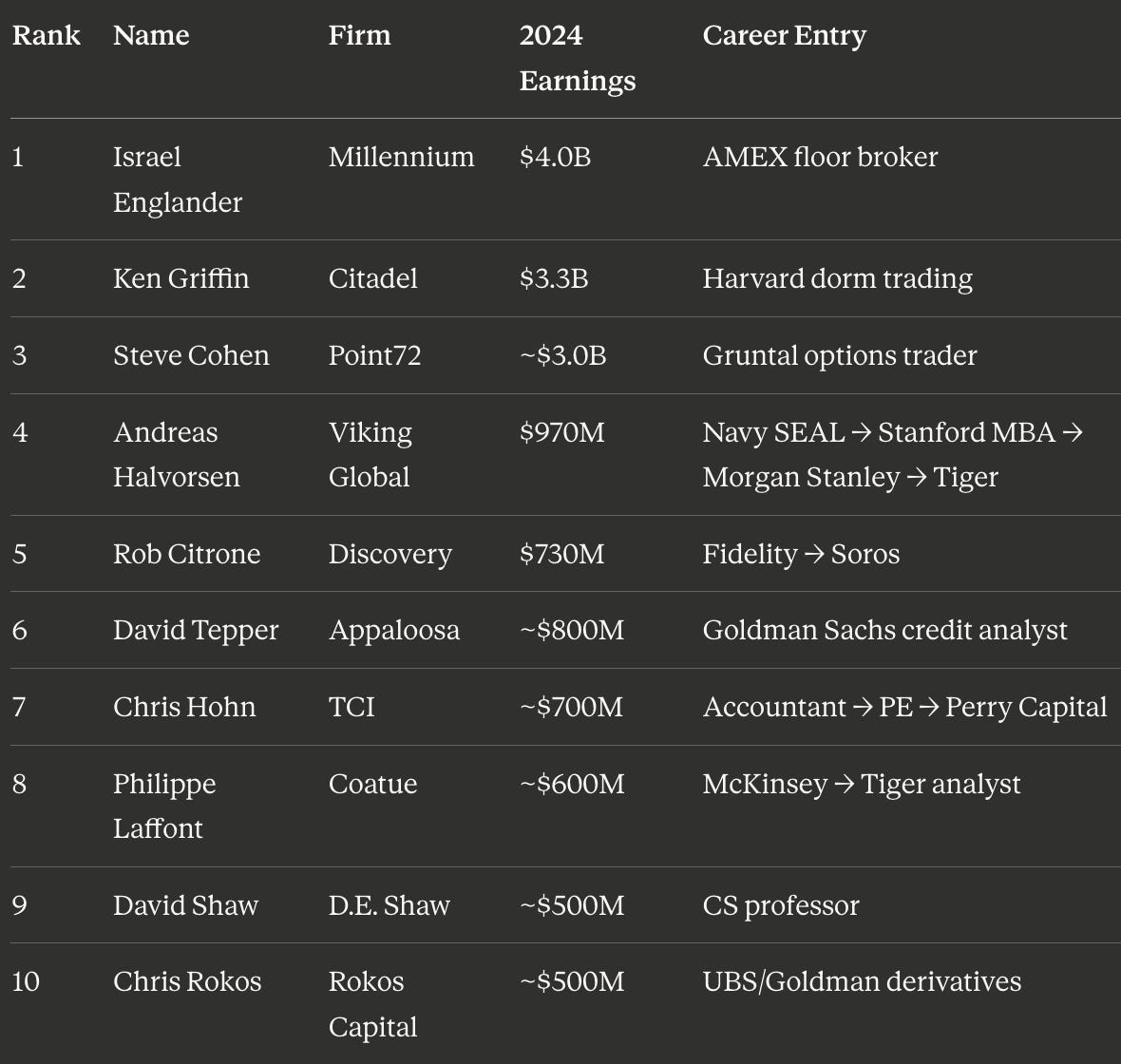
Total for top 25 managers: $30.045 billion in 2024 earnings
Key Insights from the Data
1. Floor trading and early market exposure launched multiple billionaire careers: Israel Englander (AMEX specialist), Paul Tudor Jones (Cotton Exchange), and Steve Cohen (Gruntal options trader) all started in positions requiring direct market exposure and risk management.
2. Academic credentials dominate systematic funds: All major quantitative fund founders hold advanced STEM degrees (Shaw, Siegel, Overdeck). The PhD to quant researcher path remains the standard route for systematic investing.
3. Multi-manager funds raised analyst pay 40–120% in 2024–2026: Point72 increased base salaries from ~$85k (2023) to $125k (2026); Millennium raised floors to $100k-$150k to compete with prop trading firms offering $250k-$500k total compensation.
4. Tiger Management produced an unprecedented founder pipeline: Julian Robertson’s training ground spawned at least 4 founders worth $4B-$7B each (Coleman, Laffont, Mandel, Halvorsen), making it the single most successful incubator.
5. The 3–15 year launch window (median around 8 years): Most founders spent 3–15 years building track records before launching. Examples: Englander (12 years), Cohen (14 years), Tepper (8 years at Goldman), Tiger Cubs (3–7 years).
Sources & Verification
All data cross-verified January 9, 2026. Net worth and earnings figures are time-sensitive estimates that vary by source, methodology, and market conditions.
Primary Sources for Net Worth & Earnings
Bloomberg Billionaires Index (January 8, 2026 snapshot)
Forbes Real-Time Billionaires (December 2025-January 2026)
Institutional Investor Rich List 2024 (24th Annual Ranking, published March 21, 2025)
Career Path Verification
Wikipedia biographies: Israel Englander, Steve Cohen, Paul Tudor Jones, Ken Griffin, Alex Gerko
Susquehanna International Group — Company history and founding details
Compensation Data (2025–2026)
Levels.fyi — Self-reported salary data (January 2026)
H1B Salary Database — 2025 visa disclosures
Point72 Careers — Official 2026 job postings
Official firm career pages (Jane Street, Citadel, Two Sigma, HRT)
Methodology Note on Net Worth:
Net worth estimates vary significantly across Bloomberg, Forbes, and other trackers due to:
Snapshot timing: Figures reflect different dates (Bloomberg daily updates vs. Forbes periodic updates)
Valuation methodology: Private holdings (e.g., Susquehanna’s ByteDance stake) use different assumptions
Market volatility: Billionaire wealth can fluctuate hundreds of millions or billions daily based on equity markets and private valuations
Where sources diverge significantly (e.g., Cohen $17.5B Bloomberg vs. $23B other estimates), we report both values with sources. All figures should be treated as estimates accurate to the cited date.
Methodology Note on “2024 Earnings”:
Institutional Investor’s annual Rich List estimates total compensation/withdrawals by hedge fund managers using proprietary methodology based on fund performance, AUM, fee structures, and industry sources. These are estimates, not audited disclosures.
Compensation Data Methodology:
Entry-level compensation figures represent typical ranges for new graduate hires based on:
Self-reported data on Levels.fyi and Glassdoor (medians and ranges)
H1B visa salary disclosures (legally required public filings)
Official job postings where available
Verified employee submissions
Ranges vary by specific role (quant trader vs. researcher vs. software engineer), location, educational background, and individual performance. Upper bounds often reflect top performers or higher-level entry positions.
📊 Support this research: https://www.patreon.com/c/NavnoorBawa
Cover photograph: Web Summit, CC BY 2.0, via Wikimedia Commons.