


This is a detailed research piece. If you find value in institutional-quality hedge fund analysis, support this work on Patreon.
Hudson River Trading generated $8 billion in 2024 — nearly doubling 2023 earnings — proving modern prop trading profitability derives from statistical inference, not speed. HRT’s Q2 2025 revenue of $2.62 billion exceeded Citadel Securities’ $2.39 billion, a reversal in quarterly performance between the firms.

The Latency Arbitrage Thesis Is Dead
In a Bloomberg Odd Lots interview, HRT’s Head of AI Iain Dunning signaled that the pure sub-millisecond speed arms race no longer drives primary competitive advantage. HRT has extended typical holding periods into the multi-minute range with a material portion of capital held overnight — antithetical to stereotypical HFT. The firm now handles 10% of US equity volume, on par with Jane Street on both overall market share and retail wholesaling metrics.
Core thesis: Revenue derives from prediction accuracy materially above random chance on microstructure data, scaled globally — not nanosecond execution advantages.
Sources: Business Insider | Rupak Ghose Analysis | Bloomberg Odd Lots
Three Revenue Engines
1. Market Making (~50% of profits)
P&L Formula: (Bid-Ask Spread × Volume × Fill Rate) - (Adverse Selection Cost + Inventory Risk)
Competitive edge: July 2025 execution quality outperformed Jane Street by 19 basis points on common tickers — a statistically significant advantage correlating with market share gains.
Scale: 10% retail equity market share (June 2025). Entry into retail wholesaling occurred 2022 — HRT is the only successful new entrant in a decade.
Source: Global Trading Rule 605 Data
2. Prism Unit: $2B+ Annually
Primary strategies: ETF arbitrage and index rebalancing across equities, futures, rates, credit.
Index Rebalancing Mechanics:
Trade structure: Long index additions, short deletions
Holding period: 1–5 days around announcement/effective dates
Alpha source: Price pressure from $trillions in passive ETF forced flows
Empirical evidence: Academic research documents positive returns from front-running index rebalancing, though crowding risk has compressed alpha over time
P&L Driver: Mechanistic passive flows create “buy high, sell low” scenarios for ETFs. Arbitrageurs extract this institutional cross-subsidy systematically.
Risk management: According to S&P commentary, HRT recorded a rare trading loss in Q2 2022, cited by analysts as an example of crowding and signal-decay risk materializing in mid-frequency strategies.
Source: Business Insider
3. AI-Powered Microstructure Prediction
Architecture: Transformer-like models applied to order book data (quotes, cancellations, volumes, flow imbalances).
Performance: Industry analysis, citing third-party commentary and firm disclosures, indicates HRT’s microstructure-based models deliver prediction accuracies materially above random chance — generating materially higher Sharpe ratios than fundamental data or alternative data approaches.
Scale advantage: Processing order flow like LLMs process text — massive throughput with consistent predictive accuracy across global markets.
Key insight: HRT deliberately prioritizes microstructure signals over fundamental data. Broker reports and SEC filings generate inferior risk-adjusted returns compared to order book analytics.
Source: Rupak Ghose — Bloomberg Odd Lots Analysis
Technology: 100% Systematic
Zero discretionary trading. All decisions algorithmic — enabling simultaneous execution of thousands of micro-strategies with consistent risk management across 200+ global markets.
Capital efficiency: $8–10M revenue per employee (H1 2025 annualized) — matching Jane Street, 8–10x traditional investment banks.
Source: Rupak Ghose | eFinancialCareers
Strategic Advantages
1. Multi-horizon diversification: Market making (stable base) + Prism (event-driven alpha) = superior combined Sharpe.
2. Forced flow monetization: Passive rebalancing structurally creates exploitable mispricings. Growth in passive investing expands addressable alpha.
3. Statistical inference at scale: Prediction accuracy materially above random × millions of daily decisions × global instrument coverage = billions in systematic alpha extraction.
Key Metrics
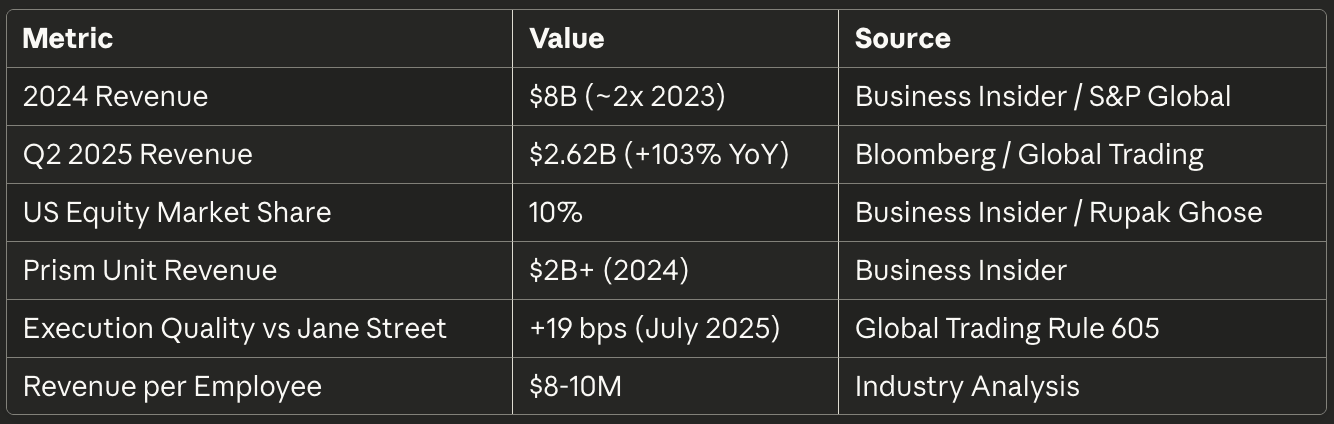
Note: Revenue figures from Bloomberg reporting and Business Insider citing people familiar with the matter. HRT is privately held; figures derived from S&P Global credit analysis and industry sources.
The Alpha Extraction Model
Modern prop trading success requires:
Infrastructure: Process order book data at LLM-scale parallelization
Signal generation: Prediction accuracy materially above random on microstructure (not fundamental data)
Multi-strategy execution: Simultaneously harvest market making spreads and event-driven rebalancing flows
Systematic discipline: Zero discretionary overlay; algorithmic risk management only
HRT’s $8B milestone demonstrates latency arbitrage is obsolete. Alpha derives from correctly predicting multi-minute price moves with accuracy materially above random — repeated millions of times across every liquid instrument globally. As passive investing grows, firms systematically front-running forced rebalancing flows while providing competitive two-sided markets will continue extracting billions in institutional cross-subsidy.
References
Primary Sources:
Business Insider — HRT $8B Revenue (citing people familiar with the matter)
Supporting:
Transparency note: HRT is privately held. Revenue figures, market share data, and strategic details sourced from Bloomberg reporting, Business Insider investigations citing people familiar with the matter, S&P Global credit ratings analysis, and industry commentary. Performance metrics represent industry analysis rather than firm-disclosed figures.
📊 Support this research: https://www.patreon.com/c/NavnoorBawa
Cover photograph: Christian David, CC BY-SA 4.0, via Wikimedia Commons.
Great article