


Schonfeld’s London office filed its 2025 accounts on 16 October: a £155.2m bill, charged at cost. It goes to Schonfeld’s New York adviser and, through it, to the funds’ investors. The office is one of the portfolio managers that trade Schonfeld’s funds.
The press files Schonfeld as a pass-through shop. A pass-through bills a manager’s costs to investors at cost, and in its full form it replaces the management fee. Schonfeld’s open funds run what a Barclays study calls a partial pass-through: a management fee, with every client also paying its portfolio managers on top, and some clients carrying the firm’s overhead too.
Pricing Schonfeld by its fee misses that bill.
I read all eight years of Schonfeld’s London accounts, its brochure and four years of its fund filings; the four parts of London’s 2025 bill add back to its turnover, the accounts’ word for the bill.
Five chapters make the case:
The brochure keeps a 0.75% to 2% fee, and a Barclays study sent to the SEC names the structure.
London’s 2025 bill comes apart into staff, its 11 members’ share and running costs, all at cost.
Money left in 2023 while London’s bill rose; by end-2025 outsiders held about 85% of the flagship, Strategic Partners.
Point72’s London arm books $323.7m of pass-through fees beside its management fee.
What one office’s bill equals against the two main funds, the flagship and Fundamental Equity, and what it did in the year money left.
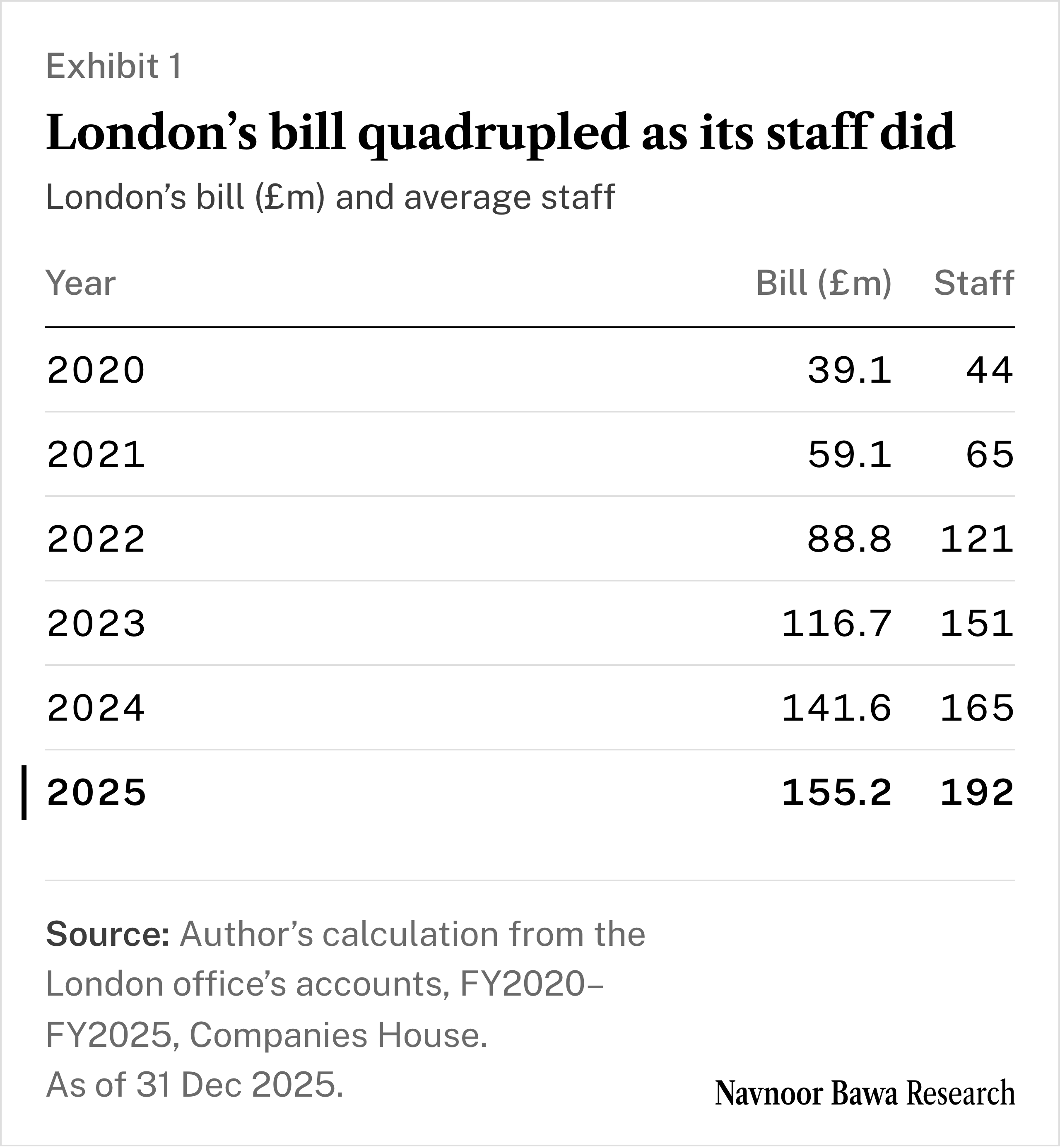
Source: Author’s calculation from Schonfeld Strategic Advisors (UK) LLP accounts, FY2020–FY2025, Companies House · as of 31 Dec 2025
Staff are average headcount; the bill rose with headcount in every year shown.
Not instead of the fee
eFinancialCareers wrote in November 2023 that “Schonfeld adheres to the ‘pass through model’, whereby its costs are passed on to investors”. Hedgeweek’s account of Bloomberg’s 2025 tally of pass-through charges named Citadel, Millennium, Balyasny, ExodusPoint and Point72; Schonfeld did not appear.
The New York adviser, Schonfeld Strategic Advisors LLC, prices its funds in Item 5 of its brochure, the Form ADV Part 2A disclosure it files with the SEC, dated 1 July 2026. For funds “generally available for subscriptions”, “the Advisor charges a management fee ranging from 0.75% to 2% (depending on the applicable class of ownership interest)”, plus a performance allocation, the firm’s share of gains, of 12.5% to 22.5%. Some classes may pay neither, and fees can be waived.
The label turns on one sentence in the same item. “The management fee and performance allocations described above are in addition to the fees and performance-based compensation charged by Portfolio Managers who manage the funds’ assets.” Item 6 makes it universal. “For all clients, Portfolio Managers (including Internal Portfolio Managers) are paid performance-based compensation, which is directly or indirectly borne by clients whose assets are managed or traded by such Portfolio Managers.”
So every client pays its portfolio managers on top of anything it pays the firm. The rule travels to any pod shop: read the expense section before the fee table, because “in addition to” there makes the fee one line of the price.
AIMA, the industry body, sent the SEC a Barclays study of how multi-manager funds charge with a September 2022 letter.1 Of the multi-manager funds reviewed, 26%, with 55% of the assets, ran a full pass-through with no management fee. A further 37%, with 30% of the assets, ran a partial pass-through: performance-based portfolio-manager pay and strategy expenses passed through, with a management fee for infrastructure. Schonfeld’s brochure describes the partial kind of the pod-shop pay deal.
A full pass-through does exist at Schonfeld, in one corner: “Investors in certain classes of one private fund do not pay a management fee and instead are allocated the expenses of the Advisor and its affiliates”. The brochure does not say which fund, or how large those classes are; call them the expense class.
The firm’s own wording goes further than its fee table: “The expenses of the Advisor are generally borne by its non-management-fee-paying clients and certain management-fee-paying clients”. Another spreads the affiliates’ costs wider: “Expenses of the Trading Vehicles, the Portfolio Managers and the Advisor’s affiliates are borne by non-management-fee-paying and management fee-paying clients of the Advisor, as applicable.” The trading vehicles are the accounts most client money trades through.
So the firm’s overhead and other staff’s bonuses fall on clients that pay no management fee, the expense class among them, and on “certain” fee-paying funds. The objection to “on top” is that for some fee payers the fee itself pays those costs:
All or a portion of the management fee compensation payable by certain management-fee-paying funds […] will be used by the Advisor to offset expenses incurred by the Advisor and its affiliates.
Which fee payers bear which costs is set in offering documents that are not public. The objection holds for overhead, at a size the firm does not publish, and fails for the portfolio managers’ pay, which Item 6 puts on all clients.
The brochure names the temptation, an “incentive to allocate expenses to non-management-fee-paying clients instead of management-fee-paying clients who do not bear such expenses.” That choice sits with the adviser: expenses are “allocated in the discretion of the Advisor or relevant Manager”.
Steven Schonfeld founded the firm, and the adviser “is owned 100% by three trusts for the benefit of Steven Schonfeld and/or his family”. Ryan Tolkin, chief executive since 2021, runs it with an Executive Committee that “functions similarly to a board of directors” but has no direct decision-making authority over client accounts.
London bills at cost
The brochure lists Schonfeld Strategic Advisors (UK) LLP, the London office, among the affiliates that “act as Portfolio Managers”. Its accounts say its portfolio managers “primarily invest in the European markets”, sub-advising “a portion of the capital of the funds” for the New York adviser. That adviser’s subsidiaries are London’s two designated members, the members legally responsible for its filings.
Two of London’s documents say how it is paid. Note 1.3 of the accounts says so plainly. “The LLP employs an expense-based pass-through model and does not receive a management fee or any other asset-based fee.” Its MIFIDPRU 8 disclosure, the statement the FCA’s disclosure rules require, published in September 2025: “SSA UK grows revenues by increasing the underlying asset base on which it charges a management fee via a ‘pass-through’ model in reimbursement of expenses.”
Both describe the same money, London’s bill: a reimbursement of its expenses, which the regulatory filing calls a management fee and the accounts a sub-advisory fee, and which the accounts say is not charged on assets. Under the funds’ offering documents it includes “performance-based compensation charged by the SSA UK’s portfolio management teams, salaries, operational and overhead expenses”. London’s share is sized by “a methodology that the LLP, in its sole discretion, believes to be fair and equitable”.
The 2025 bill comes apart into the lines that make it:
Staff: £97.2m, for an average of 192 people.
The 11 members’ profit share: £29.8m.
Rent and the rest of administrative expenses: £28.9m.
Less sublease income and interest received: £0.7m.
£97.2m + £29.8m + £28.9m − £0.7m = £155.2m, the turnover in the accounts.
That bill holds both layers of the partial pass-through. The pay of London’s portfolio-management teams comes on top of the fee for every client whose money they trade (Item 6).
London is both an affiliate and a portfolio manager, so its overhead and members’ share can sit in either layer. Where they count as affiliate expenses, the expense class and “certain” fee payers bear them, and some fee payers have them offset by their fee. All but £5.7m of the members’ share is charged as an expense; that £5.7m stayed in the partnership’s reserves.
Tolkin was a guest on the Generating Alpha podcast, as eFinancialCareers reported on 5 January 2026. “We have tons of people today who used to spend a lot of time organising data.” … “If programmed effectively, that can be done in a fraction of the time.” London’s 2025 accounts, closed before the remark was reported, show operations staff up from 26 to 33. Technology went from 30 to 34. The remark is a forecast about the work; the accounts are a payroll, and the 2026 accounts will test it.
Money left in 2023; London’s bill rose
In 2023 Schonfeld held talks with Millennium that broke down. eFinancialCareers reported that November: “There were redemptions.” It added that “Schonfeld raised $2bn from investors in spring, before still more redemptions led to it to seek a further injection of cash in the failed Millennium deal.” London’s bill rose that year anyway, from £88.8m to £116.7m.
Each year’s Form ADV Part 1, the registration form an adviser must update at least once a year, asks in Schedule D what share of each private fund is “beneficially owned by you and your related persons”. Those are the firm, its owners’ vehicles and its staff. Four copies give four year ends for the flagship’s onshore fund.2
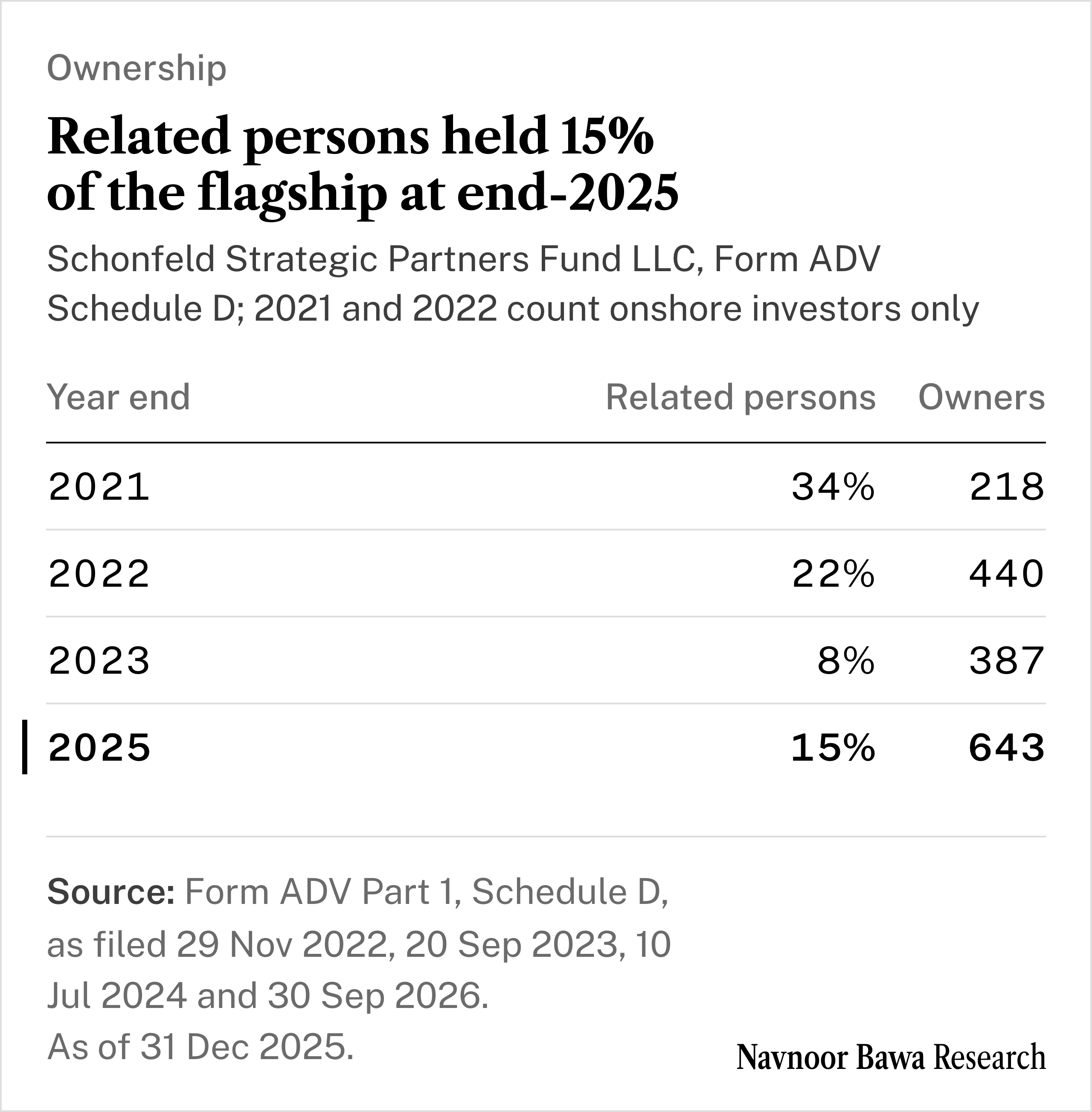
Source: Form ADV Part 1, Schedule D, Schonfeld Strategic Partners Fund LLC, as filed 29 Nov 2022, 20 Sep 2023, 10 Jul 2024 and 30 Sep 2026. Each is a mid-year amendment carrying the prior annual update’s fund rows · 2021 and 2022: onshore investors only
On the later basis the related persons’ share rose from 8% at end-2023, so outsiders held about 85% by the end.3 The two earlier copies counted onshore investors only, so they cannot be set beside the later two.4
The form cannot show the family taking money out. Its measure counts staff, and the family’s holding company, SGH, also invests directly, “within the same Trading Vehicles as assets of non-affiliated clients”.
One insider told the site that November what falling assets do to a pass-through shop: “The pass through model works great when you’re growing your assets and your cost base” … “but if assets are falling and the cost base is high, a smaller number of investors have to cover the remaining costs” … “It’s a very negative convex business model.” Joel Litman and Rob Spivey of Valens Research put it more briefly that month: “Costs don’t drop in line when assets do, so a gap is created.”
How rivals pay London
Three rivals run London partnerships too, each paid a different way. Point72 Europe (London) LLP booked $323.7m of pass-through fees in 2025, a line that “equals the total pass-through eligible expenses the Partnership incurred during the year”, beside $71.2m of management fees and $57.2m of performance fees.
Point72’s brochure says the same thing outright: an advisory fee of 1.50% to 2.85% a year of net asset value, and “There is no limit on the amount of Pass-Through Expenses that may be charged to the Point72 Multi-Strat Funds”.
Balyasny Asset Management (UK) LLP is paid a service fee “based on the residual profit-split model, subject to a cost reimbursement floor”, on 2025 turnover of £558.3m. ExodusPoint Capital Management UK, LLP nearly doubled its advisory revenue in 2025, to £423.3m. Its 15 members kept £221.9m of it, about half.
Schonfeld’s London is paid its costs, its members’ share included: £29.8m for 11 members, about a fifth of the bill. The difference is how each firm pays its London partners, not whether investors pay for London: at fund level, all four firms pass costs through.
Cambridge Associates reviewed the expenses of the platforms it sampled for 2024. It puts the pay risk in one line: “Variable compensation is generally charged in addition to a fund level incentive fee, exposing investors to possible netting risk”. That is the risk of paying winning teams in a year the fund loses.
Why did London’s bill keep rising in 2023, the year investors pulled money out?
Below the paid line:
London’s bill against the two main funds’ capital at four year ends, at two exchange rates.
The year money left, split into bill and capital on two bases, and which fund it left from.
What the regulator counts as London’s fixed overheads, from London’s own filing.
The bet on London’s next accounts, its odds and the two dated checks.