



Izzy Englander’s Millennium Management is pulling more than $1.5 billion of leveraged capital from two outside hedge funds. Both had investment losses, Hedgeweek reported from a Bloomberg story: Troluce Capital Advisors of Dorado, Puerto Rico, and Axebrook Capital, a credit firm in London. Troluce is event driven, trading around corporate events such as mergers. Millennium, a platform funding many trading teams, counts that capital as exposure, leverage included, not cash.
The coverage reads the pull as a stop loss, a rule that cuts a manager’s capital after set losses, aimed at small firms living on Millennium’s money. Troluce’s own filing, counted ten months before the pull, shows the bulk of its book in four funds it keeps in custody, leaving little room for Millennium’s account. That gap decides what a pull costs anyone invested beside the platform.
The closing chapters settle how often Millennium ends these accounts and what this one took from Troluce. The public documents lean toward a lost client; those chapters give our odds and the deciding number, the most Troluce ran outside its custody.
Troluce began inside another platform
I read every Form ADV, the registration form an SEC adviser files, that Troluce has filed since July 2024 in the SEC’s monthly adviser data. Its four own funds add up to its custody line, the client money the adviser itself holds, to the dollar.
Jared Dubin has run Troluce as managing member and chief investment officer since January 2021, according to its Form ADV. Its first entry in the SEC’s holdings record, a notice for the fourth quarter of 2021, names someone else.
That 13F notice says Troluce’s holdings were reported by ExodusPoint Capital Management, another platform that backs outside teams. Bloomberg reported in May 2021, in a story FA Mag carried, that Dubin had “recently set up Troluce Capital Advisors there to manage money for ExodusPoint”. Dubin told Bloomberg of Dorado: “There has been exceptional interest, in part because Dorado has access to fiber broadband.”
The same story said a platform’s pods, the independent teams of traders it allocates capital to, can set up as separate firms, “such as Dubin did with Troluce”, so Millennium was Troluce’s second platform.
Its filing lists about five employees, three doing investment work, in Dorado and New York. Its regulatory assets, the gross figure the form asks for, with no deduction for borrowing, went from $449 million in its July 2024 filing to $1.48 billion at its December 2024 count. At the December 2025 count they stood at $2.24 billion. More than half of that rise came before 2025, the year Millennium backed it, by Bloomberg’s account.
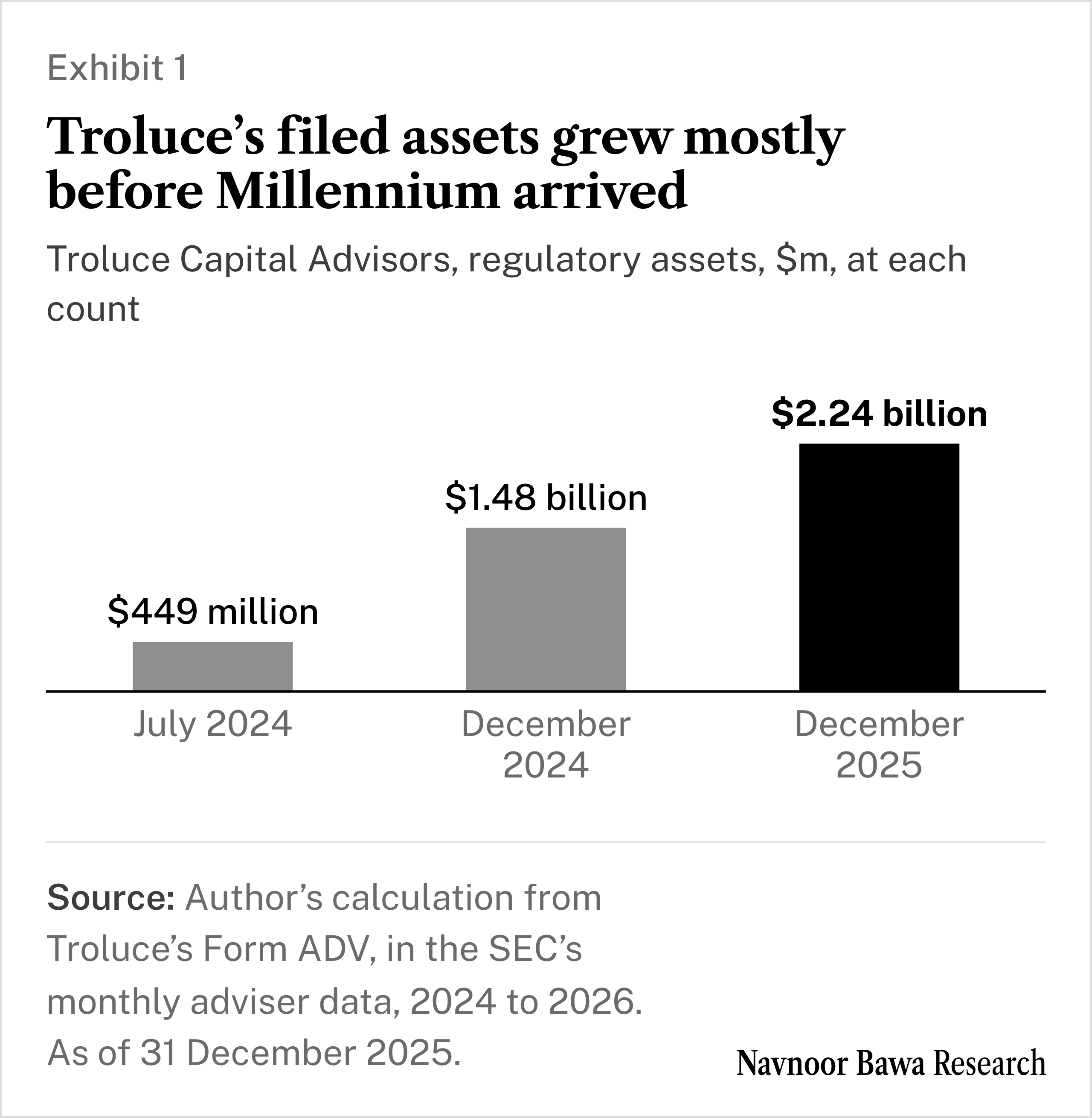
Millennium took back more than $1 billion of leveraged capital from Troluce, yet Troluce’s own filing puts almost nine tenths of its book in four funds it keeps in custody.
Those funds belong to allocators. Special Opportunities II held $1.27 billion for 62 owners, more than half of it through funds of funds. Nexus Fund LP held $645 million for three owners, 94% of it held outside the US.
Nexus’s Form D, the notice a private fund files when it sells interests, shows the same $420 million from two investors in March 2026 as in March 2025. No new money came into it between the two filings.
Troluce was an ordinary Millennium ticket. The ten live Millennium commitments the press has sized run from about $500 million to $3 billion, with a middle near $1.1 billion. They mix cash and exposure figures, and the money pulled from Troluce sat near that middle. The business it sat beside was already built.
Troluce’s filing leaves little room for Millennium
Millennium’s outside money goes into accounts the manager runs and the platform keeps. Scopia Capital’s account “was managed through a separately managed account”, Hedgeweek reported when Millennium ended it in March. On Form ADV, such an account counts in Item 5.D, among the pooled vehicles the adviser advises. Because the assets stay with the platform, it is missing from Item 9.A, the custody line of client money the adviser itself holds. So the gap between the two lines is a bound on such an account, the most it can hold.
At its count for 31 December 2025, Troluce answered seven pooled vehicles and six custody clients holding $1.98 billion.
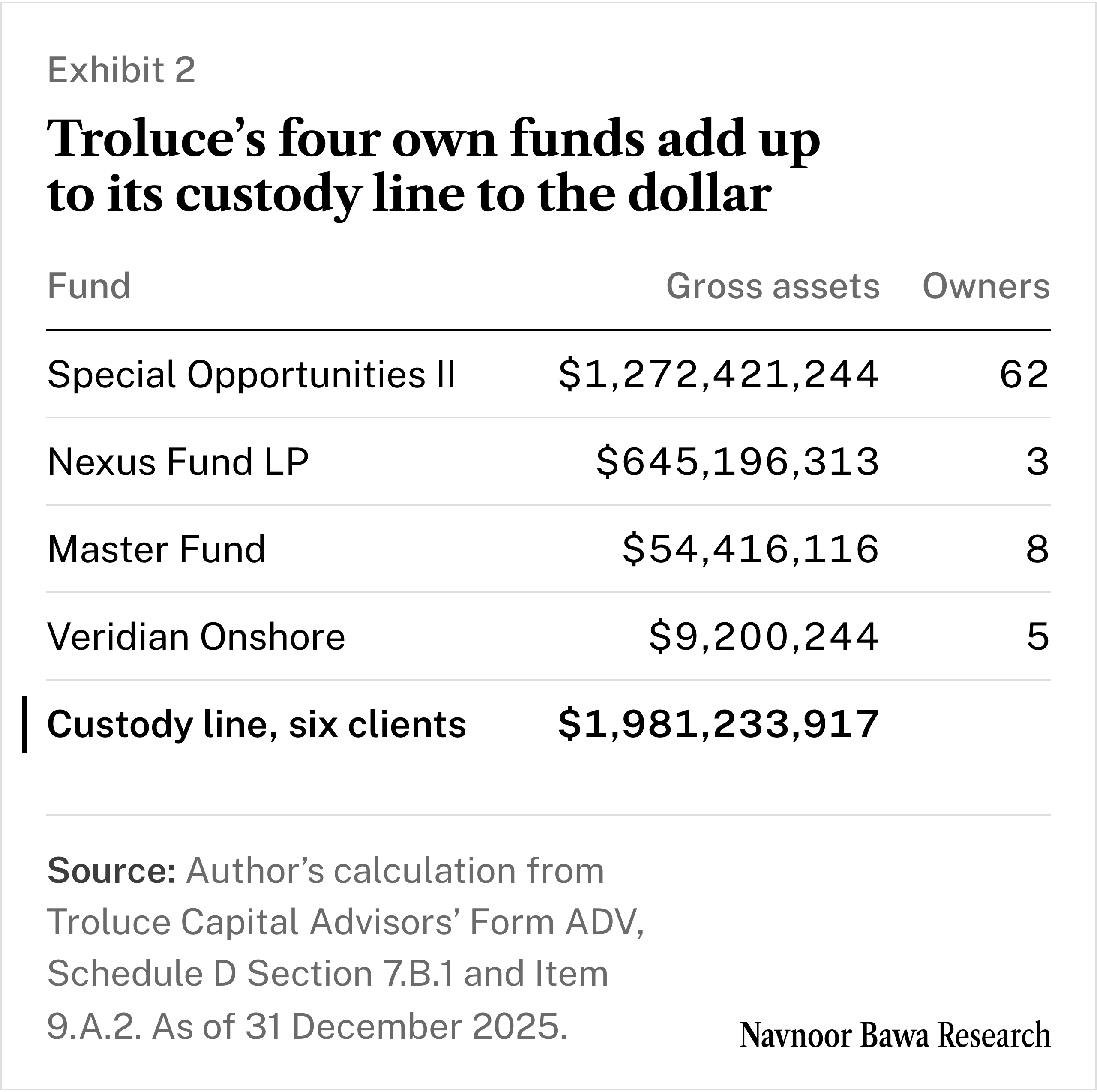
The four funds sum to $1,981,233,917, the custody line exactly. The other two custody clients are feeders, funds that invest only through the Master Fund. Four funds and two feeders make the six custody clients, and all six sit among the seven pooled vehicles. Seven less six leaves one pooled vehicle Troluce advises but does not hold in custody, the position a platform’s account takes. Stargazer and Farpoint, two funds the latest filing also lists, first sold interests in March and August 2026, after that count.
The case against this reading is the date. The count is ten months older than the pull, so an account Millennium funded after 31 December 2025 would not be in it at all. Bloomberg’s account dates Millennium’s backing to 2025, so the account most likely sat inside the count; Troluce’s next annual filing settles it.
The filing does not name the vehicle. Schedule D, the tables attached to the form, has a section where a subadviser lists the funds it runs for others. Troluce’s miscellaneous page says “certain responses to Schedule D, Section 7.B.(2) have been omitted and are the subject of a request for confidential treatment”. The slot for a platform account exists, and the name stays out of it.
“Leveraged capital” is not a figure the filing uses. When Millennium and Engineers Gate, another outside manager, ended their account in March, Millennium “viewed the mandate as a $3.6bn exposure when accounting for leverage”, Hedgeweek reported. Engineers Gate “assessed the direct capital commitment at approximately $1.5bn”, so the two firms read one account 2.4 times apart. The headline figure on Troluce is Millennium’s own measure of exposure, and the filing counts assets at market value.
Axebrook is an exempt reporting adviser, a manager excused from SEC registration that files only part of the form: its Form ADV lists funds and gives no total. Its own Credit Alpha Master Fund held $748 million for 80 owners at its March year end. It also subadvises three funds for other platforms, one for Lighthouse Investment Partners and two reported by Morgan Stanley AIP GP LP, and withholds more. Millennium’s account was one sleeve among several, a sleeve being one account inside a manager’s book.
Millennium’s side stays dark: its own Form ADV, filed on 25 August 2026, names none of the outside managers the press has reported.
Eight Millennium outside accounts have ended since 2024
How often this happens is a count anyone can rebuild from the trade press. Since January 2024, Hedgeweek, Private Banker International and Bloomberg have reported eight managers losing a Millennium account. That was seven endings, because Troluce and Axebrook went in one.
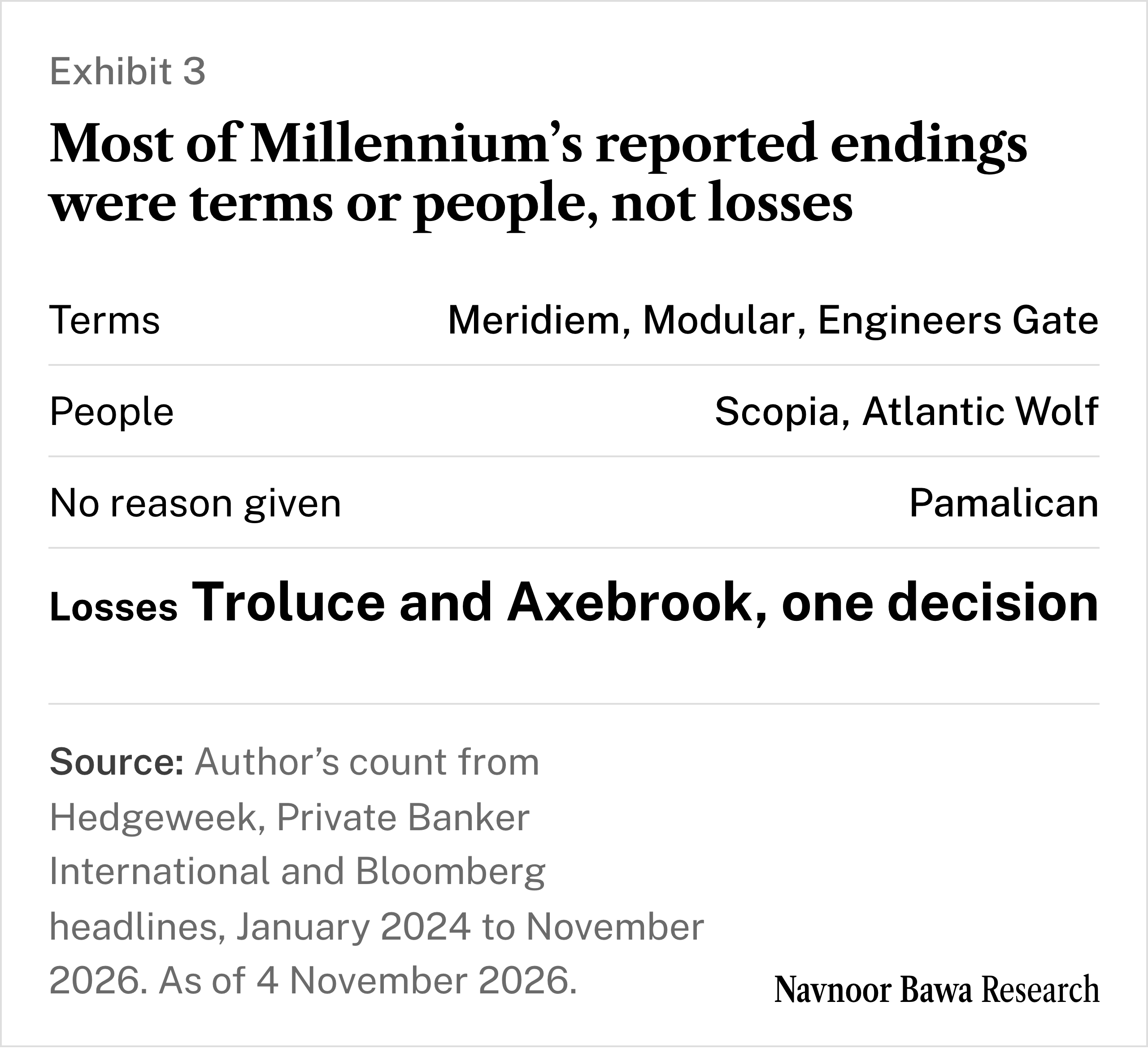
Losses explain one of the seven. Three were terms. Meridiem Capital Partners lost its account at the end of its lockup, the term its money was committed for, in January 2024. Modular Asset Management parted by mutual agreement in September 2025 after more than eight years. Engineers Gate went over liquidity terms in March 2026, when Hedgeweek put it down roughly 7% for the year.
Two were people: Scopia after “personnel changes” and other investors’ redemptions, and Atlantic Wolf when its founder, Aaron Weiner, went back to Coatue. Pamalican, another outside manager, saw the money leave eight months after it began trading, with no reason given.
Private Banker International wrote that the ending “allows Modular to diversify its investor base, reducing its dependency on a single large investor”, one that held a third of its assets, in its report. Pamalican was “planning to raise capital from new investors to replace the withdrawn allocation”, Hedgeweek wrote. Both describe a firm replacing one client.
Three explanations compete for this pull. A stop loss predicts endings soon after a manager’s drawdown, one manager at a time. Terms and people predict mutual endings at contract dates or staff changes, which is most of the record. Millennium’s own need to cut risk predicts several accounts across strategies cut at once.
The programme was still growing in June, which argues against a retreat. Millennium had at least 32 active outside allocations in June 2026, up from 24 a year earlier, With Intelligence counted, and that month it committed about $800 million to Mycor Capital Management.
Balyasny, the nearest peer, ended a $250 million account at Sparta within a year of funding it, after Sparta lost 8% in the first quarter of 2024. A year later With Intelligence found it had no active outside allocations.
This decision cut an event driven account and a credit account on the same day. That fits a stop loss on two managers and a cut across the firm equally well. On the record, its outside accounts end often, and mostly for reasons other than losses.
→ Millennium’s 1999 mutual fund timing, rebuilt from the SEC’s order, Trade File No. 7 on Patreon.
How much of Troluce did Millennium’s money really reach?
Below the paid line:
A table of odds for the next 12 months, by number of endings, for any reason and after losses.
Troluce’s custody line worked to its bound, with a placement table and a four line test for any adviser.
Four dated checks, each with the filing or report that settles it.