


Meiji Yasuda’s president, Hideki Nagashima, and Man Group’s chief executive, Robyn Grew, announced an expanded partnership on 26 October. Bloomberg’s headline that day read: “Meiji Yasuda Commits $1.25 Billion to Man Group.”
In other words, a Japanese life insurer plans more money for Man’s funds and Man shares bought on the market. The money is the smaller half of what Man sold. The larger half is a channel into the insurer, Man’s products and know-how one way and its yen the other, and a planned shareholder whose purchase pays Man nothing. That shareholder would take more of Man off the market than this year’s buyback has.
Dai-ichi Life, another Japanese life insurer, used the same template at M&G, the London asset manager, in 2025. The test for Man is whether a holding notice, the filing owed once a holder reaches 5% of Man’s votes, appears by 30 April 2027.
I read both companies’ announcements, Man’s latest results and trading statement, every holding notice Legal & General (L&G) has published since 2024 and M&G’s first notice on Dai-ichi, and rebuilt the arithmetic from Man’s own tables, reproducing its stated fee margin and voting-share count.
The headlines read the sum, about $1.25bn over three years, mostly for private credit.
The 2025 plan, as Nikkei reported it, weighed ¥150bn over about ten years, so the pace changed more than the sum.
The shares pay Man nothing, because the 57.1m shares the stake needs would come from other holders.
Meiji Yasuda did this at L&G, holding 5.000045% of L&G’s votes on the day it announced, with a bank’s swap behind them.
The paid chapter settles what the commitment is worth in Man’s own fees, how the deal compares with Dai-ichi’s at M&G term by term, and our odds that the stake is built.
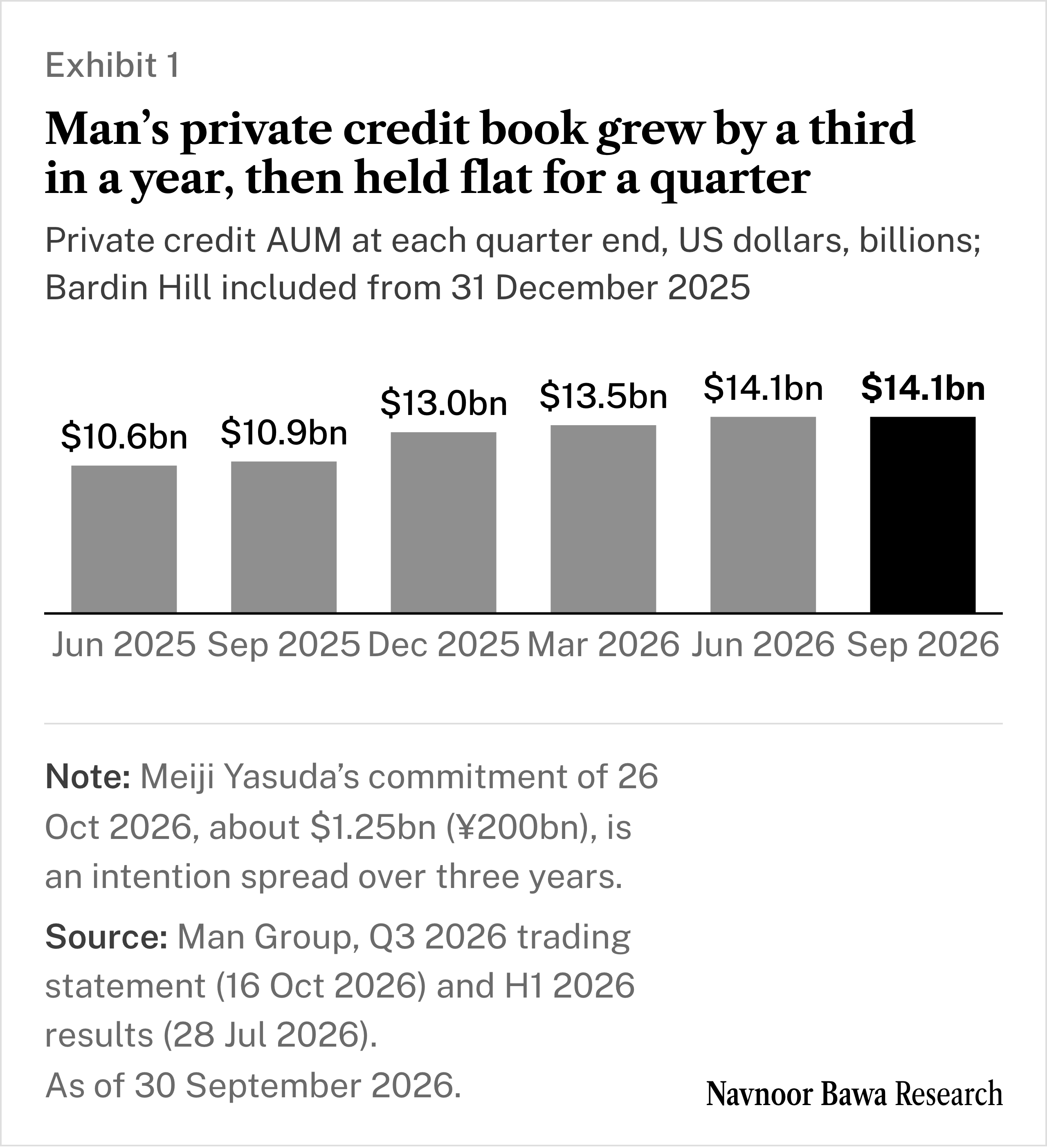
Source: Man Group Q3 2026 trading statement, 16 Oct 2026; H1 2026 results, 28 Jul 2026; Man Group and Meiji Yasuda releases, 26 Oct 2026.
The last row is a three-year intention, set against a book that held flat in the third quarter.
The headlines read the sum
Man’s announcement put the money first: “Meiji Yasuda intends to increase its capital commitment to Man Group’s investment strategies to JPY 200 billion (approximately $1.25 billion) over the next three years, with a particular focus on private credit.” That yen is the commitment, what Meiji Yasuda says it will invest in and entrust to Man over three years, an intention rather than money that moved on Monday, 26 October.
The rest of the release describes a relationship. Man becomes “a preferred asset management partner” and the two “will also work together to develop new products for the Japanese market”. “The financial terms of the transaction are not disclosed.” The release names Antoine Forterre, Man’s chief financial officer and chief operating officer, as the person responsible for it.
Meiji Yasuda’s own release says the partnership of February 2025 worked “primarily in private assets” and now goes “beyond private assets”, to “quantitative methods and AI” and “personnel exchanges”, including “the secondment of Meiji Yasuda employees.” Its release of that February had already promised joint research on AI and quantitative methods, so what widens now is money, products and staff more than ideas.
Nagashima, its president and group chief executive, gave his reason in Man’s release: “Man Group is an important partner for Meiji Yasuda, with extensive expertise in quantitative investment management, AI utilization, private assets, and other areas.” His list opens with Man’s quant side, while the money, by Man’s own sentence, goes mostly to private credit. Knowledge travels to Tokyo; the yen travels to London.
The photograph in Meiji Yasuda’s release places Corin Robertson, Britain’s ambassador-designate to Japan, between the two chief executives. Her line in the release was that the UK “is committed to remain a partner of choice for Japanese capital and investment.”
Hedgeweek headlined the sum, “Man Group secures $1.3bn investment commitment in Japanese insurer tie-up”; Reuters, “Meiji Yasuda to lift Man Group private credit commitment to $1.3 billion”. Man’s shares closed up 6.6% that day, at 334.4p by Yahoo Finance’s price feed, while the FTSE 250 rose 1.1%.
Monday’s close undid most of a slide from 345.0p on 13 October to 313.6p on 23 October, and by 30 October the shares had kept the day’s gain but not mid-October’s level.
Private credit, $14.1bn at 30 September, sits inside private markets, at $17.4bn Man’s smallest business line, out of $270.9bn under management. Man says the deal “supports the firm’s strategic ambitions to continue growing its private credit platform and serve large insurance clients globally”. The money lands on that line; the stake would touch every Man share.
The pace changed, not only the sum
The word doing the work in Man’s sentence is “increase”. Meiji Yasuda’s three-year programme for FY2024 to FY2026, “MY Mutual Way Phase II”, “positions asset management as one of its growth strategies”. Its release of 25 February 2025 put the first Man partnership inside a plan to grow private-asset investment by ¥600bn over those three years, and named no amount for Man. Man’s final results that month did not mention Meiji Yasuda at all.
The number in circulation comes from analysts at Panmure Liberum. Reuters’ Yamini Kalia reported on Monday: “The firms did not disclose the previous investment but Panmure Liberum analysts said Meiji Yasuda made a 150 billion yen commitment.” Nikkei’s report of 25 February 2025 gave the figure its frame: ¥50bn by March 2027, the last year of Meiji Yasuda’s plan, mostly in private debt through Man’s funds, and ¥150bn over about the next ten years, which the insurer was considering (our translation).
So the change is the pace more than the sum. Meiji Yasuda’s words, “a total of JPY 200 billion over the next three years”, come to about ¥67bn a year, against roughly ¥15bn to ¥24bn a year in Nikkei’s two figures: about three to four and a half times faster.
Man’s “increase … to” fits a total that replaces the old plan, and neither firm says how large the increase is, or how much of the ¥200bn is already invested.
Abid Hussain, an analyst at Panmure Liberum, gave Reuters the deal’s best case, and the strongest counterargument to this piece: “A large Japanese Life insurer putting its own capital behind Man’s private credit push is a useful vote of confidence as well as sticky flows.”
Two of his three claims stand on the documents. A planned stake of about 5% with a three-year lock-up is a vote of confidence, and an insurer’s three-year commitment is sticky by design. The third, flows, depends on the base. Against a private credit book of $14.1bn, in a quarter when Man’s private-market line took no net new money, $1.25bn is large. Against Man’s fee revenue, the base that decides whether Monday was about money at all, it has to be priced at Man’s own margin.
The shares pay Man nothing
The two companies describe the stake with different verbs. Man’s announcement: “Meiji Yasuda will consider the acquisition of an equity stake of approximately 5% in Man to further align their interests. Any acquisition would be in the open-market, with no new shares being issued by Man Group.” Meiji Yasuda’s: “we also plan to acquire approximately 5% of Man Group’s outstanding shares from the market.”
Robyn Grew chose a third verb in Man’s release: “The intention to acquire an equity stake reflects our shared vision for the future and further aligns the long-term interests of both companies.” Meiji Yasuda says it plans to buy, Grew calls it an intention, and Man’s own announcement says only that Meiji Yasuda will consider it. The firm with the money to spend is the more committed of the two.
Man’s second sentence matters more. No new shares means Meiji Yasuda’s cash goes to whichever investors sell, not to Man.
Man had 1,141,113,769 voting shares at 30 September, the shares in issue less the 88.2m it holds in treasury; those are the voting shares from here on. About 5% of them is 57.1m shares, roughly £191m of stock at Monday’s close.
Man is a Jersey company, and the holding notices filed with it, the TR-1 forms a shareholder sends the company, are made as a non-UK issuer’s: BlackRock’s of 17 July is marked “Non-UK”. Under the UK transparency rules, a holder in such a company owes its first notice at 5% of the votes, then at 10%, 15% and so on. So a stake built below 5% leaves no public trace, and the first sign of Meiji Yasuda’s buying may be the 5% notice itself.
The other terms bind the buyer. Any shares come with a three-year lock-up, a standstill that caps Meiji Yasuda’s holding at 19.99% of Man’s issued share capital, far above anything planned, and “orderly market arrangements relating to any future disposals”.
Grew’s “aligns the long-term interests” holds as far as the lock-up reaches: it runs three years from the agreement, to October 2029, so a holder that buys now cannot sell before then.
Meiji Yasuda did this at L&G
Two deals of 2025, by Japanese life insurers in London-listed financial firms, show how such a stake gets built. Meiji Yasuda’s at L&G was on the register the day it was announced. Dai-ichi Life’s at M&G reached its first holding notice 124 days after the announcement, at 9.6%.
On 7 February 2025 Meiji Yasuda agreed to buy L&G’s US insurance business for $2,281m and said how it would take its stake: “We plan to acquire 5% of L&G’s shares (based on voting rights …) from the market … Additionally, we plan to assign a financial institution for this acquisition and risk management.”
The bank’s role shows in the notices. Meiji Yasuda crossed 5.000045% of L&G’s votes, 294,664,836 shares, on 7 February, and notified L&G the same day. Morgan Stanley’s notice for the same day shows the bank holding 5.189306% of L&G through financial instruments. Among them is a cash-settled equity swap over exactly 294,664,836 shares, expiring on 8 February 2027.
Read together, the two filings suggest Meiji Yasuda held the votes from day one while Morgan Stanley carried the economic exposure. L&G’s completion release of 2 February 2026, when the $2.3bn cash sale closed, fits that reading: “Following completion of the transaction, Meiji Yasuda will acquire a 5% economic interest in L&G.”
Later notices in March and April 2025 show the same share count. The votes sat with Meiji Yasuda a year before the deal closed.
Dai-ichi’s deal is the closer match in shape. M&G’s announcement of 30 May 2025 made M&G Dai-ichi’s “preferred asset management partner” in Europe, said Dai-ichi “intends to acquire a c.15% shareholding”, and said it “plans to appoint a financial institution to facilitate its acquisition of M&G shares”.
Its first holding notice came on 1 October 2025, at 9.601839% of the votes. M&G announced on 19 August 2026 that Dai-ichi’s nominee would join its board from 3 September, “following satisfaction of certain conditions of the Implementation Agreement”.
Man’s terms follow M&G’s: on-market purchases, no new shares, a 19.99% standstill, a lock-up and a preferred partner. The plainest difference is the stake, c.15% of M&G for Dai-ichi against about 5% of Man for Meiji Yasuda.
Both cycles turned in the same order, the announcement first, the stake on the register second and, at M&G, the board seat third. Man is at the first step. Four days on, Man’s announcement feed shows nothing after the partnership release, and no holding notice naming Meiji Yasuda. That says nothing yet, because only 13.9m Man shares traded from 26 to 30 October, by Yahoo Finance’s data, far short of the 57.1m that 5% needs.
What Man’s announcement lacks is the sentence both earlier deals carried: no financial institution is named to buy the shares or to carry the risk.
→ A bank’s swap book at its worst, Archegos’s in 2021, rebuilt from the SEC complaint and the Credit Suisse report, Trade File No. 3 on Patreon.
What is Monday’s deal worth to Man whether or not Meiji Yasuda’s stake reaches its register?
Below the paid line:
Exhibit 2: Dai-ichi’s deal at M&G against Man’s, term by term, with the channel each sizes.
Three numbers on the buyer: the stake in shares, against Man’s buyback and its daily trading volume.
The commitment’s fee value, worked from Man’s own fee table, and what the 26 October move priced.
The verdict with our odds, the line that proves it wrong, and three dated checks.