


This is a detailed research piece. If you find value in institutional-quality hedge fund analysis, support this work on Patreon.

Opening
47% of traditional hedge funds now hold digital asset exposure (up from 29% in 2023), with derivative usage surging to 58% from 38%[¹]. This shift signals institutions aren’t buying crypto narratives — they’re trading market structure. Brevan Howard, Millennium, Renaissance Technologies, and DE Shaw entered crypto markets not for directional beta but to arbitrage persistent inefficiencies in retail-dominated, valuation-uncertain markets where traditional fundamental analysis fails[²].
The Valuation Problem
Crypto assets lack discounted cash flows, EBITDA multiples, or earnings. Proposed models (MVPQ, stock-to-flow, NVT) fail to achieve DCF-level reliability[³]. HFR now classifies 11 crypto sub-strategies[⁴]: Fundamental (store-of-value/utility assessment), Market Neutral (arbitrage without directional exposure), Quantitative (algorithmic pattern recognition), Volatility (derivatives mispricing), and Arbitrage (structural inefficiency exploitation).
Core institutional reframe: How does protocol success translate into token value capture — not “will price rise”[⁵].
Dominant Trade Structures
Basis Trade (Cash-and-Carry Arbitrage)
The institutional workhorse generating mid-single-digit annualized returns with minimal directional risk. Bitcoin futures-spot basis can reach 8–10% annualized without leverage[⁶].
Execution mechanics:
Buy $30,000 Bitcoin spot
Short $30,100 Bitcoin futures (basis = $100)
Hold to convergence
P&L: At settlement, the delta-neutral position captures the full $100 basis — a gross return of $100 / $30,000 = 0.333% before fees and financing[⁷]. For a one-month futures contract, this annualizes to ~4% p.a.; BIS data shows crypto carry averaged 7% p.a. from April 2019 to July 2024, with pockets reaching 8–10% during market segmentation[⁸]. The trade is theta-positive, extracting time value from futures premium decay.
Critical risks: Margin frictions create forced liquidation risk before convergence. A 10% increase in standardized carry predicts a 22% increase in short position liquidations across open interest[⁸]. The trade requires institutional-grade collateral management across fragmented exchanges and separate margin accounts for spot and futures legs.
Scale: The crypto basis trade mirrors the $1.4 trillion Treasury basis trade that dominates fixed income relative value[⁹], but with higher premiums due to market immaturity.
Derivatives Overlay & Relative Value
Options arbitrage exploits discrepancies between options, futures, and perpetuals. Event-driven strategies trade forks, upgrades, governance proposals[⁶]. Lemvi Capital: “We rarely take valuation views — they’re too uncertain. We structure optionality”[⁶].
Cross-exchange arbitrage: Early delta-one compression created new alpha in funding rate differentials. Example: 70% perpetual swap funding vs. 20% term futures — sell swap, buy future, capture 50% spread if holding period justifies costs[¹⁰].
Institutional Valuation Framework
Network Effects & User Growth
Token value anchors to user base via network externalities — larger networks enable easier counterparty matching and trade surplus[¹¹]. Institutions track adoption metrics as primary fundamental indicators for fair value triangulation[¹²].
Tokenomics Quantification
Revenue Sustainability Score = (Tier Weight × Revenue %) + (Growth Consistency × 0.3) + (Bear Market Retention × 0.4)[⁵]
Tier 1: Protocol transaction fees (most sustainable)
Tier 2: MEV capture, sequencer revenue
Tier 3: Inflationary rewards (least sustainable)
Supply mechanics: Institutions prioritize controlled inflation, usage-linked value, regulatory clarity, and liquidity depth (>$1M daily volume for position sizes)[¹³].
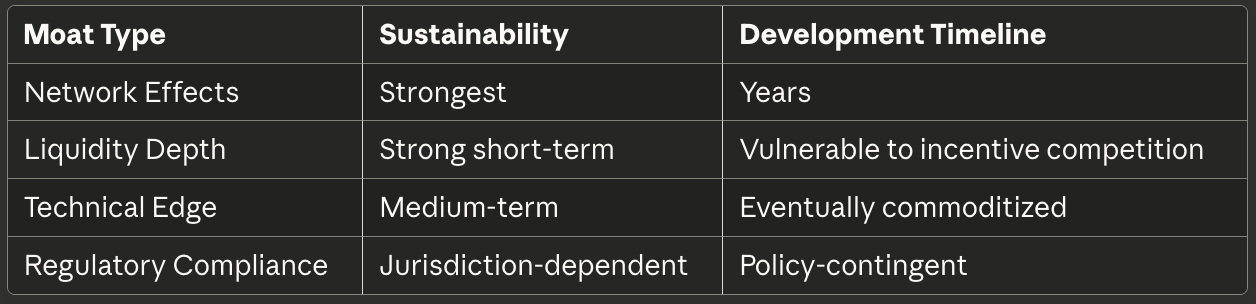
Competitive Moat Taxonomy[⁵]
Systematic Factor Models
11 factors significantly priced in crypto cross-sections[¹⁴]: market beta, size, momentum, supply dynamics, network activity, hashrate, technological attributes, governance decentralization, liquidity, volatility, behavioral attention.
Alpha source: Retail-dominated markets with high leverage create exploitable behavioral patterns — momentum cascades and volatility clustering persist when fundamentals can’t anchor valuations[³].
Portfolio Construction and Risk Management
Hedge funds apply traditional risk management techniques adapted for crypto volatility:
Position sizing: Crypto strategies typically represent 1–5% of multi-strategy fund portfolios, with concentrated high-conviction positions in 1–3 trades rather than diversified token baskets[⁶].
Leverage management: Basis trades use 10–30x leverage via repo financing (similar to Treasury basis trade), while directional strategies rarely exceed 2x given crypto’s inherent volatility[⁶].
Liquidity risk: Funds maintain exposure only in tokens with >$1M daily volume for intended position size to enable exits without excessive slippage[⁵].
Correlation monitoring: Despite crypto’s “diversification” narrative, correlations spike during volatility shocks. The October 2025 flash crash saw $370 billion in market cap evaporate with approximately $19 billion in leveraged positions liquidated, testing institutional infrastructure resilience and exposing margin fragility across exchanges[¹⁵].
The Strategic Shift: From Speculation to Structure
Key strategic evolution: Traditional hedge funds shifted from 69% spot trading in 2023 to 58% derivative trading in 2024[¹]. This signals sophistication — institutions trade volatility, relative value, and carry rather than outright directional bets.
Example fund approaches:
Pantera Capital: Early mover (2013) managing Bitcoin Fund, Digital Asset Fund, and ICO Fund with diversified blockchain exposure[¹⁶]
Galaxy Digital: Multi-strategy approach combining hedge fund strategies with blockchain infrastructure investment, reporting strong performance in digital asset trading and principal investments[¹⁶]
BH Digital (Brevan Howard): Dedicated digital asset unit combining crypto-native expertise with traditional investment discipline, operating multiple portfolio strategies[¹⁷]
Renaissance Technologies’ approach: Known for systematic strategies, RenTech holds spot Bitcoin ETF exposure[²][¹⁸] rather than direct crypto trading, suggesting quantitative models haven’t yet found robust alpha in crypto derivatives despite extensive backtesting infrastructure.
Critical Takeaway: Trading the Absence of Consensus
The institutional crypto playbook reveals a deeper insight: when fundamental valuation breaks down, trade the structure of that breakdown.
P&L sources in the valuation vacuum:
Basis trades monetize the premium retail traders pay for leveraged exposure
Options strategies exploit volatility mispricings in immature derivative markets
Quantitative approaches harvest behavioral inefficiencies sustained by retail dominance
Arbitrage captures fragmentation premiums across exchanges and instruments
Over the five-year period ending February 2025, the HFR Cryptocurrency Index produced a 51.4% annualized return and 694.6% cumulative gain, with 59.5% annualized volatility[⁴]. These returns reflect skilled navigation of structural inefficiencies rather than passive beta exposure.
The convergence trade: It’s not spot versus futures — it’s TradFi discipline versus crypto-native chaos. Until robust valuation consensus emerges (if ever), P&L accrues to institutions arbitraging the gap between narrative and structure.
Future catalysts: Further regulatory clarity (spot ETFs for Solana, XRP), continued derivative market maturation, and integration of AI/ML trading strategies will reshape opportunity sets. But the core thesis persists — absent fundamental anchors, market structure itself becomes the alpha source.
Sources
[¹]: AIMA/PwC 6th Annual Global Crypto Hedge Fund Report 2024 | AIMA Press Briefing
[²]: Coinbase Institutional: Allocator’s Guide to Digital Asset Hedge Funds
[³]: The Hedge Fund Journal: Hedge Fund Strategies in Cryptoland
[⁴]: HFR: Cryptocurrency Hedge Fund Strategies Classification System (March 2025)
[⁵]: Julian Gropp: The Tokenomics Due Diligence Framework
[⁶]: The Hedge Fund Journal: Lemvi Capital — Arbitrage and Relative Value in Crypto
[⁷]: BitMEX: How to Arbitrage with Crypto Futures and Spot
[⁸]: BIS Working Papers No 1087: Crypto Carry
[⁹]: Reuters: $1 Trillion Basis Trade Analysis (May 2025) | Federal Reserve: Cross-Border Trail of the Treasury Basis Trade
[¹⁰]: New Money Review: Bitcoin Arbitrage Opportunities and Risks
[¹¹]: Duke FinReg Blog: Tokenomics — Crypto-Asset Valuation and Blockchain Networks
[¹²]: CFA Institute: Valuing Digital Assets with TradFi Tools
[¹³]: Newsweek: Wall Street Firms Bet on Alternative Crypto Ecosystems
[¹⁴]: ScienceDirect: Risk Factors in Cryptocurrency Pricing (September 2025)
[¹⁵]: IG: RockTober Cryptocurrency Flash Crash (October 2025) | Nasdaq: 3 Critical Lessons From the Great Crypto Flash Crash of 2025
[¹⁶]: Galaxy Digital Q4 2024 Financial Results | Pantera Capital Bitcoin Fund
[¹⁷]: Brevan Howard: BH Digital Official | Blockworks: Brevan Howard Digital Asset Launch
[¹⁸]: Investopedia: Bitcoin ETFs Find Favor on Wall St as Big Name Investors Jump In
For questions about institutional crypto strategy implementation, risk management frameworks, or factor model construction, readers can reference the cited academic papers and practitioner reports listed above.
📊 Support this research: https://www.patreon.com/c/NavnoorBawa
Cover photograph: Shixart1985, CC BY 2.0, via Wikimedia Commons.