



Kevin McGurn, Trump Media’s interim chief executive, told CNBC on 24 August that its feed gives buyers “a 50-millisecond advantage.” Donald Trump’s posts are public the instant he makes them, so what is Jump Trading, a buyer Reuters named, paying for? I read both firms’ filings, the court briefs and the research on speed races.
A buyer gets time: up to about 50 milliseconds to read each post before slower readers can. The meaning still decides the trade; the head start decides who trades first, against the quotes slower readers leave resting. Trump Media’s report due by 9 November will test whether buyers pay its price. Anyone quoting futures when the president posts stands on one side of the head start; Jump, a market maker too, could stand on both.
Six chapters make the case:
Trump Media sells the fast road, up to about 50 milliseconds ahead of ordinary web delivery by its own estimate, and charges a toll for it.
Fifty milliseconds is a hundred times the longest gap one study allowed between two firms’ responses to the same news.
Jump, a buyer by Reuters’ account, could stand on both sides, and fast readers can earn from slow ones when a post moves prices.
What the head start is worth to buyer and seller, with our odds on Trump Media’s next report.
Where the toll could fail.
What it changes for a desk that quotes when he posts.
Trump Media sells the fast road
On 1 August 2026, Trump Media & Technology Group, which owns Truth Social, switched on Truth API, a paid, licensed, machine-readable feed of posts from the ten top Truth Social accounts, the president’s included, as the government later put it in court. The launch release promised to “deliver Truth Social posts to our customers in milliseconds” for “high-frequency and algorithmic trading firms that require a low-latency, machine-readable feed”. The reader it was built for is a machine.
The second-quarter call, filed 11 August, counted “more than 10 customer agreements to date, primarily high-frequency trading firms, at rates generally in the range of $60,000-$100,000 a month.” Reuters reported on 28 October, citing people with direct knowledge, that the buyers include Bloomberg and two trading firms, Susquehanna International Group and Jump Trading. All three declined to comment, and Trump Media said the report rested on “misleading information being peddled by anonymous sources”.
The common reading is written into a suit The Intercept and the Freedom of the Press Foundation filed on 12 August against the president and White House officials. Their complaint begins: “President Donald Trump is charging $100,000 per month for advance access to his official government announcements”. They asked for a preliminary injunction; Judge J. Paul Oetken heard it on 7 October and reserved decision, and the government moved to dismiss on 30 October, the docket shows.
Trump Media’s spokesperson to the Wall Street Journal, 22 July 2026 (court exhibit): “Truth API is designed to deliver posts the instant they are made public to everyone, not before.”
McGurn on CNBC, 24 August 2026, in a transcript Trump Media filed with the SEC: “We give a 50-millisecond advantage in that post, but that’s the internet delivery.”
They agree on the instant a post is published and part on who can act on it first. A firm quoting S&P 500 futures, Treasuries or oil when he posts now quotes against machines that read him sooner.
Trump Media’s amicus brief of 29 September, filed as a friend of the court, sets the order: “Truth Social sends each new Truth into the public feed before it sends the same content through Truth API. The milliseconds Plaintiffs emphasize arise afterward, because machines process structured data faster than humans load and read webpages.” It says which copy is sent first, never which arrives first, and a trading machine acts on arrival.
So the record supports “faster”, not “advance”. The milliseconds can still cost someone: whoever has quotes resting when a post moves the price and the paid machines arrive. The government, defending the president, used the seller’s number in its opposition of 24 September: “at most, a subscriber to Truth API receives a 50-millisecond advantage”. It called that “a fraction of a second, and thus entirely negligible”.
Trump Media’s brief calls the feed a “response to unauthorized scraping”. McGurn told CNBC that when scrapers were offered “a product they can pay for and do it in a legal way, all of these customers came and signed up.” The complaint quotes him on the other half: “We’re going to create a lot of friction for those folks that aren’t coming to us directly.”
So the feed is a data licence, sold beside promised friction for anyone scraping the free copy, which is how a licence becomes a toll. The government’s brief adds the president’s side, a “Social Media 6-Hour Exclusive”, “an agreement in which the President commits, with some exceptions, to first post on Truth Social”. The first copy appears on one site, and its fast copy is for sale.
Fifty milliseconds is a head start
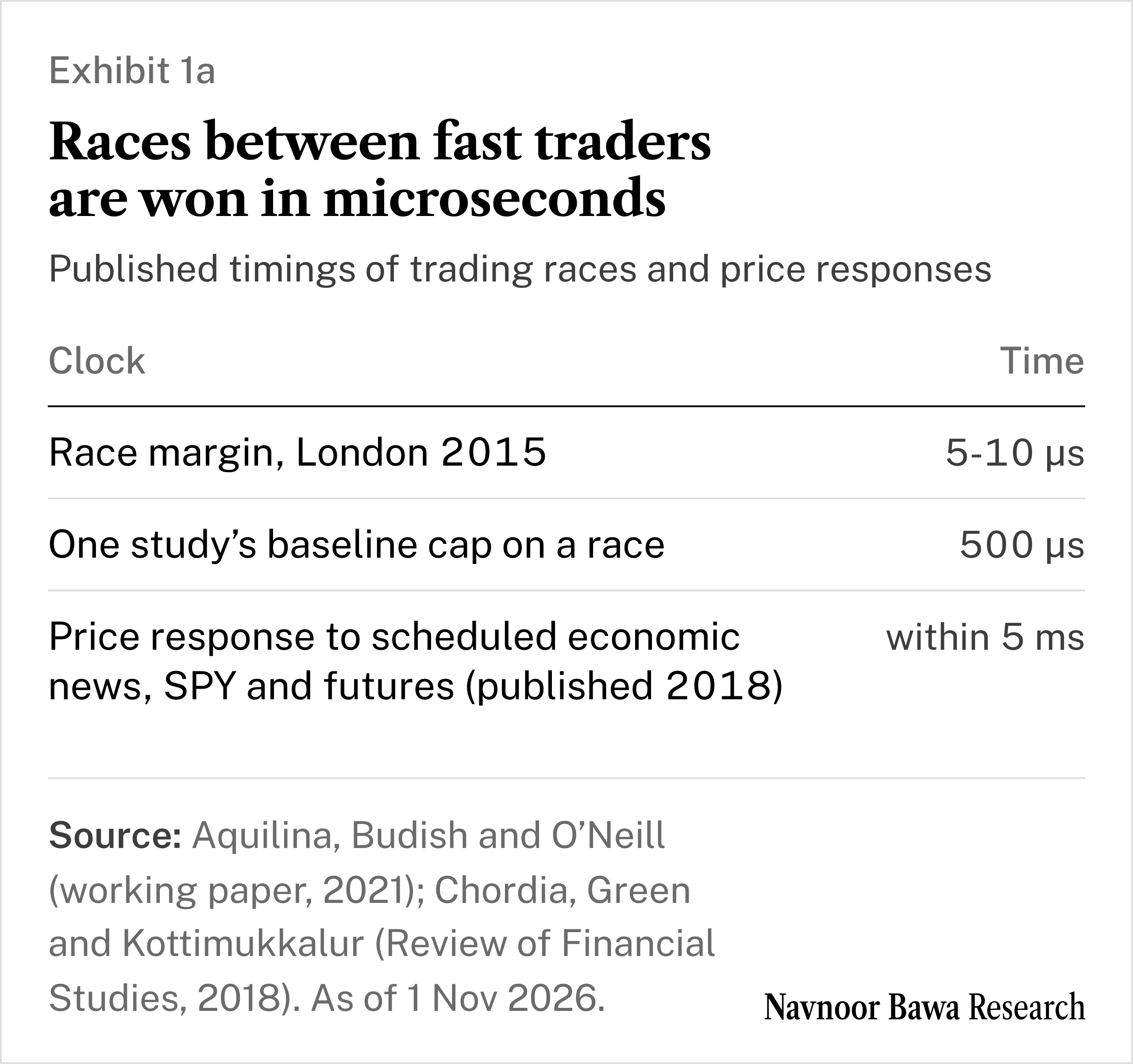
Eric Budish, a University of Chicago economist, and two coauthors timed latency races in London Stock Exchange messages for FTSE 350 stocks, August to October 2015. A latency race, as Aquilina, Budish and O’Neill define it, is two or more traders acting on the same stock, side and price at essentially the same moment, some trying to trade against a resting quote and, often, others trying to cancel it.
Races came about once a minute in the average FTSE 100 stock and held about a fifth of volume. “In the modal race, the winner beats the first loser by just 5-10 microseconds”; call that the race margin. The top six firms took about 80% of the liquidity taken in races, and firms outside them provided about 58%, so on net the outsiders’ resting quotes pay for the races.
For their baseline count the authors “place an upper bound on the information horizon of 500 microseconds”, the longest gap between two firms’ messages that they still treat as responses to the same news; call it the cap. Past it, they write, the assumption that firms react to the same information becomes strained.
To a person at a screen, the feed’s twentieth of a second is negligible, as the government says. In the study’s units it is no race at all: up to 50 milliseconds is 100 times the cap, and 5,000 to 10,000 times the race margin.
It is also longer than prices take to start moving on scheduled economic news. In S&P 500 futures and the SPY exchange-traded fund, prices respond to economic surprises “within five milliseconds”, Chordia, Green and Kottimukkalur found in the Review of Financial Studies. Up to 50 milliseconds is ten times that, though a release with a forecast to beat is quicker to read than a post. Against anyone reading the web copy, the feed works as a head start, step by step.
The president posts, and Truth Social puts the post in its public feed.
Truth API sends the same post to subscribers as structured data, up to about 50 milliseconds ahead of ordinary web delivery.
Subscriber machines race one another to the exchange, and the race margin decides the winner.
The prize is every stale quote, meaning a bid or offer priced before news its owner has not yet read.
Slower readers see the post later, and their cancels arrive after their quotes are gone.
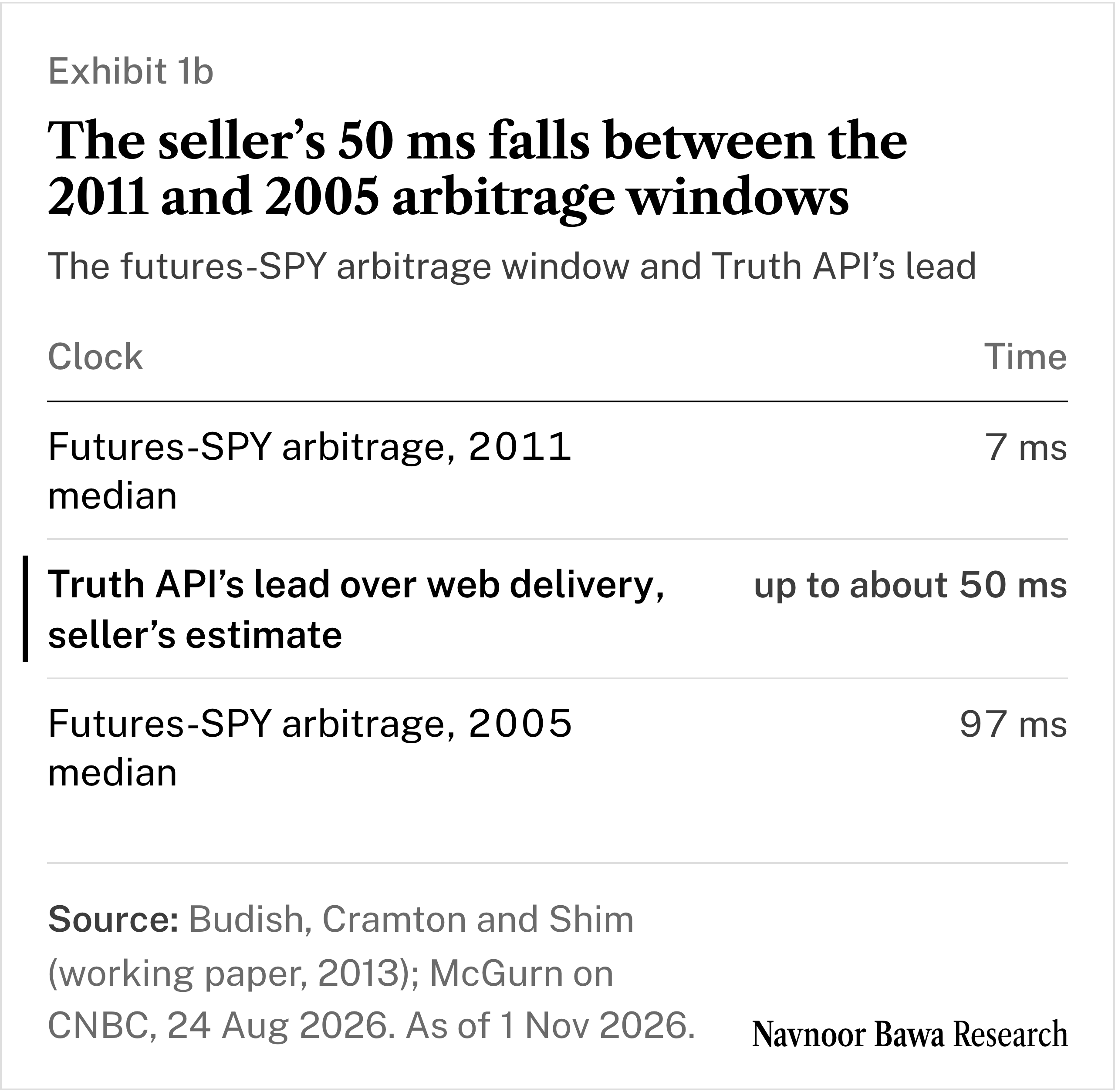
Below, the seller’s 50 ms sits beside the published clocks of fast trading (µs is microseconds, ms milliseconds).
Source: Aquilina, Budish and O’Neill (working paper, 2021); Budish, Cramton and Shim (working paper, 2013); Chordia, Green and Kottimukkalur (Review of Financial Studies, 2018); McGurn on CNBC, 24 Aug 2026 · as of 1 Nov 2026
Budish, Cramton and Shim found the historical twin in the same pair: the arbitrage between S&P 500 futures and the SPY lasted “a median of 97 ms in 2005” and “a median of 7 ms in 2011”. Over those years “median profits per contract traded have remained steady at around 0.08 index points”. Speed shrank the window and left the prize with whoever got there first.
Against that 2005 window, 50 milliseconds would look like half a race, but that window is gone. Budish, Cramton and Shim’s rule still holds: “only the first message to reach the exchange matters – liquidity providers usually lose the race”. Among subscribers that race is run in microseconds; between subscribers and everyone else the lead is open, and Trump Media charges for it.
Jump could stand on both sides
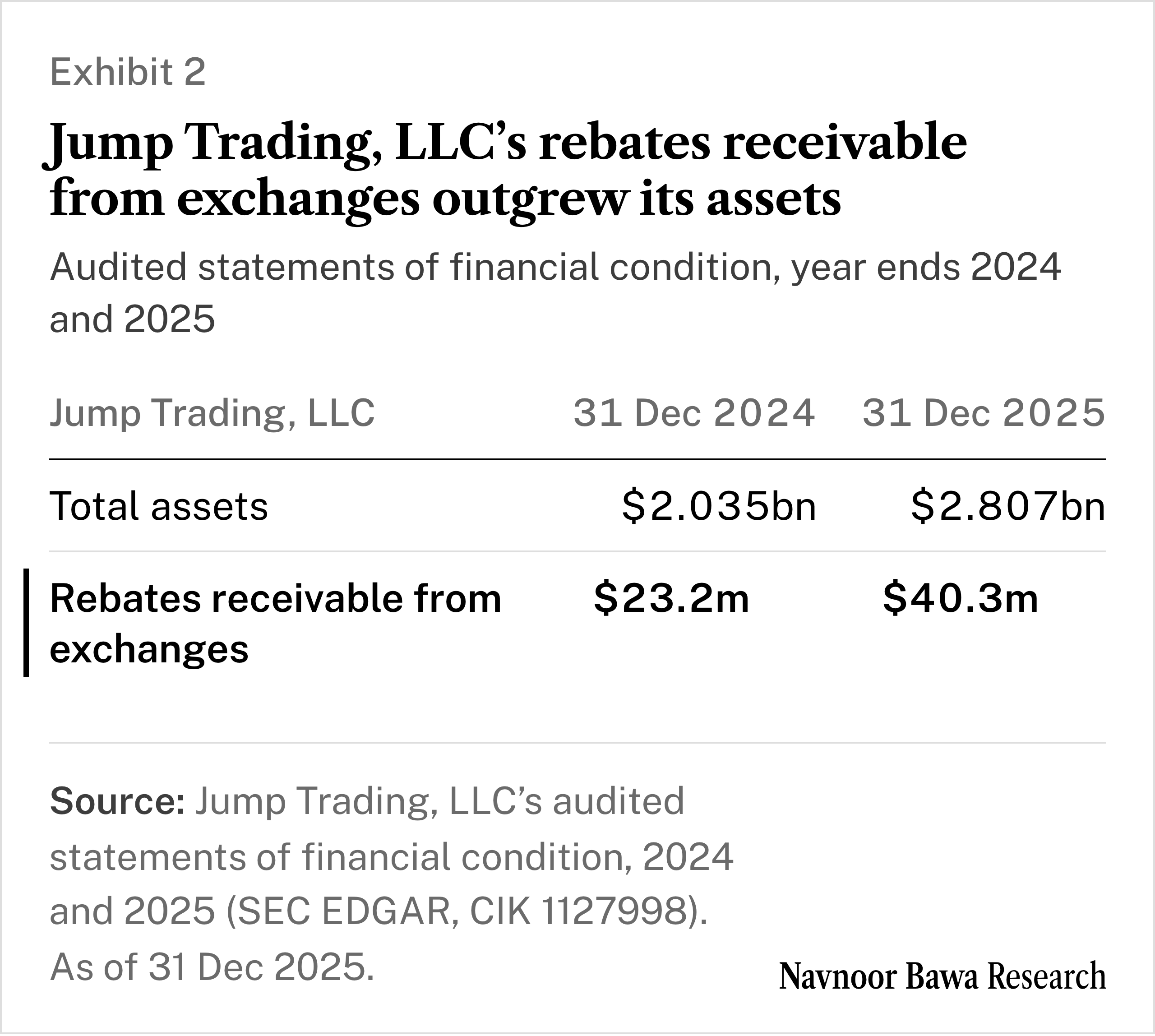
Jump Trading, LLC, the group’s larger US broker-dealer, says in its audited statement for 31 December 2025 “All trading activities are proprietary … no customer accounts are maintained,” and “The Company is also a market maker at certain exchanges.” So Jump Trading, LLC trades only its own money and, on some exchanges, keeps quotes resting for others to hit.
Source: Jump Trading, LLC’s audited statements, 2024 and 2025 · as of 31 Dec 2025
Read each row across: assets rose 37.9%, and rebates receivable, mostly liquidity rebates exchanges still owed it at the year end, rose 73.7%. Exchanges pay those rebates when resting quotes are filled, so the rise points to more resting quotes filled around the year end, and more resting quotes are more to lose in the milliseconds after a post, which is the defensive reason to buy the feed.
Neither Jump’s statement nor Susquehanna Securities’, the other trading firm Reuters named, shows revenue to set the feed against.
Jump also pays for speed: “over 100 co-located compute environments near global exchanges”, its site says. Its resting quotes can be picked off in races, and its machines are built to win them. McGurn told Axios in October that “the high-frequency trading platforms came to us over the last 18 months with demand”; Jump’s place among them rests on Reuters alone.
The rare post that pays
JPMorgan, as investingLive reported in February 2025, found that of “126 posts on trade and economics … only 10% of them triggered notable currency fluctuations”. Our count of the archive that Queensland University of Technology (QUT) researchers publish finds about 17.5 posts a day from 20 January 2025 to 8 April 2026. About a quarter of them landed in New York Stock Exchange hours, which cover about 19% of the week, so more of his posts land while markets are open than the clock alone would give. A buyer pays every month and collects only on the rare post that matters.
On 9 April 2025 he posted a 90-day tariff pause at 1:18 p.m. New York time. Within seconds the Dow “surged more than 2,000 points”, CNBC reported. Every bid and offer resting at 1:18 was priced for a world without the pause, and the first machines to read the post could trade against them. Truth API did not exist yet.
QUT’s Graham, Chorazy and Harrington found 15 events of unusual trading in oil-linked markets among 1,341 posts in early 2026; on some of those days “the price had already moved sharply in the minutes before he posted”, in work not peer reviewed. Where the price moves first, the head start reaches only what is left.
David Boole of the options brokerage BayCrest told the Journal on 22 July: “It’s a defensive cost, not even necessarily alpha.” Boole is right about defence and may be too modest about offence: a market maker such as Jump could use the feed to cancel its own stale quotes in time, and the same feed would let it take slower firms’.
The meaning still picks the side: buyers, McGurn says, “start to look at context to figure out what their trades can be”. Boole also names who pays: “Retail won’t be able to act fast enough to matter.”
→ Pershing Square’s 2020 credit hedge, rebuilt from its own letters and filings, Trade File No. 4 on Patreon.
What is the head start worth to the firms that buy it, and what must Trump Media’s report due by 9 November show?
Below the paid line:
The verdict and our odds on Trump Media’s next report.
A buyer’s year of the feed in measured profits on economic releases, and Trump Media’s revenue table.
Two dated checks, the first by 9 November.