

This is a detailed research piece. If you find value in institutional-quality hedge fund analysis, support this work on Patreon.
The Setup
Hedge fund spinoffs are systematic wealth transfers enabled by mentor networks, seed capital structures, and talent arbitrage. Tiger Management (1980–2000) directly seeded 38 funds and spawned approximately 200+ affiliated firms (per industry network analysis). SAC Capital alumni launched 12+ funds post-2013 guilty plea. Goldman Sachs asset management division produced three major platforms: Omega Advisors (approximately $10B peak AUM, mid-2000s), Och-Ziff (approximately $50B peak, mid-2010s), and AQR Capital (approximately $142B as of mid-2025).
The economics are clear: junior portfolio managers at top-tier funds learn proprietary strategies, build track records on house capital, then replicate alpha generation with lower fee drag and concentrated positioning. Commonly reported seed capital ranges from $25M–$200M for 15–30% revenue share, though deal terms vary significantly by fund size, track record, and market conditions.
Tiger Management: The Original Incubator
Julian Robertson’s Systematic Seeding Model (1980–2022)
Robertson closed Tiger Management in March 2000 at $6.5B AUM after catastrophic losses from anti-tech positioning during dot-com bubble. Peak AUM: $22B (1998). Career returns: 31.7% annualized (May 1980 to August 1998, after fees).
Post-closure strategy: Convert proprietary capital into seed investments. Robertson seeded 38 hedge funds (“Tiger Seeds”) as of September 2009, taking equity stakes in management companies rather than just fund performance fees. Economic logic: capture 10–25% of fee revenue streams across diversified strategy set versus concentrated single-fund risk.
First-Generation Tiger Cubs (Direct Employees)
Operational DNA Transfer
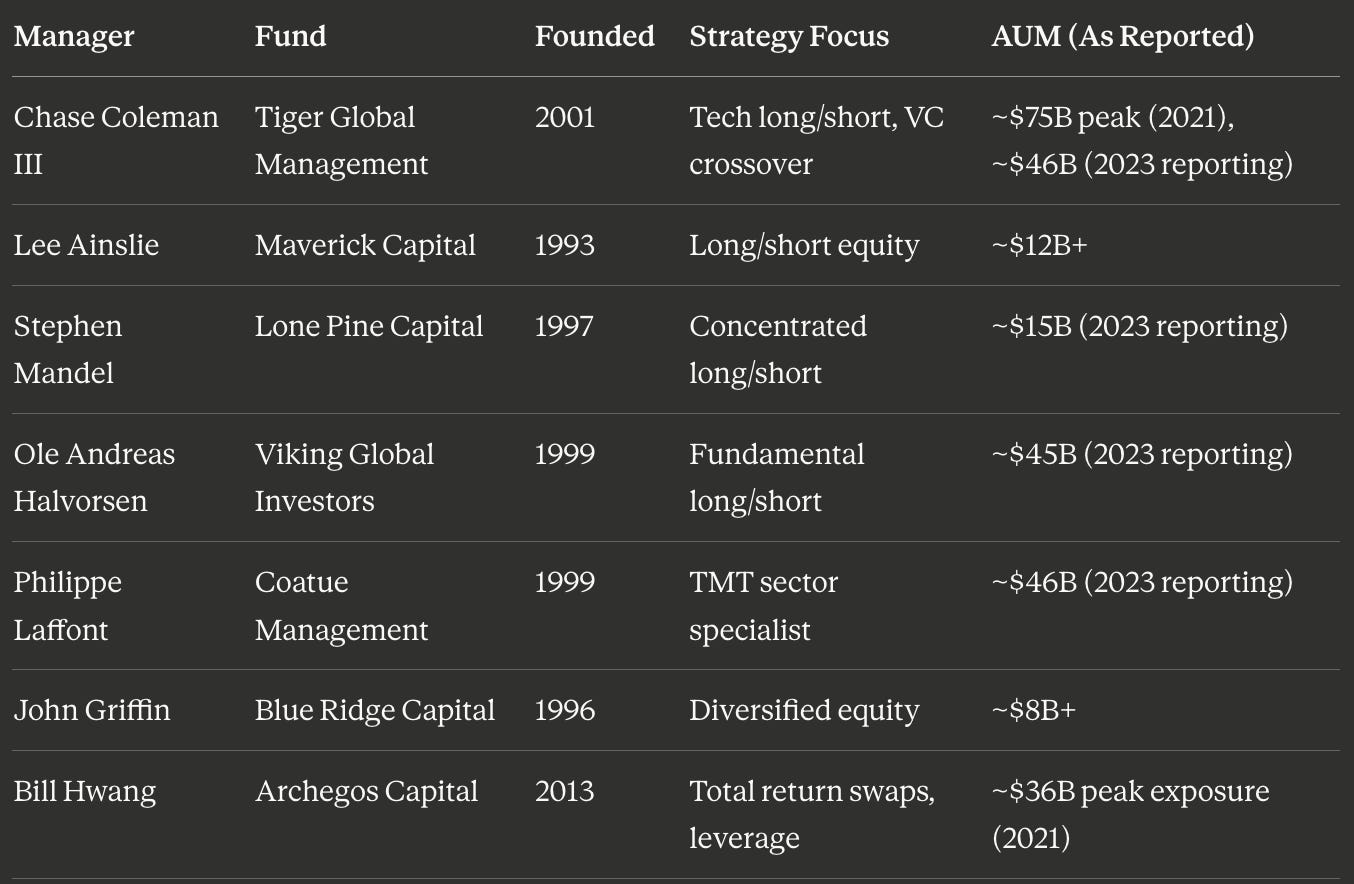
Tiger cubs inherited Robertson’s operational framework: concentrated portfolios (20–40 names), deep fundamental research (field visits, channel checks), and bottom-up sector specialization. Portfolio managers typically ran with high gross exposure and conviction-weighted sizing.
Performance divergence: Tiger Global’s flagship fund returned approximately 21% net annualized over its first two decades (2001–2020) per investor letters, before 2021–2022 tech correction. The fund posted 24% gains in 2024. Lone Pine gained 36% in 2024.
Archegos imploded in late March 2021 when concentrated positions in ViacomCBS, Discovery, and GSX Techedu triggered forced liquidations. Prosecutors and the SEC described peak exposure of approximately $36B. Multi-day liquidations caused banks to report over $10B in combined losses, with Credit Suisse and Nomura absorbing the largest hits.
Second-Generation (Grand Cubs)
Post-2008 proliferation: Former employees of Tiger Global, Coatue, and Viking launched 50+ firms. Strategy drift: Shift toward venture capital, growth equity, private crossover. Example: D1 Capital (Dan Sundheim, ex-Viking) raised approximately $6B at launch in 2018–2019, among the largest hedge fund launches of that period.
Sources:
SAC Capital: The Post-Scandal Diaspora
The Economic Incentive Structure
SAC Capital (1992–2013) generated 25–30% annualized returns over two decades before pleading guilty to securities fraud in November 2013. Settlement structure per DOJ (https://www.justice.gov/usao-sdny/pr/manhattan-us-attorney-announces-guilty-plea-agreement-sac-capital-management-companies): $1.8B total penalty comprised of $900M criminal fine plus $900M forfeiture; a previously paid $616M SEC settlement was credited against this amount, resulting in $1.184B net additional payment. Firm prohibited from managing external capital; converted to Point72 Asset Management (family office) managing $11B+ of Steve Cohen’s wealth as of 2014.
Alumni Performance During Transition (2011–2016)
Cohen’s economic decision: Provide seed capital to proven portfolio managers rather than retain as employees under regulatory constraints. Commonly reported structure: $100M–$250M seed plus infrastructure support for 20–30% profit participation, though specific terms varied by manager and track record.
Manager Fund Launch Year Seed Capital (Cohen) 2015 Returns Strategy Gabriel Plotkin Melvin Capital 2014 $200M +47% Consumer/tech long/short Aaron Cowen Suvretta Capital 2011 Undisclosed +26% (2013) Generalist equity Ping Jiang Ping Exceptional Value 2014 Undisclosed +39.2% Value-oriented Sol Kumin Folger Hill Asset Mgmt 2015 Undisclosed Pass-through model Multi-PM platform
The Melvin Capital Case Study
AUM trajectory: $1.5B (2015) to approximately $12.5B (early 2021) to liquidation (June 2022).
Failure mode: Concentrated short positioning in heavily-shorted stocks produced 53% loss in January 2021 (GameStop primary driver). Portfolio construction flaw: Insufficient hedging against short-squeeze gamma dynamics and options-driven volatility spikes. January 2021 drawdown necessitated $2.75B emergency capital injection from Citadel and Point72 for non-controlling stakes.
2021 performance: -39% despite S&P 500 +28.7%. Structural issue: High conviction shorts (25–40% portfolio weight) amplified by retail coordination via r/WallStreetBets and gamma squeezes from call option buying.
Plotkin announced fund wind-down in May 2022. He now operates Tallwoods Capital (family office, Miami).
Sources:
Goldman Sachs: The Quant Factory
Systematic Talent Pipeline to Independent Platforms
Goldman’s asset management division and proprietary trading desks functioned as talent incubators. Key pattern: 10–15 year apprenticeships followed by independent launches with institutional backing.
Leon Cooperman to Omega Advisors
Career Arc: Goldman Sachs (1967–1991). Final roles: Chairman/CEO Goldman Sachs Asset Management (1989–1991), General Partner (15 years).
Track Record at Goldman: #1-ranked portfolio strategist (Institutional Investor All-America Research Team) for 9 consecutive years (1977–1985). Performance during 1970s stagflation validated fundamental stock selection over macro timing.
Omega Advisors (1991–2018): Launched with personal capital plus Goldman partner network. Peak AUM: approximately $10B (mid-2000s). Strategy: Concentrated value long/short (30–50 positions). Average net exposure: 60–70%.
Returns vs S&P 500: Outperformed in 17 of 27 years. Drawdown management: 2008 loss approximately 37% (in-line with S&P 500), but recovery via distressed energy positions 2009–2011.
Regulatory event: SEC filed insider trading charges September 2016 (Atlas Pipeline Partners, 2010). Settlement reached May 2017: $4.95M, no admission of wrongdoing, compliance monitoring through 2022.
Conversion to family office: December 2018. Current structure: Omega Family Office managing $3B+ personal wealth.
Sources:
David Tepper to Appaloosa Management
Goldman Career (1985–1992): Head trader, high-yield bond desk within 6 months. Specialized in distressed debt and bankruptcy situations. Exit trigger: Passed over for partnership twice (1990, 1991).
Appaloosa Management (1993–Present): Founded with $57M. Current AUM: approximately $4B (family office conversion 2019).
Core Strategy: Distressed debt arbitrage with asymmetric payoff profiles. Key trades:
2001 California Energy Crisis: Bought PG&E and Edison International shares at low-teens when credit ratings cut to junk. Exit mid-$20s post-state bailout. Position size: approximately $1B deployed.
2009 Financial Crisis: Purchased Bank of America common at $3/share (February–March 2009), exited $15.79 (Q4 2009). AIG debt acquired at $0.10 on dollar. Total 2009 P&L: approximately $7B (personal share: $4B). Single-year compensation: Highest-earning hedge fund manager, 2009.
Risk Management Framework: Maximum 5% of capital per position. Catalyst-driven thesis (government intervention, restructuring, M&A). Portfolio turnover: 150–200% annually.
Conversion to family office: 2019 (concurrent with Carolina Panthers NFL team acquisition).
Sources:
Daniel Och to Och-Ziff Capital Management
Goldman Career (1982–1993): Risk arbitrage department to Head of proprietary trading, Equities Division to Co-head U.S. Equities Trading.
Och-Ziff Launch (1994): Initial capital: $100M from Ziff brothers (publishing heirs). Strategy: Multi-strategy (merger arbitrage, convertible arbitrage, credit, real estate).
Growth Trajectory: $100M (1994) to approximately $50B peak (mid-2010s). IPO: November 2007, NYSE listing at $32/share.
Post-IPO Challenges:
2016 FCPA Violation: Firm paid $412M ($213M DOJ plus $199M SEC) for bribing African government officials to secure investments. Och personally fined $2.2M.
Performance degradation: Client redemptions 2017–2019 following scandal and underperformance.
CEO exit: Och replaced by Robert Shafir (February 2018). Full departure: March 2019.
Rebranding: Och-Ziff to Sculptor Capital Management (August 2019). Firm acquired by Rithm Capital (November 2023) for $12.70/share ($676M total).
Current Platform: Willoughby Capital (family office). Portfolio: Robinhood, Coinbase, Instacart (growth equity/venture focus).
Sources:
Cliff Asness to AQR Capital Management
Goldman Career (1990–1997): Manager, quantitative research desk (GSAM). Built factor models combining Fama-French value/size factors with momentum. Team managed $7B by 1997 with minimal monthly losses.
AQR Launch (1998): Co-founders: Asness, David Kabiller, John Liew, Robert Krail (all ex-Goldman). Initial raise: $1B, largest hedge fund launch at the time.
Factor-Based Framework:
Value: Low P/E, P/B relative to quality-adjusted fundamentals
Momentum: 12-month price trends excluding most recent month
Carry: Interest rate differentials, commodity roll yields
Defensive: Low beta, low volatility
Performance History:
1998–2000: -60% drawdown during dot-com bubble (value factor worst decade). Firm survived due to institutional LP commitment vs retail redemptions.
2007–2008: Quant quake (August 2007) caused multi-strategy fund losses as factor crowding unwound. Full-cycle recovery 2009–2010.
2020: COVID-induced growth rally crushed value strategies. Peak-to-trough: -40%+ in value-focused funds.
2021–2025 Recovery: Value factor reversal post-2021. Mid-2025 H1 results: Apex (multi-strategy) +11.4%, Delphi (long/short equity) +11.6%.
Current AUM: Approximately $142B (mid-2025, up from $99B start of 2024). Strategy mix: 40% alternatives, 60% long-only/factor funds.
Structural Advantage: Academic rigor plus systematic process equals institutional sticky capital. Average client tenure: 8+ years.
Sources:
Key Structural Insights
1. Seed Economics Outperform Direct Employment
Mentor providing $100M seed capital for 20% management company equity generates asymmetric returns if protégé scales to $5B+ AUM. Example: $5B at 2/20 fee structure equals $100M management fees plus $100M incentive fees (assuming 10% gross return, 8% net) equals $200M annual revenue. 20% equity stake equals $40M/year versus approximately $10M salary as employee.
2. Strategy Replication with Structural Advantages
Alumni firms operate with: (a) Lower AUM allows concentration (8–12% position sizes vs. 2–4% at $50B+ funds), (b) No legacy exposure management, (c )Smaller compliance/infrastructure costs as % of AUM, (d) Performance fees reset to high-water mark vs. institutional funds carrying forward losses.
3. Failure Modes
Archegos (Hwang): Total return swaps created estimated 5:1 effective leverage on approximately $10B capital base, generating peak exposure prosecutors and SEC described as approximately $36B. Concentrated positions in ViacomCBS and Discovery forced liquidation when margin calls triggered. Banks reported over $10B in combined losses (Credit Suisse, Nomura largest) on position unwinds in late March 2021.
Melvin Capital (Plotkin): Short portfolio construction ignored gamma exposure from retail option buying. Prime broker risk management failure: Insufficient margin requirements on crowded shorts with 100%+ short interest ratios.
4. Institutional Memory Transfer
Tiger cubs inherited operational practices: Multi-hour team debates on investment theses before position entry. SAC alumni carried forward daily P&L explanation requirements plus position risk decomposition. Goldman quants transferred systematic frameworks: Code reviews, factor attribution, scenario analysis.
Conclusion
The hedge fund apprenticeship model functions as systematic risk transfer: established managers exchange seed capital plus operational IP for equity stakes in protégé platforms, diversifying across strategies while protégés capture 100% upside on incremental capital raised. Tiger Management’s 200+ affiliated firms collectively generated more aggregate value post-closure than Tiger’s $22B peak. The economic logic favors spinoffs when: (1) protégé has 5+ year audited track record, (2) strategy capacity constraints limit parent fund growth, (3) regulatory/reputational risks incentivize capital dispersion.
The seeding model’s asymmetric payoff profile explains its persistence: Robertson’s 38 direct seeds, each capturing 10–25% management company equity, generated estimated aggregate valuation exceeding $5B across the portfolio by 2020. Cohen’s post-SAC diaspora seeding (2014–2016) yielded similar returns until GameStop (January 2021) exposed systematic risk in crowded short strategies. Goldman’s pattern of 10–15 year apprenticeships followed by $1B+ launches (AQR ~$142B as of mid-2025, Och-Ziff ~$50B peak mid-2010s) demonstrates that systematic talent development plus seed capital structures create self-reinforcing networks of capital allocation expertise.
Complete Source List
Primary Regulatory/Legal Sources:
Tiger Management & Cubs:
https://www.latimes.com/archives/la-xpm-2000-mar-30-fi-14145-story.html
https://www.opalesque.com/IndustryUpdates/506/Julian_Robertson_reveals_what_makes_a_good506.html (38 seeds confirmation)
https://www.institutionalinvestor.com/article/2btgi8fqfibzyw3hnycqo/home/the-tiger-in-winter (Tiger alumni network analysis)
https://www.gurufocus.com/news/1857538/tiger-managements-julian-robertson-one-of-the-top-gurus
https://fortune.com/2022/08/23/julian-robertson-hedge-fund-billionaire-tiger-cubs-dies-at-90/
https://www.hedgeweek.com/tech-surge-helps-tiger-cubs-post-second-straight-year-of-gains/
SAC Capital & Alumni:
https://www.businessinsider.com/gabe-plotkin-melvin-capital-returns-2016-2
https://www.insidermonkey.com/hedge-fund/melvin+capital+management/804/
Goldman Sachs Alumni:
Cliff Asness & AQR:
📊 Support this research: https://www.patreon.com/c/NavnoorBawa
Cover photograph: Carlos Delgado, CC BY-SA 3.0, via Wikimedia Commons.