


On 25 March 2024, FTX’s bankruptcy estate filed its revised list of Anthropic buyers. Jane Street Global Trading, LLC sat second from the top. This week Fortune wrote that Jane Street “spent $1.34 billion to purchase Anthropic shares at the time”, a stake “likely to be worth over $35 billion after the IPO.”
But the court record is narrower. I read the purchaser list the estate filed line by line, with both sale orders, and Jane Street appears once. Its line in the court exhibit is $99,999,988 for 3,332,833 shares. The $1.34 billion is what the whole estate raised, and the $35 billion fits its whole block.
That row is the one-line purchase, a buyer’s single line in a sale’s purchaser list. Anthropic’s first close, on 19 November 2026, prices it for the first time.
The paid half prices the line at that close, with our odds, and narrows when it can be sold. Its deciding number is the 0.5% threshold, the holding size that sets a holder’s lock-up, a bar on selling after the IPO.
Jane Street paid Anthropic’s own price
The list’s own Schedule A, its table of buyers, puts every purchaser at $30.0045 a share. Multiplied by Jane Street’s 3,332,833 shares, that is the $99,999,988 on its line, to the dollar.
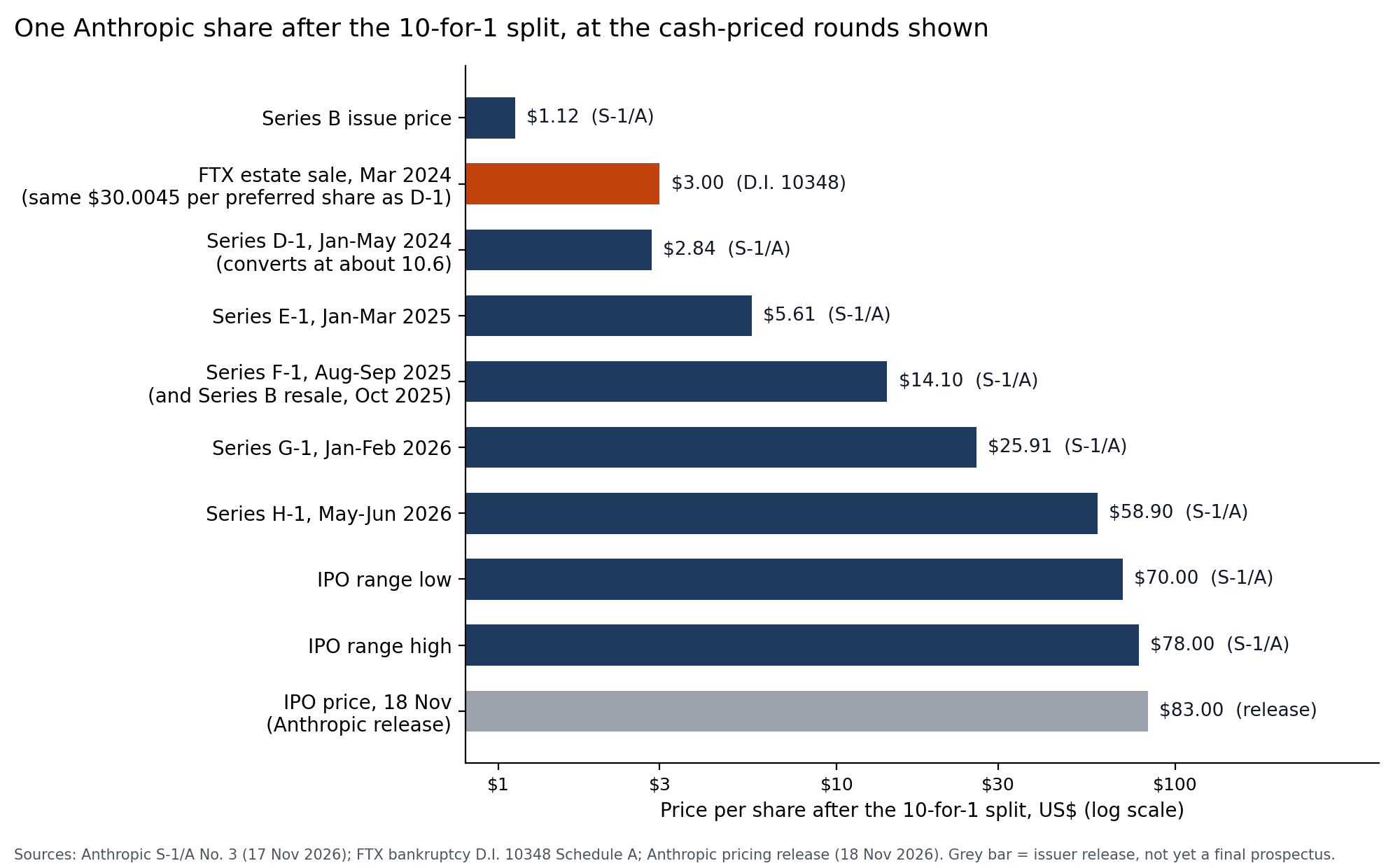
Each bar is one Anthropic share on the converted count, each preferred share counted as the ten common shares it becomes. The estate’s bar comes from the same $30.0045 a preferred share that Anthropic’s own Series D-1 round paid; D-1 now converts at about 10.6, so its bar sits a little lower. The grey $83 is the offer price Anthropic announced, ahead of its final prospectus.
FTX held Series B, one of Anthropic’s non-voting preferred series, issued at $11.23 a share. The estate, in Chapter 11 in Delaware, sold 44,539,240 of those shares, 50.9% of the series, in two sales in 2024, on its first and second purchaser lists.
Jane Street Global Trading, LLC, one company of Jane Street Group, LLC, had the second largest of the 24 lines on the first list, 11.3% of that sale’s $884,109,327. Only ATIC Third International Investment Company, the largest buyer, wrote a larger cheque, at $499,999,999. Below Jane Street sat certain funds managed by Fidelity Management & Research, at $44,999,999, and HOF Capital, at $29,999,999.
That March, CNBC reported that Jane Street “is purchasing shares worth almost $100 million”, and the exhibit agrees. The estate’s second purchaser list, filed on 31 May 2024, has 21 lines for $452,268,300, all at the same price, and none of them is Jane Street’s.
The docket holds the court’s approval of each sale and no completion receipt, so the line here is the documented purchase as the court approved it. Nothing public shows whether Jane Street still holds all of it. The only sellers in Anthropic’s offering are its seven co-founders, 23,648,646 shares between them, so the offering says nothing either way. I found no public statement from the firm on why it bought.
The seller ran the sale, and the issuer held a consent. The estate’s investment bank, Perella Weinberg Partners, marketed the shares. Its banker swore in a declaration filed on 25 March 2024: “I believe that the inclusion of the Release is necessary for Anthropic to consent to the Sale Transaction”.
The Delaware bankruptcy court signed the first sale order on 8 April 2024 and the second on 13 June 2024. The first order found that Anthropic “would not have consented to the Sale Transaction in the absence of such releases”. Its Finding G reads:
“No other person or entity or group of entities has offered to purchase the Anthropic Shares for higher or otherwise better value to the Debtors’ estates than Purchasers.”
In plain words, the court found that nobody had offered the estate more for the block, and every buyer on both lists paid the same price per share.
Anthropic’s prospectus prints that same price, per preferred share, for its own Series D-1 round, sold from January to May 2024, and for Series D-3, a further preferred series. What surprised me is that the estate sold at $30.0045 a share, exactly what Anthropic charged its own Series D-1 and D-3 investors that spring.
Fortune wrote that the buyers “snapped up shares at firesale prices”. On price, the record does not bear that out: a seller that matches the issuer’s current round, under a court finding that nobody bid more, did not dump the block.
In October 2025 Anthropic bought back 4,453,900 Series B shares from the US government, “to which such shares had been forfeited by former holders in legal proceedings to which we were not a party”. It paid $140.9676 a share, the prospectus says, and resold them, at the same time, to nine accredited investors. That is 4.7 times the estate’s price for the same class, about a year and a half later, and it put Jane Street’s line at about $470m.
The one-line purchase was made at Anthropic’s own price, so its gain is all timing: every dollar of it came after the sale.
One share became ten Class N
What Jane Street bought was preferred stock, and preferred stock does not list. At the IPO, Series B converts into Class N, Anthropic’s non-voting common stock. Class N shares “are not listed on a stock exchange”, in the prospectus’s words.
They turn into the listed Class A when sold on the market or in a registered offering, a sale registered with the SEC. A private sale converts them too, if the buyer holds no Class N and is left owning no more than 9.99%. So the share class does not stop a Nasdaq sale; a lock-up does.
The prospectus holds an outside holder like this one in one of two ways. One is a market standoff, the company’s own version of a lock-up, in its shareholder agreements. The other is a lock-up signed with Goldman Sachs and Morgan Stanley, acting for the underwriters as their representatives. Either way the holder lands on one of two release schedules.
The longer one reaches certain holders above the 0.5% threshold of fully diluted shares, which on my reading counts every share as if all preferred, notes and awards had converted.
The share count changed too. The prospectus records the split:
“On September 17, 2026, the Company effected a 10-for-1 stock split of its authorized, issued, and outstanding shares of Class A common stock and Class N common stock.”
The split touched only the common. Anthropic instead adjusted the preferred’s conversion rate to match, so that as of 30 September 2026 each Series B share converts into 10 shares. Every Series B share on Jane Street’s line becomes ten Class N shares, each carrying a tenth of what the estate charged. Sized on the documented line, Jane Street’s FTX gain is a low-billions number, not a $35 billion one.
The headlines priced the whole estate
Fortune’s page title on 16 November said Jane Street “could share in $35 billion windfall from FTX’s Anthropic sale”. Its body then named “the quant giant Jane Street” as the buyer of the $1.34 billion and the holder of the $35 billion. I rebuilt both figures from the documents. The two sales’ 45 purchaser lines give the dollars and shares, the conversion rate the Class N count, and Anthropic’s filed price range the price. Both reproduce, and both belong to the estate.
The $1.34 billion is the two sales added together. The first raised $884,109,327 and the second $452,268,300, for $1,336,377,627 across 45 lines.
The $35 billion is a share count times a price. Call the 44,539,240 Series B shares the estate sold in both sales the estate cohort. On conversion they become 445,392,400 Class N shares. Anthropic filed a price range of $70 to $78 a share, and at the top the cohort is worth $34.74bn. Fortune’s figure implies $78.58 a share on the cohort, and Jane Street’s line is one of the 45 inside it.
Half of the correction is already in print. Crypto Briefing ran both accounts the same day, Fortune’s and “separate research findings” describing $1.34 billion as “the total liquidation figure”. It also put the former FTX stake at “theoretically worth between $31 billion and $35 billion”. That band is the cohort across the filed range, from $31.18bn at the bottom to $34.74bn at the top.
Jane Street’s ties to Anthropic do run wider than one line. A case study of the firm in Anthropic’s prospectus materials, filed on 12 November 2026, reads: “Claude is now deployed nearly wall-to-wall across the organization.” What none of the coverage I read printed is the exhibit line read whole, with its conversion, its share class and its lock-up. The $1.34 billion and the $35 billion are true numbers about the wrong subject.
The 10-for-1 split reached the preferred through its conversion rate, so a correction that fixes the price and skips the conversion comes out ten times too low. At the $83 offer Anthropic announced, the unconverted line comes to $277m; converted, it is worth ten times that. I would put 3 to 1 on the first close lifting it higher, and our base case puts it higher still. The 0.5% threshold, about 85 to 89 million shares, sets how fast it can be sold, and the line alone does not reach it.
Crypto Briefing’s “at around $30 each” is that price-only reading. I’m wrong if Anthropic’s Class A closes its first day, 19 November 2026, at or below the $83 offer, as 29.4% of 2,825 US IPOs since 2001 did in the University of Florida statistics. My 75% sits a little over the record’s 70.6%, because Anthropic priced above its filed range and such IPOs have averaged a far larger first day.
The claim itself, one line and a low-billions gain, is wrong if a filing shows Jane Street bought more of the estate’s shares, or sold part of this line before the IPO. The only later purchaser list carries no Jane Street line, and no public filing shows a sale.
The conversion, in four steps:
Start from the exhibit: 3,332,833 Series B shares.
Multiply by the conversion rate of 10: the line converts into 33,328,330 Class N shares.
Divide the cost the same way: $99,999,988 over the converted count is $3.00045 a share.
Price the converted count, at the offer and on the first-day record.
Each step can be checked against a document this piece links: the first number is on the court’s exhibit, the rate is in the prospectus’s description of Class N, and the last is Anthropic’s own offer price. Only that last step needs a view on the market, and the first close prints it. What no close prints is who may sell. The paid half reads the agreement the FTX buyers signed in March 2024 against Anthropic’s two lock-up schedules, shows which early release dates can reach this line and how many of its shares each frees, and runs the same four-step test on the largest buyer on the purchaser list.
Can the holder sell into a first-day rise, or does a lockup decide when the gain becomes real?
Below the paid line:
The valuation: the price at the first close, our verdict and odds, the model.
The lock-up: a table of the two release schedules, the agreements binding the FTX buyers, the longer lock-up’s threshold.
A four-step test for any bankruptcy-sale buyer, the next firm, and the dated watch list.