


On 3 November, Icahn Enterprises (IEP) reported that its refining hedges lost $522m in the third quarter. They hedge its stake in the refiner CVR Energy (CVR), which gained about $1.7bn in those months, so the hedge gave back about a third of the stake’s gain. Earnings Whispers wrote that IEP “effectively lost on one side of the trade what it gained on the other.”
In a rally, that is what a sector hedge does. The trouble is the part it cannot see, the moves that belong to CVR alone. That morning CVR announced a refinery deal and a share sale in which IEP was to sell. From that day’s close to 23 November, CVR fell 33.5%, about twice the refiners’ 17.2%.
Carl Icahn and his affiliates took $450m out of the funds holding the hedge in the nine months to September, leaving it mostly inside IEP, where he owns about 87% of the units, so he still bears most of it. IEP’s annual report, due by 1 March, will show how much of CVR’s fall the hedge covered.
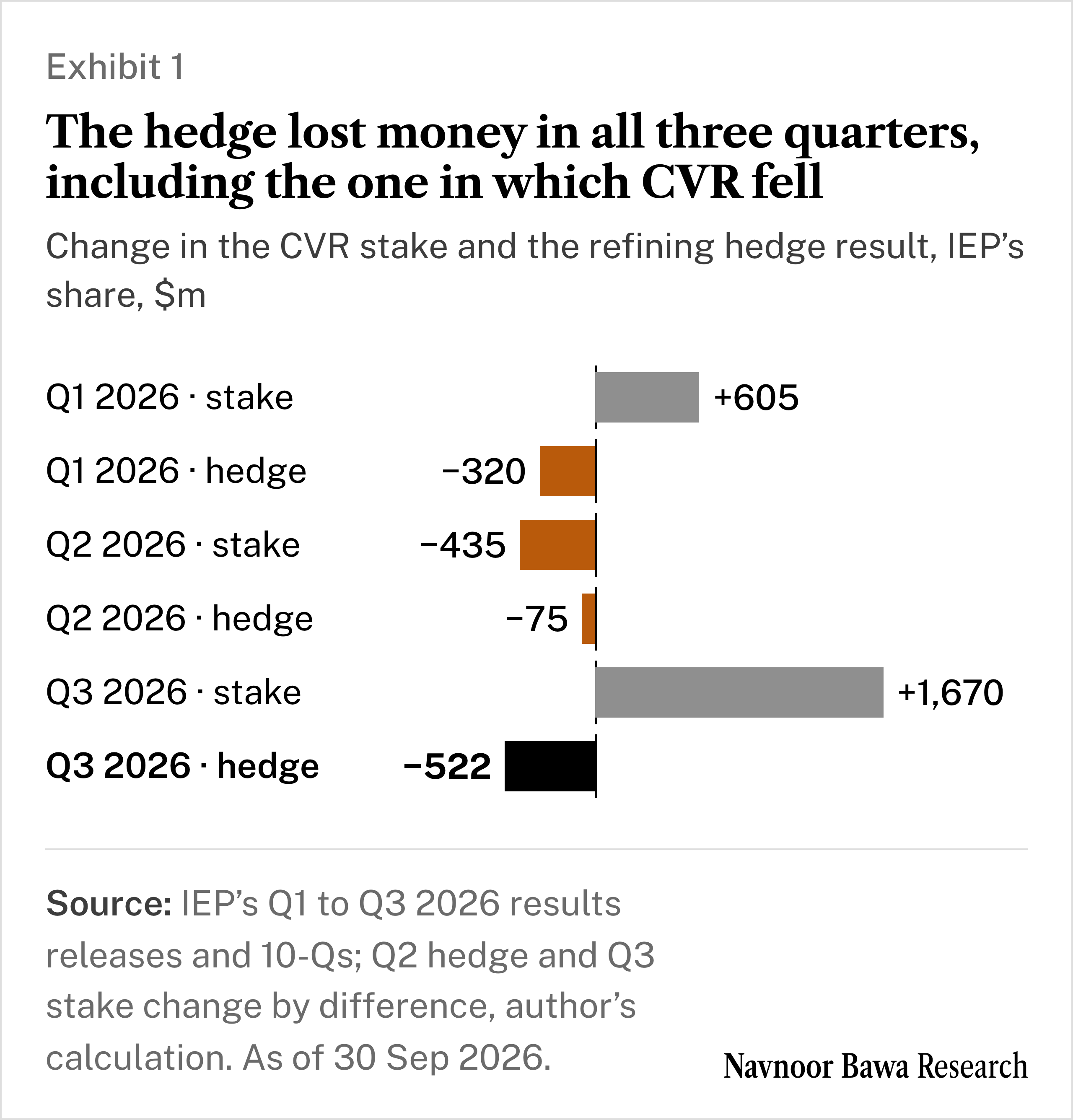
Each pair is one quarter: the stake’s change beside the hedge’s result, on IEP’s share.
One refiner, two lines
The third quarter results release put the two lines side by side. IEP’s CVR stake rose 85%, to $3,631m. By the 10-Q, the hedge lost $653m inside the Investment Funds, which IEP and the Icahn family own together; the release put $522m of that on IEP.
I read the hedge’s size two ways: from the short positions in Notes 4 and 6 of IEP’s 10-Q, and from the gap between the two exposure lines IEP prints each quarter (long minus short as a share of the funds’ net asset value, with and without the refining hedges), times the funds’ size. At fund level the two agree within $9m at the March, June and September quarter ends. At the last the two read $978m and $985m.
IEP calls the positions “economic hedges against the value of CVR Energy”. The funds’ book entered the quarter at about $1.36bn of energy shares sold short and commodity contracts, more than half the funds’ net asset value. The refiners rose by more than half, and both legs lost. Note 6 of the 10-Q puts the commodity leg’s loss at $245m; the other $408m of the $653m, by difference, is the equity leg.
IEP describes the legs only as “equity and commodity derivative positions”. Reading Note 4’s energy shares sold short as the equity leg and Note 6’s commodity contracts as the commodity leg is my identification; the second route confirms the total, not the instrument.
The hedge turned a small loss into a large one. Robert Flint, IEP’s chief financial officer, said on the 3 November call: “The investment funds had a negative return of 5.5% for the quarter, excluding the refining hedges.” And: “Including the refining hedges, the funds had a negative return of 31.3% for the quarter.”
Only the losing line reaches the accounts: the net loss “does not include the increase in value of approximately $1.7 billion from our long position in CVI”, CVR’s ticker. GAAP showed a net loss attributable to IEP of $225m. Indicative NAV, IEP’s own non-GAAP measure, marks its stake (71% of CVR at the quarter’s end) at the closing price, which the GAAP accounts, consolidating CVR, do not; it rose $865m. An IEP unitholder owns both lines.
Icahn defended the hedge after a second losing quarter in which CVR fell. In the 5 August release, results “were impacted by exceptional geopolitical events that disproportionately affected our long refining exposure versus crack spreads and other short refinery positions.” A crack spread is the refining margin: product prices less crude. He called the dislocations temporary, citing “the timing differences that can occur between our underlying positions and related hedges.”
Neither Earnings Whispers nor TradingKey sized the hedge. A short its size, on IEP’s share, on CVR itself or on five refiners (Valero, Marathon Petroleum, Phillips 66, PBF Energy and Delek US), would have lost $0.75bn to $1.06bn on CVR over the nine months (low end at each quarter’s end size, high end at its start size) and $0.81bn to $1.03bn on the refiners. The CVR short is a benchmark IEP could not use: a holder of more than 10% cannot simply short the shares.
Over nine months the hedge’s loss came to 29% of IEP’s indicative NAV at the start of the year, $3,166m, inside a GAAP net loss attributable to IEP of $1.0bn over the same months.
Icahn’s refining hedge lost $917m doing a sector hedge’s job in a rally; by 30 September it was a quarter of the stake, and when CVR’s own deal hit it could not see CVR’s part of the fall.
Cut, rebuilt, cut
From the two notes, the funds’ book stood at $1.14bn at the start of the year; on IEP’s share it was about half the stake. By March the funds’ book was $0.79bn, a quarter of the stake on IEP’s share; by June $1.36bn, more than half; by September $0.98bn, a quarter again.
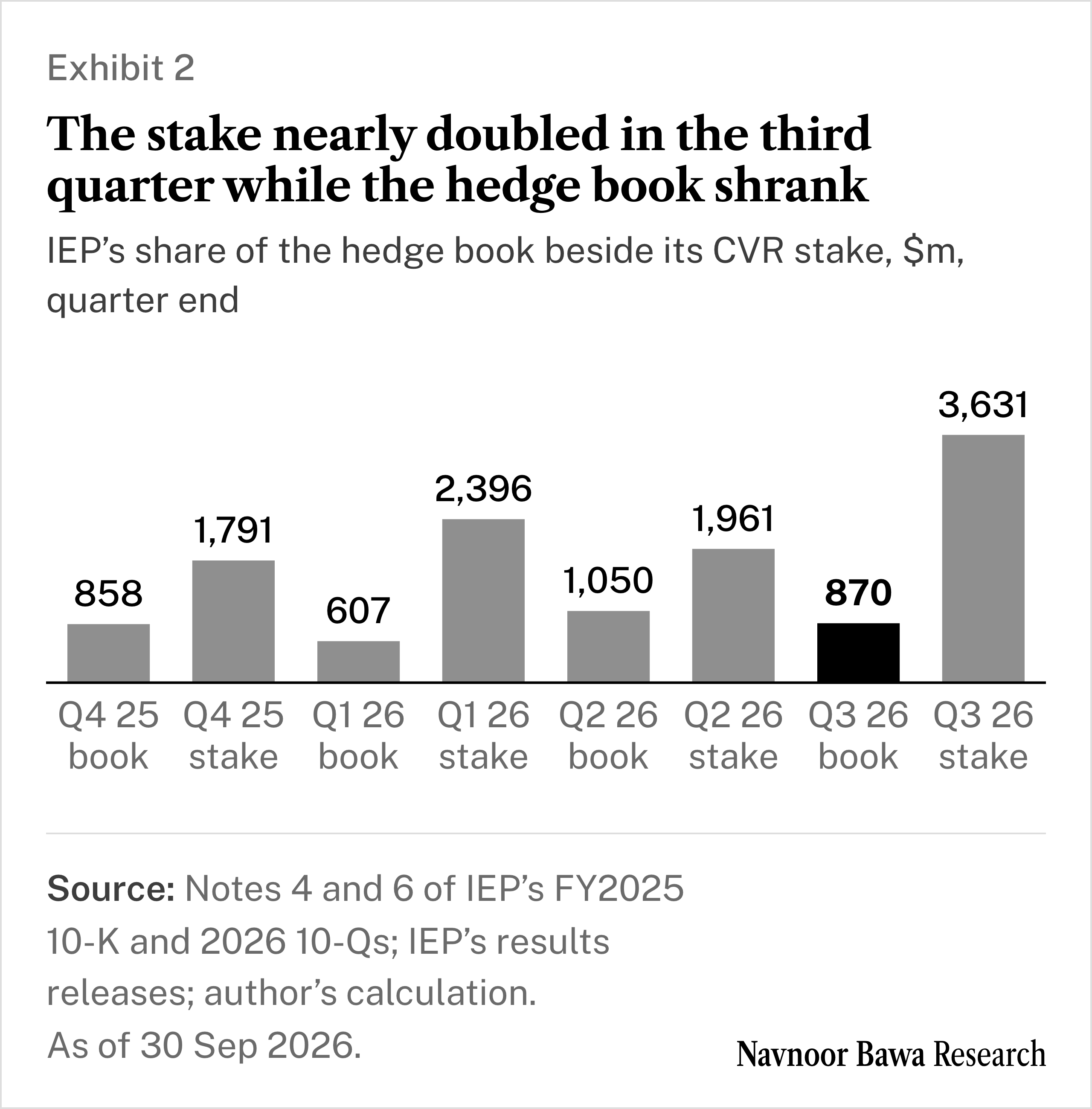
The wider the gap in a pair, the less of the stake the hedge reaches.
What surprised me was that the funds, on my estimate, bought back about half their energy shorts as the refiners rose: that and CVR nearly doubling took the hedge from more than half the stake in June to about a quarter in September. Against the stake the hedge shrank. Against the funds, which redemptions and the hedge’s own losses had shrunk, it grew from 27 points of their net asset value in March to 64 in September.
Icahn and his affiliates’ interest fell from $908m to $161m, and IEP’s share of the funds rose from 75% to 89%. “We and Mr. Icahn and certain of his family members and affiliates are the only investors in the Investment Funds,” says IEP’s 5 November presentation, so each hedge dollar now falls mostly on IEP.
Icahn sets the size. In August he wrote that “we are continuing to right-size our hedge portfolio to better align with our underlying exposures.” The third quarter 10-Q added a warning the first two lacked: the positions “may not correlate with changes in the value of CVR Energy and therefore may not produce the intended offset.”
IEP’s filings stop at 30 September; its 10-K will give the 31 December book. Their one sentence on shorts to come, “We have reduced our market short positions in recent months, but may increase those positions in the future,” is a risk factor IEP has printed unchanged since early 2024.
So below the line I carry September’s book, which the two routes put within $9m, to 23 November on market prices, with two readings for the equity leg and two fits for the commodity contract. I also test a book half as big again, rebuilt since, the main case against the result.
Where CVR moved on its own
From November 2024 to 30 September CVR kept pace with the refiners on price, and it left them in four windows, the last since the deal. The test: daily closes for CVR and the five refiners, equal weighted, from Yahoo chart data retrieved on 24 November, and for each window where they parted, an event of CVR’s own in its 8-Ks and 10-Q. The pitfall is the window: the twelve months to 30 September show CVR up 40% against 119%, the six from 31 March 51.5% against 55.8%.
Over that span Icahn’s timing holds: from my first stored close, 25 November 2024, CVR and the refiners finished level on price at those two dates, 164.5% against 167.5%. Inside the four windows it fails, and the latest, since the deal, has not closed.
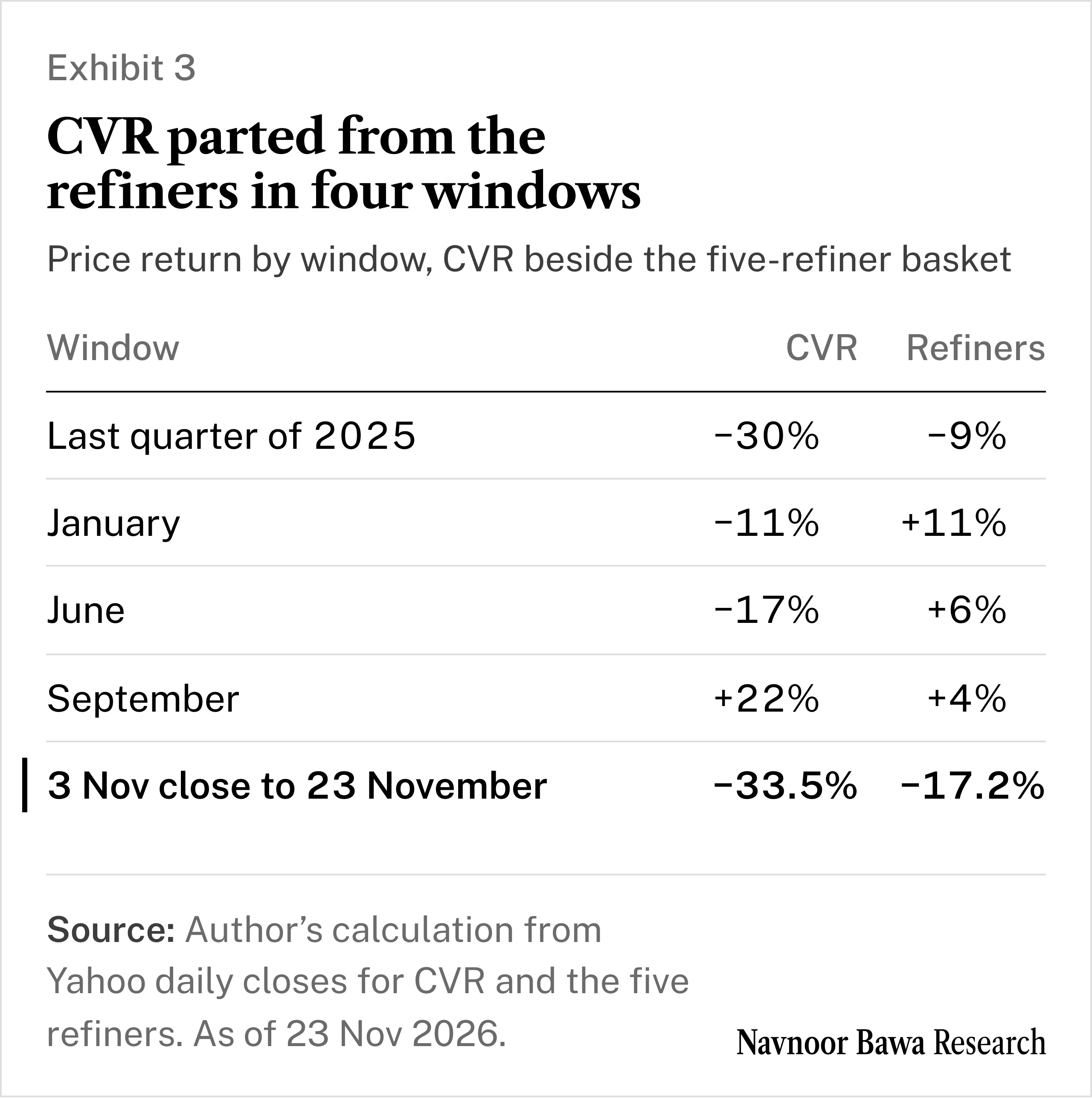
In the last quarter of 2025 CVR fell 30% against the refiners’ 9%. Its preliminary results, released on 26 January, blamed, among other things, the “delayed post-turnaround startup at the Coffeyville fertilizer facility”, a plant of CVR Partners, the fertilizer partnership CVR controls. That day CVR fell 9.5% against the refiners’ 2%, and January ended with CVR down 11% and the refiners up 11%.
In June CVR fell 17% while the refiners rose 6%, and about half of that gap opened before CVR’s 22 June release, which said Dane Neumann, the finance chief, had been promoted “following Mark Pytosh’s resignation from the CVR Entities for personal reasons.” Pytosh, chief executive since 1 January, had signed a separation agreement effective 18 June.
The EPA’s final renewable fuel rule also took effect that month. CVR’s refineries, unable to blend most of their fuel, must buy credits or win waivers, so part of June’s gap may be the rule.
September ran the other way, CVR up 22% against 4%. By CVR’s third quarter 10-Q, the EPA had granted CVR’s Wynnewood refinery “a 100 percent waiver” worth “approximately $253 million”, about a third of the month’s excess. The decision is dated 31 August, the window’s start, so some reaction may precede it.
Each window has an event of CVR’s own in its filings; none is shown to explain the whole gap, and a sector hedge could see none of them.
The deal, and the sale IEP dropped
On 3 November CVR announced it would buy Marathon Petroleum’s St. Paul Park and Mandan refineries for $4.2bn, financed with $2.5bn of secured debt, IEP’s $500m commitment, $800m of preferred from Trafigura, the commodity trader, and cash on hand.
CVR’s preliminary prospectus launched $750m of shares, of which “the selling stockholder identified in this prospectus supplement is offering $250,000,000”: IEP Energy Holding, an IEP subsidiary. IEP’s chief executive, Ted Papapostolou, said the sale would provide “additional liquidity to IEP”.
It priced that day at $47.55, 2.2% under the close, as a $500m sale of new shares only. Icahn’s amended ownership report, the 13D/A of 6 November: “The Reporting Persons and their affiliates did not sell Shares as selling stockholders in the Equity Offering.” IEP’s leg was launched and dropped; the documents give no reason.
By CVR’s own lender presentation, its debt roughly triples, from $1.22bn to $3.85bn.
On deal day CVR fell 13.1% while the refiners rose 0.9%. On 23 November it closed at $32.33, 32% under the offering price, which values IEP’s stake at about $2.3bn.
IEP must repay or refinance $1,382m of notes due in May 2027; its 10-Q names refinancing, cash on hand and redemptions from the funds, and its holding company had $921m at 30 September. Papapostolou said they “may become callable at par beginning November 15th.” He added: “We expect to address these notes in the coming months.” No redemption notice had been filed by 23 November. IEP keeps a right to sell CVR shares before the deal closes, once its lockups, the underwriters’ bar on selling, end.
The deal with its debt, the new shares and the overhang of IEP’s own shares (the stock it may still sell) share the fall beyond what CVR’s beta to the refiners explains. No document says in what parts, and none of them is in a sector hedge.
That fall is why the size matters: what the hedge makes sits in the funds IEP may redeem for the May 2027 notes, and in its indicative NAV. If the hedge covers little, a unitholder should value the CVR stake as unhedged, and a noteholder should read a redemption paid from the funds as one that may shrink the hedge too.
How much of the CVR stake’s fourth quarter loss is IEP’s hedge covering?
Below the paid line:
The cover, the hedge’s gain per dollar the stake lost since 30 September, and my odds on the 10-K’s line.
The fourth quarter bridge by leg against its ceiling, with a mark you can run to 31 December.
Three outcomes for CVR at year end, with the hedge’s value in each.
The energy line across eleven quarters, and a test you can run on any holder that hedges a controlled stake.
The dated checks, and the filing that settles them.